Monday, February 27, 2017

Favorite Baseball Movies


Spring training has started.  The world reawakens.  And over at Bill James Online, Daniel Marks has written a lovely piece summarizing the consensus on the best baseball movies, along with defending Field of Dreams, his, and many others #1 pick, but a movie also detested by many.  First, the results, second, my take and finally, the "problem" of Field of Dreams.

The first list is from a Bill James Online Poll:

1.  Field of Dreams
2.  Bull Durham
3 (tie): Eight Men Out
3 (tie): The Sandlot
5.  A League of Their Own
6.  The Natural
7.  Moneyball
8.  Major League
9.  Bad News Bears
10. Bang the Drum Slowly

The second list is a combination of 20 other lists and contains 9 of the ten listed above.

1.  Bull Durham
2.  Field of Dreams
3.  The Natural
4.  A League of Their Own
5.  The Bad News Bears
6.  Eight Men Out
7.  Moneyball
8.  The Sandlot 
9.  Major League
10.  The Pride of the Yankees

My take.  I've seen all 11 movies and there's only one bad film on these lists; The Natural.  I couldn't stand it.  It's the bizarro version of Field of Dreams, which continually teetered on the verge of being silly and maudlin but managed to mostly make the right decisions in telling its story, while The Natural mostly made the wrong ones.  Trying way to hard to be mythic it compounded its problems by changing the end of Bernard Malamud's novel, thus killing its point.

Like pretty much everyone else, Field and Bull Durham are at the top of my list, with the latter my #1 pick (only marred by Tim Robbins' inability to throw a baseball properly), though the former is the one that tears me up at the end every time I see it.  All the rest are fine films but who knows how they sort out?

There are a lot of good baseball movies out there.  Ones that didn't make the list include 42, The Rookie and Fever Pitch Cobb is definitely not on my list.

Most of Marks' piece explains why Field of Dreams is not really a baseball movie.  He's right and his analysis is insightful, though I disagree about the James Earl Jones speech at the end; it really was clunky.  Some excerpts.  You should really read the whole piece, particularly the part where he tells us why what Bill James created was like what author WP Kinsella did with Field of Dreams.

But first; everyone knows Kevin Costner starred in the top two movies on this list.  Who is the only other actor to star in two of the Top Ten films?  Answer at end of post.

And now, back to Marks: 
It’s not a fictional drama, it’s not a dramatization of real events, it’s not a comedy.  The genre it belongs in is fantasy.  It belongs in the same class as films like "The Wizard of Oz" and "The Princess Bride", films like that. . .  Saying that "Field of Dreams" is a baseball film contains some truth to it, but I think it’s a little like saying that "The Wizard of Oz" is a witchcraft film.

See, the film is indeed about second chances.  But, not just any second chances.  It’s not about getting another chance to do something that you weren’t able to do before.  It’s about getting second chances directly related to decisions that the characters themselves made, second chances related to regretful decisions or errors on their part. 


Look at the main characters more closely, their background stories, and their connection to the Field of Dreams that offers them a second chance:


  • Ray Kinsella (Kevin Costner) and his father John (Dwier Brown) – their relationship deteriorated over time due to their respective actions and behavior, and they never reconciled.


  • Terence Mann (James Earl Jones) – an author who loved baseball and writing, but over time became cynical and reclusive.


  • Moonlight Graham (Burt Lancaster as the old Graham, Frank Whaley as the young Graham) – A fringe ballplayer who only made one appearance in the Majors and never got a turn at bat, and then hung it up to become a doctor.  He didn’t regret his choice, because he knew that being a doctor was his calling, but he always wondered about what it might have felt like had he stuck with baseball a little longer and had the chance to take a turn at bat.


  • The 8 Black Sox players – Found guilty of throwing the 1919 World Series, banned from the Majors forever for their actions.


What do these characters all have in common?  They all made choices that, to one degree or another, they regretted, because those decisions caused them to lose something they loved, whether it was a relationship, a passion, an opportunity, or a livelihood.  The Field of Dreams is not simply some kind of Nirvana where all the dead players can regroup and play together in peace and harmony while re-living their glory years.  It’s a place for second chances, most definitely…..but specifically it’s a place that provides second chances for those who have erred in the past, a chance to right a wrong of their own doing.  A chance for redemption.  A chance for absolution, if you will.  A place of forgiveness.

Answer:  James Earl Jones; Field of Dreams and The Sandlot

Saturday, February 25, 2017

Juan Seguin Returns To The Alamo

 February 25, 1837, San Antonio, Republic of Texas

Precisely a year earlier, on February 25, 1836, Captain Juan Seguin left the besieged Alamo at the order of Colonel William Travis.  He carried with him a request for help from the army gathering under the command of Sam Houston at Washington-on-the-Brazos.  Making his way without detection through General Santa Ana's forces, which had arrived in San Antonio on the 23rd, Sequin made his way to Houston, but the general was determined not to allow his small and unready army to encounter the well-trained Mexican force.
http://www.sanjacinto-museum.org/images/2013/commanders/JuanSeguin-Large.png(Juan Seguin, San Jacinto museum)

In a predawn assault on March 6, the Alamo fell and all its defenders killed ((for more on the myths and controversies surrounding the Alamo read Remember (My Visit To) The Alamo)).  The victorious Santa Ana resumed his march eastward, seeming on the verge of extinguishing the rebellion, when six weeks later at San Jacinto, near present day Houston, his force was destroyed by the Texian army led by Sam Houston.  Juan Seguin led his men bravely in the fight and was subsequently promoted to Lieutenant Colonel.

Seguin was born in 1807 at Bexar (later San Antonio), the largest town in Texas, then part of a province within the Spanish Empire of the Americas.  His family was one of the most prominent in Texas and of tejano (Texians of hispanic descent) origin.  In the 1820s, after Mexico obtained its independence from Spain, Juan's father, Erasmo worked with Moses Austin and his son, Stephen, on facilitating the settlement of thousands of Anglo settlers from the United States.  In 1829, Juan was elected Judge of San Antonio and became Alcade (Mayor) of the town in 1834.  Jim Bowie, the Louisiana adventurer who'd settled in Texas and married the daughter of another prominent local family. became a close friend.

When the Texas Revolution began in the fall of 1835, the Juan sided with the revolutionaries as did most Texas tejanos.  At the time the divisions were not between anglos and tejanos but rather about whether Mexico should operate on a federal or centralized basis.  Santa Ana had sought power pledging to be a federalist, but upon attaining the presidency quickly became a centralizer.  Along with Texas, several other Mexican provinces also rebelled at the same time.

Juan Seguin participated in the storming of San Antonio on December 5, 1835 and then worked with Bowie in preparing the defense of the Alamo.
Robinson to Houston - Page 1(1837 letter from James Robinson, VP of the Texas Provisional Government to Sam Houston, recommending Juan Seguin for an appointment)

Following San Jacinto and the capture of Santa Ana, the Mexico army retreated south of the Rio Grande but refused to recognize the independence of Texas.  In November 1836, Lt Col Seguin took over command of the Texian garrison at San Antonio.  In late February, he organized a  ceremony to bury the remains of the defenders from the 1836 battle.

After Santa Ana captured the Alamo he ordered the bodies of the defenders collected in three locations inside and just outside the walls and had them burned.  It is unclear what happened to the remains over the next year, but in February 1837, Seguin ordered the remaining ashes and bone fragments collected and had a Bexar carpenter make a coffin.  Juan caused the lid to be inscribed with the names of Crockett, Travis and Bowie (though it was impossible to identify the remains).

Seguin ordered church bells to peal throughout the day and led a procession through the street of the town to the Alamo.  Three volleys were fired over the casket.  Addressing the crowd in Spanish, he proclaimed (according to an account published several weeks later in the Columbia (later Houston) Telegraph & Register):
Companions in Arms!! These remains which we have the honor of carrying on our shoulders are those of the valiant heroes who died in the Alamo. Yes, my friends, they preferred to die a thousand times rather than submit themselves to the tyrant's yoke. What a brilliant example! Deserving of being noted in the pages of history. The spirit of liberty appears to be looking out from its elevated throne with its pleasing mien and point to us saying: "There are your brothers, Travis, Bowie, Crockett, and others whose valor places them in the rank of my heroes." Yes soldiers and fellow citizens, these are the worthy beings who, by the twists of fate, during the present campaign delivered their bodies to the ferocity of their enemies; who, barbarously treated as beasts, were bound by their feet and dragged to this spot, where they were reduced to ashes. The venerable remains of our worth companions as witnesses, I invite you to declare to the entire world, "Texas shall be free and independent or we shall perish in glorious combat."
Later that year Juan Seguin was elected to the Texas Senate, serving until 1840, but the alliance between tejanos and anglos was beginning to weaken.  Two factors were at play.  The first was the flood of American settlers moving to Texas in the wake of obtaining independence, many of whom brought with them prejudices against tejanos and catholics.  Second, the continuing threat of further attacks on the new republic by Mexico.  Caught in the middle were tejanos, increasing mistrusted by their fellow citizens of the Texas republic.
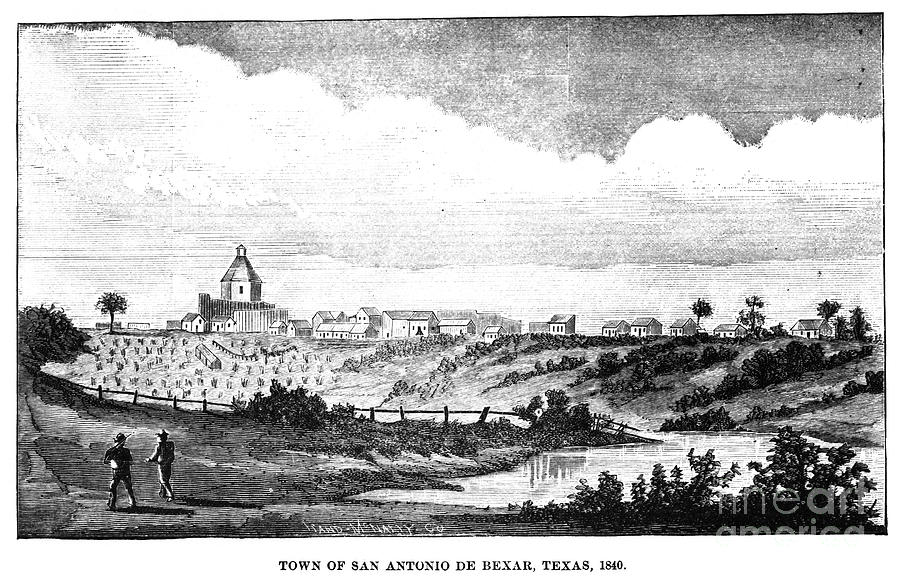
http://images.fineartamerica.com/images-medium-large/san-antonio-de-bexar-texas-granger.jpg
(from fine art america)

Sequin was once again serving as mayor of San Antonio when matters came to a head in 1842.  In January, Mexico announced its planned invasion of Texas (in part in retaliation for a failed Texian invasion of New Mexico the prior year), offering amnesty to anyone who did not resist.  In early March, the Mexican army seized Goliad, Refugio and Victoria and, on March 5, captured San Antonio, which it held until March 9 before retreating (Mexican forces would again occupy the town from September 11 through 20 of that year).  Juan Seguin and his family were among those who fled the invasion.  However, there was a growing clamor among the anglo settlers that unfairly portrayed Juan as a collaborator with the invading forces (to which the Mexican commander contributed by claiming Seguin was still a loyal Mexican citizen).  He was forced to resign in April and to protect himself and his family, fled to Mexico.

When Santa Ana learned of Seguin's presence he offered him a choice - prison or joining the army.  Seguin joined and served for the next six years until the end of the Mexican-American War in 1848, after which he returned to Texas.  Seguin remained politically active in the 1850s and 60s, but conditions continued to worsen for tejanos.  Eventually (at some point between the late 1860s and 1883 according to various sources), Juan moved to Nuevo Laredo, in Mexico just south of the Rio Grande where his son was mayor, where we live until his death in 1890.

In recent decades his role in helping Texas obtain its independence has been increasingly recognized and Juan Seguin is now celebrated as a Texas hero.  On July 4, 1976 his ashes were returned from Mexico to be reburied in the Texas town of Seguin, named in his honor in 1837.

(Status of Juan Seguin, Seguin, Texas, from andrew butler photo)
http://www.andrewbutlerphotos.com/img/s/v-3/p1624632434-3.jpg

Wednesday, February 22, 2017

The State v Harold Israel

I sometimes write and read with the sound of the TV low in the background.  A few weeks ago, a movie had just started on TCM when I heard the narrator's voice mention something about "a city in Connecticut".  That caught my attention (it doesn't take much to do that).

The movie was Boomerang!, released in 1947, and one of the first films directed by Elia Kazan, who went on to do On The Waterfront, A Streetcar Named Desire and East Of Eden.  Boomerang!, starring Lee J Cobb, Dana Andrews and Karl Malden, starts with the murder of a priest walking on a street.  An ex-GI and drifter is eventually accused of the killing with local police and the coroner's office pressing the case.  The state's attorney is brought in to prosecute, but in a surprising twist begins to have doubts about the case and eventually presents to the court the case against the prosecution, leading to the dismissal of charges.

As is my habit, I checked wikipedia to find out more about the film during my viewing.  Boomerang! is based on a true story that occurred in Bridgeport, Connecticut in 1924.  A popular Catholic priest, Father Hubert Dahme, was gunned down at the intersection of High and Main Street, in the center of the city, on the evening of February 4.  Someone walked up behind him and shot him in the head.  Father Dahme's funeral was attended by 12,000 people.

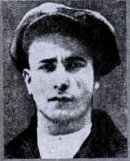
Although initial eyewitness testimony was confusing a week later Harold Israel, a 21 year old former soldier and vagrant, was arrested in the nearby city of Norwalk.  Israel was already in custody on a gun-possession charge, and the investigation by the police and the coroner revealed his gun was of the same make as that which killed Father Dahme, the ballistics on the deadly bullet matched the gun, he was identified by seven eyewitnesses and, after two days of interrogation, he confessed, though he later recanted.

In those days, the counties in Connecticut were still functioning governmental authorities (these powers were removed in the 1960s).  The state's attorney for Fairfield County, responsible for criminal prosecutions, was Homer Cummings.   Born in 1870, Cummings already had a distinguished career.  A graduate of Yale Law School, Homer was three times elected mayor of Stamford in the early 1900s.  In 1909, along with Charles Lockwood, he founded the law firm of Cummings & Lockwood. which for most of the 20th century was the largest firm in the state.  In 1914, Cummings was appointed state's attorney for the county.  Homer was also a powerful player in the state's Democratic party, with aspirations for higher office, and was also a member of the Democratic Party's National Committee at the time of these events.
https://upload.wikimedia.org/wikipedia/commons/7/7d/Homer_Cummings,_Harris_%26_Ewing_photo_portrait,_1920.jpg(Cummings)

Because of the popularity of Father Dahme and the brazeness of the crime, shooting a priest on a city street, the case generated enormous publicity and most were convinced of the guilt of Harold Israel.  The prosecution's case was of huge public interest and the Court was jammed when Homer Cummings rose to speak on May 27, 1924.   Fortunately, the full transcript of the presentation of the state's attorney can be found in the Journal of Criminal Law & Criminology, Vol 15/Issue 3 (1925)

The introduction to the Journal account of the proceedings contains an introduction by William Maltbie, Judge of the Superior Court in Hartford.  Judge Maltbie informs the reader that the state's attorney is appointed by the judges in his jurisdiction, and the judges are nominated by the governor and serve an effective life tenure.  He goes on to write:
The method of appointment of the state's attorney has made that office one of high honor, and, despite the small salaries provided by law, the very leaders of the bar have been willing to assume its onerous duties; so it has removed the office from the stress of politics and the vagaries of popular feeling and given the opportunity for the untrammeled exercise of independence in judgment and action.
After summing up what seemed to be overwhelming evidence of guilt, including eyewitnesses identifying Israel as the man they'd seen fleeing the shooting; Israel taking the police to his room and showing them a spent cartridge, later identified as for the bullet that killed Father Dahme; the positive identification of Israel's .32 caliber revolver as the weapon which fired the fatal bullet; as well as Israel's confession, Cummings told the Court: "There did not seem to be a vestige of reason for suspected for a moment that the accused was innocent."  However, he then added:
. . . there were sufficient circumstances of an unusual character involved to make it highly important that every fact should be scrutinized with the utmost character and in the most impartial manner.  It goes without saying that it is just as important for a state's attorney to use the great powers of his office to protect the innocent as it is to convict the guilty.
Cummings then proceeded to conclusively demolish each leg of the case against Israel.
(Harold Israel)

Regarding the confession, Cummings introduced the statement of three physicians who examined Israel and concluded that at the time of his confession, after two days of questioning and deprived of sleep, he was "totally incapable of rendering a coherent, dependable statement" on top of being:
. . . of low mentality of the moron type, quiet and docile in demeanor, totally lacking in any characteristics of brutality or viciousness, of very weak will and peculiarly subject to the influence of suggestion.
I think they'd phrase this differently today.
 
Once Israel recovered from the interrogation he had been steadfast in maintaining his innocence according to Cummings.  The state's attorney then introduced convincing evidence that the cartridge found in Israel's room was not fired by the accused's revolver and proceeded to deconstruct the credibility of the eyewitness testimony, including relating attempts by he and his assistants to perform identifications at the scene under the exact conditions the witnesses faced.

Attorney Cummings then took on the matter of ballistics.  For this purpose he used the testimony of no less than six experts (it probably helped that in those day Connecticut was the home of the American firearms industry), of whom four were from the Remington Arms Company, one from the Winchester Arms Company and the sixth a nationally renowned expert used frequently by the New York City Police Department.  He reported that the experts were:
. . . not only of the opinion that there is no evidence that the mortal bullet came out of the Israel revolver, but they are clearly of the opinion that the mortal bullet came out of some other unknown weapon.
This opinion was based on the distinctive difference between the markings and grooves on bullets fired by the Israel revolver compared to those on the mortal bullet.  Further, Israel's revolver was in bad repair and frequently misfired when held at the angle at which the murderer held his weapon (as determined by the path of the bullet through the victim's head).  In fact, in an experiment, the Israel revolver misfired 18 times in a row when held at the angle of the Father Dahme shooting.

Homer Cummings then told the court:
In view of what I have said about every element of the case, I do not think that any doubt of Israel's innocence can remain in the mind of a candid person.
The Court quickly approved the entry of a nolle prosecution in the case and Harold Israel was a free man. 
 
Related image

It is difficult at this distance to judge exactly how and why Cummings and those in his office decided on this course of action.  It is clear that an enormous amount of time was spent by Cummings and his assistants in trying to determine what actually happened on the evening of February 5, rather than merely trying to build the best case for the prosecution.  Whatever the motivation and from whom ever initially raised doubts about the case, the result does honor to Cummings and his team.

Bridgeport police were surprised and outraged by Cummings' action and he also received some criticism from within the Democratic party.  However, his actions were also praised by others as the model for how a prosecutor should act.  In 1933 he was appointed Attorney General of the United States by President Franklin D Roosevelt, serving for six years.  Cummings died in 1956 at the age of eighty six. 

Feelings about the unsolved case remained raw in Bridgeport and, in 1946, when Elia Kazan sought film Boomerang! on location in the city he was denied permission by the authorities.  Instead, Boomerang! was shot in nearby Stamford, where it also had it premiere on March 5, 1947.

Harold Israel lived until 1964, reportedly marrying and being steadily employed with no further encounters with the criminal justice system.  The murder of Father Dahme was never solved. 

Tuesday, February 21, 2017

The AuthaGraph World Map

You cannot accurately represent the global of the Earth on a flat map.  The most common flat map projections grossly overestimate the size of land masses near the poles such as Greenland, Antarctica and Siberia.  Recently, Japanese architect Hajime Narukawa came up with an award winning approach to minimize distortion, the AuthaGraph World Map.

As you can see, the map does away with most of the distortion at the poles and gives a better sense of the scale of the Pacific and Indian Oceans.  While it emphasizes how far South America is from Asia, it deemphasizes how close it is to Africa. It also makes it easier to visualize the Great Circle airplane routes.

For more, watch this: