Thursday, January 31, 2019

Smart Folks

17 of the 29 attendees were or became Nobel Prize winners.

The photo above was taken in October 1927 at the Fifth Solvay International Conference on Electrons and Photons.  Located in Brussels and founded by industrialist Ernest Solvay, the conferences allowed for leading physicists to discuss open problems in their field.

Of the 29 scientists in this photo, 17 were to win the Nobel Prize.

It was at this conference that Einstein, disturbed with Werner Heisenberg’s uncertainty principle, remarked “God does not play dice”. Niels Bohr replied: “Einstein, stop telling God what to do”.

Some of the best known participants (summaries courtesy of rare historical photos).

Front Row:
2nd from left: Max Planck - originated quantum theory, which won him the Nobel Prize in Physics in 1918. He proposed that exchanges of energy only occur in discrete lumps, which he dubbed quanta.
3rd from left: Marie Curie - was the first woman to earn a Nobel prize and the first person to earn two. In 1898, she isolated two new elements (polonium and radium) by tracking their ionizing radiation.
4th from left: Hendrik Lorentz - discovered and gave theoretical explanation of the Zeeman effect. He also derived the transformation equations subsequently used by Albert Einstein to describe space and time.
Center: Albert Einstein - developed the general theory of relativity, one of the two pillars of modern physics (alongside quantum mechanics).He is best known in popular culture for his mass–energy equivalence formula (which has been dubbed “the world’s most famous equation”).

Middle Row:
Far right: Niels Bohr - started the quantum revolution with a model where the orbital angular momentum of an electron only has discrete values. He spearheaded the Copenhagen Interpretation which holds that quantum phenomena are inherently probabilistic.
2nd from right: Max Born - his probabilistic interpretation of Schrödinger’s wave function ended determinism in physics but provided a firm ground for quantum theory.
3rd from right: Louis de Broglie - discovered that any particle has wavelike properties, with a wavelength inversely proportional to its momentum (this helps justify Schrödinger’s equation).
5th from right: Paul Dirac - came up with the formalism on which quantum mechanics is now based. In 1928, he discovered a relativistic wave function for the electron which predicted the existence of antimatter, before it was actually observed.

Back Row:
Far left: Auguste Piccard - designed ships to explore the upper stratosphere and the deep seas
6th from left: Erwin Schrodinger - matched observed quantum behavior with the properties of a continuous nonrelativistic wave obeying the Schrödinger Equation. In 1935, he challenged the Copenhagen Interpretation, with the famous tale of Schrödinger’s cat.
8th from left: Wolfgang Pauli - formulated the exclusion principle which explains the entire table of elements. Pauli’s sharp tongue was legendary; he once said about a bad paper: “This isn’t right; this isn’t even wrong.”
9th from left: Werner Heisenberg - replaced Bohr’s semi-classical orbits by a new quantum logic which became known as matrix mechanics (with the help of Born and Jordan). The relevant noncommutativity entails Heisenberg’s uncertainty principle.

Monday, January 28, 2019

The Legend Of Drunken Master

As an aficionado of Jackie Chan films we've featured many of his stunts and comic turns on this blog.  The climax of The Legend of Drunken Master is considered by many his best fight scene.  Without further ado:

Friday, January 25, 2019

I Got Rhythm

The only known footage of George Gershwin playing piano.  From 1931 in New York City.  With lyrics by his older brother Ira.  I Got Rhythm was written for the Broadway musical Girl Crazy, and over the past 88 years has been covered by hundreds of recording artists. 

Thursday, January 24, 2019

Fat Man

The only Hollywood actor to have an atomic bomb named after him, Sydney Greenstreet was 61 when he made his American movie debut in 1941; and quite a debut it was as Kaspar Gutman in The Maltese Falcon (for the origins of the real Maltese Falcon read The Stuff That Dreams Are Made Of).  Once you saw and heard Greenstreet you never forgot him;


Greenstreet appeared in 24 films, retiring in 1949; Peter Lorre co-starred with him nine times, including The Maltese Falcon. Here's a little montage of the two of them


Though he appeared in few films, many of them are now considered classics along with The Maltese Falcon - Casablanca in which he played Rick's competitor, Signor Ferrari owner of The Blue Parrot; They Died With Their Boots On; Passage To Marseille (with Bogart again); Across The Pacific (with Bogart for the 4th time); The Mask Of Dimitrios; Christmas In Connecticut (with the luminous Barbara Stanwyck).

Born in Britain (he later became a naturalized American), Greenstreet first appeared onstage in 1902, and had a long and distinguished stage career in both Britain and America before making his first Hollywood film.

During WW2 the Manhattan Project developed three designs for atomic bombs, with different triggers for each - uranium gun, plutonium gun, and an implosion device. Each was given a code name by project physicist Robert Serber; Little Boy for the uranium, Thin Man for the plutonium, and for the implosion device, the roundest and fattest of the three bombs, Fat Man, which Serber named after Greenstreet's character in The Maltese Falcon who Sam Spade (Humphrey Bogart) refers to as The Fat Man.  Little Boy was dropped on Hiroshima, Fat Man on Nagasaki.


Wednesday, January 23, 2019

Commemorative Air Force Museum

In December I wrote of my father in law's WW2 experience and used a couple of photos from my visit to the Commemorative Air Force (CAF) Museum in Mesa AZ.  Last week I returned to the museum accompanied by Ed Bearss and two members of our Scottsdale Civil War Roundtable.  I wrote of my last experience with Ed in Bearss & Stripes Forever.  As the new Program Chair for the Roundtable I'm responsible for booking monthly speakers, arranging logistics, and managing their appearance at our Roundtable, one of the largest in the U.S. with normally between 125 and 275 attendees.

Ed has been coming every January for the last twenty years, speaking on Tuesday nights, and then on Wednesday seeing a museum or other attraction he's never visited before.  Even at the age of 95 he remains intellectually curious and seeks out new experiences.  This past week our tour guide at the museum was Dennis Fennessey, who leads the CAF. 

The CAF was founded in 1953 in Texas and consisted for a few years as a motley collection of historical aircraft.  The group's original name was an inside joke, the Confederate Air Force (the name was changed in 2002).  During the 1960s the members realized that historical, particularly WW2 aircraft were not being preserved and made it a mission to do so.  Today the CAF consists of 175 aircraft at 71 bases across America, with the Mesa outfit being one of the largest.

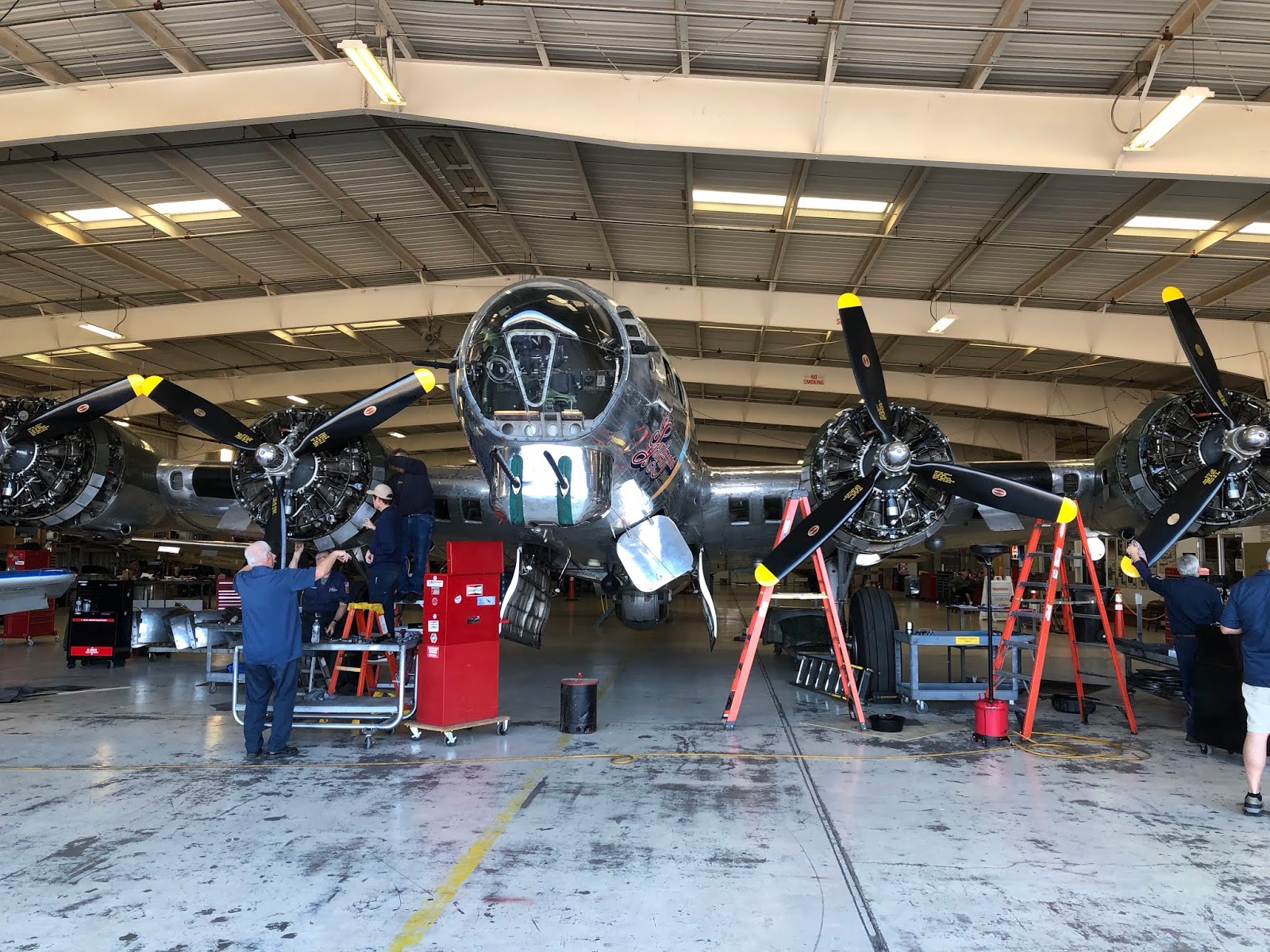
Visiting is a wonderful experience.  There is a museum section with aircraft on exhibit ranging from WW1 biplanes to F-4's and Mig 21's, along with many displays explaining the history of the American air force.  The Museum also has a lecture series and we were fortunate to listen to one during our visit - on the origin of the DC-3, the most famous plane in aviation history and a tale I wrote about several years ago (see TWA Flight 599).  You can also tour the maintenance hanger and walk among the aircraft as they are being worked on.  The Mesa museum has a B-25 and its star attraction a B-17 which flies passengers on short rides much of the year, but was in the hanger when we visited. 

Don't miss it!  Some photos below starting with the B-17 landing when I visited in December.