Showing posts sorted by relevance for query macarthur. Sort by date Show all posts

Monday, April 11, 2016

Truman Fires MacArthur

http://images.rarenewspapers.com/ebayimgs/8.d.2007/image034.jpg(from rarenewspapers)

On April 11, 1951, President Harry S Truman released a statement which shocked the American public:
With deep regret I have concluded that General of the Army Douglas MacArthur is unable to give his wholehearted support to the policies of the United States Government and of the United Nations in matters pertaining to his official duties. In view of the specific responsibilities imposed upon me by the Constitution of the United States and the added responsibility which has been entrusted to me by the United Nations, I have decided that I must make a change of command in the Far East. I have, therefore, relieved General MacArthur of his commands and have designated Lt. Gen. Matthew B Ridgeway as his successor.

Full and vigorous debate on matters of national policy is a vital element in the constitutional system of our free democracy. It is fundamental, however, that military commanders must be governed by the policies and directives issued to them in the manner provided by our laws and Constitution. In time of crisis, this consideration is particularly compelling.

General MacArthur's place in history as one of our greatest commanders is fully established. The Nation owes him a debt of gratitude for the distinguished and exceptional service which he has rendered his country in posts of great responsibility. For that reason I repeat my regret at the necessity for the action I feel compelled to take in his case.
The origins of this controversial action go back many years.  The 71-year old MacArthur had a long and distinguished career also marked by a large ego and imperious behavior which put him in constant conflict with his peers and superiors.

Douglas MacArthur graduated at the top of his West Point class in 1903 and became a brigadier general while serving with the Army in France during World War I and receiving the Silver Star for bravery in action.  After the war he became Superintendent of West Point and by 1925 was the youngest major general in the US Army.  Promoted to Army Chief of Staff in 1930, he gained notoriety by forcibly expelling the Bonus Army protesters from the Washington Mall in 1932.  A vocal Republican, though he supported the initial aspects of the New Deal, his further promotion was stymied by President Franklin D Roosevelt, one of the few men capable of intimidating MacArthur, and who, quite rightly, viewed him as a potential political opponent in a future presidential election.

In 1937 he resigned from the Army to become Military Advisor to the Commonwealth Government of the Philippines where he was responsible for building and training an Philippine Army (of which he became the Field Marshal) in anticipation of the island nation attaining its promised independence in 1945.  It also allowed him to indulge his taste for luxurious living and being deferred to as a major personage.

With the threat of Japanese expansion growing, on July 26, 1941, FDR federalized the Philippine Army and recalled MacArthur to active duty as Commander, US Army Forces in the Far East.   The President and the US Chiefs of Staff of the Army and Navy knew that in the event of a Japanese attack, the Philippines would fall but MacArthur never really accepted this.

On December 8, 1941, a Japanese air strike destroyed most of the American air force in the Philippines on the ground, despite MacArthur having warning of the attack on Pearl Harbor nine hours earlier and being urged to get his planes into the air in anticipation of an attack.  It was his worst mistake as a commander until nine years later.

After the American and Filipino forces retreated to the Bataan peninsula later the month, MacArthur was ordered by FDR to leave his command and go to Australia to organize Allied resistance in the region.

In late 1942, Allied forces under MacArthur's command began a campaign in New Guinea that would eventually take them back to the Philippines in late 1944.  Though initially opposing the island-hopping strategy, once embraced he executed it with great skill.  From a strategic perspective he always insisted on a dual path approach to defeating Japan in which he would lead a thrust towards the Philippines while Admiral Nimitz led a parallel approach through the Central Pacific.  He also felt it essential to redeem his personal pledge to return to liberate the Filipinos. There is still a debate among military historians as to whether the invasion of the Philippines was necessary and how much of MacArthur's insistence on it was due to his vanity, and his staff's focus on publicly promoting their boss by the media was a constant irritant to other military leaders like Marshall, Eisenhower and Bradley.  Throughout the war, FDR, conscious of the political implications, went out of his way to keep MacArthur on board with the overall war strategy and avoid his resignation and possible entry into politics.http://cdn.history.com/sites/2/2014/01/douglas_macarthur-P.jpeg
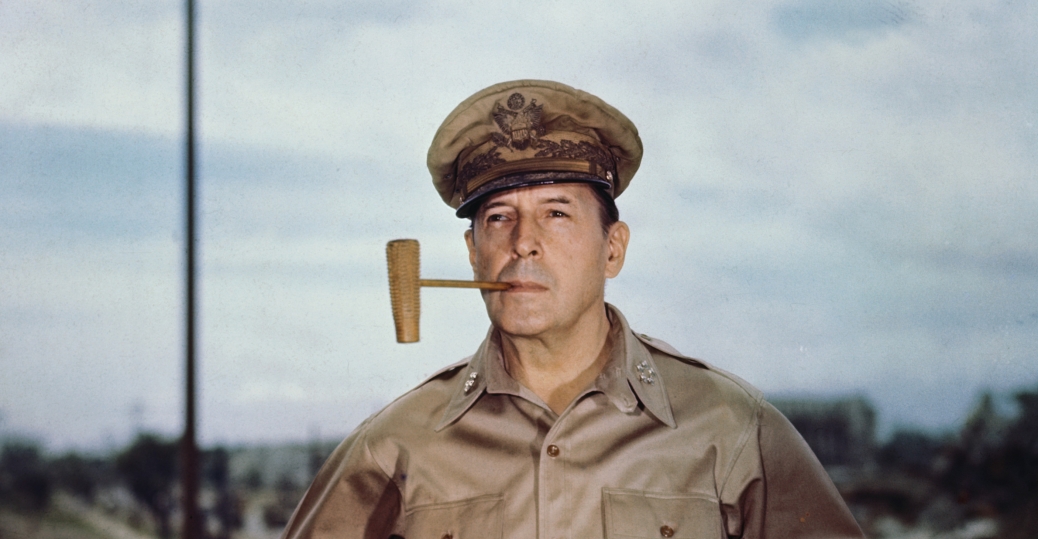
(MacArthur in the Philippines from history.com)

At war's end, MacArthur was to command the invasion of Japan, scheduled for November 1, 1945 (for more on the what-ifs surrounding the invasion read Downfall).  With Japan's surrender, he was appointed Supreme Commander for the Allied Powers in Japan, where he functioned for the next four years as the virtual ruler of the defeated nation.  Operating in the mode of a Roman proconsul assigned to a distant province, MacArthur, with little interference from the Truman administration, set the course for modern Japan.  His staff drafted a new constitution, which still governs the country, renouncing war, enfranchising women, abolishing racial discrimination, weakening the Emperor and strengthening the Parliament.  He also enacted a sweeping land reform under which 38% of the nation's cultivated land was purchased from landlords and redistributed to tenant farmers.  It was an  accomplishment for which he received much well-deserved praise.  In 1949, when the US returned control to a civilian government, MacArthur remained in Japan in his military command.
http://d1udmfvw0p7cd2.cloudfront.net/wp-content/uploads/2014/09/n-empwar-a-20140910.jpg(MacArthur & Emperor Hirohito)

On June 25, 1950, North Korea, with the approval of Joseph Stalin and the new Chinese communist government, invaded the Republic of South Korea.  The United Nations Security Council (the Soviet Union had been boycotting the Council for some time and was unable to veto the resolution) quickly authorized a UN military response with an American commander and MacArthur was immediately named to the post.

The North Korean's surprise onslaught achieved initial success.  Seoul quickly fell and by the end of July the American dominated UN force along with the remnants of the South Korean army was confined to a small perimeter around the southeast Korea port of Pusan.  While the front stabilized in August, MacArthur came up with plans for a daring, and very risky, counterstroke.   His plan called for an amphibious attack on the heavily fortified port (abetted by tricky and fall rising and falling tides) of Inchon, near Seoul, far behind the enemy lines.  Overcoming doubts from other military leaders, MacArthur's plan was approved and the landings took place on September 15.  It proved to be his greatest military triumph, one for which he deserves full credit.
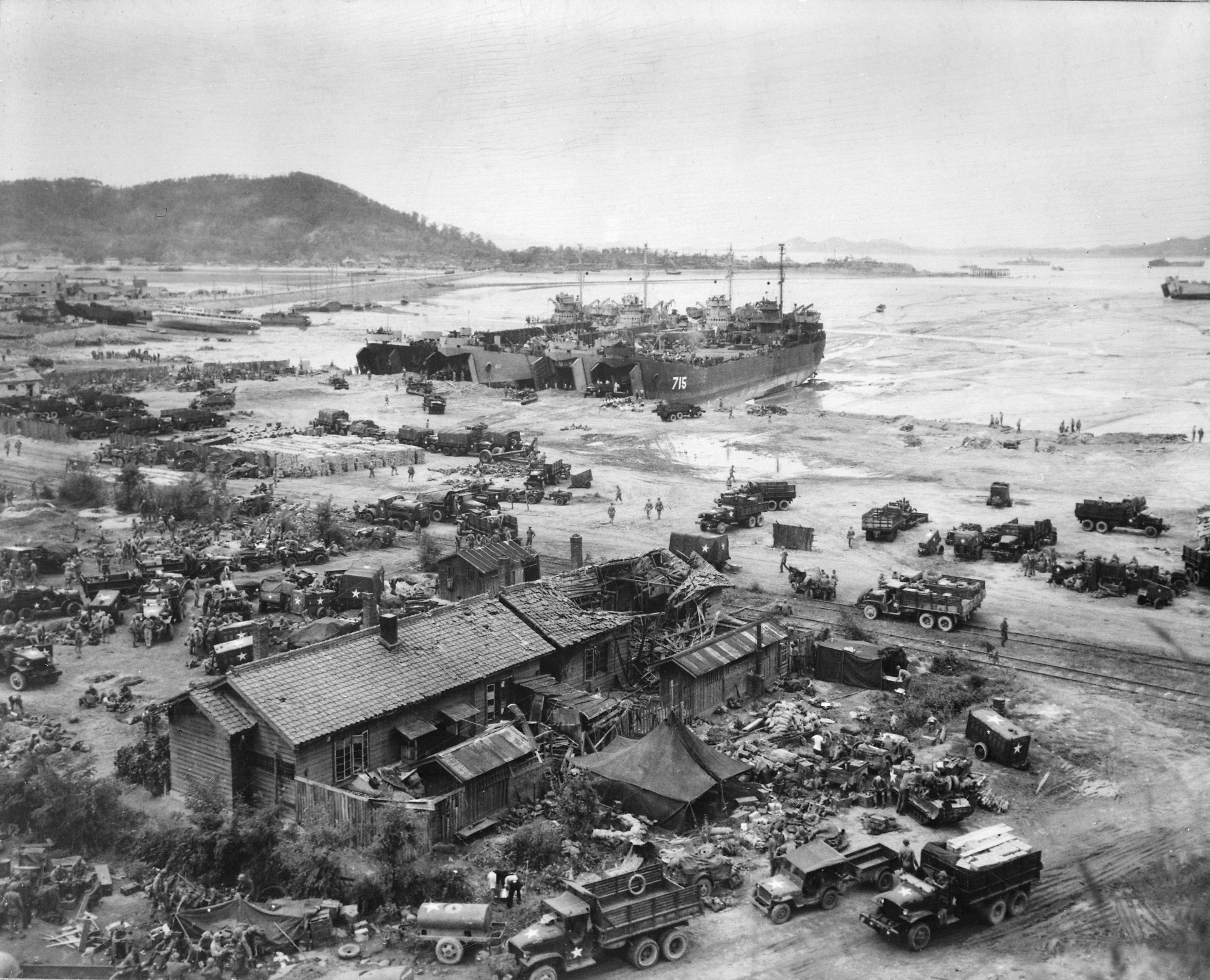
https://upload.wikimedia.org/wikipedia/commons/9/92/Battle_of_Inchon.png
(Inchon)

After a few days of fierce resistance the North Korean army collapsed everywhere and Seoul was soon reoccupied and the UN forces advanced beyond the 38th parallel, the previous dividing line between the two Koreas.  And it was at this point that the controversy begins and we enter the world of geopolitics.

Harry Truman came to the presidency with FDR's sudden death on April 12, 1945.  A senator from Missouri, he'd only been Vice-President for one month and was ill-prepared for the top office as FDR had not involved him in any strategy discussions about the war or his plans for the post-war world.  In contrast to MacArthur, Truman had been a lowly captain of an artillery battery in World War One.

Truman faced huge challenges in those years; the final decisions on how to end the war with Japan, including the decision to use the atomic bomb, America's return to a peacetime economy with fears of a return to the Depression of the pre-war years and, looming above all, the newly powerful and expansive communist regime of the Soviet Union under Stalin.  In the three years prior to the Korean War, Truman had decided that the US needed to take the lead in European reconstruction in order to counter communist inroads by launching the Marshall plan, announced the Truman Doctrine in which the US would undertake global commitments that the UK could no longer shoulder, confronted Stalin directly, defeating his effort to force the withdrawal of the Western powers from Berlin (an event that took place during the 1948 election campaign in which the Progressive Party candidate, Henry Wallace, FDR's former vice-president, called for our withdrawal) and finally created NATO in 1949.
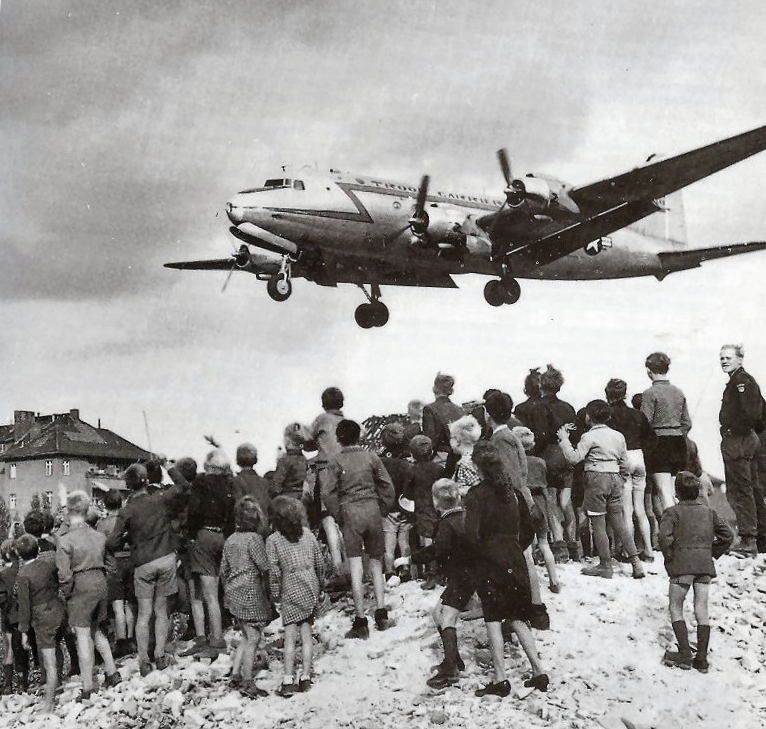
https://upload.wikimedia.org/wikipedia/commons/d/d8/C-54landingattemplehof.jpg
(American plane landing in Berlin during the Soviet blockade)

While some degree of stability had been reached in Europe, the news was grim in Asia, where the Chinese communists took power in October 1949 (only five weeks after the Soviets tested their first atomic bomb, breaking the American monopoly) and the US anticipated that the fall of Tawian would shortly follow.  This was the situation when the North Korean attack occurred.

Another element played into what happened after Inchon - poor communications between Truman and MacArthur.  How, and in what form, MacArthur's advance beyond the 38th parallel was approved is still in dispute, though there is no doubt an approval in some form occurred.  Although a UN document recommended a policy that as the UN forces neared North Korea's border with China that only South Korean troops be deployed, MacArthur rejected the advice, while at the same time Truman was telling reporters that only Korean, and not American, forces woud occupy the border area.

Looming behind this was the threat of Chinese, and possibly Soviet intervention.  As the North Korean army crumbled and MacArthur's forces advanced further towards the Yalu River border, the Chinese were very vocal about threatening to intervene if the UN advance was not halted.  MacArthur discounted the likelihood of the Chinese intervening and believed it would be ineffective even if it happened.  When asked by the President whether we was concerned about intervention during their meeting at Wake Island on October 15, MacArthur responded:
Very little. Had they interfered in the first or second months it would have been decisive. We are no longer fearful of their intervention. We no longer stand hat in hand. The Chinese have 300,000 men in Manchuria.  Of these probably not more than 100–115,000 are distributed along the Yalu River.  Only 50–60,000 could be gotten across the Yalu River. They have no Air Force. Now that we have bases for our Air Force in Korea if the Chinese tried to get down to Pyongyang [North Korean capital] there would be the greatest slaughter.
https://2neatmagazines.com/Life-Magazine-Covers/1956/Life-Magazine-1956-02-13.jpg
In late October, the first clashes occurred between Chinese and Americans, but then the Chinese cut off further contact for three weeks.  It appears the initial Chinese attack was meant as a warning not to advance further towards the border.  The warning was ignored and the advance continued with American and South Korean forces becoming increasingly isolated from their ability to support each other in the heavily mountainous terrain.  It was to be MacArthur's worst military mistake and only two months after his greatest moment.

On November 24, MacArthur launched the Home by Christmas offensive to close out the war.  The next day, the Chinese began a massive counterattack.  Disaster followed.  Despite MacArthur's confidence the Chinese had been able to move large numbers of troops into Korea without Allied detection.  All across the peninsula, the UN troops were overwhelmed.  In the northwest, Pyongyang quickly fell to the communists, while in the northeast the Marines were only able to narrowly escape total destruction around the Chosin Reservoir through heroic efforts under harrowing arctic conditions.
http://www.slidego.com/res/palooza/america/BeginningofColdWar/1E1F1334.jpg(from slidego)

By mid-December, the UN forces were back at the 38th parallel and a month later Seoul fell again, this time to the Chinese and there was talk of an evacuation of American forces from the entire peninsula. The American 8th Army was now under the command of General Matthew Ridgeway, who increasingly took the lead in battlefield initiatives.  After stabilizing the front, the Americans began to counterattack, retaking Seoul in March, 1951.  It was shortly after this that the final events took place leading to MacArthur's firing.

The tension between MacArthur and Truman went back to August 1950 when the general sent a statement to be read aloud at a Veteran of Foreign Wars convention in Chicago, in which he denounced "appeasement and defeatism" in the Pacific which Truman saw as a direct attack on his policies in the region and with "appeasement" being a particularly toxic term in the light of Munich and World War Two.  This was compounded by the poor communication and confusion over US policy north of the 38th parallel as well as by MacArthur's dismissal of warnings about Chinese intevention and the vulnerable placement of his forces when that event transpired.  Throughout this period, MacArthur was also making statements to the press without complying with White House directives to clear them with the State Department, statements that sometimes directly contradicted those of the administration.

Matters came to a head in late March.  McArthur was increasingly becoming vocal that the U.S. needed to militarily confront Red China everywhere, not just in Korea, while Truman, and other senior military leaders, had no interest in a broader conflict.  As the Americans were able to stabilize and then begin advancing again, the President began seeking a way to achieve a ceasefire.  MacArthur was opposed and on March 23 issued a communique that, after deprecating China's military capabilities, went on to say:
These military weaknesses have been clearly and definitely revealed since Red China entered upon its undeclared war in Korea. Even under the inhibitions which now restrict the activity of the United Nations forces and the corresponding military advantages which accrue to Red China, it has been shown its complete inability to accomplish by force of arms the conquest of Korea. The enemy, therefore must by now be painfully aware that a decision of the United Nations to depart from its tolerant effort to contain the war to the area of Korea, through an expansion of our military operations to its coastal areas and interior bases, would doom Red China to the risk of imminent military collapse. These basic facts being established, there should be no insuperable difficulty in arriving at decisions on the Korean problem if the issues are resolved on their own merits, without being burdened by extraneous matters not directly related to Korea, such as Formosa or China's seat in the United Nations.
Truman later wrote of this statement:
This was a most extraordinary statement for a military commander of the United Nations to issue on his own responsibility. It was an act totally disregarding all directives to abstain from any declarations on foreign policy. It was in open defiance of my orders as President and as Commander-in-Chief. This was a challenge to the authority of the President under the Constitution. It also flouted the policy of the United Nations. By this act MacArthur left me no choice - I could no longer tolerate his insubordination. 
On top of that, at the same time, Truman became aware through US espionage intercepts of conversations MacArthur had with Spanish and Portugese diplomats in Tokyo in which he expressed confidence that he would succeed in expanding the war to directly involve China.

The final straw came on April 5, when the Republican Minority Leader in the House, Joseph Martin, read on the floor a letter sent to him by MacArthur which included these words:
It seems strangely difficult for some to realize that here in Asia is where the Communist conspirators have elected to make their play for global conquest, and that we have joined the issue thus raised on the battlefield; that here we fight Europe’s war with arms while the diplomatic there still fight it with words; that if we lose the war to communism in Asia the fall of Europe is inevitable; win it and Europe most probably would avoid war and yet preserve freedom. As you pointed out, we must win. There is no substitute for victory.
Truman finally made the decision to relieve MacArthur.  After initial opposition, both Secretary of Defense George Marshall and Chairman of the Joint Chiefs Omar Bradley concurred with the proposed action.  The resulting uproar left MacArthur more popular with the public than ever, particularly after his speech to a joint session of Congress just eight days after he was relieved, an address he ended with these poignant words:
The world has turned over many times since I took the oath on the plain at West Point, and the hopes and dreams have long since vanished, but I still remember the refrain of one of the most popular barracks ballads of that day which proclaimed most proudly that old soldiers never die; they just fade away.

And like the old soldier of that ballad, I now close my military career and just fade away, an old soldier who tried to do his duty as God gave him the light to see that duty. Good-by.
http://www.authentichistory.com/1946-1960/2-korea/1-overview/19510419_General_Douglas_MacArthur_Address_To_Congress.jpg(MacArthur addresses Congress)

Faced with a stalemate and continuing war in Korea that lasted through the rest of his presidency, Truman became ever more unpopular, leaving office with the lowest favorability rating of any 20th century president.

Since then Truman's reputation has improved and he is now widely considered one of the best American presidents of the century.  While his own communication errors and indecision contributed to the MacArthur crisis, he was correct in the final analysis in asserting his authority to make the country's foreign policy.

MacArthur made great contributions to America but was in the wrong in this squabble.  From late 1942 when he began his counterattack in the South Pacific, through his administration of Japan after the war to his decision to undertake the Inchon invasion, General MacArthur had seen all of his judgements proven correct.  Perhaps that streak of success contributed to his overconfidence in predicting the reaction of China as he advanced north and to his continued and public provocations to the nation's civilian leadership.

Sunday, April 10, 2022

MacArthur On Democracy

At least according to William Manchester in his biography of General Douglas MacArthur, American Caesar, which I'd read many years before but forgotten about until seeing this quote..  I've written of the ups and downs of MacArthur's career before.  I ran across this quote, which I found surprising, on the twitter feed of Nemets who has a wide variety of history posts.

During the war, the general was at a dinner with his subordinates.  MacArthur's chief of staff argued that America should abandon democracy in wartime, elections should be abolished and a dictatorship proclaimed.  According to Manchester's account:

General MacArthur listened for a while and then told Sutherland he was wrong: that democracy works and will always work, because the people are allowed to think, to talk, and keep their minds free, open, and supple.  He said that while the dictator state may plan a war, get everything worked out down to the last detail, launch the attack, and do pretty well, at the beginning, eventually something goes wrong with the plan.  Something interrupts the schedule.  Now, the regimented minds of the dictator command are not flexible enough to handle quickly the changed situation.  They have tried to make war a science when it is actually an art.  He went on to say that a democracy, on the other hand, produces hundreds and thousands of flexible-minded, free-thinking leaders who will take advantage of the dictator's troubles and mistakes and think of a dozen ways to outthink and defeat him.  As long as a democracy can withstand the initial onslaught, it will find ways of striking back and eventually it will win.  It costs money and at times does look inefficient but, in the final analysis, democracy as we have it in the United States is the best form of government that man has ever evolved. 

MacArthur's comments may be surprising to some who have cast him as a full fledged villain and autocrat.  They also reflect the confidence of mid-20th century Americans in the strength of their country.

The validity of the general's comment rests upon the definition of what constitutes the prime aspects of a democratic people.  If that definition changes, even if what remains is still referred to as a democracy, his comments may no longer be valid.


Wednesday, November 11, 2020

The Battle Of Rizal Ballpark

 For Veteran's Day . . .

On February 15-16, 1945 American and Japanese soldiers fought a pitched battle in and around the Rizal baseball field in Manila, capital of the Philippines.

The Rizal Memorial Field sports complex opened in 1934 in time to host the Far East Games, an Asian multi-sport competition and included track, football, baseball, tennis and swimming stadiums.  Baseball had been introduced by the Americans who occupied the Philippines after the Spanish-American War in 1898.  The complex was named after Jose Rizal, doctor, author, and a figure in the resistance to the Spanish occupation who was executed by a firing squad in 1896.

The first home runs hit in the baseball stadium were in an exhibition game on December 2, 1934 by Lou Gehrig and Babe Ruth who were on a Far East tour to promote baseball (it was this tour that also sparked baseball interest in Japan).

The 1945 Battle of Rizal was part of the horrible month long Battle of Manila, the most intense urban warfare in the Pacific during WW2 and considered by many historians only second to Stalingrad in the extent of destruction.  The American reconquest of the Philippines began with landings on the island of Leyte in October 1945.  In early January, Americans under the command of General Douglas MacArthur, landed on Luzon, the largest island and began advancing on Manila.

MacArthur, who had lived in the Philippines for many years and been evacuated by order of President Roosevelt in March 1942 desperately wanted to retake the city intact.  When the Japanese attacked in December 1941, MacArthur declared Manila an open city and evacuated his forces, so the capital fell intact and undamaged.  He hoped the Japanese would take the same course now that the position was to be reversed.  It was not to be.

General Tomoyuki Yamashita, the Japanese commander in the Philippines, situated his headquarters in the mountains of northern Luzon (from where resistance continued until the surrender in August 1945).  Knowing Manila to be indefensible he ordered the local commanders to evacuate the city as the Americans approached.  However Rear Admiral Sanji Iwabuchi ignored the orders and with the 17,000 naval personnel under his command began transforming Manila into a fortress.  Iwabuchi was under no illusions about the outcome of the battle; his address to his troops included this:

We are very glad and grateful for the opportunity of being able to serve our country in this epic battle. Now, with what strength remains, we will daringly engage the enemy. Banzai to the Emperor! We are determined to fight to the last man.

It is thought that Iwabuchi's actions were motivated by his surviving the sinking of his battleship Kirishima off of Guadalcanal in late 1942, a survival that stained his reputation in the Navy. 

Beginning on February 3, American soldiers had to fight there way step by step, building by building, block by block through Manila against fanatical resistance.  MacArthur, desperate to avoid destroying the city refused to allow aerial bombardment throughout the month, though increasingly field artillery was deployed to reduce enemy strongholds.

It was not only the complete destruction of Manila that made the battle so terrible.  The worst were the crimes committed by the Japanese, leading to the deaths of more than 100,000 Filipino men, women, and children.  The violence escalated as the battle raged.  On February 13, Admiral Iwabuchi ordered his soldiers to kill all remaining civilians, including priests and nuns, within the Japanese lines.  Civilians were shot individually and in mass executions though eventually, to save ammunition, the Japanese preferred setting people on fire, driving them into buildings which would then be blown up, bayonets, and beheadings.  In some instances, Japanese lashed civilians to the outside of strategic buildings hoping they would be a deterrent to American artillery.  Japanese soldiers also committed mass rapes.  I will spare you further details.

On February 15, the 5th and 12th U.S. Cavalry regiments approached Rizal Stadium, where four companies of Japanese soldiers were stationed.  Late in afternoon troopers of the 5th Cavalry broke into the ballpark but were driven out by mortar, machine gun and rifle fired.

The assault was renewed the next morning and by late afternoon the Americans controlled the field.  This is the most complete account of the action I've found:

The 5th Cavalry cleared the baseball grounds on 16 February after three tanks, having blasted and battered their way through a cement wall on the east side of the park, got into the playing field to support the cavalrymen inside. Resistance came from heavy bunkers constructed all over the diamond, most of them located in left field and in left center, and from sandbagged positions under the grandstand beyond the third base-left field foul line. Flame throwers and demolitions overcame the last resistance, and by 1630 the 5th Cavalry had finished the job. 

In addition, the Japanese were dug into the stands, dugouts and tunnels behind home plate and the first base line and firing slots had been cut into the walls in those areas.  Every Japanese in the ballpark was killed. 

You can watch footage of the battle here and go here for a longer video containing footage inside the baseball stadium.

On February 26, Admiral Iwabuchi committed suicide and several days later all Japanese resistance ceased.

In the concluding volume of his trilogy on the Pacific War, Twilight of the Gods, Ian Toll's writes of the battle's aftermath:

"For the Filipino people, the price of losing Manila was incalculable.  In the old, historic city center, it was not even a question of rebuilding - they would have to cart off the rubble and begin anew, with a blank slate.  Much of the nation's cultural patrimony had been obliterated: architecture, libraries, museums, archives, the history of several centuries . . . Manila, the elegant and functional city, "Pearl of the Orient" had been the single most valuable asset possessed by this emerging Asian democracy."

One of the American soldiers in the battle was Rod Serling, creator of The Twilight Zone, a demolition squad member of the 11th Airborne Division, who was wounded in the fighting.

35,000 American troops assisted by 3,000 Filipino guerrillas fought in the battle.  1,010 Americans died and 5,595 were wounded.  We honor all of them.

Saturday, September 2, 2017

Japan Surrenders


General Douglas MacArthur remains a controversial presence in American history.  Franklin Roosevelt was wary of the man, distrusting his ambitions, while Harry Truman fired him (for more, read Truman Fires MacArthur).  His fellow generals, even those who admired his military talents, could not abided his naked ambition and unceasing self-promotion.  Amidst the turmoil and controversy of his career, his rule of Japan from 1945 to 1950 stands as an undisputed high point.  It all began on September 2, 1945, aboard the USS Missouri in Tokyo Bay.

Japan announced its capitulation on August 15 but the official surrender ceremony and signing of the documents took two weeks to arrange.  General MacArthur's words on that occasion were thoughful, measured, and worthy of the best in the American tradition.

We are gathered here, representatives of the major warring powers—to conclude a solemn agreement whereby peace may be restored. The issues involving divergent ideals and ideologies, have been determined on the battlefields of the world and hence are not for our discussion or debate.

Nor is it for us here to meet, representing as we do a majority of the people of the earth, in a spirit of distrust, malice or hatred. But rather it is for us, both victors and vanquished, to rise to that higher dignity which alone befits the sacred purposes we are about to serve, committing all our people unreservedly to faithful compliance with the undertakings they are here formally to assume.

It is my earnest hope and indeed the hope and indeed the hope of all mankind, that from this solemn occasion a better world shall emerge out of the blood and carnage of the past—a world founded upon faith and understanding—a world dedicated to the dignity of man and the fulfillment of his most cherished wish—for freedom, tolerance and justice.

The terms and conditions upon which the surrender of the Japanese Imperial Forces is here to be given and accepted are contained in the Instrument of Surrender now before you.

As Supreme Commander for the Allied Powers, I announce it my firm purpose, in the tradition of the countries I represent, to proceed in the discharge of my responsibilities with justice and tolerance, while taking all necessary dispositions to insure that the terms of surrender are fully, promptly and faithfully complied with.


Saturday, November 10, 2018

Revisiting Bing

This morning's Wall St Journal contained an interesting assessment of Bing Crosby, of whom I wrote yesterday, commenting that his emotional remoteness limited his appeal to me.  Today's Book Review section of the Journal (which is wonderful every Saturday) contains a review of Bing Crosby: Swinging On A Star: The War Years, 1940-46 by Gary Giddins.  Ted Gioia's review provides a counterpoint to my comment, quoting a 1945 letter from an unnamed U.S. military commander to Bing, in which the officer informs Crosby his music possesses the:
"power to soften the hearts of the man who so shortly after goes back to shoot down his brother man . . .  [yet keeps] our boys from turning into the beasts they are asked to be . . . [because his voice] strikes to the bottom of the hearts of men.  I have watched it happen, often, not just in the rare case but in many many thousands of men - sitting silent, retrospective, thoughts flying back to home and loved ones . . . [as his voice tapped into the] power of music, put into humble, throbbing words, as these fellows want it, need it, bow to it."
Gioia goes on to write:
"Gary Giddens . . .  calls this aspect of his singing 'a zone of emotional safety'  You could even claim that Bing Crosby invented emotional restraint in popular music.  As leader of the first generation of singers to take advantages of the improved microphones of the late 1920s and early 1930s, Crosby grasped better than anyone the potential of conversational delivery."
It was during the war years that Crosby's recording of White Christmas became the best-selling record of all time (and remains so) and won an Oscar for his first serious film role, as a priest in Going My Way.  He also devoted enormous time to traveling and entertaining troops in the U.S. and abroad.  In a public opinion poll, conducted at end of the war, to pick the most admired man alive, Bing easily won, beating President Truman, and Generals Eisenhower and MacArthur.

From 1944, Out Of This World, composed by Harold Arlen and Johnny Mercer:

Saturday, June 22, 2013

Songs I Didn't Like To Admit I Liked: Glen Campbell

We all have them.  Songs we thought were sappy or stupid so didn't want to tell anyone else how much we enjoyed them.  I'm talking about tunes you liked at the time they were released, not songs you disliked at the time but grew to appreciate years later.  What are yours?

Here's the first one I'll fess up to; Wichita Lineman, which reached #3 on the charts in 1968, which would have been very uncool for me to admit at the time.  Written by Jimmy Webb (of MacArthur Park fame) and sung by Glen Campbell.  Gorgeous melody and odd, but memorable, lyrics plus Burt Bacharach style horns in the solo (and a little Moody Blues orchestral touch at the end of each verse), unresolved melodic and lyrical tension at the end and a fine vocal by Campbell (who, earlier in his career, had been a touring member of The Beach Boys and done studio work with Elvis Presley, Jan & Dean, Merle Haggard and others).  THC was reminded of the song by this post at Sippican Cottage.

I hear you singin' in the wire
I can hear you through the whine
And the Wichita Lineman is still on the line

Of course, nowadays, the Wichita Lineman would be working for the NSA adding further meaning to the lyrics. 

Wednesday, March 25, 2026

Apeman

To note the recent death of Paul Ehrlich, it seemed appropriate to reference Apeman, a song from The Kinks 1970 album Lola Versus Powerman and the Money Go Round, Part One (for my ridiculously compulsive exploration of a little known period in The Kinks discography read Kinkdom).  It was the lyrics in the first two verses that made me think of Ehrlich and gave me an excuse to show the band playing the entire song.

I think I'm sophisticated'Cause I'm living my lifeLike a good homo sapiensBut all around meEverybody's multiplyingAnd they're walking round like flies, manSo I'm no better than the animalsSitting in the cages in the zoo, man'Cause compared to the flowersAnd the birds and the treesI am an apeman
 
I think I'm so educatedAnd I'm so civilized'Cause I'm a strict vegetarianAnd with the over populationAnd inflation and starvationAnd the crazy politiciansI don't feel safe in this world no moreI don't want to die in a nuclear warI want to sail away to a distant shoreAnd make like an apeman
 
The Population Bomb, Ehrlich's enormous best seller, was published in 1968, a book in which he predicted mass famine by the end of the 1970s and global environmental deterioration.  He had a distinguished academic career at Stanford University and received countless awards and recognition over the decades for his work.
 
The problem is that Ehrlich was wrong, incredibly wrong, but it never seemed to impair his academic credibility.  I read The Population Bomb during my freshman year of college (1969-70) and, in my naivete, was impressed with his thesis, though even at the time, found some of his language overwrought.  By the end of the 70s it was clear to me Ehrlich was wrong and became baffled by the continuing respect accorded him and those who adopted his views.
 
The most dramatic evidence of Ehrlich's wrongness was his 1980 bet with economist Julian Simon, summarized by Wikipedia:

The economist Julian Simon argued in 1980 that overpopulation is not a problem as such and that humanity will adapt to changing conditions. Simon argued that eventually human creativity will improve living standards, and that most resources were replaceable.[50] Simon stated that over hundreds of years, the prices of virtually all commodities had decreased significantly and persistently.[51] Ehrlich termed Simon the proponent of a "space-age cargo cult" of economists convinced that human creativity and ingenuity would create substitutes for scarce resources and reasserted the idea that population growth was outstripping the Earth's supplies of food, fresh water and minerals.[8]

This exchange resulted in the Simon–Ehrlich wager, a bet about the trend of prices for resources during a ten-year period that was made with Simon in 1980.[8] Ehrlich was allowed to choose ten commodities that he predicted would become scarce and thus increase in price. Ehrlich chose mostly metals, and lost the bet, as their average price decreased by about 30% in the next 10 years.

Ehrlich's prognostication failings reminds me of the quote attributed to Nobel Prize winning physicist Wolfgang Pauli after reviewing the paper of a young physicist, "That is not only not right, it is not even wrong". 

I never met Ehrlich but did have the opportunity to sit with one of his acolytes (they'd co-authored papers and was involved in setting up the Ehrlich-Simon bet), Paul Holdren, at a small dinner in Cambridge, Massachusetts in 2008.  Like his mentor, Holdren has had a distinguished academic career with positions at Harvard and Berkeley and receiving a MacArthur Foundation "genius" Fellowship.  In 2009, President Obama appointed Holdren as his chief science advisor and director of the White House's Office of Science & Technology, a role he served in both of Obama's administrations.

While I don't remember most of the details of the dinner discussion, my overall impression was Holdren fit the pattern found in Harvard academics in encounters during my twelve years working in Cambridge and, for a decade after, being a frequent visitor; they tended to be close-minded, provincial, and intolerant of dissenting opinions, not something I would have predicted when I began working in the city in 1980. Most found it incomprehensible that anyone would disagree with their political opinions or general thoughts on the world out of anything other than ignorance and/or bigotry, and automatically devalued the views of anyone lacking the "right" credentials.  

In the wake of Ehrlich's death I came across a tweet he'd sent on January 3, 2023 after a 60 Minutes appearance, which explains how he and Holdren maintained their academic reputations. It is quite an indictment of academia:

"60 Minutes extinction story has brought the usual right-wing out in force. If I'm always wrong so is science, since my work is always peer-reviewed, including the POPULATION BOMB and I've gotten virtually every scientific honor." 

Notice one of the tactics he, and many other academics, employs is to call any criticism "right-wing" thus casting those criticizing him into the outer darkness where the substance of the criticism can be completely disregarded.  The funny thing is I came across the quote in a tweet from Roger Pielke Jr, a traditional liberal and critic of Ehrlich.  Pielke wrote a longer piece, Gravediggers of Science, on Ehrlich in his substack, relating his encounter with Ehrlich in 2010, in which Ehrlich and the scurrilous climate scientist Michael Mann engaged in their favorite smearing tactic and making completely false allegations.

Ehrlich and others employ these tactics because in the circles they swim in it works.  There is no price to pay for being wrong or for trying to destroy others with false innuendo and worse.  In fact, they are rewarded for doing so. 

Rereading The Population Bomb and some of Ehrlich's other work one is struck by what a miserable and misanthropic view of humanity he holds.(1)  It probably explains his desire of widespread sterilization and a powerful world government to enforce his views.

I'll give the last word to this summary from The Free Press.  They are unfortunately correct that his worldview has infected society:

Imagine getting almost everything wrong and still transforming the world with your ideas. That, more or less, is what happened to economist and professional eco-pessimist Paul Ehrlich, who died this week at 93. Ehrlich shot to fame in 1968 with his bestseller The Population Bomb. It predicted an explosion in humankind, draining the planet’s resources and triggering a near apocalypse.

Thankfully, Ehrlich would be proven wrong—stunningly wrong—by events. But even if Ehrlich lost the argument, his Malthusian mindset still won him award after award and, in many ways, became conventional wisdom.

Today, we’re bringing you two pieces on Ehrlich’s ideas and why they matter.

Up first, the British science writer Matt Ridley details the callous policy proposals Ehrlich’s thinking led him to support—including forced sterilization programs that Ehrlich called “coercion in a good cause”—and the policymakers who listened to him.

Up next, Larissa Phillips. She was born to parents beholden to Ehrlich’s theories. In fact, she says, she almost wasn’t born because of them: Her parents were trying to model their own family planning on his prescription for zero population growth. Thankfully, they didn’t quite get it right. Ehrlich’s death caused Larissa to contemplate not just the impact of his ideas on her family but also where the line falls—where idealism becomes pretentious, or pessimistic, or harmful.

----------------------------------------------------

(1)  In that regard, Ehrlich reminds me of the leaders of the AI crowd.  Though Ehrlich preached scarcity and the AI dudes abundance, at heart they are all anti-humanists.  If AI can perform better than humans, of what use are people?  The AI leaders have clearly said this and don't care about the implications.  In February 2025 I summarized Elon Musk's worldview but it can be said for all of the AI proponents:

Musk and a small group of "creatives" run society, with robots operating our factories, and AI, using Musk-designed algorithms, running everything else.  Enough wealth is created to fund a Universal Basic Income for the rest of Americans, who live in a ketamine and cannabis induced haze. 

Thursday, January 16, 2020

Civil Service Day

On this date in 1883 the Pendleton Civil Service Reform Act was signed by President Chester MacArthur.  The Pendleton Act gave birth to today's federal civil service system, eliminating political patronage for most government positions and providing job protection for employees.  At the senior level about 5,000 positions remain to be appointed by each new Administration of the approximately 2.8 million civil servants in the federal government.

Prior the Pendleton Act federal jobs were patronage based, doled out by each new incoming Administration to its political supporters; in those days the number of federal jobs was much smaller.

Concerns over corruption and incompetence had prompted several attempts at reform but it was the 1881 assassination of President Garfield by a disgruntled office seeker that finally prompted passage of reforms.

Today it is time to repeal the Pendleton Act and revert to a patronage based system.  The current civil service system served its purpose for a time, but that time has expired. 

With its growth and added political power, the federal civil service has become an unelected 4th branch of government that operates on its own terms, complete with job security and court and legislative fiats that encourage a lack of accountability along with poor decision making.  A new administration, particularly one not aligned with the existing value system of the bureaucracy, has limited impact on its operations being able to only pick a few critical fights where it seeks to impose its agenda.  A couple of years ago I was at an event and ended up talking with the guy sitting next to me.  Turns out he was a recently retired senior civil service employee at the Department of Agriculture.  At one point he told me that the job of a career employee at his level was to "make sure the political appointees didn't make any important decisions".   He was a nice guy, but that's just wrong.  This is not how our governmental system is supposed to work.

We need to drastically reduce the number of protected civil service positions and revert to a patronage system for the rest.  The only civil service positions should be those that are strictly ministerial and entail no discretionary decision making, such as making social security, medicare, and medicaid payments.  Everything else, including administrative positions supporting other positions would be patronage appointments.

Will it take longer to fill positions?  Yes.  But perhaps we will find that all those positions are not really necessary.  Will there be some disruption?  Yes, but worth the price in order to restore accountability and the ability of elected officials to actually govern.

Maybe after 50 years it'll be time to go back to a civil service system.

Tuesday, December 13, 2016

Japan Decides On War

"The navy cannot afford to fight.  There is a feeling that, if possible, the navy would want to avoid a Japanese-American war.  If we pass up this opportunity, war will be impossible to avoid."

- Rear Admiral Takamatsu Nobuhito to his brother, Emperor Hirohito; November 30, 1941, seven days before Pearl Harbor
The die was cast nearly three months earlier.  On September 6, 1941, an imperial conference was held in Tokyo with the Emperor, prime minister, foreign minister, finance minister and the army and navy ministers, along with their chiefs of staff.   The outcome was Hirohito's approval of "Essentials for Carrying Out the Empire's Policies", a document agreed to three days earlier by the members of his government.  It provided:
1.The empire would not refrain from war with the United States, Britain, and the Netherlands and would prepare for war.
2. While those preparations moved forward, the empire would try its utmost in diplomatic efforts with the United States and Britain, guided by an attached document.
3. If diplomatic efforts did not succeed by early October, the empire would launch a war at the end of October with the United States, Britain, and the Netherlands.
The attached document contained Japan's negotiating demands and limits of concessions, including:
Noninterference by the United States in Japan's war settlement with China
A request to close the Burma Road [Nationalist China's main line of supply to the outside world]
Japan's promise not to use French Indochina as a base for further military advances into SE Asia
As long as the Soviet Union remained neutral regarding Japan, Japan would not use force against it.
By placing war preparations ahead of diplomacy, the September 6 conference set Japan on the path towards Pearl Harbor, despite the private misgivings of many of those in attendance, including Hirohito, a story told in riveting fashion by Eri Hotta, in her 2013 book, Japan 1941: Countdown To Infamy.  While most of the author's research is not new, she has pieced it together into a compelling narrative.
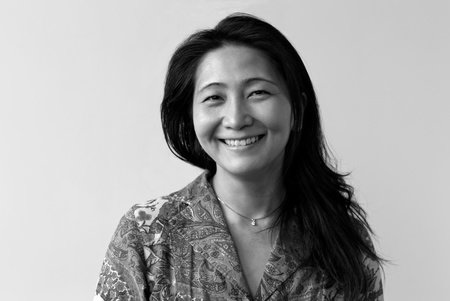
https://images.randomhouse.com/author/119452(Eri Hotta, from Random House)

Ms Hotta is clearly distressed by her story; of a government blundering its way into a conflict with the United States, making choice after choice that narrowed its options, panicking when faced with deadlines it had needlessly imposed upon itself, with no coherent strategy for achieving victory and with most of the major players having little confidence in achieving it in any case.  With its emphasis on not saying publicly and directly what many thought privately, the system as described by Hotta, led to disaster for Japan, as she concludes:
Japan's leaders must be charged with the ultimate responsibility for initiating a war that was preventable and unwinnable. 
By the summer of 1941, Japan had been at war in China for four years; a conflict it anticipated winning quickly.  Instead, its army was bogged down, inflicting defeat after defeat on Chaing Kai-Chek's forces, but with little long-term gain to show for it, while suffering significant losses, and at great economic cost.  The thoughtless way Japan entered into war in 1937 was to be duplicated in 1941, even as the principals in those discussions knew the 1937 decision was a mistake and refused to draw the obvious lessons.

In preparation for the September imperial conference, the army and navy chiefs of staff were called to a meeting with Hirohito on the prior afternoon to explain the war plan.  Hotta reports the following interchange between Army Chief of Staff Sugiyama and Hirohito, whom she describes as "displaying the incisiveness he was capable of when utterly compelled - which did not happen often", when the emperor inquired of the duration of the planned war: 
Sugiyama:  Sir, we intend to complete [our mission] in the South Seas in three months.

Hirohito: When the China Incident broke out, you were our army minister.  I remember you telling me then that the conflict would be over in about a month.  But after four long years, it hasn't ended!

Sugiyama: China has a huge hinterland.  That was why we couldn't carry out our plans as we had originally envisioned.

Hirohito: If you say that China has a huge hinterland, the Pacific Ocean is even bigger.  On what basis are you now telling me three months?
Sugiyama had no good response yet, once again, the implications were not engaged by the participants.
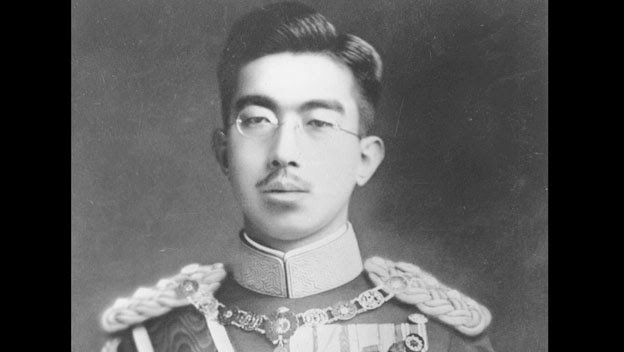
http://www.history.com/s3static/video-thumbnails/AETN-History_Prod/82/148/History_Speeches_3031_Japan_Unconditional_Surrender_still_624x352.jpg(Emperor Hirohito)

How had Japan reached this situation in September 1941?  Partly due to its baffling governmental structure which seemed designed to maximize the ability of its members to avoid clear responsibility, and to the role of the "all-powerful" emperor, which, in reality, was limited by his courtiers who wished to shield Hirohito and the reputation of the throne from the dangers of Japanese politics.  Government cabinets consisted of both civilians and military, and technically all ministers reported individually to the emperor, including the army and navy ministers.  Parliament had been neutered through a series of actions in the 1920 and 30s, and the military carried inordinate power in decisions.

Partly due to history.  Since the late 1800s, Japan sought territorial expansion on the Asian mainland.  In 1910, it annexed Korea, beginning a brutal occupation that only ended in 1945, and which Koreans resent to this day.  In 1931, the army launched a coup in the northeastern China province of Manchuria (see The Mukden Incident), taking over the entire region and establishing a puppet government.  Six years later, the army used an incident near a bridge outside Peking to launch an attack on the rest of China.  That war was to last eight years, creating a quagmire for Japan and resulting in the death of more than ten million Chinese soldiers and civilians due to combat, torture, massacre, biological warfare, starvation and flooding.

Throughout the 1930s, the United States became more disenchanted with Japan.  It furiously denounced the occupation of Manchuria, and the China war that began in 1937 evoked a great deal of American sympathy for the Chinese (don't underestimate the impact of Pearl Buck's 1931 novel, The Good Earth, the best selling novel in America for two years, and its successful 1937 film adaptation, in creating a favorable image of China).

At the same time, the militarization of Japan proceeded apace, fed by a growing fear of encirclement by its perceived enemies; the United States, the British Empire, the Netherlands and the Soviet Union.  To neutralize this threat, Japan grew closer to Nazi Germany.  After the fall of France in June 1940, Japan saw an opportunity to improve its position in Southeast Asia and occupied the northern part of French Indochina (what was later North Vietnam and Laos) on September 23, 1940.

Japan's move prompted immediate retaliatory action by the United States just three days later - increasing economic support to China and embargoing scrap metal exports to Japan.  The following day, Germany, Italy and Japan signed the Tripartite Pact,  After realizing it would not be able to invade Britain, Germany became the driving force in arranging the Pact, seeing an alliance with Japan as a way to deter the U.S. from entering the European war, while Japan viewed it as providing a balancing alliance against its enemies and improving its negotiating position with the U.S.  Initially opposed to the alliance, the navy assented once it was clear that the Pact did not automatically require Japan to participate in a war if Germany was attacked, and by the promise of a large budget increase.

It was an enormous miscalculation.  Japan's membership in the Tripartite Pact convinced the American government that Japan was an enemy and the goal of U.S. negotiations became to obtain Japanese repudiation of the Pact.  These miscalculations were only to grow over time, a curious situation in light of the American connections of many senior government officials.  For instance:
https://media1.britannica.com/eb-media/40/100940-004-BAE1EEFE.jpg(Prime Minister Konoe from britannica)
  • Prime Minister Konoe, head of government for most of the period from 1937 to 1941, whose  eldest son attended Lawrenceville Prep and then went on to Princeton.
  • Foreign Minister Matsuoka emigrated to America as a 13-year old, living in Portland and Oakland with American families, with whom he remained close, converting to Methodism and obtaining a law degree from the University of Oregon, graduating second in his class.
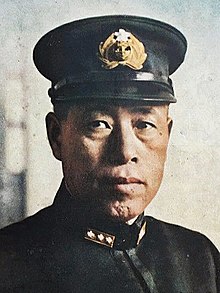
  • Admiral Yamamoto, planner of the Pearl Harbor attack, attended Harvard from 1919 to 1921, was posted to Japanese embassy in Washington from 1926 to 28, a great admirer of the U.S., who personally identified with Abraham Lincoln. 
And how did America view Japan in 1940-1?  The public was sympathetic towards China, as was President Roosevelt personally.  He viewed Japan as a threat in Asia and the Pacific, particularly in light of the Tripartite Pact, and wanted a settlement of the China War and Japan's withdrawal from the Pact.  At the same time, FDR and American military leaders viewed Nazi Germany as the much more serious threat to the United States, convinced that American involvement in the European War was coming, the only unknown being the timing.

For that reason, FDR did not want to trigger a war with Japan and, in the event of war involving both Germany and Japan, it was already agreed that America's primary effort would be directed to the defeat of Germany (the figure often used was 85% of American resources for the European conflict).  Even within this framework, there was an ongoing tension between FDR and the military.  FDR's aggressive diplomacy, including embargoes, raised fears among the military that our diplomatic actions were too far ahead of our relatively weak military capacities in the Pacific, and they worried that if war did come, our forces would be overwhelmed.

The critical turning point was July 1941.  On June 22, Germany, to Japan's surprise, attacked the Soviet Union.  Initial reports anticipated a decisive Nazi victory and the attack also eliminated the risk of any Soviet attack against the Japanese army in Manchuria (for more on this, read The Secret of Khalkin Gol).  The government saw an opportunity to further bolster its strategic position in Southeast Asia, deciding to occupy the southern portion of Vichy French Indochina.  It was viewed as a low risk, high return operation that would provide access to more natural resources and bringing Japanese forces within range of the strategic British naval base at Singapore and the oil fields of the Dutch East Indies.

Even then, not every element of the government did not agree with the Indochina action. Though the language of the document approved at the imperial conference on July 2, included this stirring passage, "The Empire shall not flinch from war with Britain and the United States", the navy was not in agreement, though it did not voice its dissent at the conference.   After the meeting, the Vice Navy Minister recorded this conversation:
"I was surprised [at the 'shall not flinch' passage] and asked Navy Minister Oikawa about it.  He said he was against war, but considering the army's general preoccupation with the north . . . we had to say that much to stop the policy from slipping out of [the traditionally south-inclined] navy's control."
Throughout these months, Minister Oikawa was to repeatedly express his reservations about the drift towards war, but mostly privately, and even when doing so in conference, always tempering his comments.  Though constantly complaining, he refused to resign, which would have sent a strong signal to the emperor, and triggered the fall of the cabinet.
Oikawa koshirō.JPG(Navy Minister Oikawa)

In advance of the formal occupation, President Roosevelt met on July 24 with Nomura, Japan's Ambassador to the U.S., telling him that if Japan refrained from entering southern Indochina, he would obtain declarations from China, Britain, the Netherlands and the U.S., declaring all of Indochina neutral and thus reducing Japan's fear of encirclement.  This proposal never reached the cabinet in Tokyo.

The Japanese were taken aback by the ferocity of the American response; freezing Japan's assets in the U.S., naming General Douglas MacArthur to head the new U.S. Army Forces in the Far East command and, most importantly, embargoing petroleum exports from America to Japan.  This was potentially devastating, as more than 90% of Japan's oil supplies came from the U.S., and without adequate supply its navy would be immobilized.

Though many in government realized a mistake had been made, and a withdrawal could have be done easily, particularly as no blood had been spilled in the occupation, no one person took it upon themselves to push for it.  Hotta writes:
Despite surface bravado, there was now a growing sense within the military that the southward advance had been an error in judgment.  Although no leaders would assume blame for the mistake, they would have conceded to a reversal, especially if diplomatically arranged.
Typical of the confused and contradictory approach were the statements of Navy Chief of Staff (and former Navy Minister) Nagano to the emperor, when they met to review the war plan on July 31.  Nagano told Hirohito he was opposed to war with the U.S., as well as to Japan participating in the Tripartite Pact, but also said, "If our petroleum supplies were cut off, we would lose our stock in two years", so there was "no choice but to strike", though "I am uncertain as to any victory".

Misgivings and bad news continued to mount in August.  Prime Minister Konoe told a confidant :
I have made a big mistake on Japan's relations with China. I am so ashamed and cannot face up to my ancestors. I do not want to repeat such a mistake.  And I want to avoid war with the United States at all costs.
The same month, Army Minister Tojo, who became Konoe's successor as PM on October 17, received a report from the War Economy Research Office finding that America's industrial economy was 20 times the size of Japan's (other estimates placed it as much as 50 times bigger).  A prolonged war with the U.S. was unwinnable for Japan.

Near the end of the month, a team from the Total War Research Institute met with the cabinet at Konoe's home.  For six weeks they had investigated the country's war making capabilities and run a simulation of a U.S.-Japan war.  Over a period of more than ten hours, they reviewed, in detail, their findings with the top government officials, concluding that Japan would definitely lose a war with the United States after winning a few initial battles.  Yet this unwinnable war was made inevitable by the imperial conference decisions just ten days later.

The dual track thinking and a growing sense of panic continued beyond September 6, as government ministers realized they had trapped themselves by the war encouraging decision made at the imperial conference.

Even as the plans for Pearl Harbor were advancing, Admiral Yamamoto was telling naval staff, "a war with so little chance of success should not be fought."  On September 29, he told Chief of Staff Nagano:
. . . it is evident that a U.S. - Japanese war is bound to be protracted.  The United States will not give up fighting as long as Japan had the upper hand.  The war will last for several years.  In the meantime, Japan's resources will be depleted, battleships and weaponry will be damaged, replenishing materials will be impossible . . . Japan will be impoverished.
https://upload.wikimedia.org/wikipedia/commons/thumb/4/48/Yamamoto-Isoroku.jpg/220px-Yamamoto-Isoroku.jpg(Yamamoto)

Hotta writes that the liaison conferences between the services "were becoming a tragic farce of keeping up appearance for appearances sake".   Chief of Staff Nagano told Minister Oikawa privately on October 2 that he preferred to avoid military confrontation, but at October 4 liaison conference demanded, "We should [set a timetable for war] right away!".

Two days later Navy leaders met and agreed it was "folly to start a war with the United States" and the army should begin withdrawing forces from China.

On October 7, the Army and Navy Ministers met.  Regarding the war plan, Tojo told Oikawa, r"If the navy is not confident, we must reconsider it."  The following day, Tojo lamented to the Navy Minister:
"We've lost tens of thousands of lives over the China Incident.  To withdraw seems an unbearable option.  And yet if we do go to war with the United States, we will lose tens of thousands more.  I am thinking about withdrawing troops, but I just cannot decide."
At almost the same time, the commander in chief of Japan's army in China sent a message to Tokyo urging it to accept U.S. demands and settle the war with China.

"We must continue to seek a diplomatic settlement", PM Konoe said on October 12, "I have no confidence in a war such as this".  The same day, Foreign Minister Toyoda, who succeeded Matsuoka in August, bluntly told Konoe, "If I am allowed to be brutally frank, the imperial conference resolution [of September 6] was impetuous."
 
In a climatic meeting on October 14 Konoe met with Tojo, informing him:
I am greatly responsible for the China Incident. . .  I simply cannot agree to starting yet another great war whose outlook is very vague.  I suggest that we now concede to the U.S. withdrawal formula and avoid opening fire between Japan and the United States.  We really need to end the China Incident.
https://upload.wikimedia.org/wikipedia/commons/7/70/Prime_Minister_Tojo_Hideki_photograph.jpg(Hideki Tojo from wikimedia)

By now, Tojo had made his decision - no withdrawal from China.  It was a matter of honor, in light of the thousands of dead Japanese soldiers in the war, as well as the disgrace if the army admitted it could not win the China war, and was thus responsible for Japan backing down to the demands of the United States.  As Hotta puts it:
The navy would not say it did not want war . . . The army, which would bear the bulk of public humiliation of troop withdrawal . . was accusing the navy of not clearly stating its opposition to the new war so that the army, too, would have to admit its weakness by saying it could not fight.
Tojo endeavored to find another path towards the same result, without the army making the recommendation, visiting the imperial palace to meet with Lord Kido, Keeper of the Privy Seal, and eminent advisor to the emperor.  Tojo urged Kido to seek resignation of the entire cabinet and they agreed, according to Hotta, "that to avoid war they had to ensure that the next prime minister would move away from the problematic imperial resolution".  Tojo recommended Prince Higashikuni for the position since the Prince was known to have strong antiwar views and, as the emperor's uncle, the prestige to carry out a change in course.  Kido rejected the suggestion, not wanting the imperial family involved in such a controversial decision.  Once again, no one in power position - whether in the imperial family, the civilian leadership, army or navy, was willing to take the lead in changing what was seen as a disastrous course of action.

On October 17, Tojo, packing up his office in anticipation of the dismissal of the entire government, was summoned to meet with Hirohito and stunned to be asked to become prime minister.  Lord Kido's flawed reasoning in recommending the appointment was that since Tojo had been the most insistent the September 6 declaration, he would be best suited for the task of reversing and, indeed, Kido met with Tojo and Navy Minister Oikawa to inform them, "I must stress that it is the emperor's wish that in formulating the nation's policy, you would not be a slave to the September 6 imperial resolution." Seeming to further help things along, Tojo's picks for finance and the new navy minister (replacing Oikawa), only agreed to serve after being assured the new prime minister was committed to avoiding war with the U.S.

Yet Tojo was to prove incapable of changing course because he still resisted the army taking the initiative and blame for policy change, a failure compounded by his lack of insight into how Japan's negotiating strategy would be perceived by the U.S.

The September 6 decision was reconsidered in daily liaison conferences from October 23 through 30. Japan 1941 recounts the dreary, frustrating, and confused discussions, which seemed to constantly circle around the key issues, but never land.  It is as though the participants felt the decision was out of their control, though all of the deadlines and negotiating positions were of their own creation.  A final, 17-hour conference on November 1-2, set November 30 as the final deadline for negotiations.  In a final fittingly inept move, Japan's negotiators in America were given two plans, A and B, to present.  Only if Plan A was rejected (and it was clearly unacceptable to the U.S.), were the negotiators to present proposals from Plan B, and it was only explicitly with Tojo's permission that they were allowed to discuss the only aspect of Plan B which would get the attention of the other side - a pledge to immediately withdraw from southern Indochina (permission that was never granted, though the Japanese negotiators, disobeying instructions, informally presented it to Secretary of State Hull on November 18).  Further complicating the task of the Japanese negotiators is they were not initially told of the November 30 deadline.

On November 25, Secretary Hull prepared a response which provided for (1) a three month truce; (2) Japan's immediate withdrawal from southern Indochina; (3) reduction of northern Indochina forces to 25,000; (4) US unfreezing Japan assets; (5) resumption of economic relations.  But it was never delivered.  Instead, on November 26, the Japanese negotiators were presented with what is known as the Hull Note containing a series of stiff and uncompromising U.S. demands, which even if subject to negotiations would take months to resolve. Why the change?  Both China and the British opposed the terms in the November 25 draft but, more importantly, the U.S. had just received reliable intelligence that Japan was moving naval, air and army forces into areas south of Taiwan, in what was apparently the initial move of a military onslaught.  Combined with increasingly militant public speeches by Japan's cabinet members, and the interception of Foreign Minister Togo's message to the Japanese embassy that after November 29, events would proceed "in an automatic fashion", FDR viewed the entire Japanese negotiating position as a sham.  The President informed his advisers that Japan would likely attack the United States on December 1.
https://www.awm.gov.au/sites/default/files/exhibitions/underattack/images/maps/advance1.gif(Japan moves south)

Although the U.S. had uncovered Japan's move south, it failed to detect six Japanese carriers leaving northern Japan on November 26 under radio silence; their objective - Pearl Harbor.

At a November 29 lunch with emperor, Admiral Yonai, convinced of the disaster a war with America would bring, spoke up, "Excuse me for speaking my mind in crude ways, but I think we mustn't become utterly poor in our quest to avoid becoming gradually poor".  The following day, Hirohito's brother conveyed his warning, but the countdown to war was on, and those who could have stopped it believed they were powerless to do so.

In frustration over the failure of diplomacy, in which the key issue of contention, the war in China, was known by the Japanese government to be a mistake, Japan set a course for war, with the forlorn hope that initial success against the United States would drive it to further negotiations, demonstrating, as Yamamoto warned on September 29, a fundamental misunderstanding of the American psyche, and knowing that their country was doomed if the war was prolonged.


For more on the early phases of the Pacific War, read Tarawa.
For the ending of the war, read Downfall: Ending The War With Japan.
For the nature of the war in the Pacific, read With The Old Breed.


Tuesday, December 7, 2021

Japan Decides On War

First posted in 2016.  Though some aspects of the decision making process reflect specific Japanese cultural attitudes, I was struck with the similarities when reading HR McMaster's account of how America became mired in Vietnam, Dereliction of Duty.   My own experiences with group decision making also alerted me to commonalities with what is described below.


"The navy cannot afford to fight.  There is a feeling that, if possible, the navy would want to avoid a Japanese-American war.  If we pass up this opportunity, war will be impossible to avoid."

- Rear Admiral Takamatsu Nobuhito to his brother, Emperor Hirohito; November 30, 1941, seven days before Pearl Harbor
The die was cast nearly three months earlier.  On September 6, 1941, an imperial conference was held in Tokyo with the Emperor, prime minister, foreign minister, finance minister and the army and navy ministers, along with their chiefs of staff.   The outcome was Hirohito's approval of "Essentials for Carrying Out the Empire's Policies", a document agreed to three days earlier by the members of his government.  It provided:
1.The empire would not refrain from war with the United States, Britain, and the Netherlands and would prepare for war.
2. While those preparations moved forward, the empire would try its utmost in diplomatic efforts with the United States and Britain, guided by an attached document.
3. If diplomatic efforts did not succeed by early October, the empire would launch a war at the end of October with the United States, Britain, and the Netherlands.
The attached document contained Japan's negotiating demands and limits of concessions, including:
Noninterference by the United States in Japan's war settlement with China
A request to close the Burma Road [Nationalist China's main line of supply to the outside world]
Japan's promise not to use French Indochina as a base for further military advances into SE Asia
As long as the Soviet Union remained neutral regarding Japan, Japan would not use force against it.
By placing war preparations ahead of diplomacy, the September 6 conference set Japan on the path towards Pearl Harbor, despite the private misgivings of many of those in attendance, including Hirohito, a story told in riveting fashion by Eri Hotta, in her 2013 book, Japan 1941: Countdown To Infamy.  While most of the author's research is not new, she has pieced it together into a compelling narrative.
https://images.randomhouse.com/author/119452(Eri Hotta, from Random House)

Ms Hotta is clearly distressed by her story; of a government blundering its way into a conflict with the United States, making choice after choice that narrowed its options, panicking when faced with deadlines it had needlessly imposed upon itself, with no coherent strategy for achieving victory and with most of the major players having little confidence in achieving it in any case.  With its emphasis on not saying publicly and directly what many thought privately the system, as described by Hotta, led to disaster for Japan, as she concludes:
Japan's leaders must be charged with the ultimate responsibility for initiating a war that was preventable and unwinnable. 
By the summer of 1941, Japan had been at war in China for four years; a conflict it anticipated winning quickly.  Instead, its army was bogged down, inflicting defeat after defeat on Chaing Kai-Chek's forces, but with little long-term gain to show for it, while suffering significant losses, and at great economic cost.  The thoughtless way Japan entered into war in 1937 was to be duplicated in 1941, even as the principals in those discussions knew the 1937 decision was a mistake and refused to draw the obvious lessons.

In preparation for the September imperial conference, the army and navy chiefs of staff were called to a meeting with Hirohito on the prior afternoon to explain the war plan.  Hotta reports the following interchange between Army Chief of Staff Sugiyama and Hirohito, whom she describes as "displaying the incisiveness he was capable of when utterly compelled - which did not happen often", when the emperor inquired of the duration of the planned war: 
Sugiyama:  Sir, we intend to complete [our mission] in the South Seas in three months.

Hirohito: When the China Incident broke out, you were our army minister.  I remember you telling me then that the conflict would be over in about a month.  But after four long years, it hasn't ended!

Sugiyama: China has a huge hinterland.  That was why we couldn't carry out our plans as we had originally envisioned.

Hirohito: If you say that China has a huge hinterland, the Pacific Ocean is even bigger.  On what basis are you now telling me three months?
Sugiyama had no good response yet, once again, the implications were not engaged by the participants.
http://www.history.com/s3static/video-thumbnails/AETN-History_Prod/82/148/History_Speeches_3031_Japan_Unconditional_Surrender_still_624x352.jpg(Emperor Hirohito)

How had Japan reached this situation in September 1941?  Partly due to its baffling governmental structure which seemed designed to maximize the ability of its members to avoid clear responsibility, and to the role of the "all-powerful" emperor, which, in reality, was limited by his courtiers who wished to shield Hirohito and the reputation of the throne from the dangers of Japanese politics.  Government cabinets consisted of both civilians and military, and technically all ministers reported individually to the emperor, including the army and navy ministers.  Parliament had been neutered through a series of actions in the 1920 and 30s, and the military carried inordinate power in decisions.

Partly due to history.  Since the late 1800s, Japan sought territorial expansion on the Asian mainland.  In 1910, it annexed Korea, beginning a brutal occupation that only ended in 1945, and which Koreans resent to this day.  In 1931, the army launched a coup in the northeastern China province of Manchuria (see The Mukden Incident), taking over the entire region and establishing a puppet government.  Six years later, the army used an incident near a bridge outside Peking to launch an attack on the rest of China.  That war was to last eight years, creating a quagmire for Japan and resulting in the death of more than ten million Chinese soldiers and civilians due to combat, torture, massacre, biological warfare, starvation and flooding.

Throughout the 1930s, the United States became more disenchanted with Japan.  It furiously denounced the occupation of Manchuria, and the China war that began in 1937 evoked a great deal of American sympathy for the Chinese (don't underestimate the impact of Pearl Buck's 1931 novel, The Good Earth, the best selling novel in America for two years, and its successful 1937 film adaptation, in creating a favorable image of China).

At the same time, the militarization of Japan proceeded apace, fed by a growing fear of encirclement by its perceived enemies; the United States, the British Empire, the Netherlands and the Soviet Union.  To neutralize this threat, Japan grew closer to Nazi Germany.  After the fall of France in June 1940, Japan saw an opportunity to improve its position in Southeast Asia and occupied the northern part of French Indochina (what was later North Vietnam and Laos) on September 23, 1940.

Japan's move prompted immediate retaliatory action by the United States just three days later - increasing economic support to China and embargoing scrap metal exports to Japan.  The following day, Germany, Italy and Japan signed the Tripartite Pact,  After realizing it would not be able to invade Britain, Germany became the driving force in arranging the Pact, seeing an alliance with Japan as a way to deter the U.S. from entering the European war, while Japan viewed it as providing a balancing alliance against its enemies and improving its negotiating position with the U.S.  Initially opposed to the alliance, the navy assented once it was clear that the Pact did not automatically require Japan to participate in a war if Germany was attacked, and by the promise of a large budget increase.

It was an enormous miscalculation.  Japan's membership in the Tripartite Pact convinced the American government that Japan was an enemy and the goal of U.S. negotiations became to obtain Japanese repudiation of the Pact.  These miscalculations were only to grow over time, a curious situation in light of the American connections of many senior government officials.  For instance:
https://media1.britannica.com/eb-media/40/100940-004-BAE1EEFE.jpg(Prime Minister Konoe from britannica)
  • Prime Minister Konoe, head of government for most of the period from 1937 to 1941, whose  eldest son attended Lawrenceville Prep and then went on to Princeton.
  • Foreign Minister Matsuoka emigrated to America as a 13-year old, living in Portland and Oakland with American families, with whom he remained close, converting to Methodism and obtaining a law degree from the University of Oregon, graduating second in his class.
  • Admiral Yamamoto, planner of the Pearl Harbor attack, attended Harvard from 1919 to 1921, was posted to Japanese embassy in Washington from 1926 to 28, a great admirer of the U.S., who personally identified with Abraham Lincoln. 
And how did America view Japan in 1940-1?  The public was sympathetic towards China, as was President Roosevelt personally.  He viewed Japan as a threat in Asia and the Pacific, particularly in light of the Tripartite Pact, and wanted a settlement of the China War and Japan's withdrawal from the Pact.  At the same time, FDR and American military leaders viewed Nazi Germany as the much more serious threat to the United States, convinced that American involvement in the European War was coming, the only unknown being the timing.

For that reason, FDR did not want to trigger a war with Japan and, in the event of war involving both Germany and Japan, it was already agreed that America's primary effort would be directed to the defeat of Germany (the figure often used was 85% of American resources for the European conflict).  Even within this framework, there was an ongoing tension between FDR and the military.  FDR's aggressive diplomacy, including embargoes, raised fears among the military that our diplomatic actions were too far ahead of our relatively weak military capacities in the Pacific, and they worried that if war did come, our forces would be overwhelmed.

The critical turning point was July 1941.  On June 22, Germany, to Japan's surprise, attacked the Soviet Union.  Initial reports anticipated a decisive Nazi victory and the attack also eliminated the risk of any Soviet attack against the Japanese army in Manchuria (for more on this, read The Secret of Khalkin Gol).  The government saw an opportunity to further bolster its strategic position in Southeast Asia, deciding to occupy the southern portion of Vichy French Indochina.  It was viewed as a low risk, high return operation that would provide access to more natural resources and bringing Japanese forces within range of the strategic British naval base at Singapore and the oil fields of the Dutch East Indies.

Even then, not every element of the government agreed with the Indochina action. Though the language of the document approved at the imperial conference on July 2, included this stirring passage, "The Empire shall not flinch from war with Britain and the United States", the navy was not in agreement, though it did not voice its dissent at the conference.   After the meeting, the Vice Navy Minister recorded this conversation:
"I was surprised [at the 'shall not flinch' passage] and asked Navy Minister Oikawa about it.  He said he was against war, but considering the army's general preoccupation with the north . . . we had to say that much to stop the policy from slipping out of [the traditionally south-inclined] navy's control."
Throughout these months, Minister Oikawa was to repeatedly express his reservations about the drift towards war, but mostly privately, and even when doing so in conference, always tempering his comments.  Though constantly complaining, he refused to resign, which would have sent a strong signal to the emperor, and triggered the fall of the cabinet.
Oikawa koshirō.JPG(Navy Minister Oikawa)

In advance of the formal occupation, President Roosevelt met on July 24 with Nomura, Japan's Ambassador to the U.S., telling him that if Japan refrained from entering southern Indochina, he would obtain declarations from China, Britain, the Netherlands and the U.S., declaring all of Indochina neutral and thus reducing Japan's fear of encirclement.  This proposal never reached the cabinet in Tokyo.

The Japanese were taken aback by the ferocity of the American response; freezing Japan's assets in the U.S., naming General Douglas MacArthur to head the new U.S. Army Forces in the Far East command and, most importantly, embargoing petroleum exports from America to Japan.  This was potentially devastating, as more than 90% of Japan's oil supplies came from the U.S., and without adequate supply its navy would be immobilized.

Though many in government realized a mistake had been made, and a withdrawal could have be done easily, particularly as no blood had been spilled in the occupation, no one person took it upon themselves to push for it.  Hotta writes:
Despite surface bravado, there was now a growing sense within the military that the southward advance had been an error in judgment.  Although no leaders would assume blame for the mistake, they would have conceded to a reversal, especially if diplomatically arranged.
Typical of the confused and contradictory approach were the statements of Navy Chief of Staff (and former Navy Minister) Nagano to the emperor, when they met to review the war plan on July 31.  Nagano told Hirohito he was opposed to war with the U.S., as well as to Japan participating in the Tripartite Pact, but also said, "If our petroleum supplies were cut off, we would lose our stock in two years", so there was "no choice but to strike", though "I am uncertain as to any victory".

Misgivings and bad news continued to mount in August.  Prime Minister Konoe told a confidant :
I have made a big mistake on Japan's relations with China. I am so ashamed and cannot face up to my ancestors. I do not want to repeat such a mistake.  And I want to avoid war with the United States at all costs.
The same month, Army Minister Tojo, who became Konoe's successor as PM on October 17, received a report from the War Economy Research Office finding that America's industrial economy was 20 times the size of Japan's (other estimates placed it as much as 50 times bigger).  A prolonged war with the U.S. was unwinnable for Japan.

Near the end of the month, a team from the Total War Research Institute met with the cabinet at Konoe's home.  For six weeks they had investigated the country's war making capabilities and run a simulation of a U.S.-Japan war.  Over a period of more than ten hours, they reviewed, in detail, their findings with the top government officials, concluding that Japan would definitely lose a war with the United States after winning a few initial battles.  Yet this unwinnable war was made inevitable by the imperial conference decisions just ten days later.

The dual track thinking and a growing sense of panic continued beyond September 6, as government ministers realized they had trapped themselves by the war encouraging decision made at the imperial conference.

Even as the plans for Pearl Harbor were advancing, Admiral Yamamoto was telling naval staff, "a war with so little chance of success should not be fought."  On September 29, he told Chief of Staff Nagano:
. . . it is evident that a U.S. - Japanese war is bound to be protracted.  The United States will not give up fighting as long as Japan had the upper hand.  The war will last for several years.  In the meantime, Japan's resources will be depleted, battleships and weaponry will be damaged, replenishing materials will be impossible . . . Japan will be impoverished.
https://upload.wikimedia.org/wikipedia/commons/thumb/4/48/Yamamoto-Isoroku.jpg/220px-Yamamoto-Isoroku.jpg(Yamamoto)

Hotta writes that the liaison conferences between the services "were becoming a tragic farce of keeping up appearance for appearances sake".   Chief of Staff Nagano told Minister Oikawa privately on October 2 that he preferred to avoid military confrontation, but at October 4 liaison conference demanded, "We should [set a timetable for war] right away!".

Two days later Navy leaders met and agreed it was "folly to start a war with the United States" and the army should begin withdrawing forces from China.

On October 7, the Army and Navy Ministers met.  Regarding the war plan, Tojo told Oikawa, "If the navy is not confident, we must reconsider it."  The following day, Tojo lamented to the Navy Minister:
"We've lost tens of thousands of lives over the China Incident.  To withdraw seems an unbearable option.  And yet if we do go to war with the United States, we will lose tens of thousands more.  I am thinking about withdrawing troops, but I just cannot decide."
At almost the same time, the commander in chief of Japan's army in China sent a message to Tokyo urging it to accept U.S. demands and settle the war with China.

"We must continue to seek a diplomatic settlement", PM Konoe said on October 12, "I have no confidence in a war such as this".  The same day, Foreign Minister Toyoda, who succeeded Matsuoka in August, bluntly told Konoe, "If I am allowed to be brutally frank, the imperial conference resolution [of September 6] was impetuous."
 
In a climatic meeting on October 14 Konoe met with Tojo, informing him:
I am greatly responsible for the China Incident. . .  I simply cannot agree to starting yet another great war whose outlook is very vague.  I suggest that we now concede to the U.S. withdrawal formula and avoid opening fire between Japan and the United States.  We really need to end the China Incident.
https://upload.wikimedia.org/wikipedia/commons/7/70/Prime_Minister_Tojo_Hideki_photograph.jpg(Hideki Tojo from wikimedia)

By now, Tojo had made his decision - no withdrawal from China.  It was a matter of honor, in light of the thousands of dead Japanese soldiers in the war, as well as the disgrace if the army admitted it could not win the China war, and was thus responsible for Japan backing down to the demands of the United States.  As Hotta puts it:
The navy would not say it did not want war . . . The army, which would bear the bulk of public humiliation of troop withdrawal . . was accusing the navy of not clearly stating its opposition to the new war so that the army, too, would have to admit its weakness by saying it could not fight.
Tojo endeavored to find another path towards the same result, without the army making the recommendation, visiting the imperial palace to meet with Lord Kido, Keeper of the Privy Seal, and eminent advisor to the emperor.  Tojo urged Kido to seek resignation of the entire cabinet and they agreed, according to Hotta, "that to avoid war they had to ensure that the next prime minister would move away from the problematic imperial resolution".  Tojo recommended Prince Higashikuni for the position since the Prince was known to have strong antiwar views and, as the emperor's uncle, the prestige to carry out a change in course.  Kido rejected the suggestion, not wanting the imperial family involved in such a controversial decision.  Once again, no one in power position - whether in the imperial family, the civilian leadership, army or navy, was willing to take the lead in changing what was seen as a disastrous course of action.

On October 17, Tojo, packing up his office in anticipation of the dismissal of the entire government, was summoned to meet with Hirohito and stunned to be asked to become prime minister.  Lord Kido's flawed reasoning in recommending the appointment was that since Tojo had been the most insistent the September 6 declaration, he would be best suited for the task of reversing and, indeed, Kido met with Tojo and Navy Minister Oikawa to inform them, "I must stress that it is the emperor's wish that in formulating the nation's policy, you would not be a slave to the September 6 imperial resolution." Seeming to further help things along, Tojo's picks for finance and the new navy minister (replacing Oikawa), only agreed to serve after being assured the new prime minister was committed to avoiding war with the U.S.

Yet Tojo was to prove incapable of changing course because he still resisted the army taking the initiative and blame for policy change, a failure compounded by his lack of insight into how Japan's negotiating strategy would be perceived by the U.S.

The September 6 decision was reconsidered in daily liaison conferences from October 23 through 30. Japan 1941 recounts the dreary, frustrating, and confused discussions, which seemed to constantly circle around the key issues, but never land.  It is as though the participants felt the decision was out of their control, though all of the deadlines and negotiating positions were of their own creation.  A final, 17-hour conference on November 1-2, set November 30 as the final deadline for negotiations.  In a final fittingly inept move, Japan's negotiators in America were given two plans, A and B, to present.  Only if Plan A was rejected (and it was clearly unacceptable to the U.S.), were the negotiators to present proposals from Plan B, and it was only explicitly with Tojo's permission that they were allowed to discuss the only aspect of Plan B which would get the attention of the other side - a pledge to immediately withdraw from southern Indochina (permission that was never granted, though the Japanese negotiators, disobeying instructions, informally presented it to Secretary of State Hull on November 18).  Further complicating the task of the Japanese negotiators is they were not initially told of the November 30 deadline.

On November 25, Secretary Hull prepared a response which provided for (1) a three month truce; (2) Japan's immediate withdrawal from southern Indochina; (3) reduction of northern Indochina forces to 25,000; (4) US unfreezing Japan assets; (5) resumption of economic relations.  But it was never delivered.  Instead, on November 26, the Japanese negotiators were presented with what is known as the Hull Note containing a series of stiff and uncompromising U.S. demands, which even if subject to negotiations would take months to resolve. Why the change?  Both China and the British opposed the terms in the November 25 draft but, more importantly, the U.S. had just received reliable intelligence that Japan was moving naval, air and army forces into areas south of Taiwan, in what was apparently the initial move of a military onslaught.  Combined with increasingly militant public speeches by Japan's cabinet members, and the interception of Foreign Minister Togo's message to the Japanese embassy that after November 29, events would proceed "in an automatic fashion", FDR viewed the entire Japanese negotiating position as a sham.  The President informed his advisers that Japan would likely attack the United States on December 1.
https://www.awm.gov.au/sites/default/files/exhibitions/underattack/images/maps/advance1.gif(Japan moves south)

Although the U.S. had uncovered Japan's move south, it failed to detect six Japanese carriers leaving northern Japan on November 26 under radio silence; their objective - Pearl Harbor.

At a November 29 lunch with emperor, Admiral Yonai, convinced of the disaster a war with America would bring, spoke up, "Excuse me for speaking my mind in crude ways, but I think we mustn't become utterly poor in our quest to avoid becoming gradually poor".  The following day, Hirohito's brother conveyed his warning, but the countdown to war was on, and those who could have stopped it believed they were powerless to do so.

In frustration over the failure of diplomacy, in which the key issue of contention, the war in China, was known by the Japanese government to have been a strategic mistake, Japan set a course for war, with the forlorn hope that initial success against the United States would drive it to further negotiations, demonstrating, as Yamamoto warned on September 29, a fundamental misunderstanding of the American psyche, and knowing that their country was doomed if the war was prolonged.


For more on the early phases of the Pacific War, read Tarawa.
For the ending of the war, read Downfall: Ending The War With Japan.
For the nature of the war in the Pacific, read With The Old Breed.