Vladimir Lenin died on this date one hundred years ago. That was a good event but a shame he had not died a decade earlier, before he had the chance to inflict so much damage on so many people. A man full of hate who, upon gaining power, reveled in being merciless to his perceived enemies. In October 1917, he led the Bolshevik Revolution which overthrew the social democrats who had been governing Russia since the overthrow of the Czar in February. In January 1918, he ordered the Bolsheviks to forcibly dissolve the Constituent Assembly, the first freely elected representative body in Russian history, and then consolidated the communist dictatorship. In September 1918 he launched the Red Terror; mass shootings "inflicted without hesitation" in order to intimidate the populace. As Krylenko, Lenin's Minister of Justice, stated, "execution of the guilty is not enough, execution of the innocent will impress the masses even more."
The extreme measures extended to those who supported the party but dissented from any of its actions. In early 1921, sailors of the Russian fleet at Kronstadt, an island near St Petersburg, who had supported the Bolsheviks completed since the October revolution, demanded an end to the monopoly of Bolshevik power, economic freedom and restoration of civil rights for peasants. This was not a democratic revolution, as the sailor demands were based on class differences. The repression by Lenin's government was ruthless. Military suppression in which thousands were killed in the fighting while those who survived were executed or imprisoned. Lenin used the incident to complete suppression of any dissent within the party and to completely eliminate any competing parties.
Lenin was inserted into the revolutionary chaos of Russia by the Germans who hoped his presence would undermine the new government's efforts to continue its participation in the First World War (read The Sealed Train for details). Though the German effort succeeded in the short-term, longer term it led to the rise of the Soviet Union, which proved much more deadly for Germany less than three decades later.
For decades, defenders of the Soviet Union and communism contended that it was Stalin that perverted Lenin's vision (and some have continued to do so even more recently - see the New York Times 2017 celebration of the 100th anniversary of the Bolshevik Revolution; read Normalizing Mass Murder and Repression), Solzhenitsyn's works and the documentation that became available with the fall of the Evil Empire in 1991, ended any doubt it was Lenin who instituted Terror and the Gulag as a tools of governance.
Lenin's life and death raise questions.
Do the impersonal forces of history govern? How much of a role do individuals play in determining the tides of history?
Certainly, Marxism is based on the former. But in the case of the Bolshevik Revolution it was Lenin's personality and fanaticism that determined the course of his party. None of his colleagues exhibited the stridency; none had the charisma of Lenin. He was, for the worse, the indispensable man.
Without the presence of Lenin, it is very unlikely the Bolshevik Party
would have seized power later in 1917. It was Lenin who unflinchingly insisted on the coup that, as historian Edward
Crankshaw wrote in the October 1954 edition of The Atlantic:
The Bolshevik Party in crisis was nothing but Lenin's will and the men
who were prepared to submit to it absolutely. If Lenin had resigned
after his return to Russia in 1917 it would have lost its identity,
swallowed up by the Mensheviks and the "Compromisers." Lenin would have
formed another party, but too late to win for himself the government of
Russia; there would have been no Soviet Union. On the other hand, had
Lenin given in to the popular demand and allowed his most trusted
colleagues to persuade him into compromise, he would have lost his own
identity and Bolshevism would have lost its meaning; there would have
been no Soviet Union.
When is extra-judicial violence justified to protect against those who would destroy any possibility of a freer and democratic society?
The social democrats who ruled Russia in the interim between the abdication and Lenin's coup, knew what he was plotting. While they did try to arrest him at one point, their indecisiveness and ineffectivness allowed the Bolsheviks to ultimately succeed. They lacked the will to do what needed to be done; arrange for the killing of Lenin. Without Lenin, Russian history takes a different course. We don't know what that course may have been, but we know the tragedy of the next 74 years and the toll it took on millions of lives and its long term impact politically. The same question arises in the case of Hitler, like Lenin, a unique and irreplaceable personality.
The original version of this post contained serious formatting errors which are now corrected and additional edits have been made . . .
The finest pop song about an historical event is undoubtedly Roads To Moscow, the 1973 song composed and recorded by Al Stewart which I saw performed in 1974 at the Orpheum Theater in Boston while he was on tour in support of the album Past, Present, and Future. The events he describes began more than 78 years ago as Operation Barbarossa, the German surprise attack on the Soviet Union, triggering the bloodiest conflict in human history. By its end in May 1945, 4.3 million Germans were dead, mostly military personnel, and perhaps up to 27 million Russians, two thirds of them civilians.
Stewart's song balances a vivid, poignant, and historically accurate lyric with a lovely melody, a Russian influenced chorus, and an evocative and emotional arrangement. He tells the story of a Soviet soldier, one of tens of millions of people caught in the horrific tragedy caused by two of the most brutal regimes to ever be inflicted upon the human race - Nazi Germany, led by Adolph Hitler, and the Communist Soviet Union of Josef Stalin. It's a world of spiritual darkness and limited and terrible choices for the common people trapped by those events, a dilemma also brought to life by Alan Furst in his splendid series of novels set in the same time period - particularly Night Soldier and Dark Star.
Let's look at the lyrics and explore the song in more detail.
They cross over the border the hour before dawn
At about 315am on the morning of June 22, 1941, the German army launched Operation Barbarossa. The attack, including 14 Finnish and 13 Romanian divisions, involved 3.8 million soldiers, 3,400 tanks, 3,500 aircraft and 700,000 horses. Facing the onslaught were about 2.5 million frontline Soviet troops (the Red Army had about 4 million men under arms in total in the European part of the country).
Though Hitler and Stalin had been allies since the August 1939 signing of the Nazi-Soviet Nonaggression Treaty, which divided Poland and the Baltic States between them, they were long-term ideological enemies and a conflict was inevitable at some point. However, the specific timing of the German attack was dictated by Hitler's desire to remove what he viewed as Britain's last hope for support in the war, the same motive that drove Napoleon's disastrous invasion of Russia in 1812 (for more on this read Bonapartaroo Barbarossa).
Ideological considerations drove Nazi decisions as to how the war would be conducted. The inhabitants of occupied portions of the Soviet Union were to be starved, driven out, or left as slave labor for German settlers, captured Red Army communist commissars to be executed, and roving extermination squads (Einsatzgruppen) organized that would ultimately kill a million Jews.
In the months leading to the attacks, Stalin dismissed multiple warnings from his own intelligence services as well as from Churchill and Roosevelt, claiming they were provocations designed to entice him into a war with Germany that would only benefit the Western capitalist powers. As late as the night of June 21-22 he ordered the execution of German defectors who entered Soviet lines to warn of the imminent attack. The result was that Red Army troops were left deployed in forward positions near the border, in vulnerable formations ill-suited to defense.
The Soviet Army was still recovering from Stalin's 1937-38 purge (possibly triggered by information planted by German agents) of senior military leadership in which at least 75% of these officers were killed, and its poor performance in the 1939-40 Winter War with Finland, gave the German military what proved to be unwarranted confidence that the Russians would be quickly defeated. This overconfidence also contributed to the inexplicable lack of attention by the Germans to the logistical challenges of a massive campaign designed to penetrate deeply into the Soviet Union, challenges that were ultimately to doom Barbarossa.
The border referred to in the lyric was different from the 1939 Soviet border. With the 1939 pact, Stalin was able to occupy half of Poland, all of the Baltic States and the Romanian province of Bessarabia. By advancing the border, he gained strategic depth against attack, while also arresting, murdering, and deporting hundreds of thousands of citizens of those countries who he believed might oppose his plans (a sordid tale told in disturbing detail in Timothy Snyder's Bloodlands). In addition, with his surprise attack on Finland in October 1939 he gained buffer room for Leningrad and the crucial northern port of Murmansk.
Moving in lines through the day Most of our planes were destroyed on the ground where they lay
The Luftwaffe destroyed over 2,000 Soviet aircraft on the ground that first day, losing only 35 planes in its attacks. More than 3,900 Soviet planes were destroyed in the first three days, giving the Germans overwhelming air superiority.
Waiting for orders he held in the wood Word from the Front never came By evening the sound of the gunfire was miles away Ah, softly we move through the shadows, slip away through the trees Crossing their lines in the mists in the fields on our hands and our knees And all that I ever, was able to see The fire in the air glowing red, silhouetting the smoke on the breeze
In those first days and weeks many Soviet troops found themselves isolated behind the rapidly advancing Germans and without order amidst the command chaos. "The Front" refers not to the front lines where the soldiers were, but to the organization of Russian armies into "Fronts", equivalent to American Army Groups on the Western Front. In other words, they heard nothing from the High Command.
While many isolated or surrounded soldiers surrendered (nearly 3 million by the end of 1941, 3/4 of whom would die in German captivity) many thousands were eventually able to find their way back through gaps between the rapidly advancing German Panzer units and the slower infantry following behind to rejoin their comrades, our narrator being one of those. Others remained uncaptured but behind enemy lines, becoming the core of the partisan units that would harass the Germans for years (and who make an appearance later in the lyrics).
All summer they drove us back through the Ukraine Smolensk and Vyazma soon fell By autumn we stood with our backs to the town of Orel
In this passage, the narrator uses the terms "us" and "we" in reference not to his personal location but rather to the overall plight of the Red Army.
The German attack was divided into three army groups. Army Group North advanced through the Baltic States towards Leningrad, while Army Group South drove the Soviets, "back through the Ukraine", culminating in September with a great encirclement near Kiev in which more than 700,000 Soviets were killed or captured.
The third, and initially most powerful, group was Army Group Center, taking the road to Moscow along with Smolensk, Vyazma, and Orel were located. The Battle of Smolensk lasted from July 10 to September 10, with the Red Army losing nearly a half million soldiers dead, wounded, or captured. The battle was prolonged because in its early stages Hitler diverted panzer units to the south for the Kiev encirclement. The delay in capturing Smolensk may have fatally delayed the German drive on Moscow.
With the panzers returning to Army Group Center, the advance on Moscow resumed in late September, racing against the onset of winter. During October, the Germans pulled off two more giant encirclements at Vyazma and Bryanks, in which another million Soviet soldiers were killed or captured. Orel fell on October 3 to General Guderian's tanks.
Closer and closer to Moscow they come Riding the wind like a bell General Guderian stands at the crest of a hill
On November 15, the Germans began their final push on Moscow. General Heinz Guderian (1888-1954), commander of the Second Panzer Army, is considered one of the finest tank generals of the war, performing brilliantly during the Poland invasion and then leading the armored spearheads in the 1940 French campaign. Guderian's task was to approach the Soviet capital from the southwest and encircle it. Though he made some advances, his overextended forces were halted short of the capital and left in vulnerable defensive positions. On December 26, 1941 he would be dismissed from command because of a dispute with his superiors (including Hitler) over how to respond tactically to the recently launched Soviet offensive. Recalled to duty by Hitler in 1943 after the disaster at Stalingrad, he was charged with rebuilding the army's panzer capabilities. On July 21, 1944, the day after the failed assassination attempt against Hitler, Guderian was appointed Army Chief of Staff. Though often arguing with Hitler about tactical decisions, he remained a faithful supporter of the Fuehrer until the end of the war.
(Guderian)
Winter brought with her the rains Oceans of mud filled the roads Glueing the tracks of their tanks to the ground While the sky filled with snow
In this section, two weather periods are mixed together. From late October until mid-November came a period of cold rain, turning the primitive Soviet road network into a sea of mud. Then came freezing temperatures, making the roads stable and more passable. The final German push was launched in this window before the onset of brutal cold and snow made offensive operations much more difficult.
(Mud season, November 1941)
And all that I ever was able to see The fire in the air glowing red silhouetting the snow on the breeze
Now the red is silhouetting "the snow on the breeze" rather than "the smoke on the breeze" of the first verse, signaling the passage of time from the warmth, sun, and disaster of June to the bitter cold, snow, and hope of December.
In the footsteps of Napoleon the shadow figures stagger through the winter
The German offensive continued until December 5 under increasingly taxing conditions with heavy snow and temperatures plunging to well below zero. Counting on achieving complete victory by the end of fall, German soldiers had not been issued winter clothing, nor were tanks, assault guns, and motor vehicles designed and equipped to operate in these conditions. At these temperatures the recoil fluid, lubricating oil and firing pins on German artillery, anti-tank, and machine guns failed, tank turrets would not turn and trucks had to be kept constantly running, using precious fuel. And all these troubles amplified by the already overstressed German supply system virtually collapsing in the winter conditions.
Yet despite these difficulties, isolated German units got within 15 miles of the Kremlin, while to the northwest the main German forces were within 25 miles of the city.
A German officer wrote of conditions during the advance:
It is icy cold . . . To start the engines, they must be warmed by lighting fires under the oil pan. The fuel is partially frozen, the motor oil is thick, and we lack antifreeze to prevent the cold water from freezing.
The remaining limited combat strength of the troops diminish further due to the continuous exposure to the cold. It is much too inconvenient to shelter the troops from the weather . . . In addition, the automatic weapons of the groups and platoons often fail to operate, because the breeches can no longer move.
On December 3, the commander of Fourth Panzer Group reported its offensive combat power "has run out" because of "physical and moral over-exertion, loss of a large number of commanders, inadequate winter equipment".
Finally recognizing the reality of the brutal conditions and the disintegration of offensive capabilities Hitler and the High Command issued a halt order on December 5.
References to Napoleon were also a constant theme of Soviet propaganda which constantly reminded German troops of the fate of the last western invader, whose myth of invincibility, along with his army, disappeared in the Russian winter.
Falling back before the gates of Moscow Standing in the wings like an avenger
What kept the German high command pressing ahead for so long despite the casualties and exhaustion of men and equipment was the persistent belief the Russians had exhausted their reserves and were on the verge of collapse. It was a massive miscalculation and demonstrated the complete failure of German intelligence assessments. They underestimated the willingness of Stalin to move troops from the Soviet Far East as well as the capability of the brutal and ruthless Soviet system to mobilize an almost endless number of reserves (unlike Hitler, who resisted fully mobilizing the German economy and populace until 1944, Stalin immediately took such measures). Between June 22 and December 31, the Soviets lost 4 million men, the equivalent of its entire army on June 22 yet still had 4 million under arms at the end of the year. It is hard to believe any other society surviving with that magnitude of loss in such a short time.
Less than 24 hours after the German offensive halted, the Soviets began launching their own attacks, designed to push back and isolate the German forces near Moscow. In a series of actions lasting until the beginning of March 1942, the exhausted Germans were forced back more than 100 miles, permanently eliminating the threat to Moscow.
While Soviet soldiers were somewhat better equipped for the weather, the winter conditions still took a toll, a toll only enhanced by Soviet commanders still favoring frontal assaults. Thus, despite its success, the tactical shortcomings of the Red Army can be seen in the disparity in casualties during its three month offensive - 1.6 million for the Soviets versus 262,000 for the Germans.
And far away behind their lines the partisans are stirring in the forest Coming unexpectedly upon their outposts, growing like a promise
You'll never know, you'll never know Which way to turn, which way to look, you'll never see us As we're stealing through the blackness of the night You'll never know, you'll never hear us
Though not a major factor in 1941, by the following year the partisan threat became a major problem for the extended supply lines of the German army. Partisan warfare in Russia was on a completely different, and larger, scale than in most of the rest of Europe, involving huge numbers, semi-organized and large scale assaults on German rear lines. Big chunks of the Soviet countryside behind enemy lines remained out of German control throughout the war and forcing many troops to be diverted to fighting partisans.
And the evening sings in a voice of amber, the dawn is surely coming
Using "amber" in this context is very interesting. Amber is a fossilized tree resin, valued as a gemstone. From 1500 BC there was an Amber Road by which this material was moved in trade from the shores of the Baltic to the Mediterranean. The leading source of amber was near what used to be the city of Konigsberg in Prussia, now known as Kaliningrad and part of Russia since 1945.
The famous Amber Room was initially constructed in Konigsberg and gifted in 1716 by the Prussian King to Peter the Great of Russia. Installed in a palace outside of Petersburg (later Leningrad), the room was expanded, eventually covering 590 square feet and containing over 6,000 pounds of amber on panels backed with gold leaf and mirrors.
(The Amber Room)
During the war the German Army dismantled the Amber Room and transported it back to Konigsberg. Disappearing at the end of the war, its location remains unknown, one of the last mysteries of the war.
The voice of amber is soothing - its message that things will get better. The next lines tell us how:
The morning road leads to Stalingrad And the sky is softly humming
We've moved ahead several months to the summer of 1942. Unlike 1941, when the German Army was powerful enough to attack the Soviets from across its entire front, the Nazis summer offensive would be more limited in scope. On June 28, the Germans attacked in the south, aiming for the oil fields of the Caucasus region and the heavy industrial town of Stalingrad. The Germans advanced quickly, nearly reaching the Caspian Sea, but became bogged down in Stalingrad, with an increasingly obsessed Hitler insistent upon its capture. The fighting lasted for almost six months ending in catastrophe for the Nazi regime with the destruction of the Sixth Army and the allied Hungarian and Romanian armies, along with heavy losses in other German units. Of 91,000 prisoners taken by the Russians only 5,000 ever returned to Germany, some not until a decade after the end of the war. The cost of victory was staggering for the Red Army - another 1.1 million dead, wounded or captured.
(Russian soldiers, Stalingrad)
In a military sense the failure to knock the Soviets out by the fall of 1941 was the turning point in the war, the point where unconditional victory by Germany became impossible but Stalingrad was the symbolic turning point of the war and both Stalin and Hitler were aware of its symbolism at the time. The horror of the battle from the Russian perspective is captured best inLife and Fateby Vassily Grossman, one of the greatest works of 20th century literature, in a section recounting the struggle of one Red Army squad to hold a ruined building amidst the rubble of the city. Of course, being a Russian novel, everyone dies.
After Stalingrad, German military leaders no longer believed the war could be won, though it was not certain how long it might take the Soviets to win.
Two broken Tigers on fire in the night Flicker their souls to the wind We wait in the lines, for the final approach to begin It's been almost four years, that I've carried a gun At home it'll almost be spring The flames of the Tigers are lighting the road to Berlin
The lyrics here are very cleverly structured. The first line tells us of "two broken Tigers" followed by a reference to "the final approach" but we don't know where or when it is. The next line tells us it's been "almost four years that I've carried a gun", placing us in 1945, but still not giving us a location as Soviet armies are fighting from the Baltic to Hungary. Then it's revealed that the flaming Tigers are also "lighting the road to Berlin", creating a vivid and precise word picture.
The Tiger was the heaviest and most powerful tank produced by Germany during the war. Like much German equipment it was over engineered, overly complex to manufacture and required high level maintenance to keep operational. The Tiger I was produced from 1942 to 1944 and the Tiger II from 1944 on, but fewer than 2,000 made it to the army. When it was available and running the Tiger proved devastatingly effective.
(Tiger II)
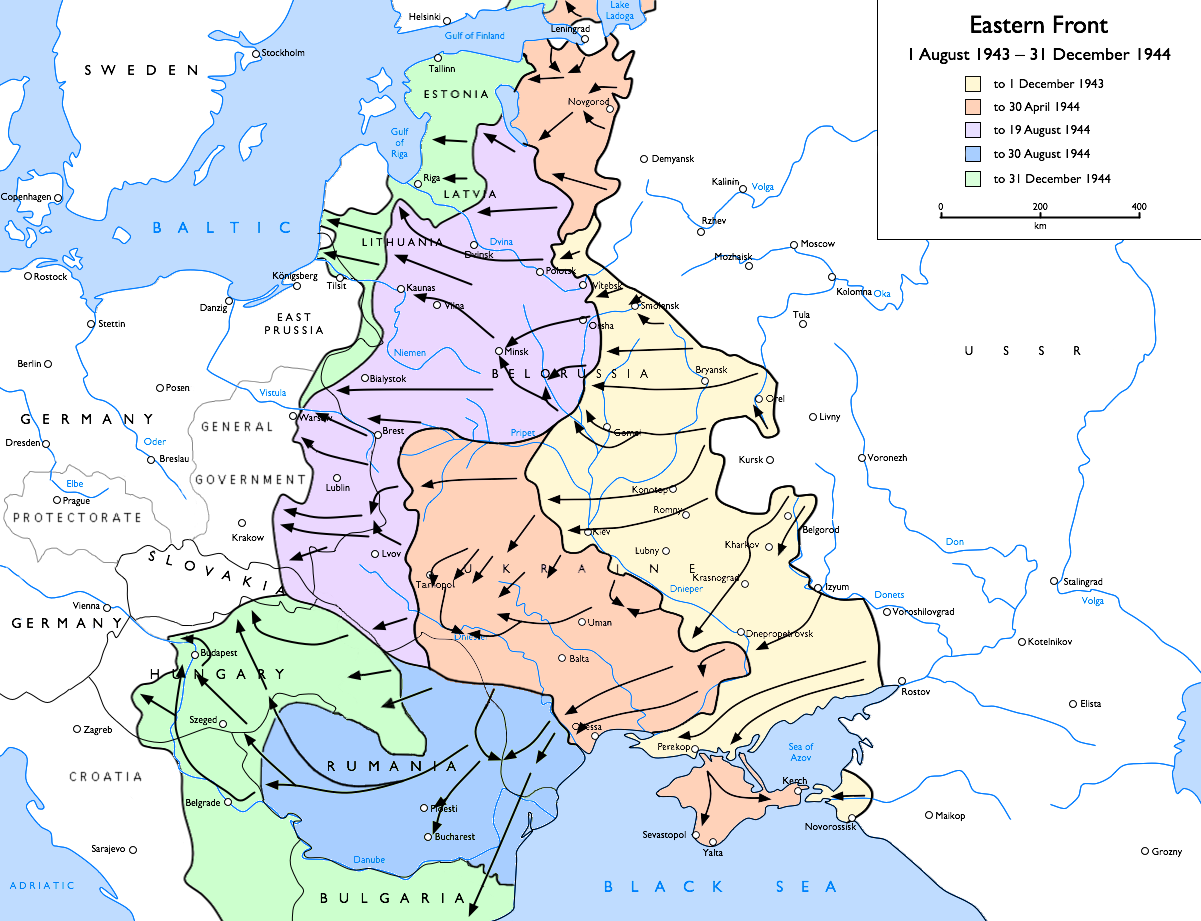
It's now April 16, 1945. The Red Army is less than 50 miles from Berlin. Much has transpired since the German surrender at Stalingrad in February 1943. In July 1943 Hitler attempted his last major attack on the Eastern Front near the city of Kursk. It quickly proved unsuccessful, the Soviets counterattacked, and from then until the end of the war the Red Army conducted a series of attacks. The German siege of Leningrad ended and most of the Ukraine was reconquered by the end of 1943. In June 1944, the Soviets crushed Army Group Center and drove the Germans out of Russia, advancing into Poland where by late July they were on the outskirts of Warsaw. Then followed another of the countless tragedies of the war when the Polish Home Army rose up to evict the Germans. Stalin, who opposed the anti-communist Poles, ordered the Red Army to stand by while the Nazis crushed the uprising, killing 200,000 Poles and razing the city (for more on the uprising read Warsaw Does Not Cry).
In late 1944, the Soviets advanced into the Balkans, causing Romania and Bulgaria to switch sides and reaching the borders of Hungary.
On January 12, 1945 the Russians renewed their attack on the Polish front, sweeping away the Germans quickly advancing to the Oder River near Berlin, where they paused to regroup for the final assault.
Ah, quickly we move through the ruins that bow to the ground The old men and children they send out to face us, they can't slow us down All all that I ever, was able to see The eyes of the city are opening now, it's the end of a dream
The Berlin campaign lasted from April 16 through May 2. Though the assault contributed to the "ruins that bow to the ground" much of the city was already ruined by American and British bombing raids, some consisting of more than 1,000 bombers striking the city.
The reference to "old men and children" refers to the Volksstrum ("People's Storm"), a national militia consisting of all men between 16 and 60 capable of bearing arms, formed in October 1944, as the manpower needs of the crumbling Third Reich became ever more desperate (though even boys of 14 and 15 would see service by the end). Poorly armed and trained, the Volkssturm units were of varying effectiveness and took heavy casualties.
Notice the contrast with the opening verse of the song. In 1941, the narrator speaks of defeat, confusion, and retreat; four years later he is moving triumphantly forwards to victory.
(Berlin 1945)
Despite the claim that "old men and children . . . they can't slow us down", the Volkssturm and remaining regular Wehrmacht units imposed heavy losses on the Army army - 79,000 dead and 270,000 wounded in less than three weeks, a per day toll higher than any the Soviets had suffered since the dark days of 1941. The human cost was made higher by Stalin's cynical move to place Marshals Zhukov and Koniev in competition to be first to Berlin, relentlessly mocking and scolding them, leading to reckless frontal assaults, particularly by Zhukov (for more on him readThe Secret of Khalkin Gol). And, with the encouragement of Stalin and the Red Army command, the victorious soldiers took a terrible vengeance on German civilians.
I'm coming home, I'm coming home Now you can taste in the wind, the war is over And I listen to the clicking of the train wheels as we roll across the border
The lyric brims over with optimism. Against all odds, our narrator has survived and looks forward to being reunited with his family. In reality the odds were low that any soldier on the front line on June 22, 1941 would be alive and healthy enough to fight continuously and still be in the Berlin fighting.
8.6 million Red Army personnel died in the war; effectively the original 1941 army was killed twice over. In comparison, the United States suffered 296,000 battlefield deaths with another 100,000 dead due to accidents and illnesses.
Nor were all the Russian dead solely the responsibility of the German army. Life for Red Army soldier during the war was brutal. Commanders employed tactics that wasted countless lives. If you died, particularly early in the war, it was unlikely your family would be notified. Any infraction, real or imagined, was subject to harsh discipline and extreme punishment. During the first 18 months of the war (the only period for which we have figures), 160,000 Soviet soldiers were executed for cowardice or desertion. By comparison, only one American was executed for these offenses during the entire war. For those not summarily executed there were the Punishment Battalions and Companies to which officers and soldiers were sentenced to be used, in Stalin's words, at "the most difficult parts of the front, to give them the possibility to redeem their crimes against their country with blood". The Punishment units were deployed for tasks such as suicidal front assaults and the clearing of minefields by marching through them, making it no surprise that an estimated 400,000 died in the process. Their existence was such an embarrassment to the Soviets after the war that the existence of the units was officially denied.
And there were the Red Army's blocking detachments formed to shoot down retreating soldiers - retreating Red Army soldiers. In this clip from the movie Enemy At The Gates, which takes place at Stalingrad, you can watch (about 2 minutes in) a blocking detachment in action (the first 20 minutes of the movie are stunning and accurate, after that it falls apart).
The optimism of those that survived extended beyond the relief of being alive and reuniting with family. The memoirs and recollections of returning soldiers and officers are filled with belief and hope that conditions in the Soviet Union would be improved. There was a feeling that, through their war effort, the common Soviet citizen had proven to Stalin they could be trusted, that the regime need not fear them, that the fear of being subject to arbitrary justice would end and there would be a new start for the Soviet people and a new and more cordial relationship with their government.. It was not to be.
And now they ask me of the time That I was caught behind their lines and taken prisoner "They only held me for a day, a lucky break", I say They turn and listen closer I'll never know, I'll never know Why I was taken from the line and all the others To board a special train and journey deep into the heart of Holy Russia And it's cold and damp in this transit camp And the air is still and sullen And the pale sun of October whispers The snow will soon be coming
In his account of the German-Soviet struggle, Absolute War, author Chris Bellamy writes, "the Red Army was the only one in the world where being taken prisoner counted as desertion and treason". Stalin believed any soldier who allowed himself to be captured was a traitor and potential counter-revolutionary, and that Russians exposed to Westerners for any length of time became a danger to the Soviet state. Bellamy adds:
The Soviet government and military command had absolutely no interest in what happened to Soviet people in German captivity. When prisoners of war who survived were released at the end of the war [3 of the 4 million POWs died due to the German policy of exposing them to the elements and leaving them to starve, though a small number also died serving as guinea pigs during the initial testing of the gas chambers used at Auschwitz], they were usually sent to the Gulag or shot, and the same fate even befell many who had fought and crawled their way out of German encirclements during the war.
Our narrators falls into this last group. His years of valiant service and suffering are to no avail.
Also subject to this treatment were civilians who either volunteered or been seized and taken to Germany as slave laborers. Bellamy estimates that up to 1.8 million returning Soviet citizens were sent to Gulag camps or shot.
In Stalingrad: The Fateful Siege, Anthony Beever tells the tale of a Soviet lieutenant caught in this madness. Captured by the Germans in August 1942, he manages to escape and rejoin the Red Army, where he is promptly arrested, charged as a deserter, and sentenced to a Punishment Company. Realizing his sentence is an effective death penalty, he deserts to the Germans! We don't know his fate but it is unlikely he had a happy ending.
To their mutual disgrace, both Britain and America contributed to this horror. Between 1945 and 1946, the two countries forcibly repatriated over a million Russians who did not want to return to the Soviet Union. While it was the British who insisted on honoring agreements made with Stalin during the course of the war, the United States eventually went along. The returnees were among those sent to the Gulag or shot.
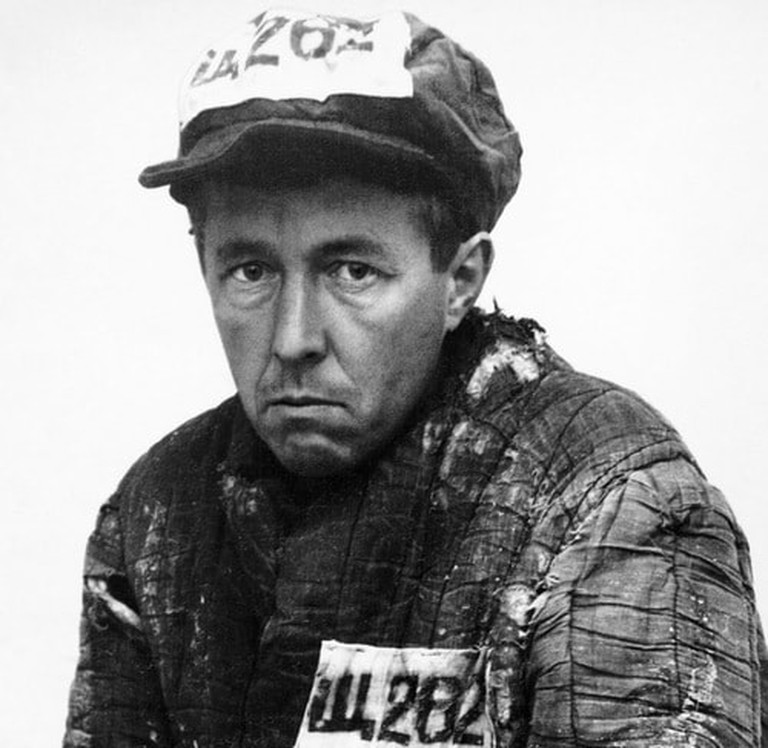
Even for those escaping the Gulag or execution, optimism proved misplaced. Stalin believed that after the "laxity" of the war years, Soviet discipline needed to reimposed to prevent any sliding back from the pre-war accomplishments of the state. The post-war years proved grimly repressive with further waves of purges and the elimination of those tiny, fragile zones of personal autonomy some had carved out during the war. Stalin even ordered the removal of crippled and disabled war veterans from the streets of Moscow because he felt their presence demoralizing. It was in this atmosphere that a young returning officer, Alexander Solzhenitsyn, found himself sentenced to ten years in the Gulag for telling a joke about Stalin.
And I wonder when I'll be home again and the morning answers, "Never" And the evening sighs and the steely Russian skies go on forever
I find these the saddest line in music and no matter how often I hear them they affect me as powerfully as the first time. They represent the betrayal of the hopes and dreams of people caught up in a horrible time, who thought they'd survived the worst, only to find themselves condemned to death, exile, continued fear and hopelessness.
We take leave of our narrator as he disappears into the mist beneath the steely Russian skies passing to an unknown fate, like so many other millions. We'll end with some lines from the poet Osip Mandlestam (1891-1938), who himself died in a Gulag transit camp after sentencing for committing "counter-revolutionary activities" consisting of writing a poem mocking Stalin.
Mounds of human heads
Are wandering into the distance
I dwindle among them
Nobody sees me
Today is the 90th anniversary of Josef Stalin's declaration of war on the kulaks. Or, as he put it in his own inimitable style on December 27, 1929, the goal of the Union of Soviet Socialist Republics (USSR) was "liquidation of the kulaks as a class",adding "Now we have the opportunity to carry out a resolute
offensive against the kulaks, break their resistance, eliminate them as a
class and replace their production . . ."
On January 30, 1930 the Communist Party Politburo formalized the decision in a resolution entitled, "On measures for the elimination of kulak households in districts of comprehensive collectivization". Under the resolution all kulak family members were to be placed in one of three categories:
To be executed or imprisoned
To be internally exiled to remote regions of the USSR
To be used as forced labor in their local regions
All kulak property was to be confiscated regardless of category.
The term "kulak" in the late Russian empire referred to peasants who owned at least 8 acres of land but after the Bolshevik Revolution in 1917 became more vague over the next decade, and by the time of Stalin's announcement meant any peasant who owned land or livestock, had tenants on their property, or sold surplus food on the open market. Communists viewed these kulaks as obstacles to collectivization, accusing them of hoarding grain and livestock. Whatever an individual kulak believed or how they acted was irrelevant, as a class they needed to be eliminated. To put it as Stalin thought about it, whatever a kulak subjectively thought or did, looking at it objectively (as Stalin did) they would ultimately be an opponent of true communism and needed to be dealt with in a preventative manner.
Stalin's announcement was not the first time kulaks were declared an enemy of the Bolsheviks. In August 1918, during the Russian Civil War, as the Bolsheviks tried to gain control over the rebellious countryside, Lenin issued a directive:
"Hang (hang without fail, so the people see) no fewer than one hundred
known kulaks, rich men, bloodsuckers. [...] Do it in such a way that for
hundreds of versts [kilometers] around the people will see, tremble,
know, shout: they are strangling and will strangle to death the
bloodsucker kulaks".
No one has an accurate account of the numbers of kulaks killed or exiled as a result of the 1930 resolution. Estimates of the dead range from 700,000 to several million (accounting is difficult since the dekulakization process overlaps with the related Soviet induced famine in the Ukraine during those years). Documents examined after the fall of the USSR indicate that 1,803,392 persons were sent to labor camps in 1930 and 1931 with only 1,317.022 actually arriving at their destinations.
Economically, the agricultural sector of the USSR never recovered, with the Soviets needing to import grain and food stocks for the remainder of its existence.
Similar debacles occurred in every other communist state, though varying in the degree of violence, with the worst examples being Pol Pot's Cambodia and Mao's China. Cambodia saw a quarter of its population die in four years, while Mao's anti-landlord campaign from 1949 to 1953 resulted in several million deaths. I have a Chinese friend whose grandfather, a local landlord in the Shanghai area, was sentenced to 25 years hard labor after the communists came to power. He died in a camp. Decades later the family discovered that prior to Mao taking power in 1949, their grandfather had supported and helped fund the communists. It didn't save him once they took power. In a socialist world, class distinctions are much more important than individual actions. The category your rulers place you in determines your fate. A lesson to keep in mind.
On this date 80 years ago the Nazi regime in Germany and the communists ruling the Soviet Union signed a Non-Aggression Pact surprising and shocking the world. The Pact opened the way to the Second World War and caused great confusion among Communist Parties outside of the Soviet Union and who, as we know now were funded and under the direct control of the Soviet communists.
In the years prior to Hitler's ascension to power in 1933, Stalin had directed the German Communist Party to consider its main enemy the parties supporting the democratic Weimar Republic, not the rising Nazi party on the theory that once Weimar had collapsed the communists could defeat the Nazis and control Germany. It was a massive miscalculation.
In the mid-30s, Stalin directed Communist parties to cooperate with other anti-fascist groups in Western countries in order to oppose the Nazis. And now, on August 23, 1939 Stalin reversed direction again. Once the war began with Germany's invasion of Poland on September 1 and Great Britain and France's declaration of war on Germany (September 3), Stalin directed communist parties in the UK and France to undermine war preparation efforts and for the American communist party to oppose any action by the United States to support Britain and France.
The public portion of the Pact was a Non-Aggression agreement between the two countries but there was also a Secret Protocol, the existence of which was not acknowledged by the Soviet Union for fifty years. That section carved upon eastern Europe, including Poland, Finland, the Baltic States, and Romania into spheres of influence and control between Germany and the Soviet Union.
Six million Polish citizens (three million of them Jews) were to die in the next six years as a result of German terror, while hundreds of thousands of Poles, Lithuanians, Latvians, Estonians, and Romanians were to die, with as many more transported to the Gulag during the Soviet occupation.
Witold Pileckiwas a symbol of those times. Joining the Polish Home Army to fight the Nazis, spending more than two years in Auschwitz, fighting in the Warsaw uprising against the Germans in 1944, and then becoming an opponent of the new Soviet backed regime until he was imprisoned and secretly executed.
During the first two weeks of September the Germans overran Poland, and then on September 17 the Soviets announced they would be entering the country to help preserve stability and security (at the time, no one knew of the Secret Protocol dividing Poland).
The Germans advanced so quickly they entered areas designated for Soviet occupation. In the city of Brest in eastern Poland a formal handover ceremony was held on September 22. Below is a photo of German General Heinz Guderian and Soviet General Semyon Krivoshein holding a joint review of their forces on that day. Krivoshein invited Guderian to visit him in Moscow after Germany defeated Britain.
Krivoshein had a distinguished career after Germany invaded Russia in June 1941. Late in the war his corps recaptured Brest and spearheaded the final assault on Berlin in April 1945, capturing the Reichstag.
TEXT OF NAZI-SOVIET PACT
Article I
Both
High Contracting Parties obligate themselves to desist from any act of
violence, any aggressive action, and any attack on each other, either
individually or jointly with other Powers.
Article II
Should
one of the High Contracting Parties become the object of belligerent
action by a third Power, the other High Contracting Party shall in no
manner lend its support to this third Power.
Article III
The
Governments of the two High Contracting Parties shall in the future
maintain continual contact with one another for the purpose of
consultation in order to exchange information on problems affecting
their common interests.
Article IV
Should
disputes or conflicts arise between the High Contracting Parties,
neither shall participate in any grouping of Powers whatsoever that is
directly or indirectly aimed at the other party.
Article V
Should
disputes or conflicts arise between the High Contracting Parties over
problems of one kind or another, both parties shall settle these
disputes or conflicts exclusively through friendly exchange of opinion
or, if necessary, through the establishment of arbitration commissions.
Article VI
The
present Treaty is concluded for a period of ten years, with the proviso
that, in so far as one of the High Contracting Parties does not advance
it one year prior to the expiration of this period, the validity of
this Treaty shall automatically be extended for another five years.
Article VII
The
present treaty shall be ratified within the shortest possible time. The
ratifications shall be exchanged in Berlin. The Agreement shall enter
into force as soon as it is signed.
Secret Additional Protocol
Article I
In
the event of a territorial and political rearrangement in the areas
belonging to the Baltic States (Finland, Estonia, Latvia, Lithuania),
the northern boundary of Lithuania shall represent the boundary of the
spheres of influence of Germany and U.S.S.R. In this connection the
interest of Lithuania in the Vilnius area is recognized by each party.
Article II
In
the event of a territorial and political rearrangement of the areas
belonging to the Polish state, the spheres of influence of Germany and
the U.S.S.R. shall be bounded approximately by the line of the rivers
Narev, Vistula and San.
The question of whether the interests of both parties make
desirable the maintenance of an independent Polish state and how such a
state should be bounded can only be definitely determined in the course
of further political developments.
In any event both governments will resolve this question by means of a friendly agreement.
Article III
With
regard to Southeastern Europe attention is called by the Soviet side to
its interest in Bessarabia. The German side declares its complete
political disinterest in these areas.
Article IV
This protocol shall be treated by both parties as strictly secret.
Moscow, August 23, 1939.
For the Government of the German Reich v. Ribbentrop
Plenipotentiary of the Government of the U.S.S.R. V. Molotov
"Most of all the blood. My arms are up to the elbows in blood."
- Nikita Khrushchev's (1894-1971) response to playwright Mikhail Shatrov when asked during his retirement what he regretted.
"Paradise is a place where people want to end up, not a place they run from. What kind of socialism is that? What kind of shit is that, when you have to keep people in chains? What kind of social order? What kind of paradise?"
- From tapes recorded by Khrushchev in his retirement. This passage was not included in the transcribed memoir his son helped to smuggle to the West and published in 1970 as Khrushchev Remembers; it came to light in 1990 when the full tapes became available.
Both quotes are from Red Plenty, one of two outstanding books I've read in recent years on the post-Stalin Soviet Union. I thought it an appropriate day to post this since today is International Workers Day; first proclaimed in 1904 by the Sixth Conference of the Second International, a convening of European socialist and communist parties.
Red Plenty (2010), by the English novelist Francis Spufford, is set in the years between Stalin's death (1953) and the end of the Khrushchev "thaw" in the late 1960s. It tells the story of the brief era when the Soviet economy was supposedly growing faster than any other country except Japan, Khrushchev was promising Soviet living standards would exceed the U.S. by 1980, and a fully planned, fully centralized economy, embracing the capabilities of the new field of computing made it seem attainable, before it all came crashing down resulting in the economic stagnation of the 70s and 80s, and the final collapse of the Evil Empire.
The brilliant accomplishment of Red Plenty stems from Spufford being a fine writer who concocted what he calls "faction", a mixture of fact and fiction. We meet fictional young idealists, factory managers, and party strivers, along with Khrushchev, Alexei Kosygin, and other apparatchiks as he spins a story with heavy doses of economic theory in an entertaining and instructive way. Because it is set in the post-Stalin era with The Terror and specter of mass murder and the gulag no longer hanging over everyone, the complete failure of the Soviet planing system makes for an even more powerful tale.
Through his deft storytelling, Spufford demonstrates that the more centralized a society is at the top, the more vulnerable it is to small mishaps at the bottom which can ripple back through the entire system. And he sums up the deterioration of the system:
Stalin had been a gangster who really believed he was a social scientist. Khrushchev was a gangster who hoped he was a social scientist. But the moment was drawing irresistibly closer when the idealism would rot away by one more degree, and the Soviet Union would be governed by gangsters who were only pretending to be social scientists.
The book is only 300 pages and also has 50 pages of the best footnotes I've ever read (one of the quotes is from there).
These reviews capture the unique aspects of Red Plenty:
"I finished it in awe, not merely at Spufford's Stakhanovite research, but at his skill as a novelist, his judgement as a historian and his sheer guts in attempting something simultaneously so weird and yet so wonderful." - The Sunday Times (UK)
Everyone knows the economic central planning in the Soviet Union was a failure . . . Few will expect to pick up a longish book on the topic by a non-economist and devour it almost in a sitting. But that is what you have in store with Red Plenty. It is part detective story - who or what is killing the Soviet economy? - and part a brilliantly clear explanation of some very intricate history and economics." - The Economist
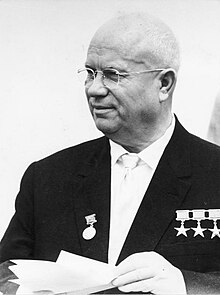
Khrushchev personified the new generation raised by Stalin after he wiped out the old Bolsheviks and anyone else with broader intellectual horizons and experience of the world outside the Soviet Union. Poorly educated, resentful of the bosses, crude and violent, Nikita initially brought into Stalin's view of the world. During the Great Purge he personally oversaw the actions in the Ukraine, approving close to 50,000 executions. During the war he was political director at the Battle of Stalingrad, ruthlessly driving the military commanders, and not hesitating to demand executions. Rising in the hierarchy after the war, he joined the Politburo, participating in the increasingly bizarre parties at the Supreme Leader's dacha where Stalin demanded his subordinates dance with each other as he ridiculed them, constantly reminding them that, when he was gone, "the capitalists will drown you like little kittens".
Underestimated by his opponents, he outmaneuvered them all after Stalin's death and by 1957 was the new Supreme Leader. Most surprisingly, in March 1956 he denounced Stalin and his crimes (though not Lenin's) at the Party Congress, while later that year he ruthlessly suppressed the rebellion in Hungary. But within the Soviet Union the last of the gulag prisoners were released and some literature critical of Stalin was allowed to be published, though Vasily Grossman's Life and Fate was a bridge too far.
Unlike both his predecessors and successors he believed a nuclear war unwinnable, but his recklessness provoked crises in Berlin and Cuba. He seemed to have some sense that changes were needed in the system but, like Stalin, he was a devotee of Lysenko's crackpot theories on genetics and agriculture. While a continued apostle of centralized planning he was prone to frequent temperamental eruptions as his own thinking was disorganized and chaotic.
He strikes me as a man with some insight into the problems inherent in the Soviet system but without the intellectual tools to figure out a solution. It was as much his increasingly erratic behavior as his anti-Stalinism that lead to his removal in October 1964. Even some of those who supported his limited opening of society approved the Politburo action because of his unpredictable behavior. In a change from Stalin times, instead of being exiled or jailed, Khrushchev was merely moved to a smaller dacha, given a smaller car, and watched carefully.
The other book I'd strongly recommend is Russia And The Idea Of The West (2000) by Robert English, the story of the evolution of Soviet reformers in the post-Stalin era, and the emergence of Mikhail Gorbachev. Stalin's isolation of the Soviet Union was so effective that the ignorance of the rest of the world by those who followed him in power and the next rising generation during the 1950s and 1960s is quite striking. English shows how the "new thinking" allowed under Khrushchev continued to evolve even during the more repressive regime that followed his overthrow and the growing determination of Gorbachev and others to end the confrontation with the West which they, unlike the Left in Europe and America, viewed as the fault of the Soviet Union.
When portions of the Soviet archives became available after 1991, numerous arrest lists were found with Stalin's notations. Some, like the one above, directed blanket executions. Others, consisting of hundreds and sometimes thousands of names had Stalin's check next to those to be executed. He spent a lot of time going through those lists.
It was seventy years ago this month that Berlin became a city divided, a status it retained until the Berlin Wall, constructed in 1961, came down on that memorable evening in November 1989.
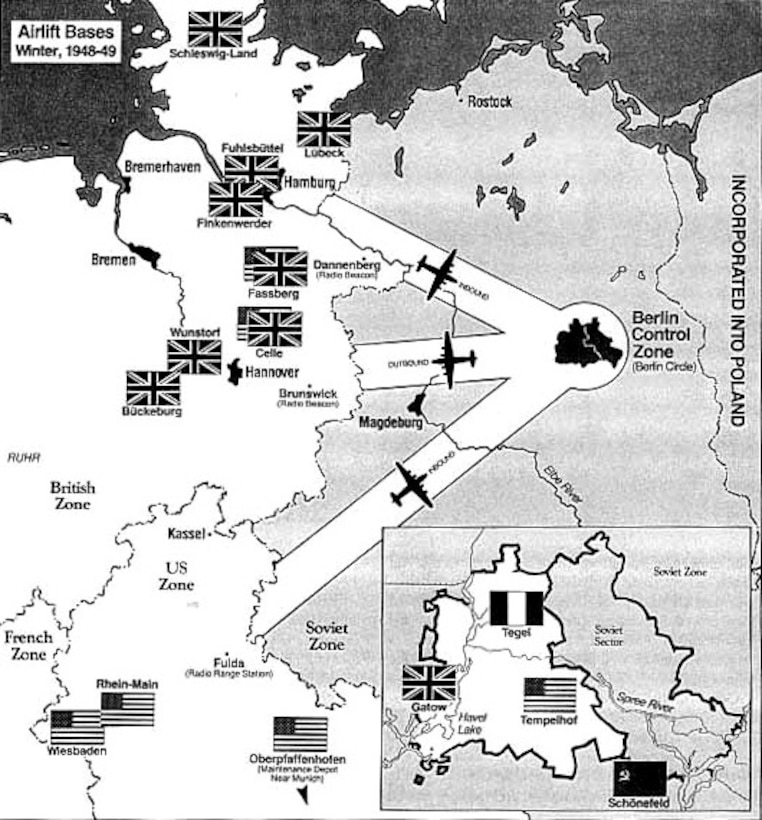
The event occurred amidst the turmoil of the Berlin Blockade and the relief airlift launched by the United States and Britain to keep its sectors of the city supplied.
With the end of the Third Reich in May 1945, Berlin was divided into four zones of occupation (Soviet, American, British, and France) but governed as a unified city. The entire country was also divided into four zones, but Berlin lay completely within the Soviet zone. In order to support their occupation forces and supply its sectors, the Western Allies had the right to use certain rail and road lines to connect their zones in Western Germany with their Berlin sectors. Governance of the entire structure was through the four-power Allied Control Council (ACC).
(Berlin: Occupation Sectors from Air Force Historical Support Division)
As relations between the Soviet Union and the West worsened, Stalin decided on a plan designed to force the U.S., Britain, and France to choose between withdrawing from Berlin or agreeing to his wishes regarding the future of Germany. On March 20, 1948 the Soviet delegates walked out on what proved to be the final meeting of the ACC. Over the next three months the Soviets intermittently interfered with Western shipments to Berlin.
Germany was in the middle of an economic crisis and the Soviets refused to agree to currency reform efforts. On June 18 Britain, French, and the United States announced the introduction of the Deutsche Mark (DM) as the new currency in their sectors. The following day, the Soviets began permanently restricting and, within a few days, completely blocking the rail and road supply links to the Western Allies sectors in Berlin. Only the air corridors remained open but the Soviets thought the Allies incapable of the massive airlift needed to maintain the civilian population of Berlin. As of late June, western Berlin had only 36 days of food supplies and 45 days of coal.
From a military perspective the West was vulnerable. There were only about 21,000 British, American, and French military personnel in Berlin and fewer than 150,000 troops (and only one combat ready division) in West Germany, while the Soviets had 1.5 million soldiers in East Germany.
President Harry Truman was confronted with deciding how to respond. Though the U.S. commanders on the ground in Germany and Europe, Lucius Clay and Curtis LeMay, urged a strong response, he was getting different advice from his senior civilian and military advisers in Washington.
Army Secretary Kenneth Royall, Secretary of Defense James Forrestal, acting Secretary of State Robert Lovett, and Truman's military advisor, Admiral William Leahy all believed the Western Allied position in Berlin to be militarily indefensible and quickly overrun if the Soviets attacked. Army Chief of Staff Omar Bradley advised that it would be better for the U.S. to pull out of Berlin on its own terms, than to be forced out. Walter Bedell Smith, the current U.S. ambassador to the Soviet Union, and former chief of staff to General Eisenhower in WW2 also thought America should leave Berlin. Several months into the crisis, Bedell Smith remarked:
"Our present hysterical outburst of humanitarian feeling keeps reminding me that just three and a half years ago I would have been considered a hero if I had succeeded in exterminating those same Germans with bombs."
The initial response from our British and French allies was also undecided on how to respond.
And there was a political aspect, with a presidential election coming in November. Thomas Dewey had just wrapped up the Republican nomination and was considered by the press as a sure victor in November. Truman was also facing what looked like a strong third-party challenge to his left from Henry Wallace.
Wallace, an Iowan, had been Secretary of Agriculture under FDR, then served a Vice-President during Roosevelt's third term, before being forced off the ticket in 1944 by Democratic party bosses, clearing the path for Truman, and returned to FDR's cabinet as Secretary of Commerce. He was also, as Andrei Cherny writes in The Candy Bombers (a highly recommended account of the Berlin Airlift), a "profoundly strange" man who "believed the future could be foretold by markings on the Great Pyramid of Egypt", and convinced FDR to add the pyramid to the dollar bill. He was also involved with theosophists (for more on this odd group readMadame Blatavsky and the Birth of Baseball).
Wallace was also not unsympathetic to the communists. In September 1946 he was fired by Truman after attacking his policy of opposing Soviet domination in Europe. As Truman moved to counter Soviet aggression, Wallace became even more outspoken. In March 1947 in response to the announcement of what became known as the Truman Doctrine under which it became the "policy of the United States to support free peoples who are resisting attempted subjugation by armed minorities or outside pressure", Wallace declared that "America will become the most hated nation in the world", placing all blame on America for the emerging Cold War. He opposed the Marshall Plan calling it a "blueprint for war". Throughout 1947 Wallace spoke to enthusiastic audiences of up to 30,000 people announcing, at the end of the year, a third party presidential run as the Progressive Party candidate. Wallace knew he could not win an election from hope to deny Truman victory and ultimately allow Progressives to take over the Democratic Party.
As 1948 began international tensions already high, became worse after a successful communist coup in Czechoslovakia, the last remaining free country in Eastern Europe. Wallace excused the coup on the grounds that the communists were driven to it by threats of a Rightist coup. It should come as no surprise that as the Soviets ratcheted up pressure on Berlin, Wallace urged an American withdrawal in order to preserve the piece.
From a political perspective Truman was faced with a strong Republican opponent, and a Wallace campaign that could siphon off much needed votes.
Harry Truman decided to stand firm in Berlin. The logistical obstacles to supply the city were overwhelming but, by trial and error over the next three months along with Herculean efforts by the American and British Air Forces, a viable air corridor was established. We were fortunate that during the next year no crisis erupted elsewhere in the world, as the U.S. had no additional air logistical capacity to deploy. It was all needed to keep Berlin supplied.
At the Progressive Party convention in Philadelphia during July, enthusiasm ran high and Wallace was doing well in the polls. With thirty being the average age of delegates, and three quarters having no prior political involvement, it appeared to be a transformational youth movement.
(Berlin after WW2 ended, from Rare Historical Photos. com)
In the meantime though, the airlift was transforming American and German views of each other. The horrors of Nazism and hundred of thousands of dead American soldiers left little sympathy for German civilians trying to survive amidst the ruins of their shattered cities. We did want we needed to do to prevent outright starvation, but economically and spiritually the country remained prostrate, and in Berlin there were still food shortages and little rebuilding; that was fine with most Americans but in 1948 the Soviet threat, the determination of the Germans in Berlin to resist the Russians, and their enthusiastic response to the Airlift sparked more public sympathy and interest in American efforts to help German recovery.
One specific event had a profound impact on both Germans and Americans during the blockade. On July 18, 1948, while on approach to Templehof Airport in Berline, C-54 pilot Gil Halvorsen, wiggled his wings and dropped chocolate bars attached to a handkerchief parachute to children waiting below. The prior day while at Templehof, Halvorsen while walking around encountered the children who were watching the planes land and asked him questions about the aircraft. He gave them gum and promised he'd drop them candy the next day after wiggling his wing. Halvorsen continued his daily candy runs and when news reached the airlift commander he organized Operation Little Vittles; soon American children sent candy for the drops and eventually U.S. candy manufacturers made donations; 23 tons of candy were dropped in toto, and Halvorsen became known as The Candy Bomber, giving title to Cherny's book. The candy drops became a symbol of America's willingness to help and of the perseverance of Berliners.
(C-54 Lands At Templehof, from wikipedia)
In November Truman pulled off one of the most surprising upsets in presidential history beating Dewey. Ironically, it was the Berlin Airlift that probably was the critical factor. For independent voters it demonstrated that Truman could be tough in protecting America's interests. For potential Wallace voters seeing the reality of the heartless face of communism in its willingness to starve millions of civilians, the American response to help those in need, and the Democratic party's attacks on Wallace as a tool of communism, blunted their progressive enthusiasm. Early in the fall it looked like Wallace was going to get 6-7% of the vote, guaranteeing a Dewey victory, but the campaign collapsed in the final weeks and Wallace polled only 2.5% (1.15 million). Even then it was close; the Wallace vote threw New York to Dewey, while if the Progressive candidate had received only 7,000 more votes in Ohio, and 18,000 in California the race would have gone to the House of Representatives, and 69,000 more in five other states given Dewey an outright victory.
The Western Allies knew winter would be their biggest challenge, as coal needs increased, and worsening weather restricted the airlift on many days. And, in the midst of this, Berlin was scheduled to have its first municipal elections since 1946 in which a communist party faced three non-communist opponents. The Soviets, knowing the communists would lose the election tried a mixture of threats, gifts, and force to intimidate Berliners.
(Airlift: Winter 48-49, from US Department of Defense)
From the start the city's population, no matter how they disliked the Russians and/or communists knew that if the Western Allies abandoned them, they would have to live under Soviet domination, a fear the Soviets made use of by constantly reminding the populace of the consequences they would suffer if they supported the West, and then were left behind when the British and Americans withdrew.
On November 30 the city parliamentarians of the Soviet supported local communist party held an assembly in which they declared themselves the legitimate government of the city. In conjunction with this, the Soviets accelerated their campaign to discourage Berliners from voting in the municipal elections scheduled for December 5. Along with threats the Soviets made generous offers to those who agreed not to vote; Soviet ration cards, nearly a ton of coal to each household, unlimited amounts of electricity, and a half pound of candy for each school age child. They also reminded Berliners, "if you vote on the 5th, you vote for war".
Meanwhile, General Lucius Clay, commander of the American garrison in the city, who had become the symbol of Allied defiance of the Russians, found himself stranded in West Germany where he had gone for meetings, because of days of thick fog in Berlin. Worried that his absence would be taken as an indicator of weakened American resolve Clay and his wife boarded a flight during the night of December 4 taking off through the mist. Arriving in Berlin before dawn the fog was so dense the controllers at Templehof refused permission to land because visibility was less than 100 feet. According to Cherny, "Clay barged into the cockpit and grabbed the microphone from the pilot." Permission to land was granted, the plane landed, skidded to a stop, and was escorted by servicemen with hand held flashlights to its stand, since the pilot could not otherwise see anything on the taxiway.
An overwhelming 86% of eligible Berliners cast their votes on December 5, with the Social Democrats, the strongest anti-communist party of the opposition winning more votes than the others combined. Two days later the newly elected city government took power. With the election, Berlin became divided, with East Berlin governed by the communist party, and the three sectors under Allied occupation having a different government. Though some connections between East and West Berlin continued until the building of The Wall in 1961severed all contact, it would be 43 years before the city would be unified under one government.
One other significant event occurred in December involving the French. Initially the French, suffering through the rise and fall of multiple governments in Paris and with the French Communists, a strong political force, supporting Stalin's actions, hesitated to strongly support the American and French response. However, in August they agreed to build a new airport in their sector to support the airlift, completed in early November, built almost entirely by hand by 17,000 Berliners working around the clock, and having the longest runway in Europe.
There was a problem though. About 400 yards from the runway were two towers of Radio Berlin, the Soviet propaganda arm. They were not illuminated and posed a danger to landing planes. The Soviets refused to move the towers, even though the Americans offered to pay for rebuilding in a different location.
On the morning of December 16, British and American officers at the airport were asked to come to French General Jean Ganeval's conference room for a reception. They found plentiful food but no explanation for their summons. At 1045 they were startled to hear a huge explosion and saw the two Russian radio towers collapse. Ganeval, who had been grossly insulted by Soviet behavior earlier that fall, told his guests, "You will have no more trouble with the tower."
The Allies and the people of Berlin persevered through the winter; Stalin knew he could not prevail. On May 12, 1949 the Soviets lifted the blockade, though the airlift was not declared ended until September 30, as the Allies continued flights in order to build up a three month stockpile of supplies in case the Russians changed their minds.
In the course of the airlift, the Allies made 280,000 flights to Berlin to deliver more than 2.3 million tons of supplies. Seventeen American and eight British planes crashed during the effort, and 40 British along with 31 Americans died.
In the 1950s, Henry Wallace realized his 1948 Progressive Party campaign had actually been run by communists and expressed regret that he had not understood that at the time.
"Candy Bomber" Hal Halvorsen, a Utah Mormon, remained in the Air Force until 1974.
His final assignment was as group commander at Templehof Airport. Hal
recently celebrated his 98th birthday and splits his time between Utah and Arizona, where he winters.
This month is the 100th anniversary of the birth of Alexander Solzhenitsyn, author of The Gulag Archipelago (for background on the bookread this). The passage below from the book remains the most vivid in my memory 40-plus years after reading.
The Gulag Archipelago is not dry history, instead brimming
with passion, anger, contempt, caustic wit and acerbic asides. The
accretion of detail on person after person, on trial after trial, on
lawless and arbitrary decrees, on the squalid dehumanizing world of
the camps is relentless, overwhelming, and the translation by Thomas P. Whitney captures it all.
The passage is from a
chapter entitled “The Archipelago Metastasizes,” which tells the
sorrowful tale of the building of the White Sea-Baltic canal in the
early 1930s. Stalin demanded a canal that would allow
the passage of Soviet naval vessels from one sea to the other in order
to avoid the Arctic Ocean, setting a 20-month deadline for its completion.
Hundreds of thousands of prisoners were assigned to its construction.
The canal was dug by hand without the assistance of any mechanical equipment, under
terrible physical conditions, and with brutal oversight from abusive guards. A quarter million human beings perished in the process. Poorly designed, the
canal never functioned as planned.
Solzhenitsyn is unsparing in his portrayal of the debacle and near
the end of the chapter recounts a visit he made to the canal in 1966 as
he was completing research on the book which he was secretly working on. He recounts the official tour he took:
“It’s so shallow“, complained the chief of the guard, “that
not even submarines can pass through it under their own power, they
have to be loaded on barges, and only then can they be hauled through.“
And what about the cruisers? Oh, you hermit-tyrant! You nighttime
lunatic! In what nightmare did you dream up all this?And where, cursed
one, were you hurrying to? What was it that burned and pricked you — to
set a deadline of twenty months? For those quarter-million men could
have remained alive. Well, so the Esperantists stuck in your throat, but
think how much work those peasant lads could have done for you! How
many times you could have roused them to attack — for the Motherland,
for Stalin!
“It was very costly“, I said to the guard.
“But it was built very quickly!“, he answered me with self-assurance.
Your bones should be in it!
The chapter ends with this summing of accounts:
My Lord! What canal is there deep enough for us to drown that past in?


 On June 28, the Germans attacked in the south, aiming for the oil fields of the Caucasus region and the heavy industrial town of Stalingrad. The Germans advanced quickly, nearly reaching the Caspian Sea, but became bogged down in Stalingrad, with an increasingly obsessed Hitler insistent upon its capture. The fighting lasted for almost six months ending in catastrophe for the Nazi regime with the destruction of the Sixth Army and the allied Hungarian and Romanian armies, along with heavy losses in other German units. Of 91,000 prisoners taken by the Russians only 5,000 ever returned to Germany, some not until a decade after the end of the war. The cost of victory was staggering for the Red Army - another 1.1 million dead, wounded or captured.