Showing posts with label Greece. Show all posts

Monday, April 14, 2025

Return Of The Magic Bus

magic-bus-reader 

Back in 2017, THC did a post on the memorable trip he took with the future Mrs THC on the Magic Bus in September 1978, traveling from Athens to Paris.  The post has drawn more comments than anything else on Things Have Changed.  As wild as our adventure was, many of the comments have matched or exceeded our experience for sheer weirdness.  The Magic Bus remains prominent in the memories of many of its passengers forty and more years later.

 Last month THC was contacted by Spiros Vasiliou, a writer for the popular Greek online newspaper, Reader.gr, who was working on an article on the Magic Bus and had come across my 2017 post, which I gave him permission to use.  I learned that the Magic Bus, which began as a transport on the Hippie Trail in the early 70s, going all the way to Nepal originally, also had a place in Greek culture and memory.

You can find the lengthy article here, including photos and excerpts from my post, but you'll have to do the translating yourself! 

Spiros also told me that the Magic Bus inspired a very popular rock song in the 1980s by one of the pioneering Greek new wave bands (it's got 2.4 million views on YouTube).  The band was Tripes and the closest translation of the song title is Psyche Taxicab.

These are the translated lyrics:

London, Amsterdam, or Berlin
You've forgotten exactly where you want to go
No matter how much I borrow, I won't let you
Go for rides on the Magic Bus anymore
 
Traveling soul 
And if I want to be by your side, it's hard to stay
It's time to see my own life
On this trip I won't wait for you
 
I'll go shopping and one night
What I have inside of me for you I'll erase
The road you've taken is a one-way street
And I don't see you turning back 
Take a listen.  It's pretty good.


Translation of the section on our trip:

American Mark Stoller is one of the thousands of passengers who traveled to Greece in the late 1970s on the Magic Bus. Several years ago, he decided to record that experience on his blog. What followed was something he never imagined. Dozens of responses to his text, from people who had similar experiences! “I am still amazed that my post on the Magic Bus has received more comments than anything else I have written on my blog since I started it in 2012,” he tells us. “So many years later, my wife and I still have such enjoyable memories of our month in Greece and the Magic Bus,” he adds, and kindly provides us with the itinerary of the trip, as it was distributed to passengers in the summer of 1978!

The article then goes on to include a long quote from my 2017 post.


Saturday, November 26, 2022

Good Counsel

I have no fault to find with those who have proposed a reconsideration of the question of the Mytilenaeans, nor do I commend those who object to repeated deliberation on matters of the greatest moment; on the contrary, I believe the two things most opposed to good counsel are haste and passion, of which the one is wont to keep company with folly, the other with an undisciplined and shallow mind.

via Laudator Temporis Acti

The quote is from Thucydides' account of the Peloponnesian War (431-404 BC), and concerns the Mytilenaean Debate of 427.  Mytilene was a city on the island of Lesbos, and had been an ally of Athens.  After war between Athens and Sparta broke out in 431, the leaders of Mytilene feared that Athens would become more repressive and they reached out to Sparta.  The Athenians discovered the plans to revolt and eventually compelled the Mytilenaeans to surrender unconditionally.

The Athenian Assembly, comprised of all male citizens of Athens, met to discuss the fate of the people of Mytilene.  The assembly quickly voted to sentence all the males of Mytilene to death, while selling the women and children into slavery.  According to Thucydides, the Athenians immediately executed about a thousand Mytilene prisoners who had already been brought back to Athens.

Second thoughts on the punishment arose and the assembly convened for further debate between those who advocated upholding the initial resolution and those seeking a milder solution.  It was Diodotus, ostensibly quoted by Thucydides above, who cautioned the assembly regarding "haste and passion" (alternatively translated as "haste and anger"), advising that the issue should be what was in Athens' best interest and questioning whether the prior day's decision would deter future revolt or make it more likely.

After lengthy discussion, Diodotus' argument carried the day and the assembly voted to execute only the leaders of the revolt.  Though a more moderate approach carried the day, as the war progressed the Athenian assembly made increasingly brutal decisions in dealing with revolts and enemies, and even with Athenian generals and admirals who were seen as failures.

Throughout the History of the Peloponnesian War, Thucydides ponders issues of diplomacy, motivation, and the passions of democracy and the authoritarianism of oligarchy and their relative merits.  As you read the book, you find his commentaries on the human condition remain relevant today.


Thursday, August 4, 2022

Poseidon Adventure

Came across this photo which reminded me that the future Mrs THC and I visited the Temple of Poseidon at Cape Sounion in Greece in September 1978.  It is an hour or two from Athens - we must have reached the site by bus.  At the time there was nothing around it - don't know if that has changed.

This version of the temple (it had been a cult site for hundreds of years prior) was built in the mid-5th century, at the same time as the Parthenon, and at the height of Athen's power.

It was later that month we boarded the Magic Bus.


Wednesday, September 29, 2021

Tunnel Of Eupalinos

In 1978, Mrs THC and I visited the Greek island of Samos.  We arrived on a boat out of Piraeus after spending a lovely afternoon and evening on the Aegean.  In those day, the ferries used in the Aegean were mostly repurposed ferries from the North Sea countries which could no longer stand up to the rough seas but were fine for the calm Aegean.

Spending our second night on Samos in the small town of Pythagoreio, named after the famed mathematician born on the island, we decided to splurge, spending $12 on a decent hotel (a big expense for us the time) and having an excellent dinner of freshly caught fish at one of the restaurants by the docks.

It was there we first heard about the water tunnel built under the direction of Eupalinos of Megara (a city on the Greek mainland), described as a wonder by the historian Herodotus in the 5th century BC, the location of which was rediscovered in the 19th century.

The 3,400 foot tunnel runs through and under Mount Kastro, carrying water from a spring to the city of Samos, then the capitol of the island (Pythagoreio was founded in the 19th century on the same site), probably in the 6th century BC.

Because only two men could work on excavating at the same time, the tunnel was started from both ends and through Eupalinos' knowledge of geometry was able to meet.

This animated video below provides an entertaining and instructive guide to how the tunnel, which may have provided water for a thousand years, was designed and constructed.

The ferry taking us back to the mainland arrived in Samos 12 hours behind schedule. We spent much of the time sitting in a crowded ferry terminal filled with cigarette smoke but afraid to leave because no one could give us any accurate information on when the ferry might arrive.  When it finally came into port we noticed the boat had a notable list but it did get us back to Piraeus eventually.  A few days later we departed Athens for Paris on the Magic Bus.


Saturday, April 29, 2017

Acrocorinth

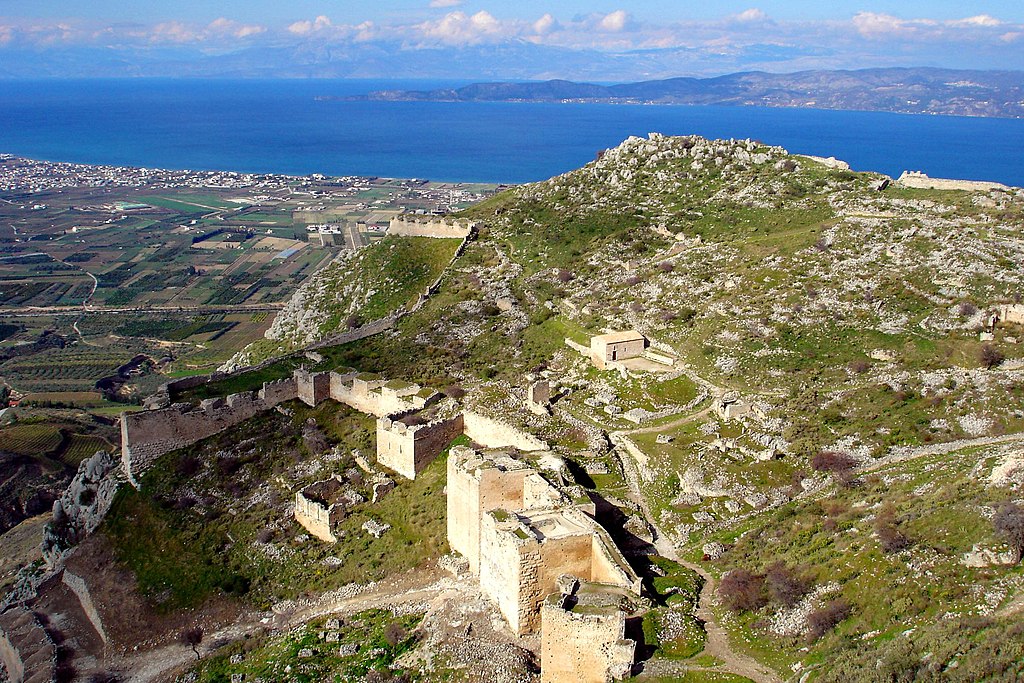
THC came across another memento of our 1978 trip to Greece (see The Magic Bus for the prior instance); this photo by the future Ms THC:
                              (Acrocorinth by Ms THC)
We'd arrived in the port of Patras that morning on the overnight ferry from Italy (we'd slept on deck as we could not afford a cabin), and then caught a train to Corinth.  For some reason we cannot remember we decided to visit the Acrocorinth, taking a cab up to the gates and then walking further up the hill and around the ruins.  We also saw the view you can see in the photo below.

(Corinth and Gulf of Corinth from Acrocorinth)

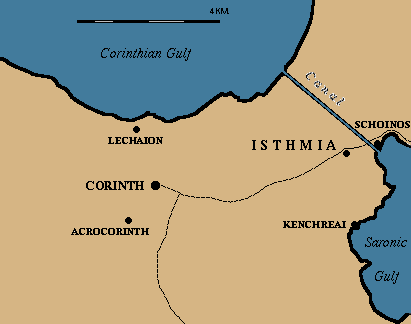
The Acrocorinth is an acropolis built on a ]isolated mountain rising nearly 2,000 feet above the plain of Corinth.  Positioned near the entrance to the Peloponnese it provides an ideal defensive site.
Image result for map of acrocorinth and peloponnesushttps://lucian.uchicago.edu/blogs/isthmia/files/2010/06/corinthia.gif

The first fortifications were built on the site around 600 BC, and over the years was occupied by Greeks, Romans, Byzantines, Franks, Venetians, Ottomans and then again, after 1822, by Greeks.   It is the largest castle in Greece and one of the largest in Europe with its perimeter walls covering about two miles.

(Corinth with Acrocorinth by Carl Anton Joseph Rottman, 1847

The most dramatic event in its history was a siege which lasted from 1205 to 1210.  In 1204, the Fourth Crusade, under Venetian and Frankish leadership, ended up seizing Constantinople and dispossessing the Byzantine emperors, instead of going to the Holy Land.  In the ensuing chaos, the local area governor, Leo Sgouros, occupied the Acrocorinth, which was then besieged by the Crusaders.  The castle fell in 1210.  Sgouros committed suicide by jumping from one of the cliffs.

Monday, March 20, 2017

The Magic Bus

[UPDATE:  I never expected that so many others would share their memories of those wacky and memorable Magic Bus days when I wrote this.  Thanks to everyone who has commented.  I so enjoy reading them!] 

UPDATE: 12/30/25 - This year I was contacted by a writer for a popular online Greek newspaper who was writing a feature on The Magic Bus which, I learned, has a legendary status in that country and was actually the subject of a hit song by a Greek rock band in the 80s!  You can find the article and the song at the post The Return of the Magic Bus.

As we plow through stuff stored away for years in preparation for our move to Arizona, we've come across many items bringing back memories.  Here's one - a flyer for the Magic Bus from the summer of 1978.


In May of 1978, I'd quit my job and gone to Paris, where the future Mrs THC was at the time,  working as an au pair for a French-American family, studying French, and living in a 6th floor walk up garret room with a primitive communal toilet down the hall.

During July we'd traveled to England and Scotland and, after a few weeks of recuperation from my badly sprained ankle (see The Highlands for more), set out south for another adventure.  We were backpacking, alternating camping and staying in cheap hotels as we had little money.  I'd brought all my saving (about $1200 which needed to cover expenses for five months plus my air fare back to the States). We traveled by train through France (I remember camping on an island in the Rhone opposite Avignon) and into Italy, visiting Florence and then rolling down its Adriatic Coast to Brindisi.  Italy was in the grip of the Red Brigades terror campaign and that may have prompted our unusual reception getting off the train at Brindisi.  We were welcomed by heavily armed Italian soldiers who escorted us as we walked the mile or so to the city's port to catch the ferry to Patras in Greece.

We couldn't afford a cabin so slept on the deck during the overnight trip, but it was wonderful waking up early in the morning to see the Greek coast gliding by.  I think it was by train we got from Patras to Athens where we stayed for several days (most of it with an old high school classmate of mine who was teaching at the American School), though before we found him we spent one night sleeping on a mattress on a fire escape at a crowded hostel.  Barb and I hiked up the Acropolis at dawn where she took this picture; back then there were no barriers and access was easy.
We did a side trip, again by train, to Mycenae and then took a hydrofoil to visit the island of Hydra.  Our final trip was to Samos, just off the coast of Turkey, on a ancient ferry that had seen prior duty in the North Sea till it was no longer fit for those rough waters, and listed the entire way across the placid Aegean.

By the time we returned to Athens it was late September and we were almost out of money.  Surveying our options for getting back to Paris, the only route we could afford was the Magic Bus, which ran three times a week from Athens to London.  Two of their routes went via Paris and we chose the one going through Italy.  It was $40 for a 48 hour ride in a rickety, un-air conditioned bus (or maybe it was $48 dollars for a 40 hour ride; this memory thing is tricky) that had 48 seats.

I came across this recollection from someone who rode the Magic Bus in 1975 and it matches up well with our memory:
You had to find a certain doorway in a side street off Syntagma Square, climb four flights of rickety stairs to a scruffy office where 1,700 drachmas changed hands. Your name was laboriously and inaccurately added to a passenger list and you were handed a scrap of paper which purported to be a ticket.
We set off on a late Friday afternoon, heading north towards the Yugoslav border where a jackbooted uniformed guard carrying a firearm got on the bus and carefully inspected passports.  When he got to the few Americans aboard he took our passports, left the bus and only returned with them awhile later.

The Magic Bus drove day and night, only stopping for food and bathroom breaks about every eight hours (some of the male passengers brought along their own private arrangements to help deal with the latter issue).  Most of us carried our own food supply, since nobody had extra money to indulge in expensive cafeteria food available at the stops along the highway.  Much of our trip remains a blur as we became increasingly exhausted.
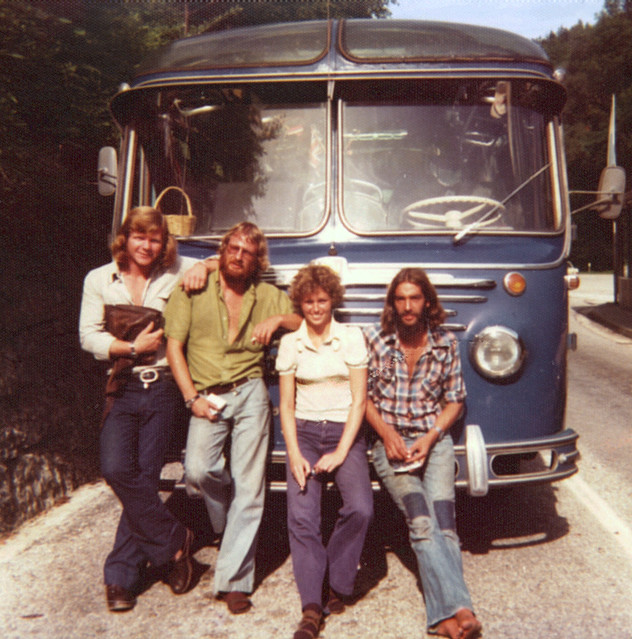
Image result for Magic Bus from athens to london(Travelers with the Magic Bus in 1976, from Flickr)

Initially we sat towards the middle of the bus but we had two obnoxious guys behind us who never stopped talking so eventually we able to get seats closer to the front which give us a close view of the most memorable moment of the journey.

It was on the highway in France, somewhere between Lyon and Paris.  There were two drivers on the bus, both Greek, who switched on and off every few hours - did I mention they always switched while the bus was moving to save time?  A loud argument erupted - what it was about we didn't know since it was all in Greek.  Both drivers were shouting and finally the one driving stood up to argue with the other - there was no one at the wheel as we careened down the highway!  The passengers all started yelling and finally the driver returned to his seat so we survived to write this in 2017.

Friday, November 22, 2013

Theatre of Dionysos

At Thorikos, near Athens.  Built in late 6th/early 5th century BC.  From Archaic Wonder

The Oldest Ancient Greek Theater: The Theater of Dionysos at Thorikos
Thorikos was an ancient fortified city in the Laurion mining district of Attica and was one of the original 12 Attic deme (burgs or subdivisions of Athens) that were according to legend, unified by Theseus, the mythical founder-king of Athens.
During the later part of the Peloponnesian War, by 412 BC, the town had become fully fortified by a wall and at least 7 gateways to protect the valuable Laurion mining district and the coastal sea lanes.
Mining in Thorikos dates back to around 3000 BC. After the exhaustion of the mines of  Laurion and the destruction of Thorikos by the Roman general Sulla in 86 BC, the area was abandoned temporarily. It was reinhabited during the Roman period until the 6th century AD, when the countryside of Attica was deserted due to the Slavic invasions.
The site of Thorikos had been inhabited since the Neolithic period (c. 4500 BC). Prehistoric and Mycenaean settlements existed on Velatouri Hill where the acropolis is now. Tombs of the Late Bronze Age and Early Iron Age are found on the lower slopes of the hill, beneath the Classical levels.
The theater was constructed between 525-480 BC and sits below the acropolis, on the south slope of Velatouri Hill. It is unique due to its shape which comprises an elongated layout with an oval orchestra and is the earliest theater ever found in Greece.