THC feels like something relaxing right now. The Mist Covered Mountains, composed by Mark Knopfler for the soundtrack to the movie Local Hero.
Saturday, March 31, 2018

Friday, March 30, 2018
The Orlando Acquittal
Omar Mateen’s wife, Noor Salman, was acquitted by
a Florida jury of charges of aiding in her husband’s plans for the attack which resulted in the
murder of 49 people at the Pulse nightclub in Orlando (a subject THC covered in prior posts). The charges were
filed by federal prosecutors.
Three startling items of note came out during the trial:
First, according to the prosecutor, the planned target off Mateen’s killing spree was the shopping and entertainment complex at Disney World, not the Pulse nightclub.
Second, the government stated prior to trial, including to the media, that Noor had accompanied her husband in "casing" locations, including the nightclub, before the shooting, a claim used to deny her bail. However, at the trial it was revealed that the Justice Department and FBI lied:
From January 1, 2013 to September 3, 2013 Robert Mueller was Director of the FBI. On September 4 he was succeeded by James Comey. Maybe someone can ask them about it.
Three startling items of note came out during the trial:
First, according to the prosecutor, the planned target off Mateen’s killing spree was the shopping and entertainment complex at Disney World, not the Pulse nightclub.
[The prosecutor] Sweeney showed a video of the Disney Springs complex that captured Mateen walking near the House of Blues club in the hours before the Pulse attack. In it, he looks behind him at police officers standing nearby.
“He had to choose a new target,” she said.In other words, contrary to the media and Obama Administration spin at the time this was not a deliberate attack on the gay community and other evidence at the trial indicated Mateen had no idea Puse was a gay nightclub.
Second, the government stated prior to trial, including to the media, that Noor had accompanied her husband in "casing" locations, including the nightclub, before the shooting, a claim used to deny her bail. However, at the trial it was revealed that the Justice Department and FBI lied:
But when Fennern testified today, he admitted that the FBI had learned “within days” of Salman signing the statement that this claim was false. Using geolocation data from cellphone records and documentary evidence of the couple’s whereabouts, the FBI had already concluded — long before Salman was arrested — that it was impossible that she went to Pulse with Mateen on that date. Indeed, the evidence, as The Intercept documented previously, is very clear that the first time Mateen ever went to Pulse was to attack it, after simply searching Google for “nightclubs downtown Orlando.” The FBI agent also testified that Salman’s cellphone records show she was never near Pulse.Third, during the course of the trial, the Justice Department disclosed that at times between 2005 and the murders in 2016 Omar Mateen’s father was an FBI informant. Attorneys for Noor Salman alleged that although FBI interviewed Omar Mateen in 2013 because of allegations regarding him, the agency declined to take action in order to protect his father’s status as an informant.
Upon hearing Fennern’s testimony that this crucial part of Salman’s statement could not have been true, and that the FBI knew this very early on, the judge began questioning him in front of the jury about the FBI’s discovery that this claim was false. After taking a break, but prior to the return of the jury, the judge more aggressively scolded the prosecutors: “I’ve heard many, many times the drive around Pulse nightclub had occurred.” “I think I’ve kicked the beehive,” he added. Though the judge said, in response to a request from Salman’s lawyers, that he was not prepared to reverse his ruling denying bail in court, he invited them to file a written motion to seek a reversal.
From January 1, 2013 to September 3, 2013 Robert Mueller was Director of the FBI. On September 4 he was succeeded by James Comey. Maybe someone can ask them about it.
Thursday, March 29, 2018
Opening Day
It's the first day of the 2018 baseball season! In honor of this momentous occasion we're getting into the Waybac Machine to take us to 1982 and an interview with Dodgers manager Tommy Lasorda. Tommy has just been asked about Padres player Kurt Bevacqua's insulting comments about the Dodgers manager in the wake of a beanball brawl. Tommy starts off slowly and then gets hilariously profane. [Very serious language warning].
Tuesday, March 27, 2018
Public Enemies
For better or worse, this is how THC's mind works. I happened across a clip from one of the Baby Face Nelson scenes on O Brother, Where Art Thou?, the wonderful Coen brothers movie from 2000, which takes its title from the fictional book that the main character of the 1940s movie, Sullivan's Travels, wants to make into a film showing the suffering of those most affected by the Depression.
That, in turn, made me think of the movie Bonnie & Clyde, and then I got curious about the other colorful outlaws of the 1930s. End result; the rundown you see below. The capture or killing of these criminals is what, along with an astute PR sense, made the FBI and J Edgar Hoover popular icons in America. This summary excludes mobsters like Al Capone, Dutch Schultz, and Legs Diamond, who met their ends in the 30s because the FBI at that time didn't believe the mob existed.
What was surprising to me is that the eight discussed below were taken out of action in a fairly brief period, from September 1933 to May 1936, with six killed within an eight month period in 1934 and 1935. All operated in the heart of America, between the Appalachians and the Rockies. Their memories have been preserved in popular culture with movies (many devoted specifically to their exploits) and songs. Four were officially named as Public Enemy #1 by the FBI (Dillinger, Floyd, Nelson and Karpis).
Machine Gun Kelly

The favorite weapon of George Kelly Barnes (1895-1954) was the Thompson submachine gun, but unlike the rest of the folks on this list, Machine Gun Kelly may never have killed anyone. Kelly was a small time criminal until he met and married Kathryn Thorne after being released from prison in 1928. She convinced him a Tommy gun could become his trademark and she became his virtual publicity agent. They went down for kidnapping Charles Urschel, a wealthy Oklahoma City businessman and holding him for ransom. After his release Urschel provided vital clues to the FBI who eventually tracked Kelly and his wife to a Memphis hotel. Upon breaking into their room on September 26, 1933, Kelly allegedly yelled "Don't shoot, G-Men! Don't shoot, G-Men!", thus providing Hoover's bureau with a catchy nickname. Within three weeks, Kelly and Kathryn were tried, convicted, and sentenced to life imprisonment (justice moved swiftly in those days).
Kelly was a model prisoner at Alcatraz until 1951 when he was transferred to Leavenworth where he died in 1954. Kathryn was released in 1958 and died in the 1980s.
Bonnie & Clyde

Lived fast, died young.
Bonnie Parker (1910-May 23, 1934)
Clyde Barrow (1909 - May 23, 1934)
Both born in Texas, their crime spree covered several states until they were ambushed by law officers led by Texas lawman legend Frank Hamer, who chased them into Louisiana. The FBI was not involved.
Blanche Barrow, Clyde's sister in law, lived until 1988. She didn't like her portrayal in the movie.
John Dillinger
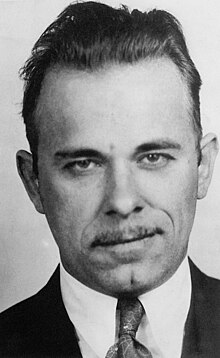 Like the other folks here, Dillinger was in trouble from a young age. Imprisoned for bank robbery in 1924 he was released on May 10, 1933 and quickly made up for lost time, robbing about twenty banks over the next 14 months. Along the way he was captured and escaped from an Indiana jail. Eventually tracked by the FBI to Chicago, he was betrayed by an informant and gunned down on the street by G-Men after leaving the Biograph Theater on July 22, 1934 after watching Manhattan Melodrama starring Clark Gable, Myrna Loy, and William Powell. It was this event, more than any other, that catapulted the FBI to national renown.
Pretty Boy Floyd

Born in Georgia in 1903, Charles Arthur Floyd's family moved to Oklahoma when he was eight. After serving three years in prison during the 20s he vowed to never again spend time in jail. He didn't. Over the next four years Floyd and his gang robbed plenty of banks and may have been involved in a dozen murders, including those of several police officers.
On October 22, 1934 Pretty Boy was shot in a cornfield near East Liverpool, Ohio. Accounts differ on the specifics of the shooting depending upon whether you believe local law enforcement, the FBI, or residents in the area.
Pretty Boy was not as benevolent as Woody Guthrie made him out to be.
Baby Face Nelson
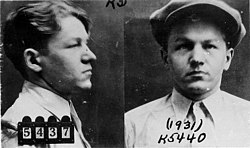
Like Pretty Boy Floyd, Lester Joseph Gillis did not care for his nickname. That's about the only thing the Coen Brothers got right in their portrayal of Nelson in the movie.
At the age of seven, Chicago born Lester "accidentally" shot a playmate in the jaw with a pistol he found. By the late 1920s, Lester, using the alias George Nelson, led a gang specializing in banks along with home invasions of wealthy businessmen. Baby Face was a stone killer, murdering anyone in his way. In one incident, he was driving with a companion in Minneapolis when another driver cut him off. Baby Face followed him, forced the driver out of his car, and shot him. He killed policemen and is responsible for killing more FBI agents (3) than anyone else. He also collaborated with Dillinger in the months before his death.
Baby Face was killed on November 27, 1934 in a bloody shoot out at Barrington, a suburb of Chicago.
Ma Barker

Ma Barker, born Arizona Dollie Clark in Missouri, was 61 years old when she died on January 16, 1935, along with her son Fred, when the FBI and local lawmen shot up the house they were holed up in at Ocklawaha, Florida. Historians still argue over whether Ma was really the criminal mastermind as portrayed by the FBI, of whether she was just along for the ride with her boys and their friends.
Ma had four sons, Herman, Lloyd, Arthur, and Fred. They were all bad guys. Herman, the oldest, served time for a robbery in which he ran over a child with his getaway car. He died in a 1927 robbery in which he killed a police officer and then shot himself when cornered. By the following year Lloyd was imprisoned in Leavenworth, Arthur in Kansas State Prison, and Fred in Oklahoma State Prison.
In 1931, Fred was released and he and Ma joined up with Alvin Karpis to form the Karpis-Barker gang (son Arthur also joined upon his release in 1932), and they all merrily embarked on the usual robbery spree. Things ended when on January 8, 1935 Arthur was captured in Chicago and on him were letters revealing Ma and Fred's location in Florida. Ten days later, federal agents poured hundreds of rounds into the Ocklawaha hideout.
Arthur ended up in Alcatraz where he was killed in a 1939 escape attempt. Released from Leavenworth in 1938, Lloyd was in the army during the Second World War serving as a cook at a prisoner of war camp in Michigan! Lloyd was finally fully rehabilitated in 1949 when he was murdered by his wife. And that's the end of the Barkers.
Alvin "Creepy" Karpis
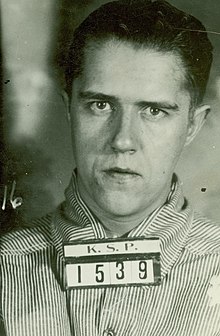 Albin Francis Karpavicius was the last of these miscreants to go down. Raised in Topeka, Kansas, Alvin was a criminal by the age of ten. In 1926, at the age of 19 he was sentenced to the State Reformatory in Kansas from which he escaped. Caught for stealing a car he was sent to the Kansas State Penitentiary where he met Fred Barker. Upon their release they formed the Barker-Karpis gang with many considering Alvin the real brains behind the operation (though we are, of course, speaking relatively when it comes to brains and this gang). With the Barkers, and on his own, he pulled off a string of bank robberies, kidnapping, and even a train robbery, while killing without compunction.
Karpis narrowly escaped the Ocklawaha shoot out having left three days before. He spent the next year on the run before being captured in New Orleans on May 1, 1936. Sentenced to life imprisonment he was sent to Alcatraz where he was held until the prison closed in 1962. He spent more time on The Rock than any other prisoner. After Alcatraz closed he was transferred to Federal prison in Michigan before being paroled in 1969 and deported to Canada (where he was born). Karpis moved to Spain in 1973 and died there in 1979.
That, in turn, made me think of the movie Bonnie & Clyde, and then I got curious about the other colorful outlaws of the 1930s. End result; the rundown you see below. The capture or killing of these criminals is what, along with an astute PR sense, made the FBI and J Edgar Hoover popular icons in America. This summary excludes mobsters like Al Capone, Dutch Schultz, and Legs Diamond, who met their ends in the 30s because the FBI at that time didn't believe the mob existed.
What was surprising to me is that the eight discussed below were taken out of action in a fairly brief period, from September 1933 to May 1936, with six killed within an eight month period in 1934 and 1935. All operated in the heart of America, between the Appalachians and the Rockies. Their memories have been preserved in popular culture with movies (many devoted specifically to their exploits) and songs. Four were officially named as Public Enemy #1 by the FBI (Dillinger, Floyd, Nelson and Karpis).
Machine Gun Kelly
The favorite weapon of George Kelly Barnes (1895-1954) was the Thompson submachine gun, but unlike the rest of the folks on this list, Machine Gun Kelly may never have killed anyone. Kelly was a small time criminal until he met and married Kathryn Thorne after being released from prison in 1928. She convinced him a Tommy gun could become his trademark and she became his virtual publicity agent. They went down for kidnapping Charles Urschel, a wealthy Oklahoma City businessman and holding him for ransom. After his release Urschel provided vital clues to the FBI who eventually tracked Kelly and his wife to a Memphis hotel. Upon breaking into their room on September 26, 1933, Kelly allegedly yelled "Don't shoot, G-Men! Don't shoot, G-Men!", thus providing Hoover's bureau with a catchy nickname. Within three weeks, Kelly and Kathryn were tried, convicted, and sentenced to life imprisonment (justice moved swiftly in those days).
Kelly was a model prisoner at Alcatraz until 1951 when he was transferred to Leavenworth where he died in 1954. Kathryn was released in 1958 and died in the 1980s.
Bonnie & Clyde
Lived fast, died young.
Bonnie Parker (1910-May 23, 1934)
Clyde Barrow (1909 - May 23, 1934)
Both born in Texas, their crime spree covered several states until they were ambushed by law officers led by Texas lawman legend Frank Hamer, who chased them into Louisiana. The FBI was not involved.
Blanche Barrow, Clyde's sister in law, lived until 1988. She didn't like her portrayal in the movie.
John Dillinger
Like the other folks here, Dillinger was in trouble from a young age. Imprisoned for bank robbery in 1924 he was released on May 10, 1933 and quickly made up for lost time, robbing about twenty banks over the next 14 months. Along the way he was captured and escaped from an Indiana jail. Eventually tracked by the FBI to Chicago, he was betrayed by an informant and gunned down on the street by G-Men after leaving the Biograph Theater on July 22, 1934 after watching Manhattan Melodrama starring Clark Gable, Myrna Loy, and William Powell. It was this event, more than any other, that catapulted the FBI to national renown.Pretty Boy Floyd
Pretty Boy Floyd by Woody Guthrie
If you'll gather 'round me, children,
A story I will tell
'Bout Pretty Boy Floyd, an outlaw,
Oklahoma knew him well.
It was in the town of Shawnee,
A Saturday afternoon,
His wife beside him in his wagon
As into town they rode.
There a deputy sheriff approached him
In a manner rather rude,
Vulgar words of anger,
An' his wife she overheard.
Pretty Boy grabbed a log chain,
And the deputy grabbed his gun;
In the fight that followed
He laid that deputy down.
Then he took to the trees and timber
To live a life of shame;
Every crime in Oklahoma
Was added to his name.
But a many a starving farmer
The same old story told
How the outlaw paid their mortgage
And saved their little homes.
Others tell you 'bout a stranger
That come to beg a meal,
Underneath his napkin
Left a thousand dollar bill.
It was in Oklahoma City,
It was on a Christmas Day,
There was a whole car load of groceries
Come with a note to say:
Well you say that I'm an outlaw
You say that I'm a thief.
Here's a Christmas dinner
For the families on relief.Yes, as through this world I've wandered
I've seen lots of funny men;
Some will rob you with a six-gun,
And some with a fountain pen.
And as through your life you travel
Yes, as through your life you roam,
You won't never see an outlaw
Drive a family from their home.
Born in Georgia in 1903, Charles Arthur Floyd's family moved to Oklahoma when he was eight. After serving three years in prison during the 20s he vowed to never again spend time in jail. He didn't. Over the next four years Floyd and his gang robbed plenty of banks and may have been involved in a dozen murders, including those of several police officers.
On October 22, 1934 Pretty Boy was shot in a cornfield near East Liverpool, Ohio. Accounts differ on the specifics of the shooting depending upon whether you believe local law enforcement, the FBI, or residents in the area.
Pretty Boy was not as benevolent as Woody Guthrie made him out to be.
Baby Face Nelson
Like Pretty Boy Floyd, Lester Joseph Gillis did not care for his nickname. That's about the only thing the Coen Brothers got right in their portrayal of Nelson in the movie.
At the age of seven, Chicago born Lester "accidentally" shot a playmate in the jaw with a pistol he found. By the late 1920s, Lester, using the alias George Nelson, led a gang specializing in banks along with home invasions of wealthy businessmen. Baby Face was a stone killer, murdering anyone in his way. In one incident, he was driving with a companion in Minneapolis when another driver cut him off. Baby Face followed him, forced the driver out of his car, and shot him. He killed policemen and is responsible for killing more FBI agents (3) than anyone else. He also collaborated with Dillinger in the months before his death.
Baby Face was killed on November 27, 1934 in a bloody shoot out at Barrington, a suburb of Chicago.
Ma Barker
Ma Barker, born Arizona Dollie Clark in Missouri, was 61 years old when she died on January 16, 1935, along with her son Fred, when the FBI and local lawmen shot up the house they were holed up in at Ocklawaha, Florida. Historians still argue over whether Ma was really the criminal mastermind as portrayed by the FBI, of whether she was just along for the ride with her boys and their friends.
Ma had four sons, Herman, Lloyd, Arthur, and Fred. They were all bad guys. Herman, the oldest, served time for a robbery in which he ran over a child with his getaway car. He died in a 1927 robbery in which he killed a police officer and then shot himself when cornered. By the following year Lloyd was imprisoned in Leavenworth, Arthur in Kansas State Prison, and Fred in Oklahoma State Prison.
In 1931, Fred was released and he and Ma joined up with Alvin Karpis to form the Karpis-Barker gang (son Arthur also joined upon his release in 1932), and they all merrily embarked on the usual robbery spree. Things ended when on January 8, 1935 Arthur was captured in Chicago and on him were letters revealing Ma and Fred's location in Florida. Ten days later, federal agents poured hundreds of rounds into the Ocklawaha hideout.
Arthur ended up in Alcatraz where he was killed in a 1939 escape attempt. Released from Leavenworth in 1938, Lloyd was in the army during the Second World War serving as a cook at a prisoner of war camp in Michigan! Lloyd was finally fully rehabilitated in 1949 when he was murdered by his wife. And that's the end of the Barkers.
Alvin "Creepy" Karpis
Albin Francis Karpavicius was the last of these miscreants to go down. Raised in Topeka, Kansas, Alvin was a criminal by the age of ten. In 1926, at the age of 19 he was sentenced to the State Reformatory in Kansas from which he escaped. Caught for stealing a car he was sent to the Kansas State Penitentiary where he met Fred Barker. Upon their release they formed the Barker-Karpis gang with many considering Alvin the real brains behind the operation (though we are, of course, speaking relatively when it comes to brains and this gang). With the Barkers, and on his own, he pulled off a string of bank robberies, kidnapping, and even a train robbery, while killing without compunction.Karpis narrowly escaped the Ocklawaha shoot out having left three days before. He spent the next year on the run before being captured in New Orleans on May 1, 1936. Sentenced to life imprisonment he was sent to Alcatraz where he was held until the prison closed in 1962. He spent more time on The Rock than any other prisoner. After Alcatraz closed he was transferred to Federal prison in Michigan before being paroled in 1969 and deported to Canada (where he was born). Karpis moved to Spain in 1973 and died there in 1979.
Friday, March 23, 2018
Preferred Nomenclature
Useful advice for those sensitive to today's battles over appropriate language.
Wednesday, March 21, 2018
The Kaiserschlacht
4:40am on March 21, 1918. Fog shrouds the ground in northern France. Soldiers of the British 5th Army are in their trenches, some asleep, some just waking, others on guard duty. Then come the booming noise, as several thousand German guns open up. Over the next five hours, 1.1 million artillery shells are fired at a 50-mile section of the British front.
It would be the second worst day in British military history (the worst July 1, 1916, the first day of the Battle of the Somme). On March 21, 38,000 British soldiers would become casualties, 8,000 of them dead, and the 5th Army dispersed. Over the next five days the stalemate on the Western Front, existing since the fall of 1914, would be shattered.
On March 26 panicked Allies agreed to a unified command under French General Ferdinand Foch, a step resisted as a matter of national pride for the prior three years. By then Germans had captured nearly 1,000 square miles in five days. By comparison, in the 141 days of the Somme the British seized only 125 square miles.
If, on that day, you told the British and French governments and military leaders that less than eight months later Germany would sue for peace, they would have thought you a lunatic.
(From Wikipedia)
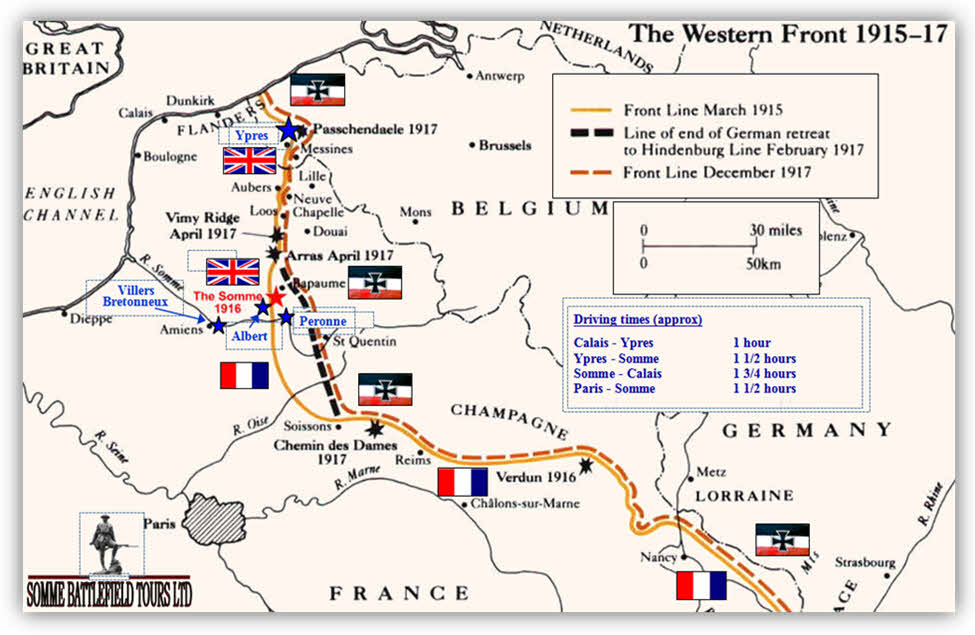
The origins of what the Germans called The Kaiserschlacht (Emperor's Battle) are in the events of 1917. The Russian Revolution erupted in March and the Czar was quickly overthrown. That same month, Germany made the catastrophic decision to start unrestricted submarine warfare which directly led to America entering the war on April 6. Germany made another decision that same month, one with short term benefits and long term disastrous results, when it transported Vladimir Lenin from his exile in Switzerland back to Russia with the hope it would lead Russia to withdraw from the war. For how the events of March and April played out a quarter century later read April 1945: Germany's End.
By the fall of 1917, the Lenin's Bolsheviks had seized power in Russia and were suing for peace with Germany, while the United States was raising a huge army to send to the Western Front.
The mastermind of the German Army was Chief of Staff, Erich Ludendorff, and he saw the necessity of taking a gamble. Germany could not win a war of attrition, and once American troops entered France in large numbers a some point in 1918, the balance of power would swing towards the Allies. However, if peace could be secured with Russia, many German divisions could be moved West and the British and French defeated before the Americans made their presence felt.
In November 1917, Ludendorff proposed a Spring Offensive on the Western Front, a series of blows designed to drive back the British and French and, more importantly, undermine their morale and create an opening for a negotiated peace favorable to Germany.
In preparation more than 500,000 German troops were moved from the Eastern to Western Front, and they would employ a new tactic in their attack; the days of "over the top" in a massed broad-front attack against enemy lines was ended. The German generals had seen the futility of that approach over the past three years of Allied assaults against their lines. Instead an approach, pioneered on the Eastern front in the German attack on Riga would be used.
Stormtrooper assault teams, consisting of experienced soldiers carrying only their weapons, and unencumbered with heavy packs, would penetrate enemy lines on a narrow front and focus on machine gun nests and gun batteries in the front lines. Once these were taken they would penetrate deeper seeking to disrupt communication lines. Other infantry would follow later to mop up isolated enemy infantry units. In a further change of tactics, the opening artillery bombardment would be intense but short, unlike the British bombardment at the start of the Battle of the Somme which lasted for six days.
Though the Allies anticipated a German attack in the spring of 1918 they did not know the specific timing or the location. The Germans selected a 50 mile segment of the British lines, primarily because they thought French troops were of higher quality. Ludendorff's intent was to drive a wedge between the British and French armies and drive the Brits back on the Channel ports. However, he established no specific territorial objectives.
(German troops advancing, Wikipedia)


(British soldiers injured in gas attack)

The initial German attack achieved enormous success with the Kaiser's troops advancing in blitzkrieg style, at least compared to the glacial progress of Allied offensives since 1914. But problems quickly mounted. The stormtrooper advance was so fast it outpaced the German supply effort and since the soldiers carried very little food themselves they often stopped to loot supplies in town they overran. Casualties were also heavy and could not be easily replaced in the chaos of the rapid advance. Ludendorff's failure to name specific geographical objectives led to confusion and hesitation on the front lines and the British were able to defend the key towns of Amiens and Arras.
(From Wikipedia)

German progress was also impeded by the terrain selected for the attack by Ludendorff. The initial German advance was into an area they had abandoned the prior year, in an effort to shorten their front lines and free up troops for use elsewhere. During the withdrawal, Ludendorff ordered a scorched earth policy, with everything of potential use to the enemy destroyed, so that on March 21 the attackers were entering a wasteland. After passing through this devastated area, the Germans would then have to cross the area where the Battle of the Somme took place from July to November of 1916, another scene of desolation.
Ludendorff's grandiose report on the first week of the attack gave false hope to those reading it back in Germany. Excerpts:
Ludendorff renewed his offensive on three more occasions at different points on the Western Front on April 9, May 27 and July 15. Though the Germans had initial gains each time, their advances were ultimately contained by the Allies. American forces saw their first large scale action in the last of these attacks, the Second Battle of the Marne in July. By early August, the Germany Army had suffered nearly 700,000 casualties in the four offensives, while the Americans were flooding to the front. Time had run out for the Kaiser.
The next decisive day was to be August 8.
(From Wikipedia)

It would be the second worst day in British military history (the worst July 1, 1916, the first day of the Battle of the Somme). On March 21, 38,000 British soldiers would become casualties, 8,000 of them dead, and the 5th Army dispersed. Over the next five days the stalemate on the Western Front, existing since the fall of 1914, would be shattered.
On March 26 panicked Allies agreed to a unified command under French General Ferdinand Foch, a step resisted as a matter of national pride for the prior three years. By then Germans had captured nearly 1,000 square miles in five days. By comparison, in the 141 days of the Somme the British seized only 125 square miles.
If, on that day, you told the British and French governments and military leaders that less than eight months later Germany would sue for peace, they would have thought you a lunatic.
(From Wikipedia)
The origins of what the Germans called The Kaiserschlacht (Emperor's Battle) are in the events of 1917. The Russian Revolution erupted in March and the Czar was quickly overthrown. That same month, Germany made the catastrophic decision to start unrestricted submarine warfare which directly led to America entering the war on April 6. Germany made another decision that same month, one with short term benefits and long term disastrous results, when it transported Vladimir Lenin from his exile in Switzerland back to Russia with the hope it would lead Russia to withdraw from the war. For how the events of March and April played out a quarter century later read April 1945: Germany's End.
By the fall of 1917, the Lenin's Bolsheviks had seized power in Russia and were suing for peace with Germany, while the United States was raising a huge army to send to the Western Front.
The mastermind of the German Army was Chief of Staff, Erich Ludendorff, and he saw the necessity of taking a gamble. Germany could not win a war of attrition, and once American troops entered France in large numbers a some point in 1918, the balance of power would swing towards the Allies. However, if peace could be secured with Russia, many German divisions could be moved West and the British and French defeated before the Americans made their presence felt.
In November 1917, Ludendorff proposed a Spring Offensive on the Western Front, a series of blows designed to drive back the British and French and, more importantly, undermine their morale and create an opening for a negotiated peace favorable to Germany.
In preparation more than 500,000 German troops were moved from the Eastern to Western Front, and they would employ a new tactic in their attack; the days of "over the top" in a massed broad-front attack against enemy lines was ended. The German generals had seen the futility of that approach over the past three years of Allied assaults against their lines. Instead an approach, pioneered on the Eastern front in the German attack on Riga would be used.
Stormtrooper assault teams, consisting of experienced soldiers carrying only their weapons, and unencumbered with heavy packs, would penetrate enemy lines on a narrow front and focus on machine gun nests and gun batteries in the front lines. Once these were taken they would penetrate deeper seeking to disrupt communication lines. Other infantry would follow later to mop up isolated enemy infantry units. In a further change of tactics, the opening artillery bombardment would be intense but short, unlike the British bombardment at the start of the Battle of the Somme which lasted for six days.
Though the Allies anticipated a German attack in the spring of 1918 they did not know the specific timing or the location. The Germans selected a 50 mile segment of the British lines, primarily because they thought French troops were of higher quality. Ludendorff's intent was to drive a wedge between the British and French armies and drive the Brits back on the Channel ports. However, he established no specific territorial objectives.
(German troops advancing, Wikipedia)
(British soldiers injured in gas attack)
The initial German attack achieved enormous success with the Kaiser's troops advancing in blitzkrieg style, at least compared to the glacial progress of Allied offensives since 1914. But problems quickly mounted. The stormtrooper advance was so fast it outpaced the German supply effort and since the soldiers carried very little food themselves they often stopped to loot supplies in town they overran. Casualties were also heavy and could not be easily replaced in the chaos of the rapid advance. Ludendorff's failure to name specific geographical objectives led to confusion and hesitation on the front lines and the British were able to defend the key towns of Amiens and Arras.
(From Wikipedia)
German progress was also impeded by the terrain selected for the attack by Ludendorff. The initial German advance was into an area they had abandoned the prior year, in an effort to shorten their front lines and free up troops for use elsewhere. During the withdrawal, Ludendorff ordered a scorched earth policy, with everything of potential use to the enemy destroyed, so that on March 21 the attackers were entering a wasteland. After passing through this devastated area, the Germans would then have to cross the area where the Battle of the Somme took place from July to November of 1916, another scene of desolation.
Ludendorff's grandiose report on the first week of the attack gave false hope to those reading it back in Germany. Excerpts:
The first English position has disappeared, and in its place there extends a wide and desolate crater-field. Everywhere there are the remains of wire entanglements, broken-down shaft entrances, and destroyed block-houses.Despite his report, Ludendorff faced reality and recognized his advance had stalled as British and French reinforcements stabilized the line, calling off the attack on April 6. Nearly 500,000 soldiers were dead, wounded, missing, or captured in those sixteen days, slightly more Allies than Germans.
At most places the battered-in trenches were over-run, and the survivors came rushing towards the Germans minus their weapons and with their hands in the air.
The English trenches were transformed into graves, which were full of dead. Whilst the first lines in places were only thinly occupied, the English offered a brave resistance in their second position, which was broken down in a desperate struggle. The dugouts had to be taken in hard hand-to-hand fighting.
Here the superiority of the German infantry showed itself in the best light. Unexpectedly commenced and extremely effective, German artillery preparation only allowed the counter-effect of the English to be brought into action gradually. The German losses were thus surprisingly light.
The successes achieved in the great victory are such as have not been nearly approached by the Entente since the beginning of the battle of positions in the western theatre.
The English offensive near Arras in April, 1916, was made on a front 12 miles wide; the Anglo-French attack on the Somme in July, 1916, was made on double that width; the French attacked on the Aisne in 1917 on a width of 24 miles. The English big attack, prepared for months in Flanders, never exceeded a space of 18 miles, and the whole of the territorial gains of almost half a year's fighting only amounted to 36 square miles.
In the three days' battle in the west, the Germans made a territorial gain of 700 square miles.
The enemy casualties are unusually heavy. The tremendous booty which fell into our hands from the 21st cannot yet be estimated. More than 45,000 prisoners have been ascertained, many more than 600 guns, thousands of machine guns, tremendous quantities of munitions and implements, great stores of supplies and pieces of clothing.
Ludendorff renewed his offensive on three more occasions at different points on the Western Front on April 9, May 27 and July 15. Though the Germans had initial gains each time, their advances were ultimately contained by the Allies. American forces saw their first large scale action in the last of these attacks, the Second Battle of the Marne in July. By early August, the Germany Army had suffered nearly 700,000 casualties in the four offensives, while the Americans were flooding to the front. Time had run out for the Kaiser.
The next decisive day was to be August 8.
(From Wikipedia)
Subscribe to:
Posts (Atom)