Showing posts with label WWI. Show all posts

Monday, November 18, 2024

Trenches

From our WWI battlefield tour in September.  Three sets of photos of the trenches in which so many soldiers spent months.

The first is at Ypres and are a small section of actual trenches preserved since the war.

The second is a reconstructed section of trench (which includes some materials used during the war) at the WW1 in Ypres.

The third from our visit to the Butte de Vauquois.

Preserved trenches at Ypres


Reconstructed trenches at Ypres


(The ceiling ribs are from actual trenches.  You can see damage from shell fragments.)


Preserved trenches at Butte de Vauquois  


Wednesday, September 25, 2024

Lochnagar Crater

(Two photos below from Wikipedia) 


At 7:28am on July 1, 1916 a titanic explosion occurred near La Boisselle, a village in the Department of the Somme, throwing debris thousands of feet into the air.  Its cause was sixty tons of explosives placed in a mine dug by British engineers, extending 1200 feet, to the German trenches.  It was, to that date, the largest military mine explosion in history.  The resulting crater, now known as the Lochnagar, was 70 feet deep and 330 feet wide.

The power of visiting the site, which we did on our recent trip, was that it brought down to a comprehensible scale, the otherwise overwhelming scale of the Battle of the Somme, which lasted from July 1 to mid-November of 1916.  The site, privately owned and maintained, was purchased and preserved by a Briton in the 1970s, is set up as a memorial, a "hallowed place dedicated to Peace, Remembrance, and Reconciliation".  As you walk around the crater, you read exhibits telling the stories of the British soldiers who died that day, those who survived, and those of comrades who returned frequently over the years to honor their fallen friends.  A cross marks the spot where the body of a British soldier, subsequently identified, was found as recently as 1998.

The British-French offensive on the Somme was designed to end the Western Front stalemate, breaking the German lines.  It was also intended to take pressure off the French Army, desperately defending Verdun against a German attack that began in February and was to continue until December.  The attack was to take place on a 25 mile front, with 19 mines, Lochnagar being the largest, detonated that morning.

The first day proved a fiasco for the British.  The troops, many seeing their first combat, had been told the week long preliminary bombardment would destroy the first and second German trench lines and were instructed, once they went "over the top", to walk slowly following the rolling artillery barrage.  However, much of the German first line and most of its second line survived the bombardment.  On that first day, the British army suffered almost 60,000 casualties, of which 20,000 were killed; the worst toll of any day in British history, and achieved very little.  The division attacking in and around the Lochnagar Crater incurred 6,000 dead, wounded, and missing, the most of any attacking division.  By the time the battle wound down in November more than a million British, French, and German soldiers were dead, wounded or missing.

What happened that morning at Lochnagar? The German first line trenches were completely destroyed.  The British soldiers followed instructions marching towards the crater.  Most of the British were part of the Pals Battalions.  With the destruction of the relatively small professional British Army in the battles of 1914, and the realization that the war would last longer than anticipated, Britain, which did not have conscription until January 1916, embarked on an ambitious recruitment program to build a large army. 

One of the recruitment tools used was the creation of Pals Battalions, for volunteers who enlisted with their friends, neighbors, or co-workers and were promised they could serve together.  For these volunteers, July 1 was to be their first day of combat.

As the British approached the crater and front trenches they found themselves under intense machine gun fire.  While the German first line was destroyed, the second line, on a ridge several hundred yards beyond, was relatively unscathed.  The Germans had an unobstructed view of the British advance and were well equipped with machine guns and ammunition. 

You can see on the photo below, behind the plaque showing the story of a British soldier who perished that day, the ridgeline where the German gunners were located.  Please read the inscription.

The surviving British never made it past the crater and trenches, with many seeking cover within the crater.  One plaque at the Crater told the story of two brothers.  One made it into the crater, but the other lifting his head for a moment at the crater lip, was hit by a machine gun and killed.  His brother, with the help of a fellow soldier, pulled the body into the crater and buried him at the bottom.

On another part of the field, a Pals regiment of 700 men suffered 235 dead and 350 wounded in the first 20 minutes of the battle.  As news of the dead and wounded came back to Britain, the enormous impact of the loss to Pal communities became evident, and the recruiting of Pals units was halted.

Butte de Vauquois and Lochnagar Crater were the most moving and evocative battlefield sites of our trip.  The Crater was saved from being filled in by the purchase of Richard Dunning MBE and the creation of the Locknagar Crater Foundation.

The Pals were not the only units to suffer heavily.  After Lochnagar, we visited the Beaumont-Hamel Newfoundland Regiment Memorial, located a few miles away.  We observed the remains of the trenches from which the Newfoundland Regiment of the Canadian Army went "over the top" on the morning of July 1, and the remnants of their own barbed wire protective barrier through which they were funneled through breaches, our guide pointing out why the sloping terrain left them so vulnerable to enemy fire.  Of 790 in the regiment, 272 were killed and 438 wounded in a short time that morning.  Only 80 remained alive and uninjured.

Sunday, September 22, 2024

Butte De Vauquois

After tours of the Somme and Ypres, the rest of our recent WW1 trip was self-guided.  When planning the trip it proved very difficult to find information in English about touring the entire Western Front.  Information in English focused on the northern end of the front where British and Empire troops fought, while ignoring the French.

At the suggestion of a friend, I tried using ChatGPT for the first time, using inquiries about sites to visit at Verdun, Meuse-Argonne, Belleau Wood, and Chateau Thierry.  It proved very useful in leading me to locations about which I could do more research.  It was through ChatGPT I found the Butte de Vauquois which I'd never heard of.  Thinking it was primarily a hill taken by the Americans at the start of the Meuse-Argonne offensive, we decided to stop there on the way to the American Monument at Montfaucon and the Meuse-Argonne American cemetery.  It proved to be one of the most unique, memorable, and melancholy stops on our trip.

Butte de Vauquois is a small hill, rising more than 300 feet above the surrounding rural landscape.  In 1914 its flat top contained the village of Vauquois, with a few homes, barns, and a church.  From the top it provides a commanding view for miles of the countryside in all directions.  That view sealed its destruction in the Great War.

The German army seized the hill during its initial advance in September 1914 because of its military importance for observation of French movements.  Later that fall, the French began efforts to recapture the small plateau, by March 1915 controlling the south side of the village.  That remained the front line until September 1918.  The entrenchments of the armies, many of which still exist, were at points only 30 feet apart.  Both armies started tunneling into the hill to provide for supplies, barracks, and shafts for mines to be set off under each other's lines.

More than 15 miles of tunnels were built during the course of the war.  We saw a German trench mortar and the deep shaft in which it had been placed.  With trenches were so close, conventional artillery could not be used because of the risk to their own soldiers, so these high arcing mortars were brought in to bombard the French.  Entrance to one of the tunnels:


The two sides also set off more than 500 mines in the course of the war, creating a huge gulley, a rift line, running the full length of the plateau between what became the final German and French lines.  The largest explosion, in May 1916, killed 108 French soldiers and destroyed the western end of the hill.  The village of Vauquois was completely destroyed, only a few foundation stones of the church remaining.

Photo from French side:


 Photo from German side:


According to the sources I found, about 14,000 soldiers were killed on the hill during the war with the bodies of 8,000 never found. Among those killed was Auguste Chaillou, one of the developers of serum therapy to treat diphtheria.  From 1895 to 1914 Chaillou was chief of anti-rabies services at the Pasteur Institute.  Age 49, Chaillou died on the hill on April 23, 1915, while serving as a medical officer.

This was war on an intimate scale, the sides locked closely together for four years.  Even seeing it in person, it is difficult to envision what it must have been like for the soldiers on both sides, living day after day, month after month, year after year, in such proximity to each other.

When visiting today you park about halfway up the hill and then do the short, but steep, climb up the wide path.  We had the hilltop mostly to ourselves the day we were there, as we walked the trenches and gaped at the results of the mining.  We viewed the entrances to the underground tunnel system but could not enter without being accompanied by guides.

The video below provides further views and explanations and this link takes you online article.

  This video takes you through the underground tunnels.


Friday, September 20, 2024

Left Behind


Recently returned from the tour of WW1 battlefields I mentioned in a recent post.  Above is a photo I took of my friend looking at three unexploded shells along a small road near Ypres.  The pointing arm is that of our guide pointing out that this was still, more than a century later, live ordnance and that one of them was a gas shell.  He'd told us at the beginning of the tour that about 300 million shells(1), from mortar to heavy artillery, were fired in the 100 square miles of the Ypres battlefield between the fall of 1914 and September 1918, of which 20% did not explode, going on to warn us that it was possible we would encounter shells on our tour and that, under no circumstances, were we to touch them, regaling us with stories of the unpleasant results in recent years for folks who tried to remove the nose cones, which are valuable souvenirs.

Farmers and builders still encounter about 250 tons a year of these shells and put them by the side of the road for collection.  It was one of our fellow tourists who noticed these shells by the wayside and our guide quickly pulled over.

Flying in and out of Brussels, we saw, in order, the Somme, Ypres, Verdun, the Meuse Argonne - site of the great American offensive at the end of the war, and ended up at Waterloo, along with visiting the Museum of the Great War in Meaux, near Paris, the closest the Germans came to the city in September 1914, before being repulsed in the First Battle of the Marne.

At the Somme and Ypres we did all day tours with a guide.  At the Somme we were with four Australians, one whose grandfather was shot in the face during the 1918 battle, but survived to return home.  Although I knew Australians fought on the Western Front, I was unaware of the scale of their participation, with 46,000 dying along those lines.  At Ypres we spent the morning with four other Australians and two Brits, the Australians leaving us at lunch.  

The rest of the trip we served as our own guides, visiting museums and the battlefields on our own.  And the military cemeteries.  The endless cemeteries.  There are 410 military cemeteries at the Somme, and more than 250 at Ypres; the Meuse Argonne contains the largest American military cemetery in Europe, the final resting place for more than 14,000 soldiers.  We saw many as we passed by and visited British and Empire, French, German, and American cemeteries.

The scale of all this death and destruction occurring within a relatively contained geographical area is overwhelming.  During the entire American Civil War there were about 200,000 battlefield deaths while about 300,000 American died at on the battlefield or shortly thereafter during WW2.  During the 4 1/2 months of the Somme, 300,000 soldiers perished; during the ten month Battle of Verdun the same year, another 300,000 died.  In four years at Ypres the toll was another 400,000.  Including wounded there were between 2.5 and 3 million casualties at these three locations.

At the British cemeteries you will see many gravestones simply reading A Soldier of the Great War.  The German cemetery at Ypres contains a mass grave with the bones of 25,000 unidentified soldiers.  For many other tens of thousands not enough was ever found to bury.  On a wall at the Australian National Monument at the Somme are the names of 11,000 soldiers never found.  The British monument at the Somme is in memory of more than 70,000 who disappeared in the mud, the rain, and the repeated shelling (60-70% of Western Front casualties were from artillery).  The Menin gate at Ypres lists more than 50,000 soldiers of the British Empire who disappeared defending the city.

The bond between the people of Ypres and Britain remains strong a century later.  The Germans never took the city but it was completely destroyed by the deluge of German shells.  After the war, Ypres was rebuilt as it existed before 1914.  The city is filled with British, Australian and Canadians visitors and they receive a warm welcome.  Our hotel contained a small museum of artifacts recovered from the battlefield.  At 8pm every night since 1929 (except during WW2), a bugle band consisting of local volunteers plays at a ceremony at the Menin Gate.

Below are photos of the Tyne Cot British Cemetery at Passchendaele (Passendale) five miles from the center of Ypres.  From its low ridge, the towers of the Ypres Cathedral could be seen.  In 1917, the British, Australians, and Canadians launched an attack to capture the ridge.  It took 100 days and 75,000 lives to advance less than five miles, with the German suffering similar losses.  The cemetery is placed on top of the ridge at the limit of their advance.  On the photo at bottom, the wind turbines in the distance mark the approximate starting line for the British attack.


(1)  Doing some further research, while I've seen the 300 million figure as well as 1.5 billion for the number of shells fired on the entire Western Front from 1914 to 1918, I have my doubts whether this is accurate.  I've found some smaller figures, as well as amounts of shells produced individually by Britain, France, and Germany.  There is no doubt that staggering amounts of shells were fired, for instance, one million by the Germans on the first day at Verdun on February 21, 1916 and 1.7 million by the British and French on July 1, 1916 at the Somme, but if 300 million were fired at Ypres, that works out to about 210,000 a day, which seems high given weather and campaigning variation, as well as that until mid-1915 all the armies had shortages of shells.  My sense is the number is less but still impressive.

A further note, at Verdun and the Somme, the first day artillery barrage was intended to destroy the enemy lines and allow large advances by the infantry.  In both cases, though much death and destruction was inflicted, the expected advances did not occur, as enough enemy survived to maintain resistance.

Friday, August 9, 2024

It Begins

On this date in 1914, the British light cruiser HMS Birmingham rammed and sunk the U-15, the first German submarine to be lost in World War One.  The armies of the continent were mobilizing, about to plunge Europe into the disaster that set the course for the rest of the century.

Following the assassination of Archduke Franz Ferdinand, heir to the throne of Austria-Hungary (AH), and his wife Sophie, in Sarajevo on June 28, by the teenage Slav nationalist Gavrilo Princip, the Austrians delivered an ultimatum to Serbia on July 23, and then declared war on the Serbs five days later.  Serbia's ally Russia, began mobilizing its military against AH on July 31.  In response, AH's ally Germany, declared war on Russia the following day and then on Belgium and Russia's ally France on August 3.  The following day, the United Kingdom made its declaration against Germany.  Two days later AH went to war against Russia, and Serbia issued its declaration against Germany.

As with the American Civil War, none of the parties, to quote Abraham Lincoln's second inaugural address, "expected for the war the magnitude or the duration", while "Each looked for an easier triumph, and a result less fundamental and astounding".

In preparation for a visit to Western Front battlefields next month, I've been doing some reading.  While some has focused on the military aspects like The First World War by Hew Strachan and The Western Front by Nick Lloyd, I've also been delving into the origins of the war.  A few years ago I read Christopher Clark's The Sleepwalkers: How Europe Went to War in 1914.  Over the last month I read July Crisis by TG Otte and listened to a series on podcasts on The Rest Is History, the outstanding podcast by British historians Tom Holland and Dominic Sandbrook, on the assassination of Franz Ferdinand and the failed diplomatic efforts of the following five weeks that gave the world its war. 

The period from the morning of June 28 to July 31 leaves one with the same feeling as watching a "by the numbers" horror movie where find yourself thinking "don't open that door!", "don't go in that room!!", and "splitting up is a really bad strategy!!!", yet the characters proceed to go ahead, nonetheless.

What is striking is how much the actions of the major actors in those weeks, Austria-Hungary, Russia, and Germany was driven by fear, not expansionism or militarism.  Austria-Hungary saw itself as a weakening power, threatened by the demands of multiple nationalities within the empire, and particularly by its Slav population incited, as they saw it, by the Serbs.  Without action to finally end the Serb threat, the Hapsburg faced a dire future, a view shared by a Germany, increasingly concerned about its main ally's slow decline.  The Russians felt humiliated by recent diplomatic setbacks and worried about the lose of reputation and status if it failed to respond in defense of its ally Serbia.  The Germans feared the rapid growth of the Russian economy and its military strength which might surpass theirs within a decade, as well as the growing strength of France, leading to threats on two fronts.  As for the French, they mostly played an inciting role in this period, encouraging strong action by their Russian ally, while seeing an opportunity to liberate Alsace-Lorraine.

Though AH was seeking to militarily punish Serbia, none of the countries sought a general European war, yet they achieved that result, due to miscalculation, negligence and inattentiveness early in the crisis, and the irresponsibility of diplomats in AH, Russia, Germany, and France, along with the disengagement of Britain for much of July.

The Serbian government did not plan, nor desire the assassination, and made some ineffective efforts to stop the team of assassins once learning something was afoot.  But it was organized by Serbs of the secretive Black Hand organization, led by Dragutin Dimitrijevic, known more widely by his alias of Apis, who was also chief of Serbian Military Intelligence.  Through intermediaries a group of young and reckless Slav idealists, including the Bosnian Serb Princip, were easily manipulated into carrying out the attack on the Archduke.

Franz Ferdinand was selected as a target because as heir to the ailing 83 year old monarch Franz Joseph, he was seen as the leading AH proponent for war against Serbia, and was also advocating for a larger role for Slavs within the empire as a counterbalance to the Hungarians, a policy which, if successful, would undermine Serbian goals of establishing a larger Slav state to be run by Serbs.  On the latter issue, the Serbs made the correct assessment, but on the former, not only was Franz Ferdinand not an advocate of war against Serbia, he was the leading figure opposing a war on that nation.

On the morning of June 28 it took a series of individual decisions by officials and a lack of communication to bring about that moment when, by chance, after the driver took a wrong turn, the car carrying Franz Ferdinand and his wife stopped directly in front of the dejected Princip, who had seen one of his fellow plotters toss a bomb at the car earlier with little impact, and believed their attempt had failed completely.  Princip took advantage, acted quickly, firing two shots, and killing Ferdinand and Sophie.  If any one of those decisions or actions had gone differently Princip would never have had the opportunity.

In the aftermath most AH political and military figures saw an opportunity to attack and dismantle Serbia and designed an ultimatum they knew would be unacceptable to the Serb government.  Heedless of the larger implications of its plans it plunged ahead.  Astonishingly it was not until just before issuing its ultimatum, premised on a fast followup attack on Serbia, that the civilian government was informed by its military that it would not be prepared to attack until mid-August!  Nor did anyone give any much thought to what would happen if Russia intervened.  To the extent Russia was considered the Austrians figured that since they had been diplomatically humiliated when AH annexed Bosnia-Herzegovina in 1908 and in Balkan War maneuvering it would react the same in 1914.  But Russia, looking at those same two events when it backed down, was determined not have it happen again.

While efforts were made in Germany, Russia, and near the end of July by Britain, to prevent a wider war, they proved at cross-purposes and ineffectual.  Perhaps if Europe still had statesman with the skill and vision of Metternich, Bismarck, and Disraeli, there would have been a faster and more effective attempt to find a solution short of war but statesmen were in short supply in July 1914.

What followed cost more than ten million lives, ended the monarchies in Russia, AH, Germany,  completed the dissolution of the Ottoman Empire, gave birth to fascism and communism, and planted the seeds for the next European war.  

Austria-Hungary, the country most responsible for the war, proved inept militarily, setting the stage for its self-destruction.  In a giant humiliation for the empire, its first three attempted invasions of the small nation of Serbia were easily repulsed.  It was only with the help of Bulgaria and Germany that it finally succeeded in late 1915.  Indeed, Austria's only military successes in the war occurred with German help and under its direction; the offensive against Russia in 1915, the attack on Romania in 1916, and the offensive against Italy in 1917.

As for Serbia, whose unstable and faction ridden political scene lit the fire leading to the war, a quarter of its population died.  Though Serbia emerged from the war as the leading power in the new Yugoslavia, it was also unstable and violence prone.  In 1934, the Yugoslav king was murdered by Croatian nationalists.  In World War Two, the Germans occupied Yugoslavia, triggering a partisan war of resistance in which 10% of the population died and a fascist Croatian puppet state killed somewhere between 200,000 and 400,000 Serbs.  After the war, under the rule of the Communist Tito, a unified Yugoslavia existed for four decades, but after his death the nation fell apart, going through a series of bloody civil wars, finally splitting into six different nations.  No one dreams anymore of a greater Slav nation.

Gavrilo Princip was immediately captured after the assassination, admitted his guilt but, at 19, was too young to be executed under the law of Austria-Hungary.  Sentenced to life imprisonment he died from tuberculosis on April 28, 1918, six months before the end of the war.  

In 1917, the Serbian government-in-exile convicted the inveterate plotter Apis in a conspiracy to assassinate Prince Regent Alexander.  Apis, the individual most responsible for the war, was executed in June of that year.


There is a school of history which believes the World War was inevitable, given the military buildup in the early 20th century, and the rivalry of the Great Powers.  I'm not an adherent of that school of thought because I lived through the Cold War.  Growing up in that period, it was difficult to see a peaceful ending, yet the Cold War ended unexpectedly and peacefully.  People and contingency play a large part in how events turn out. 

In the case of pre-war Europe, the great naval buildup by Germany which caused tension with Britain had ceased.  In 1912, France extended its term of military service from two to three years which allowed it to significantly increase its army, leading Germany to divert funds from its navy to army.  The result was an easing of tension between Germany and Britain and the beginnings of productive discussion between the two countries. Sir Edward Grey, Britain's secretary of state, was a firm advocate of better relations and meetings between foreign ministers of the two countries might have occurred later in 1914, if war had not intervened.  Improved relations between the two great powers would have lessened the chances of war.

Without a war, Franz Ferdinand would have become emperor when his uncle died in 1916.  Could he have succeeded in his plan to grant autonomy to a Slav entity within the empire?  If so, could that have eased tensions?

Without a war could Russia, the fastest growing economy in Europe, continue its rapid industrial expansion?  Could it deal with its rising class tensions and could the Romanovs have transformed into a more constitutional monarchy?  Well, perhaps that last one is a bit much as it would have required brains.  Without a war, does Lenin (the horrible, but indispensable man) ever return to Russia?

It was Italy's participation in the war, and the disappointment with its share of the spoils afterwards, that emboldened Mussolini and led to the rise of fascism.  Without a war in 1914, does fascism still emerge?

And then, we have Germany without a losing war.  Enough said.

Monday, July 1, 2024

The Ghosts Of The Riven

On this 108th anniversary of the first day of the Battle of the Somme in which 60,000 soldiers of the British Empire were killed or wounded, this is film restored by Peter Jackson for They Shall Not Grow Old and narrated by Stuart Humphryes of BabelColour with a poem he's written.  This link takes you to the YouTube video, which is age-restricted.

Monday, December 17, 2018

They Shall Not Grow Old

An astonishing achievement by Peter Jackson, director of The Lord of the Rings.  The film is only being shown on two evenings in the U.S., tonight and December 27.  Find a theater showing it near you and go.

Jackson took 100 hours of archival World War One film held by the Imperial War Museum in London and has produced an unforgettable experience.  If you are used to the faded, shaky, and offspeed clips of that war be prepared for something else.  In a remarkable technical accomplishment, Jackson has colorized the footage, synced it to normal speed, been able to recreate dialogue, and given us close ups and pans to humanize the British infantry who are the focus of the film.

The result is a film that uses technical genius to achieve emotional resonance.  It unsparingly shows life (and death) for an infantryman on the Western Front; we see everything.  At times it's hard to watch; it's as if you are in the first 20 minutes of Saving Private Ryan, except with real people, real bullets, and real artillery shells.

There is no narrator or overview.  The only voices are those culled from 600 hours of audio of war veterans recorded in the 1960s and 70s.

And stay through the credits to watch Peter Jackson spend a half hour explaining how the film was put together; a segment as good as the film itself.  It is a personal mission for Jackson, whose grandfather fought on the first day of the Somme, the bloodiest day in British history, was severely wounded several time during the war, became an invalid from his wounds a few years after its end, and died from his injuries at the age of 50. 

Sunday, November 11, 2018

Armistice Day

A century ago today, at 11am, the guns stopped in Europe.  Between nine and ten million soldiers lay dead.  Empires crumbled; Russian, Ottoman, Hapsburg, and German.  Hateful and dangerous ideologies were unleashed; Bolshevik Communism, the Nazi Party founded in 1920, the Fascists beginning their rule of Italy in 1922.  The "War to End War" did not; a worse conflagration started twenty years later leaving perhaps sixty million dead in its wake. 

I've visited many battlefields over the years, Civil and Revolutionary War in the United States, the D-Day beaches and American Cemetery in Normandy; solemn places, reminding us of the sacrifice of those who fought and died, yet fascinating and instructive and, at times, inspirational.  About twenty five years ago, Mrs THC and I were driving from Paris to Alsace.  Just off the payage was Verdun and we decided to make a visit.  The emotions it invoked were very different from those I'd experienced at other battlefields and we ended our visit earlier than planned.

From February through December of 1916 the Battle of Verdun ground on between the French and German armies.  During those months somewhere between 700,000 and 1 million soldiers became casualties with 300,000 killed (about equal to all U.S. combat deaths in the European and Pacific theatres during WWII).  Weeks were spent by fighting for gains measured in hundreds of feet and tens of thousands of dead and wounded.  At its end the front lines were only a few miles from where they'd been at the start.

We saw a landscape still completely pockmarked by shell holes from the battle's devastating artillery barrages the results of which gave birth to landmarks like (in its English translation), the Forest of Dead Men.  A quarter century after our visit the scene looks the same as you can see from this recent picture by Michael St Maur Sheil (for more of his pictures go here).  A century after the battle sixty five square miles around the town are still prohibited for any use due to the density of unexploded munitions.
world war i battlefields 100 years later michael st maur sheil (6)
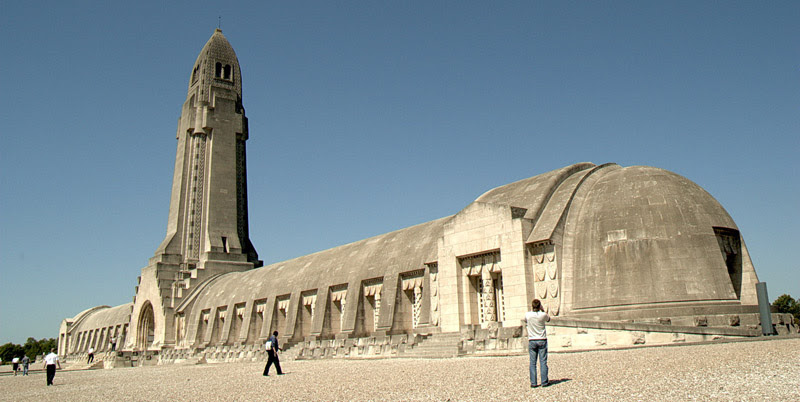
The relentless artillery and machine gun fire pounded the bodies of dead soldiers into unrecognizable fragments embedded in the endless mud that covered the entire battlefield.  After the war the Douamont Ossuary was constructed to house the bones recovered from at least 130,000 unidentified combatants of both sides.

The sense of waste, loss and despair at Verdun is overwhelming and we left there depressed.

The Ossuary
http://joarlarsson.files.wordpress.com/2010/10/17_verdun.jpg


During four years of war more than 800,000 British soldiers would die, including Wilfred Owen,  author of Dolce et Decorum Est.  Volunteering for the army in October 1915, he reached the front lines in France in late 1916 seeing extensive combat and enduring horrific experiences culminating in being blown into the air by an exploding shell.  Diagnosed with shell shock, Wilfred was sent to Craiglockhart Military Hospital in Edinburgh where he was befriended by fellow poet Siegfried Sassoon.  Returning to the front lines in August 1918 Wilfred participated in the final campaigns of the war.  Leading his company in action during October he captured an enemy machine gun which he used to kill several German soldiers, an action for which he was posthumously awarded the Military Cross. He wrote frequently to his mother of his life at war; from a letter of October 8, 1918 (quoted by Ferdinand Mount in his review of an Owen biography in the Wall St Journal, March 29, 2014):


"All one day we could not move from a small trench, though hour by hour the wounded were groaning just outside.  Three stretcher-bearers who got up were hit, one after one.  I had to order no one to show himself after that, but remembering my own duty, and remembering also my forefathers the agile Welshmen of the mountains I scrambled out myself & felt an exhilaration in baffling the Machine Guns by quick bounds from cover to cover.  After the shells we had been through and the gas, bullets were like the gentle rain from heaven."

Wilfred was killed on November 4, 1918 while leading his troops in a crossing of the Sambre Canal in Belgium.  He was 25 years old.  Word of his death reached his parents on November 11 while the bells were ringing, celebrating the Armistice and the end of the war.

Dolce et Decorum Est
Bent double, like old beggars under sacks,
Knock-kneed, coughing like hags, we cursed through sludge,
Till on the haunting flares we turned our backs
And towards our distant rest began to trudge.
Men marched asleep. Many had lost their boots
But limped on, blood-shod. All went lame; all blind;
Drunk with fatigue; deaf even to the hoots
Of disappointed shells that dropped behind.

GAS! Gas! Quick, boys!-- An ecstasy of fumbling,
Fitting the clumsy helmets just in time;
But someone still was yelling out and stumbling
And floundering like a man in fire or lime.--
Dim, through the misty panes and thick green light
As under a green sea, I saw him drowning.

In all my dreams, before my helpless sight,
He plunges at me, guttering, choking, drowning.

If in some smothering dreams you too could pace
Behind the wagon that we flung him in,
And watch the white eyes writhing in his face,
His hanging face, like a devil's sick of sin;
If you could hear, at every jolt, the blood
Come gargling from the froth-corrupted lungs,
Obscene as cancer, bitter as the cud
Of vile, incurable sores on innocent tongues,--
My friend, you would not tell with such high zest
To children ardent for some desperate glory,
The old Lie: Dulce et decorum est
Pro patria mori.


Wednesday, August 8, 2018

A Black Day For The German Army

After Germany's defeat in World War One, that country's nationalists adamantly maintained that the German Army had not been defeated in the field, and the Empire's devastating loss had been caused by a "stab in the back" from treacherous factions in the homeland, led by communists, socialists, and Jews.  The primary military proponent of the stab in the back was former Army General Erich Ludendorff, considered the brains behind General Hindenburg, the army chief of staff, Germany's most powerful military leader.  It also became a constant theme of the new leader of the National Socialist Party, Adolph Hitler.  The real story was much different.

In March 1918, after transferring hundreds of thousands of troops from the Eastern Front where Russia had withdrawn from the war, Germany launched the first of four massive Western Front offensive designed to defeat Britain and France before fresh American soldiers began flooding into France.  Those assaults resulted in advances, but ultimately failed and, in the process, caused enormous casualties among German troops, and exhausting and damaging the morale of the survivors (for more background read The Kaiserschlacht).

Sensing that the tide had turned, late July saw the Allies agree on launching a series of coordinated offensives designed to decisively evict German armies from France.  The first of these offenses occurred around the city of Amiens beginning on August 8, 1918.  The innovative attack plan, which involved masses of new available tanks and doing away with the normal lengthy pre-attack bombardment met with immediate success, as British, Canadian, and Australian forces gained seven miles in the first day, a shockingly large advance after the stagnant fronts of the prior four years.  It was the beginning of what became known as the Hundred Days Offensive which finally ending the four years of bloodletting.

More alarming to the German command than the ground lost were reports of their troops retreating without making strong resistance, and the taunting of reinforcements as they moved to the front.  Ludendorff referred to it as "the black day for the German army".  It shattered Ludendorff's confidence and from that time he was convinced that Germany could not win the war.

At an Imperial Conference on August 14, Ludendorff for the first time took up the position that victory by arms was impossible, and therefore peace by understanding was necessary.  The military situation worsened over the next six weeks, finally prompting a panicked note from Ludendorff to the military liaison to the government asking to transmit to the Imperial Chancellor his "urgent request that our peace proposals should be issued at once. To-day the troops are holding their own: what may happen to-morrow cannot be foreseen."   This was followed later in the day by a further communication from Ludendorff containing "his urgent request to issue the peace proposal at once, and not to hold it back until the formation of the new Government, which might be delayed."

The civilian government however hesitated to take Ludendorff's advice until, on October 3, General Hindenburg reiterated Ludendorff’s message, stating that “The German army still stands firm and is defending itself against all attacks. The situation, however, is growing more critical daily, and may force the High Command to momentous decisions. In these circumstances it is imperative to stop the fighting in order to spare the German people and their allies unnecessary sacrifices. Every day of delay costs thousands of brave soldiers their lives.”

It was only then that Germany's civilian government stated publicly its willingness to engage in peace negotiations based on President Wilson's Fourteen Points.  It was the military, not civilians, which prompted the actions leading to Germany's agreement to an armistice on November 11, 1918.

Wednesday, March 21, 2018

The Kaiserschlacht

4:40am on March 21, 1918.  Fog shrouds the ground in northern France.  Soldiers of the British 5th Army are in their trenches, some asleep, some just waking, others on guard duty.  Then come the booming noise, as several thousand German guns open up.  Over the next five hours, 1.1 million artillery shells are fired at a 50-mile section of the British front.

It would be the second worst day in British military history (the worst July 1, 1916, the first day of the Battle of the Somme).  On March 21, 38,000 British soldiers would become casualties, 8,000 of them dead, and the 5th Army dispersed.  Over the next five days the stalemate on the Western Front, existing since the fall of 1914, would be shattered.

On March 26 panicked Allies agreed to a unified command under French General Ferdinand Foch, a step resisted as a matter of national pride for the prior three years.  By then Germans had captured nearly 1,000 square miles in five days.  By comparison, in the 141 days of the Somme the British  seized only 125 square miles.

If, on that day, you told the British and French governments and military leaders that less than eight months later Germany would sue for peace, they would have thought you a lunatic.

(From Wikipedia)
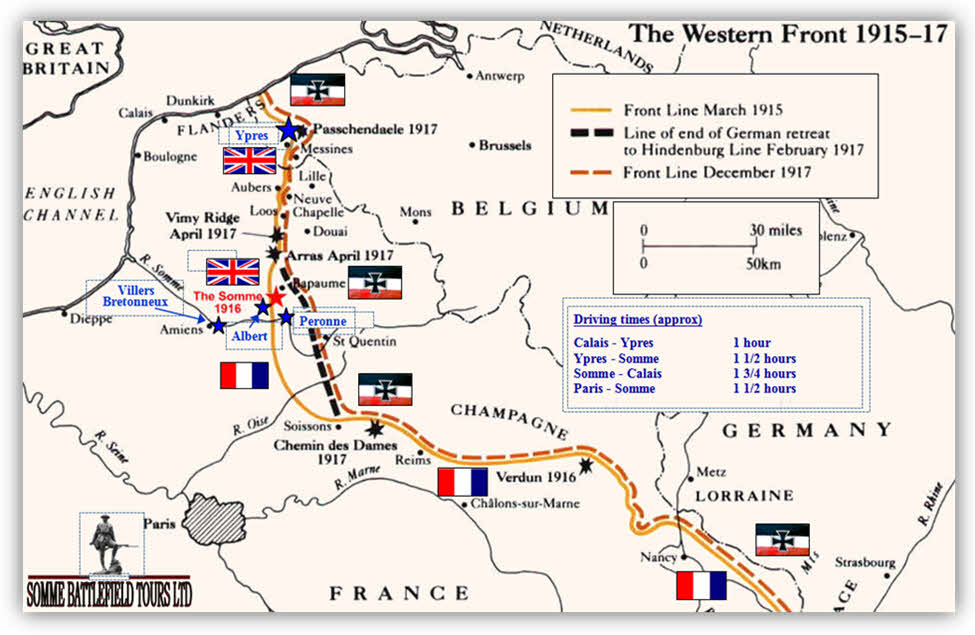
Image result for western front 1917 map
The origins of what the Germans called The Kaiserschlacht (Emperor's Battle) are in the events of 1917.  The Russian Revolution erupted in March and the Czar was quickly overthrown.  That same month, Germany made the catastrophic decision to start unrestricted submarine warfare which directly led to America entering the war on April 6.  Germany made another decision that same month, one with short term benefits and long term disastrous results, when it transported Vladimir Lenin from his exile in Switzerland back to Russia with the hope it would lead Russia to withdraw from the war.  For how the events of March and April played out a quarter century later read April 1945: Germany's End.

By the fall of 1917, the Lenin's Bolsheviks had seized power in Russia and were suing for peace with Germany, while the United States was raising a huge army to send to the Western Front.

The mastermind of the German Army was Chief of Staff, Erich Ludendorff, and he saw the necessity of taking a gamble.  Germany could not win a war of attrition, and once American troops entered France in large numbers a some point in 1918, the balance of power would swing towards the Allies.  However, if peace could be secured with Russia, many German divisions could be moved West and the British and French defeated before the Americans made their presence felt.

In November 1917, Ludendorff proposed a Spring Offensive on the Western Front, a series of blows designed to drive back the British and French and, more importantly, undermine their morale and create an opening for a negotiated peace favorable to Germany.

In preparation more than 500,000 German troops were moved from the Eastern to Western Front, and they would employ a new tactic in their attack; the days of "over the top" in a massed broad-front attack against enemy lines was ended.  The German generals had seen the futility of that approach over the past three years of Allied assaults against their lines.  Instead an approach, pioneered on the Eastern front in the German attack on Riga would be used.

Stormtrooper assault teams, consisting of experienced soldiers carrying only their weapons, and unencumbered with heavy packs, would penetrate enemy lines on a narrow front and focus on machine gun nests and gun batteries in the front lines.  Once these were taken they would penetrate deeper seeking to disrupt communication lines.  Other infantry would follow later to mop up isolated enemy infantry units.  In a further change of tactics, the opening artillery bombardment would be intense but short, unlike the British bombardment at the start of the Battle of the Somme which lasted for six days.

Though the Allies anticipated a German attack in the spring of 1918 they did not know the specific timing or the location.  The Germans selected a 50 mile segment of the British lines, primarily because they thought French troops were of higher quality.  Ludendorff's intent was to drive a wedge between the British and French armies and drive the Brits back on the Channel ports.  However, he established no specific territorial objectives.

(German troops advancing, Wikipedia)
Image result for german spring offensive 1918

(British soldiers injured in gas attack)
Image result for german spring offensive 1918
The initial German attack achieved enormous success with the Kaiser's troops advancing in blitzkrieg style, at least compared to the glacial progress of Allied offensives since 1914.  But problems quickly mounted.  The stormtrooper advance was so fast it outpaced the German supply effort and since the soldiers carried very little food themselves they often stopped to loot supplies in town they overran.  Casualties were also heavy and could not be easily replaced in the chaos of the rapid advance.  Ludendorff's failure to name specific geographical objectives led to confusion and hesitation on the front lines and the British were able to defend the key towns of Amiens and Arras.

(From Wikipedia)
Map of Operation Michael
German progress was also impeded by the terrain selected for the attack by Ludendorff.  The initial German advance was into an area they had abandoned the prior year, in an effort to shorten their front lines and free up troops for use elsewhere.  During the withdrawal, Ludendorff ordered a scorched earth policy, with everything of potential use to the enemy destroyed, so that on March 21 the attackers were entering a wasteland.  After passing through this devastated area, the Germans would then have to cross the area where the Battle of the Somme took place from July to November of 1916, another scene of desolation.

Ludendorff's grandiose report on the first week of the attack gave false hope to those reading it back in Germany.  Excerpts:
The first English position has disappeared, and in its place there extends a wide and desolate crater-field.  Everywhere there are the remains of wire entanglements, broken-down shaft entrances, and destroyed block-houses.

At most places the battered-in trenches were over-run, and the survivors came rushing towards the Germans minus their weapons and with their hands in the air.

The English trenches were transformed into graves, which were full of dead.  Whilst the first lines in places were only thinly occupied, the English offered a brave resistance in their second position, which was broken down in a desperate struggle.  The dugouts had to be taken in hard hand-to-hand fighting.

Here the superiority of the German infantry showed itself in the best light.  Unexpectedly commenced and extremely effective, German artillery preparation only allowed the counter-effect of the English to be brought into action gradually.  The German losses were thus surprisingly light.

The successes achieved in the great victory are such as have not been nearly approached by the Entente since the beginning of the battle of positions in the western theatre.

The English offensive near Arras in April, 1916, was made on a front 12 miles wide; the Anglo-French attack on the Somme in July, 1916, was made on double that width; the French attacked on the Aisne in 1917 on a width of 24 miles.  The English big attack, prepared for months in Flanders, never exceeded a space of 18 miles, and the whole of the territorial gains of almost half a year's fighting only amounted to 36 square miles.

In the three days' battle in the west, the Germans made a territorial gain of 700 square miles.

The enemy casualties are unusually heavy.  The tremendous booty which fell into our hands from the 21st cannot yet be estimated.  More than 45,000 prisoners have been ascertained, many more than 600 guns, thousands of machine guns, tremendous quantities of munitions and implements, great stores of supplies and pieces of clothing.   
Despite his report, Ludendorff faced reality and recognized his advance had stalled as British and French reinforcements stabilized the line, calling off the attack on April 6.  Nearly 500,000 soldiers were dead, wounded, missing, or captured in those sixteen days, slightly more Allies than Germans.

Ludendorff renewed his offensive on three more occasions at different points on the Western Front on April 9, May 27 and July 15.  Though the Germans had initial gains each time, their advances were ultimately contained by the Allies.  American forces saw their first large scale action in the last of these attacks, the Second Battle of the Marne in July.  By early August, the Germany Army had suffered nearly 700,000 casualties in the four offensives, while the Americans were flooding to the front.  Time had run out for the Kaiser.

The next decisive day was to be August 8.

(From Wikipedia)


Sunday, December 17, 2017

Who Wants To Live Forever

When it comes to the genre of Bombastic Rock, Freddie Mercury and Queen remain the champions.  I was reminded of this when I came upon Highlander (1986) on cable and promptly watched it from start to finish.  A wonderfully cheesy 1980s flick starring Christopher Lambert and Sean Connery its theme song, Who Wants To Live Forever, written by the band's guitarist Brian May,  is a perfect match for the tone of the movie.

Extra added bonus watching the film was realizing that its villain, The Kurgan, was played by Clancy Brown, who also portrayed the evil Captain Byron Hadley in The Shawshank Redemption.  Most recently he was Gracchus, George Clooney's Roman centurion sidekick, in the Coen Brothers film, Hail, Caesar!
https://i1.wp.com/www.fortressofsolitude.co.za/wp-content/uploads/2016/06/Clancy-Brown-as-The-Kurgan-in-Highlander.jpg (The Kurgan)https://i.imgur.com/cLGrUjZ.jpg (Hadley)https://blogger.googleusercontent.com/img/b/R29vZ2xl/AVvXsEhFc71ii6dEY5greJ7SgzUBV3skdGQMhjmyCdDwbcp-ubbLzfKHQOR3CcXaGVqdy3ZNQx7kzQXf1AEfi-0wuSvC6NyIW83_9N95mNXYpTR1Shyphenhyphenyw5Z9CMneXLhrILu41647-f_MzH2GxGu-/s1600/Hail+Caesar+%25288%2529.png (Gracchus)

The song's title echoes the words of Marine Corps Sergeant Major Dan Daly, who reputedly shouted at his company, "Come on, you sons of bitches, do you want to live forever?", as he urged them to charge German troops at the Battle of Belleau Wood in 1918.   Daly, who twice turned down promotions to officer, preferring to remain a sergeant, was awarded two Medals of Honor, the first for heroism in connection with the relief expedition sent to Peking to rescue besieged diplomats during the Boxer Rebellion in 1900, and the second for actions in Haiti during 1915.


Monday, December 11, 2017

Allenby Enters Jerusalem

On December 11, 1917, General Edmund Allenby, commander of British forces in the Middle East entered Jerusalem through the Jaffa Gate.  As a sign of respect he dismounted from his horse and walked into the city, as shown below.  It was the emotional and symbolic culmination of a campaign launched from the Suez Canal against the Turks a year earlier.


Jerusalem, part of the Ottoman Empire since 1517, consisted only of the Old City and a few buildings outside the walls.  Since the latter part of the 19th century its population had been majority Jewish for perhaps the first time in over a thousand years.

A few days ago President Trump rightfully extended United States recognition to Jerusalem as the capital of Israel, recognizing the reality of the past seventy years.  Contrary to many predictions, the American announcement has not triggered widespread outrage in the Muslim world.

The context of the President's announcement is better understood in the context of one of the final actions of President Obama's administration.  In a small and spiteful act, President Obama and Secretary of State Kerry maneuvered the passage of United Nations Security Council Resolution 2334, which effectively denied Jewish rights to East Jerusalem, including the walled city, the Jewish Quarter and to Judaism's holiest sites, and allowing the Palestinians in adding yet another set of unreasonable demands to any future peace negotiations. 

In contrast, President Trump formally fulfilled the provisions of a 1995 law, passed by Congress by a 93-5 vote and signed by President Clinton, declaring  “Jerusalem should be recognized as the capital of the State of Israel; and the United States Embassy in Israel should be established in Jerusalem no later than May 31, 1999.”   Since then presidents have signed waivers every six months deferring action on the law.

The United States Senate reaffirmed the law just six months ago by a unanimous vote.  The co-sponsor was New York Democratic Senator Chuck Schumer who, two months ago, attacked President Trump for not keeping his campaign promise to recognize Jerusalem:
 “This year is the fiftieth anniversary of the reunification of Jerusalem, yet with 2018 fast approaching, the U.S. still hasn't moved the embassy or made clear its commitment to Israel's capital…President Trump's recent comments suggest his indecisiveness on the embassy's relocation. As someone who strongly believes that Jerusalem is the undivided capital of Israel, I am calling for the U.S. Embassy in Israel to be relocated to Jerusalem. Moving the embassy as soon as possible would appropriately commemorate the fiftieth anniversary of Jerusalem's reunification and show the world that the U.S. definitively acknowledges Jerusalem as Israel's capital.”
In taking this bipartisan action the President was more circumspect and diplomatic than Senator Schumer.  The Senator supports an undivided Jerusalem, while the President was careful to say that his action involved no predetermination of the ultimate boundary of Israeli sovereignty in Jerusalem.

Monday, November 13, 2017

Contradictions

Last week I attended a talk by Prof Kyle Longley of Arizona State University on the subject of the Versailles Treaty of 1919 and its long term aftermath.  Prof Longley did a nice job in a short time laying out how the Treaty laid the groundwork for WWII and events into the 21st century, with special emphasis on Eastern Europe, the Middle East, China and Indochina.

Prof Longley is well respected in the field and, having checked his background before attending, is of the Progressive persuasion and it was two aspects of Progressive historicity, and the contradictions they present, that unexpectedly struck me during his talk.  The first is the concept of agency, which in the social sciences refers to the capacity of individuals to act independently and to make their own free choices, a concept that becomes particularly tricky in Progressive terms as it can be turned on and off as best aligns with Progressive political theory.  One example is that of African-Americans.  During the recent decades many historians of the Civil War and Reconstruction have rightfully emphasized the agency of slaves and of recently freed slaves.  Prior to this period, slaves had primarily been portrayed as passive recipients of freedom.  Modern historians have emphasized the actions many slaves took to achieve their freedom and fought as soldiers in support of the Federal cause, though like many such revisions some historians have now gone too far in ignoring non-black actions in this regard.  However, at the same time, in a Ta-Naheisi Coates' world of white privilege and Black Lives Matter we are assured by academics that African-Americans in the 21st century have far more circumscribed agency than slaves in the 1860s, a bizarre and ahistorical take on reality.  As an aside, writing this I am reminded Help Me To Find My People, a touching and illuminating book by North Carolina State University history professor Heather Andrea Williams about the search by newly freed slaves trying to locate the wives, husbands, and children from whom they were separated through sale by their masters before the war.

Agency came up in Prof Longley's description of the creation of new states in Eastern Europe and the Middle East though he did not use the term directly.  Longley believes, rightly in many cases, that these new nations had severe problems from the beginning because of how boundaries were drawn, a fault he ascribed to the winning powers, specifically Britain and France.  However, while Britain and France did play their part, they were also besieged by competing delegations from many different nationalities pleading their cases at Versailles.  They were active lobbyists for their conflicting claims, whether Poles, Hungarians, Bulgars, Serbs, Croats, Romanians, Arabs, and a multitude of others.

A specific example comes from the Arab world.  Though the magic words Sykes-Picot often start and end the conversation on post WWI borders in the Middle East, the situation was much more complicated.  While the British and French were trying to use the Arabs, various factions of Arabs were trying to use the British and French in support of their claims against fellow Arabs.  The Hashemites portrayed in Lawrence of Arabia promoted themselves as the leaders of the Arabs, a role much disputed by others.  In fact, after the end of the war they were ejected by the Saudi tribe who rule Arabia to this day, leaving the Hashemites the consolation prizes of Jordan, which they still rule, and Iraq, from which they were deposed in 1958.  There never was any good boundary solution in the post-war Middle East.  The British and French may have made a hash of it, but so have the locals in the decades since.  To pretend the solution was the creation of a new mythical Arab nation in an area which last saw such rule in the 10th century is simply romantic nonsense.

The other concept is multiculturism.  I don't think Prof Longley viewed his presentation as an indictment of multiculturalism, but it certainly was.   In his presentation, Longley repeatedly condemned the Allied leaders and mapmakers at Versailles for jamming together incompatible peoples and cultures in their settlements of both Eastern Europe and the Middle East.  He emphasized how foolish it was to ignore cultural differences in the creation of new states.  Yet Progressives turn around and urge multiculturalism and diversity as their preferred dominant value in Western societies.

Multiculturalism, at least as defined by Progressives over the past few decades, is different from a multi ethnic and multiracial society.  We've built, not without difficulty, a successful multi ethnic and racial society in the United States.  I'm certainly part of that mix and proud to be so.  But the traditional American approach and, indeed, the approach of Progressives until the late 1960s, was an assimilationist and nationalist approach to ethnicity and race (as discussed in a prior THC post) based upon common American values and pride in country.  Modern Progressives view multiculturalism as an end in itself, rejecting assimilation, nationalism and pride in our tradition of liberty and self-reliance.  The modern definition is a recipe for creating a new Yugoslavia; why anyone would have that goal.  We should learn from the truth of Prof Longley's observations; societies consisting of members of different cultures when left to their separate ways and undigested into some level of core common values, are societies based on unresolved tensions and grievances and inherently unstable.  Identity politics as practiced today are a recipe for societal disaster.


Saturday, April 8, 2017

The Sealed Train

https://render.fineartamerica.com/images/rendered/default/canvas-print/10.000/6.875/black/break/images/artworkimages/medium/1/lenin-at-finland-station-granger-canvas-print.jpg(Lenin arrives at the Finland Station)

‘It was with a sense of awe that they turned upon Russia the most grisly of all weapons. They transported Lenin in a sealed truck like a plague bacillus from Switzerland to Russia.’

- Winston Churchill
It is one of those moments on which history turns.  Tens of millions would die as a result in Russia, eastern Europe, China and elsewhere.  Hundreds of millions would be oppressed.  It is ironic that although Marxist theory is predicated on iron rules of history in which individuals are of little import, that development in Russia and for the rest of the world during the 20th century, would have taken a very different direction if the German government had not taken the decision to inject Vladimir Lenin into Russia.  It was one of two catastrophic decisions made by Germany in April 1917 (the other being declaring unrestricted submarine warfare leading to America's declaration of war), the consequences of which led to its defeat in two world wars (see April 1945: Germany's End), and unlike the submarine decision, it was also a disaster for humanity. 

Lenin's return and the Russian provisional government's reaction raises a fundamental question.  Under what circumstances should a democratic government resort to non-democratic means?  Without the presence of Lenin, it is very unlikely the Bolshevik Party would have seized power later in 1917.  As the historian Edward Crankshaw wrote in the October 1954 edition of The Atlantic:
The Bolshevik Party in crisis was nothing but Lenin's will and the men who were prepared to submit to it absolutely. If Lenin had resigned after his return to Russia in 1917 it would have lost its identity, swallowed up by the Mensheviks and the "Compromisers." Lenin would have formed another party, but too late to win for himself the government of Russia; there would have been no Soviet Union. On the other hand, had Lenin given in to the popular demand and allowed his most trusted colleagues to persuade him into compromise, he would have lost his own identity and Bolshevism would have lost its meaning; there would have been no Soviet Union.
Should the Kerensky government have arranged the killing of Lenin (and perhaps of Leon Trotsky), saving millions of lives?  The provisional government knew Lenin was plotting its overthrow, yet shied away from extreme measures.  So much depended on one man and his unshakeable will.

Anxiously watched events in Russia from his decade long Swiss exile during the early months of 1917, Lenin feared his moment might pass.  In February a revolution had overthrown the Czar and a provisional government was in place under Alexander Kerensky.  In today's political taxonomy the new government would be considered of the left, dominated by democratic socialists.  Lenin's party, the Bolsheviks, was explicitly not democratic, but was small, weak and leaderless, a relative nonentity.  Its leader was frustrated, separated from the events he had dreamt of by Russia's enemy Germany, with no way to reach his homeland in the midst of the fourth year of the great European war.

By 1917 each of the countries in the Great War was like a punch drunk boxer.  Exhausted but blindly staggering on, refusing to be knocked out.  With the war in stalemate, Germany was under great pressure.  The military High Command, with the approval of the Kaiser, was willing to role the dice in the case of both America and Russia, in a final attempt to win the war.  They needed Russia out of the war, allowing them to move millions of soldiers to the west to defeat Britain and France. They sensed the war weariness of the Russian people, the revolutionary chaos and the weakness of Kerensky's government.

At Zurich on April 8,  Lenin and his entourage entered the train provided by Germany.  Across Germany, then across the Baltic and through Sweden, entering Russia via Finland, which was then a part of Russia, and arriving at the Finland Station in Petrograd (St Petersburg) on April 16.   Lenin's objective was already set - overthrow of the provisional government and establishment of a Bolshevik dictatorship.   He smashed any thought of compromise within the Bolshevik ranks.  One observer summed up a speech Lenin gave two days after his arrival:
"He swept aside agrarian reforms, along with all the other policies of the Soviet. He demanded that the peasants should themselves organize and seize the land without any governmental interference. We don't need any parliamentary republic. We don't need any bourgeois democracy. We don't need any government except the Soviet of workers', soldiers', and peasants' deputies.'"
He was unswerving.  After a failed coup attempt in July, the Bolsheviks regrouped and succeeded in overthrowing the provisional government in October.  With armed soldiers they forcibly disbanded the first fully elected parliament in Russian history.  They triumphed in the Civil War that followed, with Lenin instituting the Red Terror, mass executions to instill terror in the populace.  As his Justice Minister explained, "Execution of the guilty is not enough, execution of the innocent will impress the masses even more".  As we now know from Solzhenitsyn and others, it was Lenin who created mass terror and the Gulag as Soviet institutions; Stalin merely expanded and perfected his predecessor's work.  Lenin's example was followed by every communist regime of the 20th century and was carefully observed as a model by the growing Nazi Party in Germany.

Would you have ordered a bullet for Lenin?

Friday, November 11, 2016

Remembrance Day

Veterans Day was originally Remembrance or Armistice Day, established by the victor nations in commemoration of the end of World War I on November 11, 1918.  In the early 1950s it was changed to Veterans Day in the United States in honor of the veterans of all wars.

Written by Canadian surgeon John McCrae, who served with his nation's forces on the Western Front, In Flanders Fields was the most popular poem of the war.  McCrae composed it in May 1915 after seeing the death of a friend during the Second Battle of Ypres.   Dr. McCrae continued to tend to wounded and injured soldiers until he died of pneumonia in January 1918.

This recital of the poem was recorded last year by Leonard Cohen, who passed away yesterday at the age of 82.

Friday, June 24, 2016

July 1, 1916

Attack launched north of River Somme this morning at 7:30a.m., in conjunction with French.
British troops have broken into German forward system of defenses on front of 16 miles.
Fighting is continuing.
French attack on our immediate right proceeds equally satisfactorily.
- British Army Communique, July 1, 1916 as quoted in The Great War And Modern Memory by Paul Fussell (1975)

By the end of the day both sides had seen, in a sad scrawl of broken earth and murdered men, the answer to the question.  No road.  No thoroughfare.  Neither race had won, nor could win, the War.  The War had won, and would go on winning.
- Edmund Blunden as quoted in The Great War And Modern Memory
Another grim anniversary this week; a reminder of how Europe spent the first half of the 20th century turning itself into a charnel house.  Also timely, because the creation of the Common Market, later transformed into the European Union, was meant to put an end to such conflicts, though perhaps the long Cold War (1945-91) had as much a role in that success. The young EU, which created a freer flow of goods and people, was successful in its modest goals and means.  But, as often happens, as elites become convinced of their essential goodness and contemptuous and mistrustful of "the people", we saw, beginning in the 1990s, a bigger and bigger grab of power, along with an increasing disregard of the expressed preferences of citizens in its member states.  Adults tend not to like it when you tell them you know how to better make decisions for them than they do for themselves. Ironically, it is this very overreach by the elites that may lead to the failure of its grand project to create a new European, worthy of being governed by Brussels bureaucrats and Davos man.

You may be puzzled by my reference to an anniversary regarding a post entitled "July 1, 1916".  That is the traditional date used to designate the start of the Battle of the Somme.  However, if you were a British artilleryman or a German soldier huddled in a dugout along the trench lines, you'd consider June 24 the start of the battle.  That's when the British (and, to a lesser extent, their French allies) began a 7-day artillery bombardment in preparation for the July 1 attack.  During that period about 1.7 million rounds were fired from over 1,400 field guns and heavy artillery along a 15-mile front.
http://www.longlongtrail.co.uk/PIX/AWM/H08331.jpg(Shell casings, from first day of artillery bombardment, from longlongtrail) 
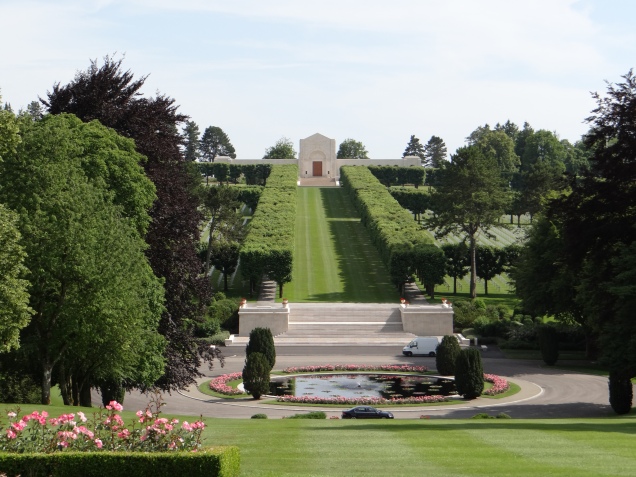
Unfortunately, enough German soldiers survived the shelling so that in the interval between its cessation and the start of the infantry assault, they were able to scramble out of the dugouts and man their deadly machine guns. The result that first day was 60,000 British casualties, including nearly 20,000 dead.  Before the battle wound down to its dreary end in mid-November somewhere between 1.1 and 1.3 million British, French and German soldiers would be killed, wounded or captured, and despite the overly optimistic British communique of the first day, all for the gain of just a few miles by the Allies.

Monday, May 30, 2016

Americans In Europe

For Memorial Day

Last year, Civil War historian Brooks Simpson was in Europe visiting battle sites and American cemeteries containing WWI and WWII dead.  Take a look at his photos and commentary.  A couple of examples:

The Meuse-Argonne Cemetery; 14,246 Americans are buried here.
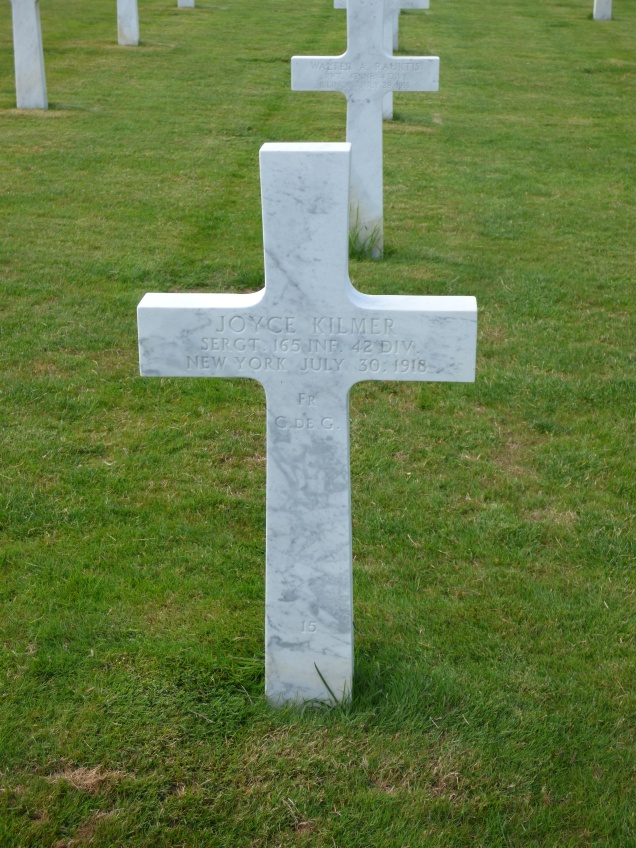
DSC00785  Grave marker of Joyce Kilmer, author of the poem "Trees", killed in action, July 30, 1918.
P1090507