When the eighth Ottoman sultan, Bayezid II, died on May 26, 1512, the Empire he left behind was mostly built on expansion into Europe from the Ottoman heartland in western Asia Minor. The Ottomans crossed the Dardanelles at Gallipoli in 1354 and rapidly began expanding into the Balkans, dominating most of the region by the end of the 14th century. With the capture of Constantinople in 1453, final destruction of the Serbian Kingdom, the new trans-Danubian dependencies in Wallachia and Moldavia, and the submission of the Khanate of the Crimea, its hold was consolidated by the time of Bayezid's death. Although there would be further European expansion (for more on that, read The Stuff That Dreams Are Made Of, and The Song of Jan Sobieski), the greatest future territorial growth of the empire would occur in the Middle East and North Africa.
Two battles, the first occurring 502 years ago on this date in 1514, and the second, five hundred years ago as of tomorrow, marked the great directional change in Ottoman expansionism, and had repercussions for the history of the region that are still felt today.
(Ottoman Empire in 1500, outlined in red, from euroatlas)
Bayezid's successor was his youngest son, Selim, who was in his early 40s in 1512. The events that brought him to the Sultanate were triggered when Bayezid, who had reigned since 1481, announced his oldest son as his heir. Selim revolted upon this news, defeated his father's troops, forcing him to abdicate and go into exile (he died a month later), and then putting his brothers and nephews to death to avoid future threats to his rule. (Selim I)
Selim faced two external challenges upon ascending the throne. The first, a longstanding rivalry with the Mamluk Sultanate which had ruled Egypt since 1250 and also occupied Syria, and the second, the new, and aggressive, Safavid dynasty of Iran/Persia.
The Safavid's were Selim's first priority. The Safavid family were able to seize power in the early 1500s in the midst of the turmoil and fragmentation that followed the slow disintegration of the empire founded by Tamerlane the Great. They quickly defeated rivals and reassembled an empire that covered all of modern Iran, parts of Afghanistan, Turkmenistan, Azerbaijan, Iraq and the eastern part of Turkey. The Safavid's aggressive expansion quickly brought them to the Ottoman borders, and they added a second element to their threat; the Safavid's were Shiite Muslims, while the Ottomans were Sunni. When the Safavids began recruiting soldiers from the Turkish tribes on their border with the Ottomans, and Selim became alarmed that they were trying to provoke a Shiite uprising in the Ottoman lands, he decided on a forceful response. Receiving a religious ruling that Shah Ismail and the Safavids were unbelievers and heretics, he assembled his army and rapidly marched eastwards into the mountainous terrain of Kurdistan.
The Ottomans encountered the Safavid army near the town of Chaldiran (just inside the current border of Iran), and the two armies battled on August 23, 1514. The Ottomans held two advantages; they had perhaps twice as many soldiers as their opponents, and they were better armed, both with firearms and artillery. The result was a rout, and the Ottomans pushed on to temporarily conquer the Safavid capital of Tabriz. Safavid expansion to the west was permanently blocked, and the Ottomans took possession of eastern Anatolia and norther Mesopotamia (Iraq).(Monument commemorating Battle of Chaldiran, from wikipedia)
It was not the end of warfare between the Ottomans and Safavids (their dynasty lasted until 1722). The next hundred years saw frequent and lengthy outbreaks of war. While the Safavids prevailed occasionally, overall the Ottomans were more successful, seizing the rest of Mesopotamia all the way to the Persian Gulf, and holding it until British Commonwealth troops seized it in 1917-18 during World War One.
With the immediate threat from the Safavids checked, Selim turned his attention to the Mamluks. While there had been a war between the regimes in the late 15th century, the Mamluks were not a direct threat to Ottoman rule, although the dynasties vied for control of the spice trade and religious supremacy in the Sunni world.
The Mamluks originated as ethnic Turks and Georgians, brought as slaves to Eqypt to serve its Arab rulers, a process that began in the 9th century. After training and conversion to Sunni Islam, the Mamluks would be freed but were expected to continue to serve their masters, both in administration and in the military. The Ayyubid dynasty of the 12th and 13th centuries made extensive use of Mamluks and they were the backbone of the Sultan Saladin's army which defeated the Christian crusaders and reconquered Jerusalem.
In 1250, a Mamluk uprising was successful and they established their own sultanate, centered in Egypt. The new dynasty consolidated its rule, expanding into Syria and defeating the Mongols, who overran much of the Middle East from 1258 on. During the mid 14th century the original Turkish Mamluk dynasty was overthrown by Circassian Mamluks, from the region of the Caucasus. Relying on their traditional methods of warfare, the Mamluks, unlike the Ottomans, had not adapted the new technologies of firearms and artillery.
In 1516, Mamluk Sultan Al-Ashraf Qansuh al-Ghawri marched north with his army to bring to an end disturbances in the Syrian portion of his empire. He had been lulled by emissaries of Selim that the Ottomans remained focused on the Safavids and thus did not expect a conflict. However, Selim advanced into Mamluk lands and the armies met on August 24, 1516 at Dabiq, a town in modern Syria, just five miles south of its border with Turkey. As at Chaldiran, Ottoman numbers and technology carried the day and the Mamluks were completely defeated and al-Ghawri killed. Not giving the Mamluks time to regroup, Selim advanced rapidly, capturing Damascus, entering Egypt in early 1517, occupying all of the former Mamluk lands, and becoming protector of the holy sites in Medina and Mecca in Arabia. Even with their success, the Ottomans arranged for members of the Mamluks to administer Egypt on their behalf. (Portrait of Sultan al-Ghawri from wikipedia)
The successful campaigns of Selim resulted in all of the Middle East falling to the Ottomans, with Egypt remaining under its control for three centuries and the lands of Syria, Iraq and Arabia for yet another century beyond that, until the end of the Ottoman regime in the aftermath of World War One. The Arab world, which had already seen turmoil and decline in the centuries before the arrival of the Ottomans, became even more of a backwater afterwards, as the Ottomans did themselves by the end of the 17th century. (Empire 1520, from wikimedia)
Selim, who died in 1520, is considered one of the most able Ottoman Sultans. The empire tripled in size during his short reign and he paved the way for his son and successor, Suleiman the Magnificent (1520-66), who expanded the empire further in both Europe, Asia and Africa. (Empire 1566, from wikmedia)
One final, and chilling note, about Dabiq, the town where the Mamluks met their end. Today, it is the place where, in ISIS ideology, the final battle for domination of the world between Christians and Muslims will take place, and their online magazine is called Dabiq.
Two ball players, who've been remarkably hot for long periods this season are Joey Votto of the Cincinnati Reds and Jose Altuve of the Houston Astros. Yes, I've read Bill James and know hot streaks aren't real, but I like pretending.
Votto has always engendered controversy over his refusal to swing at pitches outside the strike zone, regardless of circumstances (seeSkynet Is Activated), but consistently hit for high average, on-base and slugging percentages. (Votto, not swinging, zimbio)
This year he seemed to make the argument moot. Joey was horrible for the first 50 games, hitting only .207 on May 29, with an on base percentage (OBP) of .330, and slugging a miserable .367. This was coupled with an erosion in his control of the strike zone. In his last two full seasons, Joey walked in 20% of his plate appearances (PA) and struck out in 19%. As of May 29, he'd walked in only 14% of his PA and was striking out 27% of the time.
But in the 69 games since then, Votto has played like a alien visitor from another galaxy with superhuman capabilities, hitting .378, with an OPB of .507 (that's Ted Williams, Babe Ruth territory), and slugging .622, raising his season average to .307, and his stats now look like a normal Joey Votto year. During this run, he's been walking in 21% of his PA and striking out in 17%.
(Altuve, from espn grantland)
Jose Altuve, the diminutive second baseman for the 'Stros, has played well since the beginning of the season. On May 27, he was hitting .311, and an OPS of .939, with more power and walks than he'd had in prior years.
And then he got really hot. Over his last 73 games, Altuve's batting .402 (raising his average to .366), with an OPS of 1.042, and propelled himself into the American League MVP discussion.
It'd be fun to see both of them continue at this pace until the end of the season.
I get why someone would not vote for Donald Trump. Heck, I've written about it myselfhere, here, here, and here, among other places. It's why my bumper sticker for this election remains:
But why would anyone vote for Hillary Clinton? Seriously.
Not that the third-party choices are much better. The Libertarian candidate for President is a pothead (I'm not kidding, he really is a stoner), who doesn't think religious liberty is included within the concept of . . . liberty. The Libertarian candidate for Vice-President says he wants more Supreme Court Justices like Stephen Breyer and senators like Susan Collins (R-ME). Now, whatever else you may think of Breyer and Collins, they usually line up on the side of more, not less, government control, so the Libertarian ticket sure doesn't seem libertarian this year. And then you have the Green Party, with its Putin supporting Presidential candidate, and completely loony party platform, which includes a call for the destruction of Israel.
But back to Hillary.
Is it her qualifications or experience?
Her first big public policy job was serving as Healthcare & Insurance Reform czar under her husband. She managed to perform so ineptly that a Democratic-controlled Congress refused to bring her proposal up for a vote, was a major factor in the 1994 loss of Congress to the Republicans (the last time the GOP had controlled the House was in 1954), and ended up with her husband relegating her to making tea and cookies in the White House, and being sent off on ceremonial foreign trips, which, to be fair, gave her the material to write her best-selling book, It Takes A Village To Raise Your Kid, But Keep Your G--d--- Hands Off Mine.
And then she went on to become the junior senator from New York, where she was responsible for such groundbreaking legislation as . . . . ???? Oh, and on the most important issues during her tenure, she supported the invasion of Iraq and opposed the Surge (the latter of which President Obama cited in 2011 as creating a stable and secure Iraq, thus enabling him to withdraw the remaining American military force).
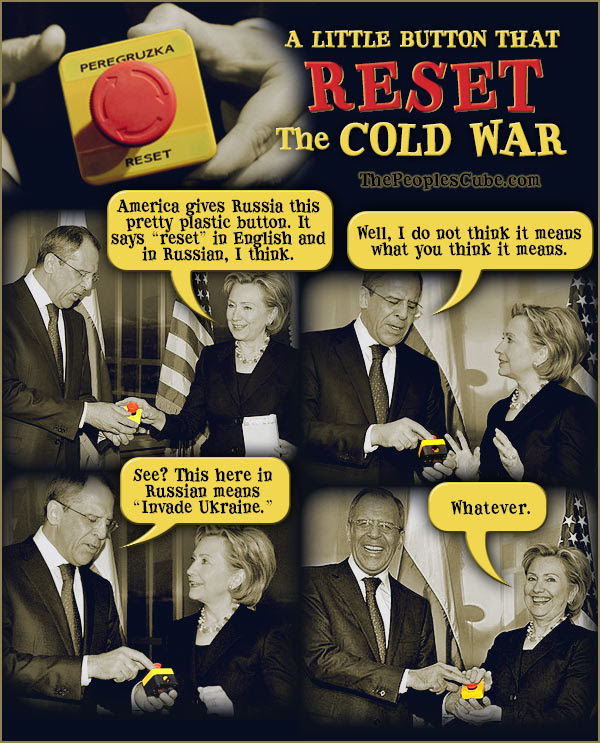
Was it when she was Secretary of State? Let's leave aside the general foreign policy chaos of the Obama Administration and just focus on her two key initiatives. The first was the "reset" with Russia, designed to restore good relations after the supposed mess George Bush made of them (and about which Barack Obama mocked Mitt Romney). How's that gone? (Hillary with Russian Foreign Minister, Sergei Lavrov & the reset button she presented to him) (from drichswier.com)
The second was the overthrow of Muammar Ghaddafi of Libya, for which Hillary was the primary advocate within the administration. The result? Ghaddafi, who had been cowed by Bush's 2003 Iraq invasion, surrendering his nuclear program and no longer supporting terrorism, was deposed and killed and Libya reverted to a state of anarchy, becoming a hotbed for terrorism, as well as leading to the creation of an ISIS mini-state within the country. Gosh, it's almost like we overthrew Ghaddafi without a plan about what to do next.
Hillary has foreign policy experience like Typhoid Mary had nursing experience.
Is it because she would be the first woman President?
She seems like an odd flagbearer for the cause under the circumstances.
Hillary Clinton would never have had the opportunity to run for President if it she had not ridden the coattails of her more personally, and politically, popular husband. Or, as a commenter on the Althouse Blog recently put it, regarding Bill Clinton's convention speech:
Bill Clinton had a very difficult job last night: He was tasked with making it seem like Hillary would have been the nominee even if she wasn't Mrs Bill Clinton, the wife of the former Governor of Arkansas and the former President of the US.
And she is in the position of having to thank Bill for his dalliance with Monica Lewinsky, which removed the stain of her healthcare failure, catapulted her back into the public eye, and allowed her to regain popularity by playing Tammy Wynette, standing by her man.
In the course of that defence, she exposed the rotting underpinnings of feminism, as many defended Bill since they liked his position on abortion, culminating in Gloria Steinem's announcement of the newly discovered "one-grope" rule. In that respect, it was similar to the moment in 2008 when Barack Obama, realizing that his wealthy donors would enable him to swamp John McCain in fundraising, reneged (unlike McCain) on his pledge to rely on public financing for his campaign, thereby confirming that "campaign finance reform" was a tactical political issue for Democrats, not something based on principle. That was the moment it became clear that campaign finance reform is not really a serious issue of principle for Democratic politicians.
But then, all this should not have been a surprise, since Hillary's built a consistent record, going back to her days in Arkansas, of enabling harsh and intimidating attacks on any woman who leveled accusations of sexual misbehavior against her husband, or even, for that matter, claims to have had consensual sex with Bill (also known as "bimbo eruptions", a term coined by her hatchet-woman, Betsey Wright). For a more recent example of Hillary's compromised position on feminism, read Hillary Scrubs Sexual Assault Pledge After Allegations Against Bill Resurface.
Is it because of her positions on the issues?
If you believe in the Progressive, upside-down Constitution, in which all rights belong to the Government, except those it decides to delegate back to the people, you may be a lost cause. But most people don't, so here goes.
Her position and Donald Trump's on what to do about ISIS are the basically the same. Yeah, I was surprised too, but once I looked more carefully through the mishmash of Trump's bad grammar, half-sentences and bombastic speech patterns, it's the same. No troops, bomb 'em a lot, have better intelligence, work with allies, though Donald shouts more when he says it.
As for the rest of her foreign policy, I can't find anything beyond bland platitudes. Can you?
She wants the First Amendment changed so she can restrain your right to free speech
and prevent political opponents from making films critical of her. While most Progressives have tried to skate
around the fact that the Citizens United case was about the government's
attempt to suppress the rights of Americans to voluntarily come
together and make a movie criticizing Hillary Clinton, Hillary has been
open in her outrage that this was allowed to occur.
On immigration, she's for open borders, and placing more downward pressure on lower wage American workers, including recent immigrants, a position particularly harmful for lower income African-Americans. Why would someone want to create downward pressure on wages at the same time as they complain about inequality? Actually, it's not really a mystery. From the political angle, Democrats are gambling they can bring in enough immigrants, naturalize them fast enough, make them dependent on the government and gain their votes to ensure a permanent Democratic majority, all before other lower income Americans realized they've been played. And, by the way, if you parse through Donald Trump's word salad, you will realize he consistently promises the largest amnesty in American history.
And when it comes to illegal immigrants, if you are yearning for a return to the 1830s philosophy ofJohn C Calhoun, you can join Hillary in supporting the nullification of federal law by sanctuary cities, where violent illegal immigrants are shielded from deportation. If you do, make sure to petition Yale University toallow Calhoun's name to remainon a building there.
On economic policy, she favors pursuing ever more strongly the policies that gave us the city of Detroit or, for that matter, my state of Connecticut, with its massive unfunded liabilities to state employees, ever higher tax rates, and fleeing businesses and taxpayers. If you read the Democratic Party platform (I actually did), there is not one word about economic growth, it's all about redistribution. They'll manage it as well as they are managing Obamacare. Trust 'em. (Detroit: Coming Everywhere! from bnet)
She's pledged to expand further the use of Executive Power. Some of you children may not remember the old days, way back in 2007, when Progressives said Bush's use of Executive Power was taking us down the road to fascism. I guess this time it's for a good cause; I believe it because President Obama said so.
Do you like choice? Sorry, but if you're a lower income family seeking a better education for your children and would like to have alternatives to what's being served to you by the 1% of the educational establishment, Hillary says, "no soup for you" - you're stuck with whatever her donors from Big Education decide to give you.
Her vision is of an America divided by race, ethnicity and gender (or gender choice, if you prefer), in which all are expected to vote in accordance with their designated categories, rather than as thinking individuals, with jobs and education divided up accordingly. For more on her flawed vision readWhat Would Otter Do?
Ask yourself, if the big cities we've been told are hot beds of racism have been run by Democrats for decades (the last Republican mayor in Chicago was 1932, Milwaukee 1908, Philadelphia 1952, Newark 1907, St Louis 1949, Detroit 1961, and the list goes on), and college campuses, controlled by Progressives for decades, festering pits of racism and sexual assault, doesn't it strike you there is something fundamentally wrong with Hillary's approach?
To solve all this, Hillary's promising a lot of free stuff. Actually, it's not free, since you are going to pay for it (for more about why, read the section below on wealth and inequality).
When Hillary starts talking about pie in the sky and free stuff, just remember that seven years ago, Barack Obama promoted Obamacare with a litany of lies (or "incorrect promises" as the New York Times referred to them, when even that stalwart defender of the President was forced to admit they weren't true):
If you like your doctors you can keep them!
If you like your health care plan you can keep it!
Your family will save $2500 a year!
Don't fall for it again. Once can happen to anyone. Twice, and you're a fool. Don't let them make you a fool.
Is it because of her record of trust and transparency?
Who does Hillary fear most; the American public or our foreign enemies?
When she became Secretary of State, Hillary had a choice; should she keep her email correspondence in compliance with law and regulation, and be willing to risk that, at some future date, some of it might become available to her fellow Americans, or should she try to avoid disclosure to the American public and accept a greater risk that foreign enemies of America could access the information? She chose to avoid disclosure to the American public, and today, most intelligence analysts believe Vladimir Putin has all the emails, including the ones she destroyed in defiance of the rules (some of which, it turned out, contained relevant material, despite her claims). And let's not forget that, as the FBI and Inspector General showed us, everything she told us about this matter since it became public was a deliberate lie. If you believed her, don't you feel used?
Compounding her previous lies, Hillary insisted the FBI found she was being truthful about her earlier statement, a claim the Washington Post awarded "Four Pinocchio's", its top rating for untruthfulness, writing:
"Clinton is cherry-picking statements by Comey to preserve her narrative
about the unusual setup of a private email server. This allows her to
skate past the more disturbing findings of the FBI investigation,"
The risks posed by the compromised security of Clinton's emails aren't just theoretical. One of the namesdiscussed in Hillary's emailswas of an Iranian scientist who had provided information on that country's nuclear program to American intelligence, and was executed upon his return to Iran. On the other hand, we all have to be ready to make sacrifices, and Hillary has always been willing to sacrifice others.
There is no doubt she violated government procedures. I think it also clear it was an indictable offense as I wrote here. But that is was deliberately done to get around the Freedom of Informationn Act, there is no doubt. Read the factual conclusions reached by FBI Director Comey, and the reportof the State Department's Inspector General, the latter summed up by the Washington Post as "concluding that she failed to seek legal approval for her use of a
private email server and that department staff would not have given its
blessing because of the 'security risks in doing so'".
Exit question:
Q. What does her decision on how to handle her emails say about how she views her fellow Americans?
A. She holds us in contempt.
The bigger issue is that Hillary's actions as Secretary of State are consistent with her personal history. Her health reform task force was run in secrecy. She used a veil of secrecy, deception and defamation to cover up that the firing of the White House travel office staff was undertake at her direction and for political reasons. The Rose Law firm billing records mysteriously disappeared for two years. The last time she held a full press conference was in December 2015, which is simply unbelievable in the middle of a Presidential campaign. And, of course, for reasons that remain unclear she spun a web of lies about the motivation for the assault on the American mission in Benghazi, lies not just told to the public, but in her conversations with the family members of the four men who died, who she then went on to publicly disparage and dismisswhen they contradicted her account.
And let me ask you; it's been reported from several sources that more than one US Attorney's office has opened an investigation of the Clinton Foundation. Given the pace at which investigations occur, it is unlikely that any investigations would be completed by January 20, 2017. If Hillary Clinton is elected, she will appoint the Attorney General for whom US Attorneys work. Do you think Hillary will do the right thing, and have a nonpartisan Special Counsel appointed, vested with the full powers of the Attorney General, to oversee the investigations (as George W Bush did in the Valerie Plame case)? Yeah, I thought so. Me too.
Do you really want to know what is going on in your government? Democrats already have an advantage. Most of the bureaucracy is staffed by Democrats, making leaks less likely. The Obama administration has scared those who might leak by launching more prosecutions for leaks than the combined total of every administration in prior American history. Indeed, most of the government's Inspector Generals wrote a letter to Congress in 2014, objecting to the Administration's obstructionist tactics that blocked investigation of wrong-doing in government agencies that might embarrass the President. I'm still waiting for the 27-part series in the New York Times about this unprecedented protest.
If Hillary Clinton is elected you will have the least transparent administration in history. On this point, if no other, Trump has a distinct advantage, for voters. He will be so hated by the permanent government, they will go running to the press on every occasion he does something they have the slightest problem with.
Is it because of her position on wealth and inequality?
Exhibit 1: George Soros, the great speculator, convicted of trading on insider information, the leading funder of Progressive and Leftist causes, who gave Congressional testimony supporting Dodd-Frank because of the need for greater transparency in the financial sector and who, when it passed, promptly took his hedge fund private to avoid public disclosure. His lack of transparency shouldn't come as a surprise, as he runs the ironically named Open Society Foundation, dedicated to promoting his nihilistic philosophy, and possibly the least transparent "public interest" foundation in the Western World.
Exhibit 2: Warren Buffet, a vocal Hillary supporter, and CEO of Berkshire Hathaway, a company designed as a tax dodge, who loves to proclaim that his tax rate is lower than his secretary's and an example of why taxes need to be raised on the rich. In reality, unlike those who work for a salary or hourly wage, Warren can control how he receives his income. He could solve his lament very simply by taking more of his income as salary and less as long-term capital gains. He doesn't.
After making their proclamations about higher taxes and inequality, Soros and Buffet go home and have a good laugh about how they fooled the rubes.
Exhibit 3: Remember the Great Recession of 2008-9 and the bad guys on Wall Street? Dick Fuld, CEO at Lehman Brothers, was a yuuge contributor to the Democratic Party. Jaime Dimon at JP Morgan is a Democrat and his wife a major fundraiser for Hillary. Citigroup operates as a virtual subsidiary of the Democratic Party, the place where Democrats are hired for some nebulous position with a big salary and bonus, allowing them to replenish their wealth, before plunging back into "public service" - see, for instance, Jack Lew (current Treasury Secretary) and Peter Orszag (former OMB Director). Even Lloyd Blankfein, over at Goldman Sachs (you know, the company that likes to frequently pay Hillary $225,000 a pop for her, no doubt, insightful speeches), is a Democrat.
And what about the hedge funds? Hedge funds get favored treatment under the tax code. In 2007, Senators Schumer (D-NY) and Dodd (D-Countrywide Financial), stopped an effort by their fellow Democrats to change this by pointing out the hedge funds were big contributors to the party. And how does that look in 2016? As of now, hedge funds have contributed more than $45 million to Hillary and less than $20,000 to Trump. Maybe that's because Trump is calling for them to be taxed at higher rates.
And what about the Clinton Foundation, a scam designed to rake in millions and provide the Clintons with a wonderful lifestyle (taking in about $500 million since 2010, and spending less than 15% on grants), all because donors can leverage Bill and Hillary's influence, and it's a game others know they need to play because, after all, "she might be President one day, and we can't tick her off"? As somebody recently said on Twitter:
"the difference
between Hillary and normal people is that when she gets an email from a
rich Nigerian proposing a deal, it’s actually from a rich Nigerian,
proposing a deal"
Ask yourself:
Why did Hillary hold a $100,000 a couple fundraising dinner, raising $3 million, on Martha's Vineyard last night?
Why are the states with the greatest income inequality (New York and Connecticut), long-time Democratic strongholds?
Why are 13 of the 15 wealthiest Congressional districts in America represented by Democrats?
Why are the three U.S. counties with the highest median income adjacent to the District of Columbia, and why are seven of the top twelve counties located in the Washington DC metropolitan area?
Why does California, another Progressive stronghold (with a dominance so complete, they were able to change primary election laws so there is no Republican candidate on the ballot for US Senate this November), have the highest poverty rate of any state? I remember when California was called the Golden State; I guess it still is for the Hollywood crowd and the libertine (not libertarian) oligarchs of tech. Under the Obama Administration, it's become hard to tell if Google is a government subsidiary, or if the government is a subsidiary of Google (see, for instance here, or the Administration rewriting the net neutrality rule to meet Google's competitive demands).
Why are the 1%, those who hold wealth and/or power, on Wall St, in the entertainment industry, technology, education, the news media, and the big foundations like Rockefeller and Ford, supporting Hillary? Because they know they'll be just fine. This is about people with protected wealth and entrenched power, planning to take money from you to give to other folks in order to buy their votes.
Bottom line, if you are not super wealthy and not poor, you are being played for a chump by Hillary. After the election, she'll be coming for your money, because with all those promises she's making about free stuff - someone is going to have to pay. It won't be Buffet or Soros.
With the first inning blast in last night's win against the Tigers, David Ortiz has 107 Extra Base Hits (58 2B, 1 3B,
48 HR) in the last 162 games he's started. The only players to have more than 107 XBH hits in a season are Babe Ruth, with 119 in 1921 and Lou Gehrig, with 117 in 1927, both in 154-game seasons.
With this remarkable end of career performance, he's moved from 26th to 12th in career XBH
and has a chance to finish 8th.
With the doubles, he's gone from 27th to 11th on the all-time list.
Driving in 153 runs moves him from 43rd to 22nd on the career list.
I came across this observation from Umberto Eco (author of The Name of the Rose, from whichI've quotedin the past) in an article by Lee Randall, For The Love Of Stuff:
The contents of someone's bookcase are part of his history, like an ancestral portrait.
It resonated with me, particularly as we contemplate moving next year, work on paring down our voluminous possessions, and as I gaze on my library (not to mention the many volumes squirreled away elsewhere in our home).
It sometimes seems silly to be so attached to my stuff, and George Carlin has a very funny routinemocking our attachment to it (your home "is just a pile of stuff with a cover on"), but at an elemental level, Eco's words captures my attitude. Lee Randall goes on to write:
Open my front door and the first thing you notice are books. They
line the walls, hover overhead, and stack up on tables. Each is a chunk
of autobiography, a clue to who I was while reading it, what I found to
love inside its pages and where it sent me next.
She has some feelings about this that don't touch me, "I fear that disposing of my possessions would dissolve me. I’m precariously balanced on an emotional seesaw". I don't fear that at all. But I do like my books, my library, the feelings they evoke and the memories they create.
Hi! If you are stopping by via SABR, I hope you'll take some time and look around. For more baseball history, just hit the tag at the bottom of this post. Or look at the website full version and in the left or right columns you may find some things of interest. Thanks again for stopping by.
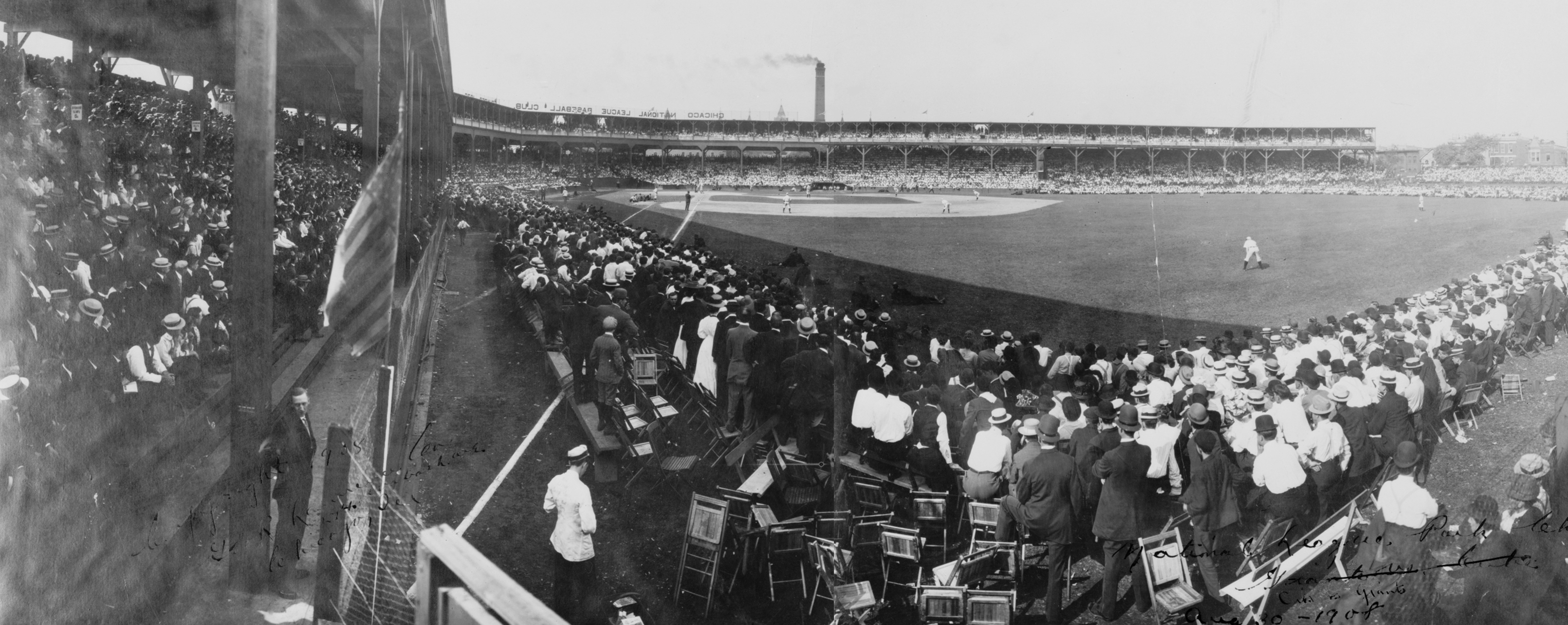
(West Side Park, home of Chicago Cubs, game with NY Giants, August 30, 1908, from chicagology)
On the evening of August 18, 1908, the Pittsburgh Pirates, led by their great shortstop, Honus Wagner, sat atop the National League with a record of 64 win and 40 losses. They finished the season even stronger, winning 34 of their last 50 games, a .680 winning percentage. The Pirates did not win the pennant.
The New York Giants were in second place that night, sitting 2 games behind Pittsburgh. Over the next seven weeks, they'd outdo the Pirates, winning 36 of their last 50, a winning percentage of .720. The Giants also failed to win the pennant.
On that same evening, the Chicago Cubs were in third, 5 1/2 games behind Pittsburgh and only a half game ahead of the Philadelphia Phillies. But the Cubs would win 40 of their last 49 (including 9 of 11 against the Pirates and Giants), scoring 232 runs and yielding only 94, to win the race by one game. Remarkably, it was only the second hottest streak by the Cubs in their historic run from 1906 to 1910, during which they captured four pennants. In 1906, they'd won 37 of 39 games from mid-August to mid-September and ended the season going 48-6 (for more, seeCubs Hot Streak Ends). The 1909 club won 37 of its last 51 contests. Coincidentally, that adds up to 154 games, giving them a 125-29 record over their three season ending streaks.
What a thrilling and nerve wracking time it must have been to be a fan of any of those clubs as they remained so tightly bunched, for so many weeks.
I'd been familiar with the great pennant races of 1908, and its most famous contest, the Merkle game, as well the dramatic replay of that contest on October 8 between the Cubs and Giants to end the season. What I had not been aware of was the torrid collective pace of the three contending clubs over the last seven weeks; 110 wins against only 39 losses! Apart from their 19-19 record against each other (with the one tie that forced the playoff), they went 91-20 against the other five National League teams. (According to Wikipedia, this is a photo of the Merkle game, September 23, 1908, at the Polo Grounds)
It was while rereading The Unforgettable Season, GH Fleming's 1981 chronicle of the National League race of 1908, that I realized what these teams had accomplished. Fleming uses daily newspaper accounts, mostly from New York City papers, to tell the story, and includes a weekly summary of the standing. The book contains no mention of this amazing collective hot streak, and it was only while looking at the weekly standing summary that Fleming includes that I was prompted to look more closely and figure it out.
That remarkable seven week sprint to the finish line breaks down into two parts. The first lasts precisely one month, ending with the games of September 18, which left the Giants with a 4 1/2 game lead over the Cubs, and five up on the Pirates. During those 30 days, the Giant won 25 of 29, the Cubs 26 of 33 and the Pirates went 21-9, a collective record of 72 wins and 20 losses, including winning 59 of 66 games against the rest of the league!
(Cubs vs Pirates, 1908, from terapeak)
Then came a scheduling oddity unlike to happen in today's game. As of September 18, the Cubs and Pirates had played 138 and 139 games respectively, while the Giants had played only 133, so over the last 20 days of the season, the Giants had to play 21 times, while the Cubs and Pirates had only 16 and 15 contests, respectively, giving them more time to rest pitchers and players. The schedule may be reflected in the results, as the Cubs won 14 of their last 16, the Pirates 13 of 15, while the Giants only managed 11 wins in their final 21 contests.
One other aspect jumped out for me when checking the day by day performances in the book, Baseball Reference, and Retrosheet, was the usage pattern of pitchers by the Giants and Cubs, specifically Christy Mathewson, Three Finger Brown and Jack Pfiester (who started both the Merkle game and the replay, as did Mathewson). As best I can tell (unfortunately, box scores for the 1908 season are yet available on Retrosheet) here's the story.
Mathewson went 37-11 that season, appearing in 56 games, starting 49, completing 34, throwing 390.2 innings (a career high), racking up 5 saves, and posting an ERA of 1.43, leading the league in each category.
On August 29, Christy lost 3-2 to the Cubs, with Brown picking up the win. Including that contest, during the 43 games the Giants played over the last 41 days of the season, Mathewson started 13 times and made two relief appearances, accounting for 9 wins (including 3 shutouts), 4 losses, one save and one tie. My estimate is he pitched at least 119 innings. Matty threw twice on three days rest, seven times on two days, three on one day and once on consecutive days. The only time he had four days rest was prior to the final game, against the Cubs on October 8. His average rest during that period was 1.8 days, and he made nine appearance between September 15 and October 3, with no more than two days rest between any of them, an average of 1.44 days.
Chicago ace Three Finger Brown went 29-9 that year, pitching 312 innings, starting only 31 games and relieving on 13 occasions. Including the August 29 matchup against Mathewson, Brown made ten starts through the end of the season, twice on five days between starts, and twice on four (though I can't determine if he made relief appearances), with the Cubs winning 7. When he relieved Jack Pfiester in the first inning of the final game, won by the Cubs 4-2, he was pitching on three days rest. (Cubs vs Giants, October 8, 1908, Polo Grounds, from greatbigcanvas)
Pfiester is a very interesting figure. He went 12-10 in 1908, starting 29 games, only relieving four times and pitching 255 innings. After the Cubs lost two of his starts to the Giants early in the season, they won three times against the Giants in games Jack started against them in August, and he pitched well in the Merkle game, a 1-1 tie. Even with the Cubs in the midst of a pennant race, he didn't start again until the last game two weeks later!
The pitcher who came out of nowhere to really kill the Giants was 22 year-old Harry Coveleski, who started only five games for the Philadelphia Phillies that year. From September 28 though October 3, the Giants and Phillies played eight games in six days. The Giants won five, but Coveleski started the other three (on Sept. 29, Oct. 1 and 3, the first two in the second game of doubleheaders), beating the New Yorkers 7-0, 6-2 and 3-2 .
During the seven weeks, the Pirates were in first place on six days and tied for first on four occasions, the Cubs led on nine days, with five ties and the Giants held first on 27 days with nine ties.
The American League race wasn't too shabby either that year, with a four team race as late as September 25:
Cleveland 83-62
Detroit 81-61
Chicago 81-62
St Louis 79-63
Although the Browns faded quickly, the other three battled it out till the final day. In a mini-version of the long National League collective hot streak by the top three teams, the Naps - named after Cleveland star second baseman and manager, Napoleon Lajoie - (9-2), Tigers (7-2) and White Sox (7-2) went 23-6 over the next two weeks, winning 19 of 21 against the other five teams.
The Tigers finished only a half-game ahead of the White Sox and 1 1/2 games up on the Naps, winning their second consecutive pennant with young Ty Cobb (for more on him, see my review of Ty Cobb: A Terrible Beauty). In another oddity of the 1908 season, only the White Sox played 154 games to a decision. Detroit had only 153 and the Naps 152. If they'd had to each play 154 games, a three way tie might have occurred.
The highlight of the two weeks was the extraordinary pitching duel in Cleveland on October 2, in which the Naps bested the White Sox by a score of 1-0. Played in front of 10,598 fans in Cleveland, the game took between 1:29 and 1:40 to play, depending on which account you read.
Pitching that day for the Sox was Big Ed Walsh, in the midst of a season in which he'd toss 464 innings (on top of 422 in 1907), start 49 games, completing 42, and go 40-15. Walsh was starting on two days rest, having started both ends of a doubleheader won by the Sox on September 29. In turn, he had pitched the doubleheader on only one day's rest. And prior to that, he'd made seven starts between September 11 and 27, throwing 4 times on two days rest and twice with one day of repose.(Addie Joss from pinterest)
On October 2, Ed was superb against the Naps, striking out 15, yielding only 4 hits and walking one. It wasn't good enough, as the masterful Addie Joss, who went 24-11 that year with a league leading 1.16 ERA, threw a perfect game using, according to one report, only 74 pitches to do so (he struck out three and induced 16 ground ball outs).
The only run scored in the third. After Joe Birmingham singled, Walsh tried to pick him off. On the throw, Birmingham took off for second and first baseman Frank Isbell's toss hit the runner, carooming into the outfield with Birmingham ending up on third. He then scored on a wild pitch by Big Ed.
After the game, Joss praised his teammates, saying "the boys played grandly behind me".
In 1909, Big Ed Walsh would reduce his workload and hurl only 230 innings, but from 1910-12 he'd average 377 innings before his arm finally gave out.
Addie Joss became ill during the 1910 season and died in early 1911, at the age of 31. Both Joss and Walsh are in the Hall of Fame, joining Mathewson and Brown.
The Cubs beat the Tigers in five games to win the World Series. It was the last time the Chicago Cubs were the champions of major league baseball.

 (Selim I)
 (Monument commemorating Battle of Chaldiran, from wikipedia)
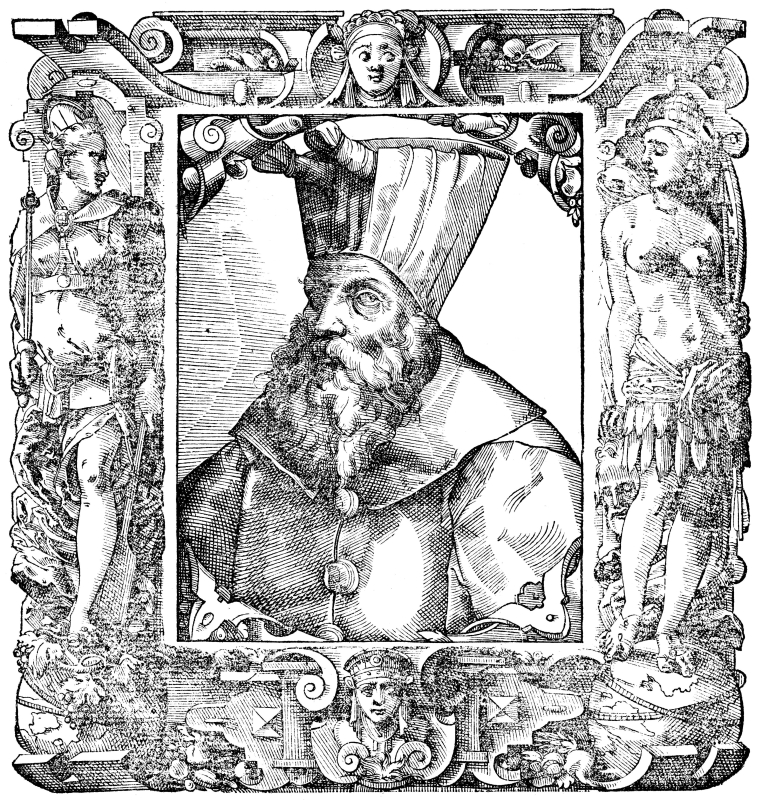 (Portrait of Sultan al-Ghawri from wikipedia)
 (Empire 1520, from wikimedia)
 (Empire 1566, from wikmedia)
 (Votto, not swinging,


 (Hillary with Russian Foreign Minister, Sergei Lavrov & the reset button she presented to him)
 (from
(from (Detroit: Coming Everywhere! from


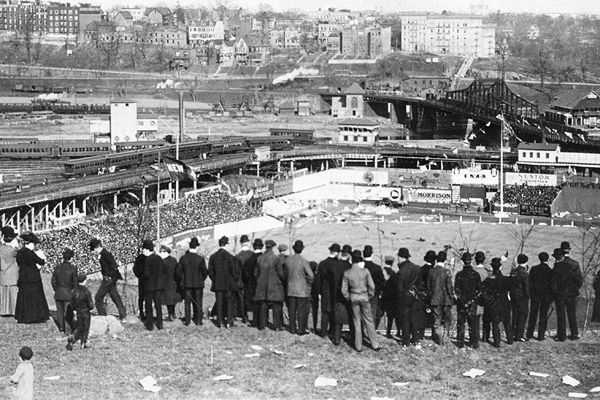 (According to Wikipedia, this is a photo of the Merkle game, September 23, 1908, at the Polo Grounds)
 (Cubs vs Giants, October 8, 1908, Polo Grounds, from
 (Addie Joss from