Saturday, December 31, 2016

Why Canada Is Not Part Of The United States

The two groups trudged through the darkness, under cover of a raging blizzard, footsteps muffled by the gathering snow.  They planned to approach the lower part of the town from opposite sides, meet in the center and then storm the upper town together, surprising the sleeping garrison.

The larger group met resistance in the lower town.  The dynamic and inspirational commander was wounded in the leg and carried off the field, but his subordinate led the remaining men into the upper town, where they then found themselves alone as the enemy troops rallied - where was the other contingent?

The smaller group, led by the overall commander of the little army, had encountered a blockhouse as they entered the lower town.  The outnumbered defenders fired a shot from their lone cannon, before retreating.  It hit the commander in the head, killing him instantly.  His command fell apart, and in the ensuing confusion most of the attackers were captured.  One of the few to escape was a future Vice President of the United States.

Abandoned in the upper town, the other group fought on, until surrounded and without hope of rescue, they surrendered.  It was all over.

It was the early morning hours of December 31, 1775.  The commander of the larger group was Benedict Arnold (see September 1780), his subordinate was Daniel Morgan, who after confinement on a British prison ship would be repatriated and then, five years later, demolish a British force at the pivotal Battle of Cowpens in South Carolina (see October 1780).  The dead commander was Richard Montgomery, and the officer who escaped was Aaron Burr, American's third Vice-President, the killer of Alexander Hamilton, organizer of a murky conspiracy to divide the newborn United States, and the reigning rogue and scoundrel of the early American Republic.

(Montgomery, Arnold, Morgan, Burr)

The invasion of Canada was born out of the early successes of the American rebels.  By the summer of 1775, the Continental Army, under newly appointed General George Washington, besieged the British in Boston.  In New York, Fort Ticonderoga, recently captured in a daring raid led by Ethan Allen and Arnold, protected the Hudson River Valley.  To the north lay Canada, a British bastion and potential launching point for invasion against the rebellious colonies.  The Americans were also aware that most Canadians were French Catholics who only became subjects of the British Protestants in 1763.  Out of these circumstances arose the idea of an American attack on Canada with the expectation that the French settlers would rise in support.

The Americans advanced on two fronts.  About 1,200 men under General Richard Montgomery left Fort Ticonderoga, heading north towards Montreal, which was captured in mid-November, reaching the area around the city of Quebec (capital of British Canada) on December 2.  Upon his arrival, he found Colonel Arnold and 600 ragged soldiers, survivors of one of the epic marches in American history.

Arnold set out on his expedition with 1100 men, and carrying orders from General Washington to allow freedom of conscience for Canadian Catholics;
 "While we are Contending for own own Liberty, we should be very cautious of violating the Rights of Conscience in others; ever considering that God alone is the Judge of the Hearts of Men and to him only in this Case they are answerable", (see All Possess Alike Liberty of Conscience)
His expedition left Fort Western (now Augusta, Maine) on September 25.  One battalion, commanded by Captain Morgan, consisted of his well-trained Pennsylvania and Virginia riflemen.  Little was known of the wild, wooded and wet route to Quebec City from Maine.  Arnold thought it was less than 200 miles; it was actually 350.   For the next 45 days the expedition battled heavy rain, snow, flooding, cold, and starvation.  The survivors reached the St Lawrence River opposite Quebec on November 9.  The American portion of Arnold's route was added to the National Register of Historic Places in 1969, and you can find an excellent fictional retelling of the ordeal in Kenneth Roberts' Arundel (1938).

The combined American force was about 1,200.  The British, well-provisioned inside the fortified city, totalled about 1,500.  The Americans had little artillery, were ill-equipped for the winter, and the enlistments of Arnold's men expired on January 1. Knowing substantial British reinforcements would be arriving in the spring, Montgomery and Arnold decided to risk storming the city.

The snowstorm that started on the night of December 30, 1775 provided perfect cover for the American approach and they moved out around 4am the next morning.  Though the attack went awry, Benedict Arnold refused to raise the siege, maintaining it despite being outnumbered three to one and not leaving the Quebec area until early May of 1776, when reinforcements arrived from Britain.  Montreal was recaptured by the British from the retreating Americans the next month.

With the expedition's failure, America's dream of conquering (or liberating, depending on your perspective), Canada was ended; at least until it was revived, and again left unfulfilled, in the War of 1812.

The British attempted to move south into New York in the late summer and early fall of 1776 to take advantage of the disarray among the Americans.  Their plans were thwarted by Arnold, who oversaw the building from scratch of a fleet of American gunboats to be used on Lake Champlain, which he used to battle the British to a standstill at the Battle of Valcour Island in October 1776, delaying British plans for a further advance until 1777.

The Americans put the year they gained to good use, building a large army in the Albany area, and then defeating and capturing a British army commanded by Johnny Burgoyne.  Once again Benedict Arnold played a key role, rallying the Americans at a critical moment at the Second Battle of Saratoga and, once again, suffering a severe leg wound.  Riflemen commanded by the recently released Daniel Morgan, inflicted large casualties on the British forces in both Saratoga battles. The American victory led directly to the decision of the King of France to enter the war against England in support of the American rebels.

The Canada campaign contained quite a rogue's gallery on the American side.  In addition to Arnold and Burr, there was also James Wilkinson, who joined Arnold as an aide during his retreat from Quebec.  Wilkinson went on to become part of Horatio Gates' efforts to remove George Washington as commander of American forces, and later, as commander of the United States Army in the 1800s, was in cahoots with Burr in his conspiracy, while also serving as a spy for Spain (for more, read The General Was A Spy)!

Wednesday, December 28, 2016

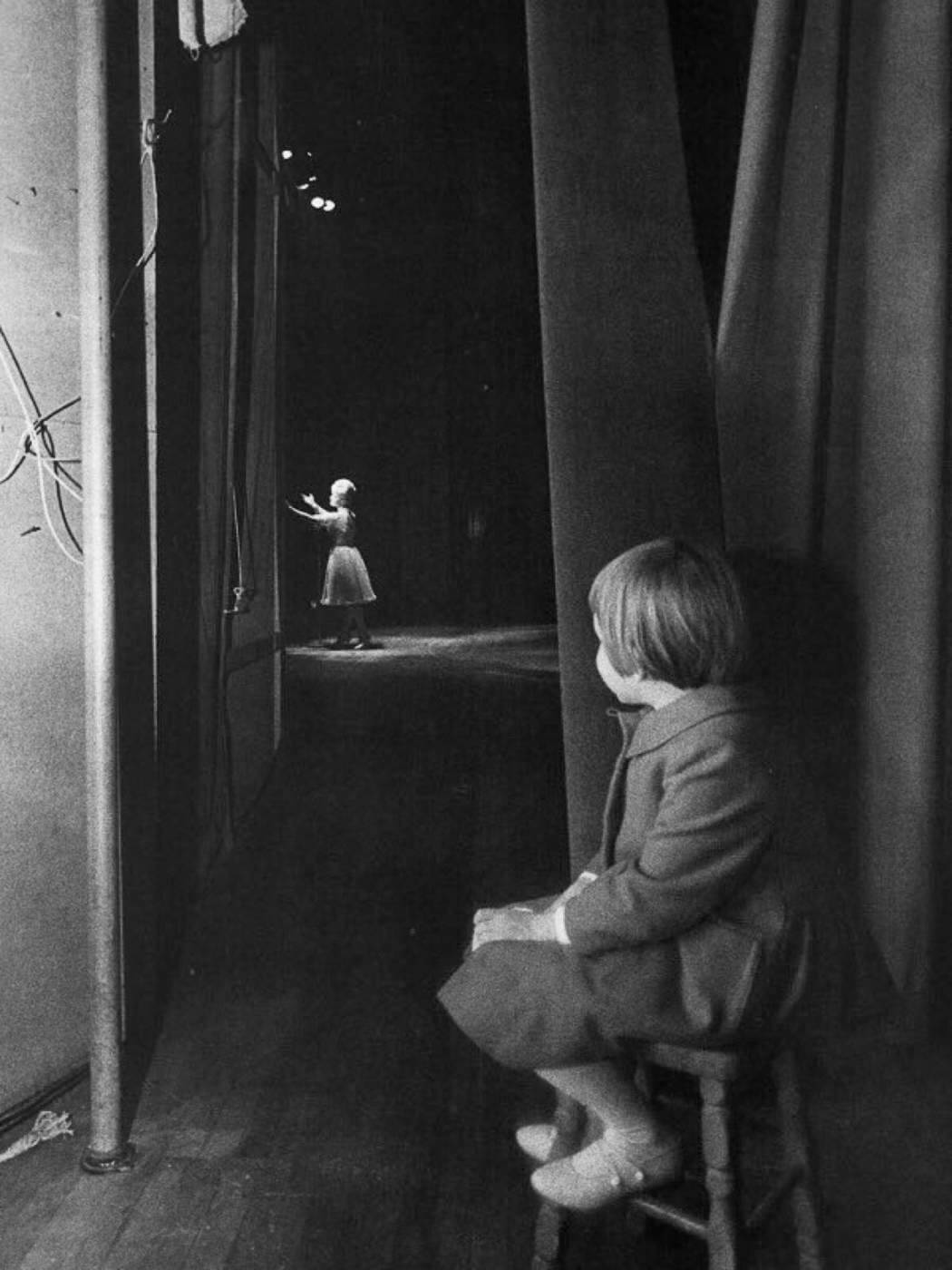
Mother & Daughter

Carrie Fisher watching her mom, Debbie Reynolds, performing in Las Vegas, 1963.

Monday, December 26, 2016

A Different Kind Of Christmas

On Christmas Day in 438 the Praetorian Prefect of Italy, Glabrio Faustus, hosted a gathering at his luxurious home in Rome.  Assembled were the members of the Roman Senate, there for the presentation of the new compilation of Roman Law, the Theodosian Code, so-named after the Eastern Roman Emperor Theodosius (408-50), at whose direction the new code was compiled.
http://pictures.abebooks.com/LAWBOOKEXC/13174843650.jpg(from Abe Books)

It was a well-rehearsed ceremony in which the attendees enthusiastically, and repetitively, endorsed the code.  Some of exhortations were the usual flattery of the Emperor:
"As Roman Emperors [Theodosius in the East, Valentinian in the West], pious and felicitous, may You rule for may years!" (repeated 22 times)    
But many others illustrate that bureaucracy has been around forever:.
"We give thanks for this regulation of Yours!" (repeated 23 times)
"Let many copies of the Code be made to be kept in the governmental offices!" (10 times)
"In order that the established laws may not be falsified, let all copies be written down in letters!" (18 times)
"To this copy which will be made by the constitutionaries, let no annotations upon the law be added!" (12 times)
"We request that copies to be kept in the imperial bureaux shall be made at public expense!" (16 times)
"You have removed the ambiguities of the imperial constitutions!" (23 times)
There's a lot more.  It's been calculated that with all the exhortations and repetitions, the shouting (in Latin) would have lasted for 40 minutes.  Sounds like a lot of fun.  Hope they exchanged gifts afterwards.

Source:

The Fall of the Roman Empire by Peter Heather.  According to Heather, minutes of this meeting in Rome were incorporated into the Preface to official copies of the Code made after 443.  The only surviving copy is an eleventh century manuscript copied from an earlier version of the Code, and preserved in the Ambrosian Library in Milan, Italy.

Sunday, December 25, 2016

Friday, December 23, 2016

General Washington Returns His Commission

The painting General George Washington Resigning His Commission by John Trumbull(Washington Returns His Commission, painting by John Trumbull (1824), on display in rotunda of U.S. Capitol)

On December 23, 1783 General George Washington strode into the State House in Annapolis, Maryland, wearing his finest uniform.  Waiting for him was the entire Continental Congress and a full gallery of spectators.  The General was there to return his commission as Commander in Chief of the Continental Army, a commission accepted from Congress at Philadelphia on June 16, 1775.  He'd held it for eight and a half years, a longer span than the Civil War and World War Two combined; of longer duration than the two terms Washington would serve as our first President.

There were times during those years that the new nation's prospects seemed dim, particularly in November 1776 (see The Jersey Campaign), and again in September 1780, when on top of a series of battlefield reversals he was betrayed by a highly trusted subordinate, General Benedict Arnold.  There were conspiracies to replace him as Commander in Chief with one of his rivals.  He and the army endured a terrible winter at Valley Forge (1777-8), and an even worse one at Morristown (1779-80), along with continued frustration at the failure of Congress to adequately supply and pay his troops, culminating in a potential revolt by his own officers at Newburgh, NY, earlier in 1783 which he'd defused by declaring his opposition and invoking their own sense of honor: 
And let me conjure you, in the name of our common Country, as you value your own sacred honor, as you respect the rights of humanity, and as you regard the Military and National character of America, to express your utmost horror and detestation of the Man who wishes, under any specious pretences, to overturn the liberties of our Country, and who wickedly attempts to open the flood Gates of Civil discord, and deluge our rising Empire in blood. By thus determining, and thus acting, you … will, by the dignity of your Conduct, afford occasion for Posterity to say, when speaking of the glorious example you have exhibited to Mankind, ‘had this day been wanting, the World had never seen the last stage of perfection to which human nature is capable of attaining’ 
And then, in his closing remarks, upon pulling out a letter to read to the assemblage, reaching into his pocket to pull out a pair of spectacles, remarking:
"Gentleman, you must pardon me, for I have not only grown gray but almost blind in service to my country."
The army and the nation had persevered and now it was time for the General to go home to his beloved Mount Vernon, to which he'd returned only once since leaving in May 1775.

All involved understood the significance of the moment.  Not only at Newburgh, but throughout the war, as well as in his Farewell Order to the Army in November 1783, Washington stressed the subordination of the military to the civilian government.  He would be Cincinnatus, returning to his plow, not Caesar nor, looking to the future, Bonaparte.  He and Congress planned every detail to emphasize this point.

Washington left New York City on December 5, after a farewell meeting with his officers at Fraunces Tavern in lower Manhattan.  Accompanied by several aides, he rode through New Jersey to Philadelphia and then on to Annapolis via Delaware, feted along the way by officials and citizens, along roads frequently lit by bonfires in his honor.

The day after his arrival, he wrote Thomas Mifflin, President of Congress, inquiring as to the desire of Congress regarding the proper way for Washington to return his commission, whether by letter or in person.  Congress decided on a public audience to be held on the 23rd, as well as appointing Thomas Jefferson, Elbridge Gerry and James McHenry to draft a response to the General's speech.  While Jefferson is a figure familiar to us today, the others were also well-known at the time.  Mifflin was a Pennsylvania merchant and first Quartermaster General of the Continental Army.  He became President of Congress in November 1783, delegate to the Constitutional Convention, and first governor of the Commonwealth of Pennsylvania, serving for nine years.  Gerry was a Massachusetts merchant, an early supporter of independence, serving in the Continental Congress in 1776.  Although a delegate to the Constitutional Convention, he was one of three to vote against the document.  Later elected governor of Massachusetts, he also served as Vice-President during the second term of James Madison.  McHenry, a physician from Maryland and aide to Washington and Lafayette during the war, delegate to the Constitutional Convention and, from 1796 to 1800, Secretary of War under Washington and John Adams, is the man for whom Ft McHenry in Baltimore Harbor was named.

An entertainment was held the evening before at Mann's Tavern, followed by a ball given by the Maryland General Assembly.  The General opened by dancing with one of the ladies, and reportedly danced every dance that evening (George was reputed to be a very good dancer).

When Washington entered the State House late the next morning, members of Congress remained seated, a gesture meant to emphasize the primacy of civilian over military.  The General also took a seat, though the surrounding crowd remained standing.  President Mifflin announced Congress was in session and assembled to hear a communication from General Washington.  The General rose and spoke:

The great events on which my resignation depended having at length taken place; I have now the honor of offering my sincere Congratulations to Congress and of presenting myself before them to surrender into their hands the trust committed to me, and to claim the indulgence of retiring from the Service of my Country.

Happy in the confirmation of our Independence and Sovereignty, and pleased with the opportunity afforded the United States of becoming a respectable Nation, I resign with satisfaction the Appointment I accepted with diffidence. A diffidence in my abilities to accomplish so arduous a task, which however was superseded by a confidence in the rectitude of our Cause, the support of the Supreme Power of the Union, and the patronage of Heaven.

The Successful termination of the War has verified the most sanguine expectations, and my gratitude for the interposition of Providence, and the assistance I have received from my Countrymen, increases with every review of the momentous Contest.

While I repeat my obligations to the Army in general, I should do injustice to my own feelings not to acknowledge in this place the peculiar Services and distinguished merits of the Gentlemen who have been attached to my person during the War. It was impossible the choice of confidential Officers to compose my family should have been more fortunate. Permit me Sir, to recommend in particular those, who have continued in Service to the present moment, as worthy of the favorable notice and patronage of Congress.

I consider it an indispensable duty to close this last solemn act of my Official life, by commending the Interests of our dearest Country to the protection of Almighty God, and those who have the superintendence of them, to his holy keeping.

Having now finished the work assigned me, I retire from the great theatre of Action; and bidding an Affectionate farewell to this August body under whose orders I have so long acted, I here offer my Commission, and take my leave of all the employments of public life.
Image 160 of 164, George Washington, December 23, 1783, Resignation

Washington then handed his commission and a copy of the speech to President Mifflin, who responded, ". . .  Called upon by your country to defend its invaded rights, you accepted the sacred charge, before it had formed alliances, and whilst it was without funds or a government to support you . . .", ending with these words:
And for you we address to him our earnest prayers, that a life so beloved may be fostered with all his care; that your days may be happy as they have been illustrious; and that he will finally give you that reward which this world cannot give.
With that the ceremony ended.  Washington and his aides quickly rode off and by Christmas Day he had reached Mount Vernon. Three and a half years later he would return to public life to preside over the Constitutional Convention.

Of the commission ceremony, the Maryland Gazette would write, "Few tragedies ever drew so many tears from so many beautiful eyes as the moving manner in which his Excellency took his final leave of Congress".

Later that day, James McHenry wrote a letter to his future wife, Margaret (Peggy) Caldwell, describing Washington's speech and reflecting on the meaning of the event:
. . . It was a solemn and affecting spectacle; such an one as history does not present. The spectators all wept, and there was hardly a member of Congress who did not drop tears. The General’s hand which held the address shook as he read it. When he spoke of the officers who had composed his family, and recommended those who had continued in it to the present moment to the favorable notice of Congress he was obliged to support the paper with both hands. But when he commended the interests of his dearest country to almighty God, and those who had the superintendence of them to his holy keeping, his voice faultered and sunk, and the whole house felt his agitations . . .

So many circumstances crowded into view and gave rise to so many affecting emotions. The events of the revolution just accomplished—the new situation into which it had thrown the affairs of the world—the great man who had borne so conspicuous a figure in it, in the act of relinquishing all public employments to return to private life—the past—the present—the future—the manner—the occasion—all conspired to render it a spectacle inexpressibly solemn and affecting.
The event also evoked astonishment and admiration in Europe. The artist John Trumbull (40 years later to paint the picture of the event that hangs in our capitol), was in London when news arrived of Washington's resignation, writing that it:
“excites the astonishment and admiration of this part of the world. ‘Tis a Conduct so novel, so inconceivable to People, who, far from giving up powers they possess, are willing to convulse the Empire to acquire more.”
And let us end with the response of Washington's foe, King George III, who, when informed by American artist Benjamin West of the general's planned resignation, reportedly exclaimed:
"If he does that, he will be the greatest man in the world.


Thursday, December 22, 2016

Shaw & Lee

This is an odd one I discovered recently.  Al Shaw (1902-85), born Albert Schultzman in Poland, and Sam Lee (1891-1980), the former Samuel Levy of Newark, were Shaw & Lee, a long-time vaudeville act.  In 1928 they made The Beau Brummels, a short film, and one of the early talkies.

What caught my eye is their routine, which has elements of post-modern deadpan and absurdist humor.  Shaw & Lee don't move much, they don't smile, speak in monotones and don't pause between jokes.  A sample of their humor:
When were you born?
I wasn't born, I'm a self-made man.                                                                                      Well, come around when you're finished. 
I dreamt that I died and went to heaven.
What woke you up?
The heat.
I suggest you start watching the video about 4 minutes in and stick around to the end for the self-referential absurdist song.