Friday, May 1, 2020

I Still Don't Know And You Still Don't Either

I recently came across this Venn diagram on a blog that is new to me, Blueberry Town, and thought it captured my own thoughts well.  The author also had a separate post entitled, Tip-Toeing In A Dark House, which expressed similar ideas, though better stated and more comprehensive, to my recent post, I Don't Know And You Don't Either.  Below is a lengthy excerpt and I urge you to read the entire post.
----------------------------------------------------------------------------------------------

Imagine you wake up in a house you have never been in before, and it is pitch dark, and there is no electricity. You need to find your way to the bathroom, and then the kitchen, and eventually to the outside. Your only option is to tip toe – there might be a Lego block, or you might fall down the stairs – and grope the walls and furniture, and eventually make your way as you gather more tactile information in little bits, with still no understanding of the bigger picture.

Everyone in the world right now, from the most sage public health expert to the wisest head of state to the anxious citizen shopping for groceries, is tip-toeing through that dark unfamiliar house.

Among the things that we do not know to any level of certainty:
  • Prevalence. We not only do not know how many current cases there have been in any given population, we don’t know how many there have been. Sure, certain experienced countries and homogeneous micro-states probably have better information than most other countries, but even when we have done extensive antibody testing, such as in California’s Santa Clara County, the extrapolations for the broader population have a huge margin of error.
  • Transmission. We know that an infected person in contact or close proximity to another person can transmit Covid-19. Other than that, there is a great deal we do not know, including whether the amount of virus at exposure makes a big difference, or whether strolling on a beach in high wind poses any risk at all.
  • R0, pronounced “R naught.” See here for the concept. R0 is the “basic reproduction rate” of the virus, which can be thought of as “the expected number of cases directly generated by one case in a population where all individuals are susceptible to infection.” The estimated R0 for Covid-19 has a massive proposed range, between 1.4 and 5.7, per the obsessively updated Wikipedia page. If you play with any of the epidemiological models, you quickly learn that there is tremendous leverage, and therefore uncertainty, in this number.
  • Rt. Rt is the actual transmission rate per case. In a nutshell, if “t” is above 1 then we are suffering an increasing rate of infection, and if it is below 1 we are gaining against the rate of infection. Click around this site for more, including purported Rt for each American state. The problem, of course, is that we can only measure Rt for cases we have confirmed, and we have very little idea how many cases there are that haven’t been confirmed.
  • The mortality rate from Covid-19. Notwithstanding evidence of excess mortality and the problem of people who die suspiciously without being tested, we probably know the rough number of Covid-19 as well as we know anything. What we do not know is the percentage of infected people who die, and under what circumstances, because we really have no clue how many people are, or have been, infected.
  • The mechanism and circumstances by which Covid-19 kills people. This is an excellent article on what we do and do not know about Covid-19’s mechanism of action, but only read it if you have a robust emotional state. There remains lots of mystery.
  • Who is at risk of dying, and why? We know that old age and various co-morbidities, such as diabetes, hypertension, compromised lungs, and autoimmune diseases are correlated with much higher mortality rates than for young and healthy people. We don’t know why some otherwise healthy people crash and become very ill.
  • Treatments. As the world’s doctors treat more patients and share their knowledge, we are learning more every day about how to respond to patients sick with Covid-19. In addition to practical interventional medicine, there are around 800 clinical trials around the world studying the safety and efficacy of old and new therapies. All this progress is great for people getting sick later rather than sooner, but we still have no clue whether we will have a robust cure in the near future.
  • Immunity, antibodies, and the testing therefor. We do not know the extent to which survivors of Covid-19 develop antibodies, how long they persist, whether they usually confer substantial immunity or only do so sometimes, how long that immunity persists — weeks, months, years? — and whether a test for antibodies, even if it works to do that much, is therefore a test for immunity.
  • Vaccines. There is a global scramble to develop a vaccine and test it sufficiently to green-light mass production and administration. Vaccines are moving along the developmental and regulatory process more quickly than under normal circumstances, probably in part because we are taking risks to accelerate their development. A vaccine would be like a light coming on in the dark house, showing us exactly the path to the front door. If we knew that the mortality rate from Covid-19 were very high, it might be wise to take even more risks to get a vaccine. But what if the mortality rate isn’t very high because the disease is far more prevalent than we now know? Do we want to take the risk of vaccinating the entire population with a short-cut vaccine if the mortality rate from Covid-19 is only, say, twice that of the seasonal flu?
  • Oh. And the models. There has been a lot of controversy about the various epidemiological models and their predictions under various social-distancing measures. “Listen to the experts!” being both the ultimate admonition and excuse for our times, models are necessary — no, they are not crackpot conspiracies — so that people in authority have some rationale for making decisions that carry the force of law. However, because those models need to embed assumptions about all of the variables in the foregoing bullets that we know little or nothing about, they inherently have extremely wide margins of error. In other words, they barely improve the likelihood that those decisions will ultimately prove to be the optimal ones, even if models help us choose a direction. As we pick our way through the dark house, the models are, perhaps, a flash of light, maybe a single distant lightning strike, that plays through the windows for a fraction of a second. We might see the top of the staircase, but we won’t see a toy left on the third step from the top, or the bad guy lurking with his cudgel.
--------------------------------------------------------------------------------------------------------

Many of the measurements we are using today to give us a handle on where we are headed in this pandemic are almost useless at this point.  Confirmed cases are a terrible metric because they are so dependent on testing availability and strategies.  I live in Arizona and the state has just announced it is loosening the criteria for testing and making it more readily available so we can expect the number of confirmed cases to increase but we will have no idea if that indicates the number of infected people is increasing or decreasing.

Deaths are a better metric since they are more certain of being counted but is a badly trailing indicator since the fatalities represent people who may have become infected a month earlier.

Two measurements that would give us a better feel for trends but are only sporadically available are hospitalizations and infections and deaths in long-term care facilities.

Hospitalizations (of both confirmed and suspected Covid cases) are also a lagging indicator but by 10-14 days from date of infection rather than a month as with deaths.  It would also tell us more accurately about trends than positive test results.  In Maricopa County (Phoenix metro) we are running at about 15 hospitalizations a day in a population of 4.5 million, which is slightly less than the peak from March 22 to April 9.

What is happening in our long-term facilities would give us a better handle on who and how we need to protect vulnerable populations and more precise information on relative risk of those under such care versus the over 65 group not in such facilities.  Maricopa County also tracks this metric.  Overall 60% of fatalities have been in long-term care and over the last week it is running closer to 75%.   As an area resident, and someone who is over 65, it has been helpful to have the county data on hospitalizations and long-term care.  The New York City Department of Health also is doing a fine job on detailed and useful metrics as are some other jurisdictions.

And we still don't know with great certainty what works to contain Covid and what doesn't.  We know New York has had a rough time of it (123 deaths per 100,000 population), yet the other three big states, California, Texas, and Florida have done much to date despite charting very different courses.  California (5 deaths per 100,000) went into lockdown mode very early, yet Florida (6 deaths per 100,000) went into it very late, and never to the extent of California.  A month ago I thought Florida was headed for disaster between delaying social distancing and stricter measures; the largest elderly population of any state; letting spring break go ahead; and New Yorkers fleeing their state for Florida.  Yet it did not happen, at least so far.  And Texas (3 deaths per 100,000) is probably in the middle of the spectrum on state action between California and Florida.  And, maybe in a month, the situation will have drastically deteriorated in one or more of those states.

Something else detracting from our ability to try to make sense of what is going on, or to more easily accept we don't know what is going on, is the obsession of many across the political spectrum from using their "priors" and triumphantly grabbing on to any bit of data reinforcing their political preferences without assessing the validity of such data by asking the most basic questions.  The result is a lot of people end up being made stupider by such discussions.

Thursday, April 30, 2020

Conquistador

Loved this back in the 60s.  Released on Procol Harum's debut album in the fall of 1967, we played Conquistador in our band.  Our keyboardist went wild on his Farfisa in the closing section.  The song remained almost unknown, despite our efforts, until Procol Harum released a version with the Edmonton Symphony Orchestra in 1972 which became a Top Ten hit.  I prefer the original.  Featuring one of Gary Brooker's trademark vocals and evocative lyrics.


Conquistador your stallion stands
In need of company
And like some angel's haloed brow
You reek of purity
I see your armour-plated breast
Has long since lost it's sheen
And in your death mask face
There are no signs which can be seen
And though I hoped for something to find
I could see no maze to unwind

Conquistador a vulture sits
Upon your silver shield
And in your rusty scabbard now
The sand has taken seed
And though your jewel-encrusted blade
Has not been plundered still
The sea has washed across your face
And taken of it's fill
And though I hoped for something to find
I could see no maze to unwind

Conquistador there is no time
I must pay my respect
And though I came to jeer at you
I leave now with regret
And as the gloom begins to fall
I see there is no, only all
And though you came with sword held high
You did not conquer, only die
And though I hoped for something to find
I could see no maze to unwind

Wednesday, April 29, 2020

Show Me The Money

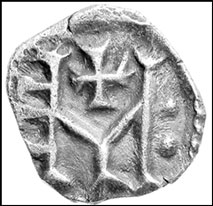
Silver penny minted around 660AD

The 5th century collapse of the Roman Empire in western Europe began a slow decline in the monetary economy.  During Roman times the western provinces had a robust money-based economy with the regular introduction of gold, silver and bronze coins from various mints.  Much of the circulation was prompted by payments to soldiers, factories supplying the legions, and the massive bureaucracy created by 4th century emperors.

For more on the end of the Western empire read Belisarius Enters Rome, and the Life of St Severinus.

With the empire gone, most mints closed, payments to soldiers ceased, the bureaucracy gone, and trade declined.  Bartering and payments in kind became more common.  Gold coins still circulated and indeed into the early 7th century the Frankish kings received subsidies in the form of gold coins from the Byzantine empire.  However, with the great Persian War (602-628) rapidly followed in the 630s and 640s by the Muslim conquest of the most prosperous Byzantine provinces, the Frankish subsidies ceased.  For more on the travails of the Eastern Empire read A Great War.

It has been known for some time that silver coins began to appear to replace the more scarce gold coins.  Their lesser value and more availability allowed for more use in commerce and helped the slow revival of Western Europe's economy.  What remained unknown was the source of the silver.  Scholars speculated that much of it came from Roman bullion that had been melted down and recast or imported from the Mediterranean.  A 2018 paper, published in the journal Antiquity, may provide an answer.

Using lead analysis of ice cores, the authors pinpointed a mining complex, located at Melle (near the modern town of Deux-Sevres), in Western France, as the source of the silver, beginning in the period between 640 and 670. Lead levels are key because silver is derived from lead ores.  We've already learned much about the lead industry during Roman times as elevated levels of lead have been found in ice cores dating back to the early centuries AD in ice sheets in Greenland and the Alps. Lead levels collapsed with the end of the Western Empire, taking centuries to rise again to similar levels.  However, even during the gap centuries, lead levels varied and scientists using analytical tools and prevailing winds have been able to identify specific lead sources, including the Melle mines.

The authors were able establish the mid-7th century dating from the Alpine ice cores by calibrating the cores with three other known events - the total collapse in lead pollution at the time of the Blakc Death from 1349-53, the increase in bismuth levels with the gigantic series of eruptions from an Icelandic volcano between 934 and 939, and the identifiable markers from the great eruption of 536 (for more on the last event read The Big Sleepy Chill).

The existence of the Melle mines have been known for some time and during the 9th and 10th centuries they provided large amounts of coins to the Frankish kingdom during the time of Charlemagne and his immediate successors.  The 2018 paper establishes they were the original source for the transition from gold to silver, enabling Frankish mints to initially produce gold coins  alloyed with silver and subsequently switching to all silver coins within a quarter century.

And now we understand event in the revival of the West.

Monday, April 27, 2020

The Tilted Playing Field

I'm so old, I remember when having a political campaign working hand in glove with high tech companies to elect a President was considered the coolest thing!

For a reminder of those golden days way back in 2012 when scraping data from Facebook to manipulate voters was considered the height of sophistication, read this article from The Guardian:
Barack Obama's re-election team are building a vast digital data operation that for the first time combines a unified database on millions of Americans with the power of Facebook to target individual voters to a degree never achieved before.

Digital analysts predict this will be the first election cycle in which Facebook could become a dominant political force. The social media giant has grown exponentially since the last presidential election, rendering it for the first time a major campaigning tool that has the potential to transform friendship into a political weapon.

Facebook is also being seen as a source of invaluable data on voters. The re-election team, Obama for America, will be inviting its supporters to log on to the campaign website via Facebook, thus allowing the campaign to access their personal data and add it to the central data store – the largest, most detailed and potentially most powerful in the history of political campaigns. If 2008 was all about social media, 2012 is destined to become the "data election".

For the past nine months a crack team of some of America's top data wonks has occupied an entire floor of the Prudential building in Chicago devising a digital campaign from the bottom up. The team draws much of its style and inspiration from the corporate sector, with its driving ambition to create a vote-garnering machine that is smooth, unobtrusive and ruthlessly efficient.

Already more than 100 geeks, some recruited at top-flight university job fairs including Stanford, are assembled in the Prudential drawn from an array of disciplines: statisticians, predictive modellers, data mining experts, mathematicians, software engineers, bloggers, internet advertising experts and online organisers.

At the core is a single beating heart – a unified computer database that gathers and refines information on millions of committed and potential Obama voters. The database will allow staff and volunteers at all levels of the campaign – from the top strategists answering directly to Obama's campaign manager Jim Messina to the lowliest canvasser on the doorsteps of Ohio – to unlock knowledge about individual voters and use it to target personalised messages that they hope will mobilise voters where it counts most.
And Time Magazine added a very interesting wrinkle to the project:
That’s because the more than 1 million Obama backers who signed up for the app gave the campaign permission to look at their Facebook friend lists. In an instant, the campaign had a way to see the hidden young voters. Roughly 85% of those without a listed phone number could be found in the uploaded friend lists. What’s more, Facebook offered an ideal way to reach them. “People don’t trust campaigns. They don’t even trust media organizations,” says Goff. “Who do they trust? Their friends.”
And it wasn't just the Obama campaign neutrally making use of data.  Facebook was happy to cooperate according to this article, according to former Obama campaign staffer Carol Davidsen:
She also said that Facebook officials came to the campaign offices after the election recruiting Obama's tech team, and that "they were very candid that they allowed us to do things they wouldn't have allowed someone else to do because they were on our side."

This wasn't entirely new news, by the way. The New York Times reported in 2013, in another glowing piece on Obama's tech team, how "The campaign's exhaustive use of Facebook triggered the site's internal safeguards." Facebook's response, according to one campaign official: "They'd sigh and say, 'You can do this as long as you stop doing it on Nov. 7.'"
Facebook wasn't the only tech company playing a key role in the Obama campaign.  Google's Board Chairman Eric Schmidt was providing hands-on assistance.  As reported in this article
Schmidt was intimately involved in building Obama’s voter-targeting operation in 2012, recruiting digital talent, choosing technology and coaching campaign manager Jim Messina on campaign infrastructure. The system was credited with helping Obama achieve his unexpectedly large margin of victory.

On election night in 2012, Schmidt was in Obama’s Chicago campaign headquarters “boiler room” alongside the team charged with maximizing voter turnout.
It was a good deal for Google, as during the Obama Administration you could not tell where Google ended and the White House began.  They even got the White House to push "net neutrality" which was a business push to advantage large internet platforms over the actual investors and owners who had provided internet access.  With the help of the White House, credulous Progressives believed that the lives of millions were at stake because of "net neutrality" rather than it being merely an effort to make Google even more profitable.  Thankfully, the Trump Administration reversed the handout to Google.  As far as I know, millions have not died.

Of course, when the 2016 election did not turn out as planned, clever use of Facebook and other social media by people the high-tech crowd and media did not approve of became "manipulation" and "election tampering''.  Both the co-founder and the CEO of Google vowed to shocked employees they would do everything possible to make sure the 2020 election turned out "the right way".  I am sure they will.

The best way to understand the situation in 2020 is to understand that while both Progressives and non-Progressives have complaints about high tech companies and social media, their viewpoints are fundamentally different.  For non-Progressives it is, "we'd like our voices to be heard along with everyone else", for Progressives it is, "we demand you shut down the voices who disagree with us".  It's why the Progressive tactic is to get the tech companies to use actual hate groups like the Southern Poverty Law Center, which defines as a "hate group" any organization that is not Progressive, to determine what type of speech should be censured.  And it is the inherent Progressive leanings of the tech companies that make non-Progressives very suspicious of where this is all headed.  It's why 21st century Progressive thought is an authoritarian cult.

Villa Cimbrone

One of our favorite spots in the world, beautiful and peaceful, particularly if you can avoid the height of tourist season and visit in during the morning.  The views, the gardens, and the joy of just sitting quietly.  The entire town of Ravello is worth a couple of days visit.

We had planned to return this fall.  Hope to make it next year.