I've written before about the unexpected pleasures that give a deeper understanding, encountered while reading and writing about history for this blog. Recently, I came across a journal article and a book that brought to my attention things I did not know, and hadn't thought about, in this case involving slavery (for a discussion of other readings on slavery go here).
Did you ever think about the implications of the Dred Scott decision on the issuance of patents? I had not, but U of Kentucky law professor Brian Frye did, and wrote about it in Invention of a Slave, originally published in the Syracuse Law Review (2018) (1).
When issued in 1857, Dred Scott instantly became the most controversial decision of the Supreme Court (for background read Dred Scott's Trial), in particular because of Chief Justice Taney's opinion finding that blacks, whether slave or free, could not be citizens of the United States. I'd already been aware that as a result of this declaration the State Department ceased to issue passports to free blacks, a policy overturned by Abraham Lincoln soon after his inauguration in March 1861. Professor Frye explores the consequences of the case and US patent law when it came to the issue of patents by the Patent Office.
Here's Frye's summary:
On June 10, 1858, the Attorney General issued an opinion titled Invention of a Slave, concluding that a slave owner could not patent a machine invented by his slave, because neither the slave owner nor his slave could take the required patent oath. The slave owner could not swear to be the inventor, and the slave could not take an oath at all. The Patent Office denied at least two patent applications filed by slave owners, one of which was filed by Senator Jefferson Davis of Mississippi . . . But it also denied at least one patent application filed by a free African-American inventory, because African-Americans could not be citizens of the United States under Dred Scott.
The Patent Act required a Patent Oath in which the applicant had to swear to be the "original" inventor and that they were an American citizen. Before Dred Scott, the Patent Office had granted many patents to free African-Americans, the first known being Thomas Jennings in 1827 for a method for "dry scouring" clothing. Many other followed and there are probably more than currently identified as the patent application did not require the applicant to disclose their race.
Following Dred Scott, slave owners objected to the position taken by the Patent Office claiming slaves were more creative than free African-Americans(!!) while free African-Americans objected to the new bar on granting them patents.
In August 1857 (five months after Dred Scott), Oscar J.E. Stuart, a lawyer and planter in Mississippi, wrote the Secretary of the Interior (where the Patent Office was housed) inquiring how to patent an invention of his slave Ned for a "double plow and scraper". The Secretary forwarded the letter to Attorney General Jermiah Black for a formal response. Black responded he could not opine until Stuart submitted an application, which Stuart did. In November, the new Commissioner of Patents, Thomas Holt, a Southerner, responded the invention could not be patented since neither Stuart nor Ned could take the oath.
As Frye writes:
Holt presumably applied the logic of Dred Scott and concluded that if slaves could not be citizens of the United States, then they could not take the patent oath, and slave owners could not patent the inventions of their slaves. In other words, Dred Scott denied citizenship to African-Americans in order to help slave owners, but Holt applied the logic of Dred Scott in order to prevent slave owners from claiming ownership of the inventions of their slaves.
In June 1858, AG Black issued his opinion agreeing with Commissioner Holt. After Black's opinion, Slave owners tried to get the U.S. Congress to amend the Patent Act to allow owners to obtain patents for the inventions of their slaves but the effort failed, though in 1861 the Constitution of the new Confederate States of America specifically allowed for such patents.
In 1859, Jefferson Davis tried to obtain a patent for the invention of one of his brother's slaves, Benjamin T Montgomery, and was turned down for the same reasons. In 1866, Davis' brother Joseph, sold his plantations to Montgomery, who even as a slave had become a successful merchant, at first secretly, because sale of property to a black violated the state's Black Code instituted after the end of the Civil War, and then the following year publicly after legislation was passed allowing such transactions.
Did you know that in the 1850s there were Brazilian and Cuban merchants in New York City actively hiring U.S. ships and crews to travel to Africa and bring slaves back to Brazil and Cuba? Reading The Last Slave Ships: New York and the End of the Middle Passage by John Harris was a revelation.
In 1807 the importation of slaves into the U.S. became illegal and in 1820 Congress passed legislation making Americans engaged in any importation subject to the death penalty (though this was only imposed once, in 1862). Likewise, under British pressure other nations banned the slave trade, though not slavery itself. In 1850 Brazil, the largest importer of slaves in the Western Hemisphere (nearly 50% of all Africans imported into the Americas came to Brazil) banned the trade, though slavery would be legal until 1888. Because of the large U.S. merchant fleet and availability of crews Brazilian and Cuban slave traders set up shop in New York City using a number of subterfuges to disguise what they were doing which was illegal under U.S. law though the slaves were not imported into the U.S.
The Last Slave Ships tells how the scheme worked, the ineffectiveness and at times collusion, of American authorities, and the efforts of some Americans but primarily of the British government to stop the slave trade.
While there were many new aspects to me, it was one particular issue that I found particularly striking.
The British devoted a large part of their navy to trying to intercept slave ships, supported by a small American squadron and, at times, by the Spanish navy. When a slave ship was intercepted what became of the freed Africans? I knew about the interceptions and even that more than 100,000 captives were freed but never thought about what happened next.
It turns out the Africans could not be returned to the ports from which they had embarked because these were run by kingdoms and tribes who were conducting the raids that had enslaved them in the first place. These Africans were from inland areas not accessible to Western navies.
Instead the British took the Africans to their islands in the Caribbean where they were indentured to work on the sugar plantations for several years and were then freed. The Americans took freed Africans to Liberia, settled earlier in the century by freed American slaves. The Africans were indentured, the start of a caste system with descendants of American slaves ruling over native Africans, a system that last well into the 20th century. As to the Spanish, they took their freed captives to Cuba where they were indentured, though apparently the terms of the indenture were often not honored and the Africans effectively reduced to slavery until it was abolished in 1886 (2).
----------------------------------------------------------
(1) I came across the article completely by accident. While following a reference that had nothing to do with slavery I came across an index of law review articles, including Frye's which caught my eye.
(2) This prompted me to do some research on these African coastal slave states. They were very prosperous in the 17th and 18th centuries when the Atlantic slave trade was booming, with most of their revenues derived from the trade. However, as the trade shrank in the first half of the 19th century and virtually ceased after the American Civil War, the search for replacement revenues led to a switch to agriculture which actually increased their need for slaves, as the labor intensity required more slaves from the inland areas subject to annual sweeps by the coastal slave states. This persisted until the European carve up of Africa towards the end of the century, which created its own set of problems.

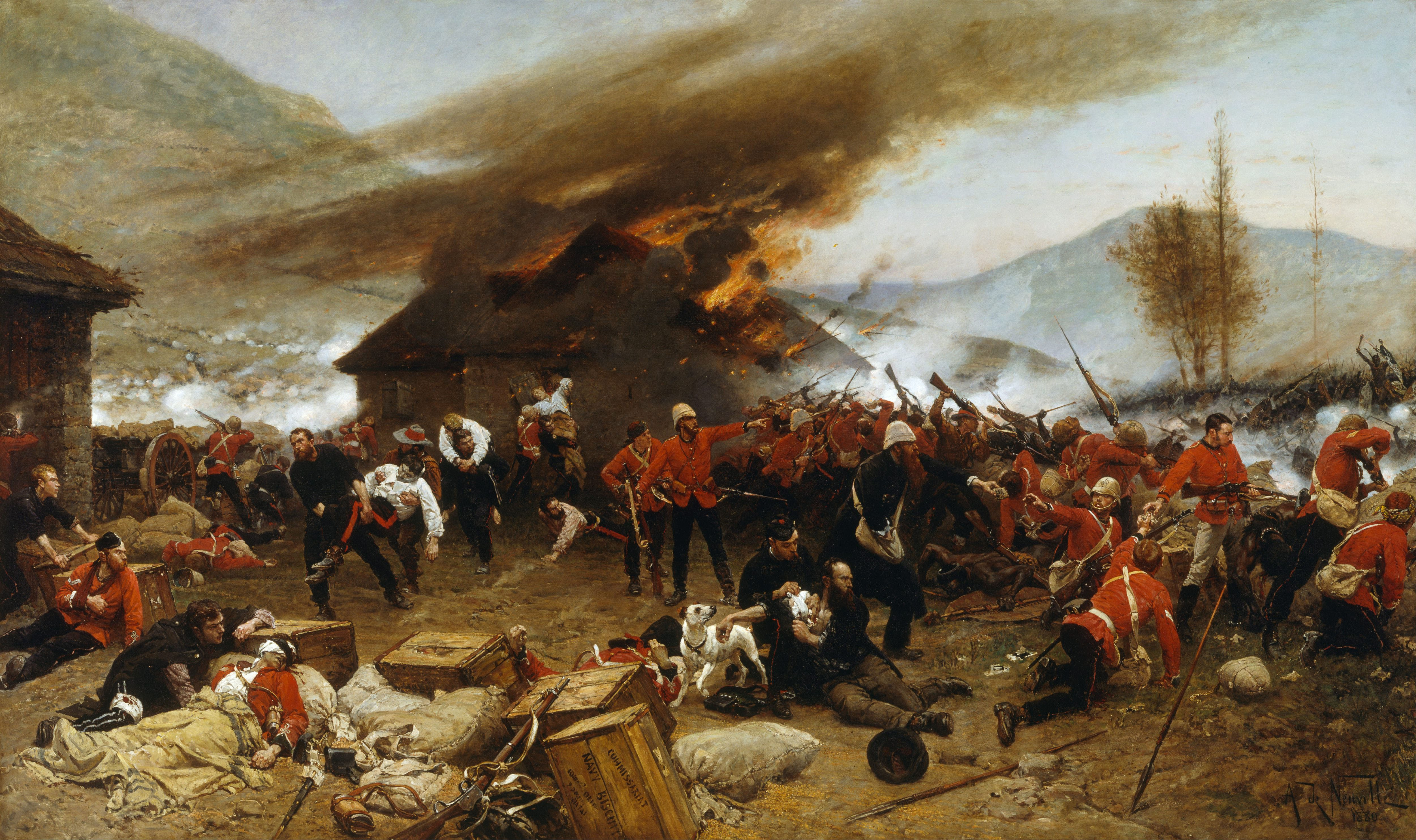 (The Defense of Rorke's Drift, Alphonse de Neuville, 1880, from wikpedia)
  (Islandhlwana, 1879, from
 (Zulu impi) The innovative military system he developed and the incredible endurance and bravery of the Zulu warriors, made Shaka's kingdom feared across the land, among both natives, Boer (who had also come to consider themselves natives) and English. Under Shaka and his successors, the Zulu controlled most of the coastal strip of southern Africa, eventually coming up against the Boers, who began their Great Trek in the 1830s to escape the encroaching English; a journey which took them to what was to become the Orange Free State, the Transvaal and Natal.
 (Map by Lt Chard, co-commander at Rorke's Drift)
 (Chief Buthelezi)