Showing posts with label Italy. Show all posts

Tuesday, January 23, 2024

Bay Of Naples

Stunning photo by Sophie Hay, an archaeologist working at Pompeii, taken from the Certosa di San Martino Museum in Naples.  The museum is housed in a former Carthusian monastery built in the 14th century, located on the north shore of the Bay of Naples.

The photo looks west towards the center of the city and the still active volcano Vesuvius, which stood 1,000 feet taller before the eruption of 79 AD.  The ruins of Herculaneum lies on the coast just behind the pillar on the right, while Pompeii is a bit further to the right and a couple of miles back from the coast.


Saturday, October 1, 2022

Harvest Moon

See Explanation.  Clicking on the picture will download
the highest resolution version available.

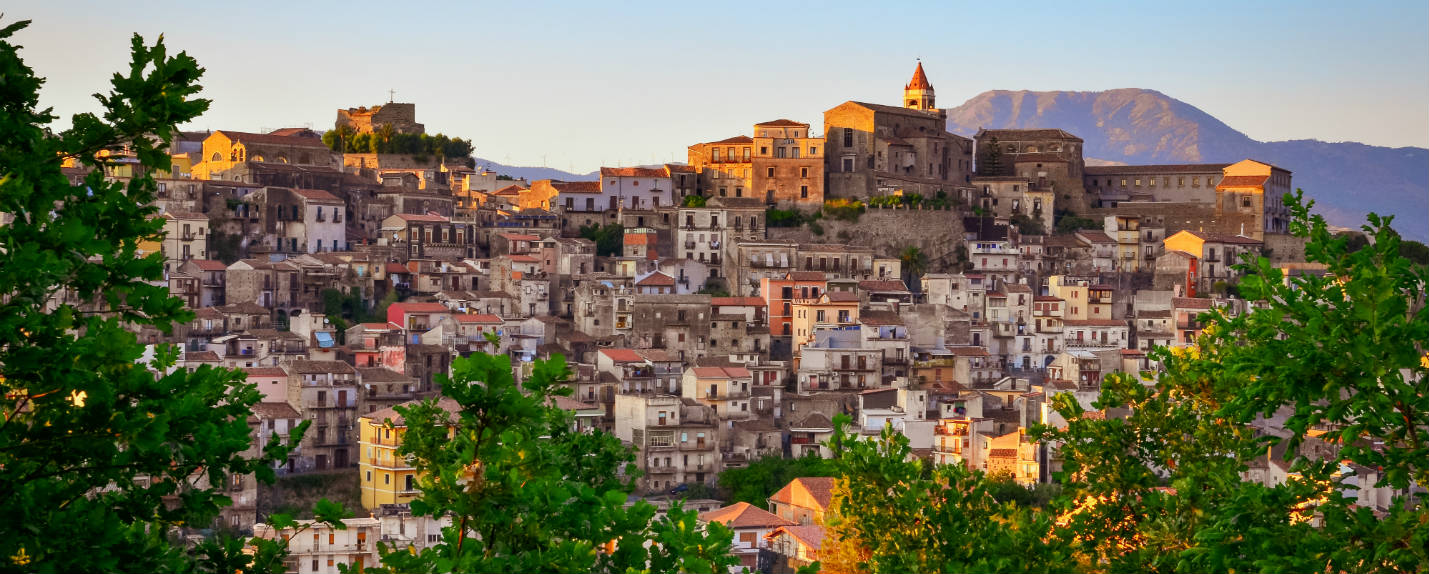
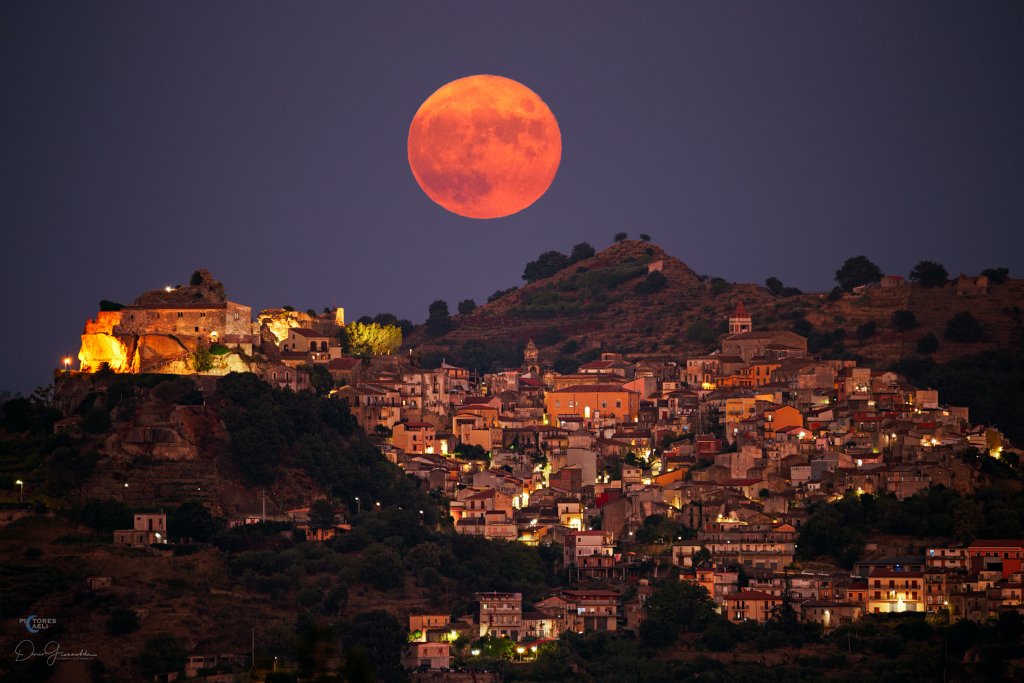
 Harvest Moon over Castiglione di Sicilia on September 15, 2022.  Photo by Dario Giannobile and found at Astronomy Picture of the Day.  Here's what the town looks like in daylight.

https://media.e-borghi.com/public/borghi/09_04_19-04_13_38-G9602519c4a40311ecfefcfb521934bd.jpg

If you're looking for a little getaway in the area, I've got something for you.  The town is in the southeast corner of Sicily at an altitude of 2,000 feet.  I'd like to visit Sicily sometime.

Sunday, November 21, 2021

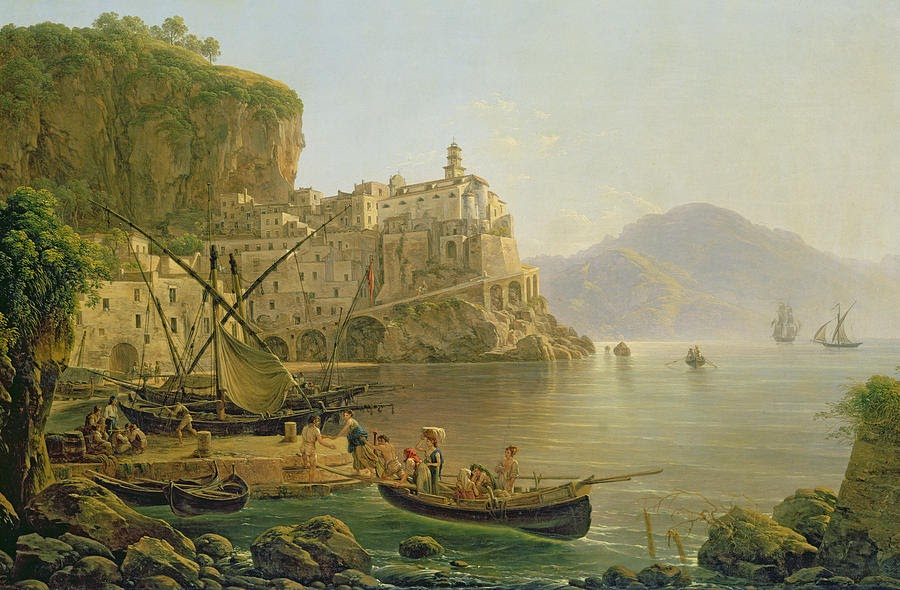
Atrani From The Sea

By Josef Rebell (1787-1828).  Born in Vienna, from 1811 to 1815 Rebell was the Court painter for Joachim Murat, King of Naples and Napoleon's brother in law.  Rebell's time as court painter ended when Murat was overthrown and executed after Napoleon's defeat at Waterloo.

Atrani is a small town on the Amalfi Coast, just east of the town of Amalfi.  The painting shows Atrani when it was a poor town clinging to the cliff side.  Later in the 19th century, the Amalfi Coast Drive was built along the coast, starting the area's path toward being a destination tourist spot.  This is what modern Atrani looks like.  On the cliff above Atrani is the beautiful town of Ravello, perched 1,000 feet above the sea, about which I've written before. Image

Wednesday, July 21, 2021

Temple Of Juno

 By Ferdinand Georg Waldmuller in 1845.  The ruins of the Temple of Juno located at Agrigento in Sicily.  Agrigento was one of the leading colonies settled by the Greeks across the Mediterranean between the 8th and 6th centuries BC with the temple constructed during the 5th century.  By the time Waldmuller painted the scene much of the area had been severely depopulated and returned to nature.

Image

Wednesday, January 6, 2021

Sawdan

For twenty four years in the 9th century an Arab Emirate existed in southern Italy.  In 847 the seaport of Bari, on the Adriatic Coast, was seized by Saracens and held until 871.  For the final 14 years of its existence it was ruled by Emir Sawdan Al-Mawri, a figure of whom we know little, but the little we know indicates he was a remarkable figure of his time.  While other cities and towns in southern Italy came under Arab control in the 9th and 10th centuries, including Taranto and Otranto in Apulia and Reggio in Calabria, Bari was the only emirate recognized by the Abbasid Caliphate in Baghdad.

A word on terminology.  The raiders and conquerors of Muslim faith who dominated the Mediterranean in those centuries go under many names in Christian chronicles and documents, including Arabs, Saracens, and Moors.  We will use Arab for simplicity sake, though most of those involved with the events described were not from the Arabian peninsula.  In fact, many were Berbers, native to North Africa and recent converts to Islam, descendants of those who invaded Spain in the early 8th century, or natives of those lands who had converted. 

In 698 the Arabs captured Carthage, the last outpost of the Byzantine empire in North Africa.  By early in the next century raids were being conducted on Sicily and Italy but it was not until in the early 9th century that the nature of the threat changed.  In 812 Arab raiders plundered the island of Ischia (near Naples), while in 827 a full scale invasion of Sicily began.  Within 20 years much of the island was controlled by Arabs, who made Palermo their capital; in 877 Syracuse fell, and the last Byzantine outpost surrendered in 902.

Italy was vulnerable. Relatively poor compared to the Arab states, its main asset were people who could be captured and sold as slaves.  The peninsula was also politically fragmented with the area around Rome ruled by the Papacy while further south there were multiple polities.  Gaeta was a small city-state to the north of the Duchy of Naples, nominally subordinate to the Byzantine Empire but, in reality, autonomous.  Northwest of Naples was Capua, under Lombard rule (a Germanic tribe which entered Italy in 568),  eventually combined with Benevento.  There were two remaining Lombard principalities, the Duchies of Benevento and Salerno, usually antagonistic to each other, while Amalfi, tucked away on the coast which now bears its name, had carved out an independent (and prosperous) seafaring existence.  Since the time of Charlemagne, late in the prior century, all of these entities owed allegiance to the Carolingian dynasty which ruled what is today France, the Low Countries, Germany and North Italy, but it was an allegiance mostly honored in the breach.

In 846 an Arab fleet landed in Ostia, raiders marched a dozen miles to Rome, sacking those parts of the city outside the ancient Aurelian walls, and looting relics from the original St Peter's Church.  Marching down the coast, they wintered near Naples before leaving in spring.  Three years later the Arabs returned in another attempted raid on Rome, but were defeated in a naval battle.  That did not end the depredations.  For the next century, hamlets, villages and small towns were at the mercy of these raiders.  Even religious sanctuaries were not spared.  The famous abbey at Monte Cassino was sacked and the surviving monks did not feel safe to return for a half century.  All along the coast "Saracen" towers were built to provide early warning to communities.

                                                   (Saracen Tower on Amalfi Coast near Praiano; photo by me)
(From Wikipedia; includes some inaccuracies, such as missing Duchy of Naples, between Amalfi and Capua, and showing Byzantine territory not conquered until the 10th century but close enough)

While South Italy was under constant threat by the Arabs, the relationship between Christians and Muslims was not always antagonistic.  Neapolitan merchants sold slaves to the Arabs and imported Arab mercenaries to protect the Duchy from the neighboring Christian Lombard (Benevento, Capua and Salerno) principalities.  The relationship of the Duchy of Naples with the Arab states, and the numerous Arab residents of the city led the Carolingian Emperor Louis II, while campaigning in the area, to complain that Naples was a "second Palermo [the Arab capital of Sicily] or Africa".  For many years, an Arab band was encamped on the slopes of Mount Vesuvius at the invitation of Naples, being tolerated until they became indiscriminate in selecting targets for their raids. 

When civil wars broke out between the Lombard principalities each hired large bands of Arab mercenaries who were allowed to plunder the area during the "down time" between fighting.  In 842 the city of Capua was sacked and burned by Benevento's Muslim mercenaries eventually prompting its inhabitants to build a new city, in a less vulnerable location a few kilometers away (which became the modern city of Capua).  For the remainder of the century Arab bands used the ancient Roman amphitheater in the old city as a base from which to stage raids.  At one point, the ancient Greek temples of Paestum, south of Salerno, were also used as a base by raiders.  When Gaeta, a coastal city-state between Naples and Rome, felt threatened by its neighbors it imported an Arab band which carved out a territory from which it launched raids for three decades.  The Duchy of Amalfi grew rich on its trade with North Africa and Egypt and when the Pope and the Byzantines attempted to form a Christian alliance to drive the Muslims from the region it failed because Salerno, Naples and Amalfi entered into a peace treaty with the Arabs.  Moreover the limited documents available from that period show that individual Muslims lived in some of these principalities and even owned land.

It was during this period that Arab raiders attempted to permanently seize footholds on the peninsula. Reggio, at the toe of Italy, was seized in the early 10th century and held for many decades.  A band of Arab raiders seized the small town of Cetera, halfway between Amalfi and Salerno, raiding across the countryside for the next twenty years.  And in Apulia (the heel of Italy), other bands seized Otranto and Taranto (the latter held for more than 30 years).  But Bari was the biggest prize.

(The map below shows the situation in the mid-12th century but shows the locations of most of the cities mentioned, including Bari, Taranto, Benevento, Salerno and Naples.)
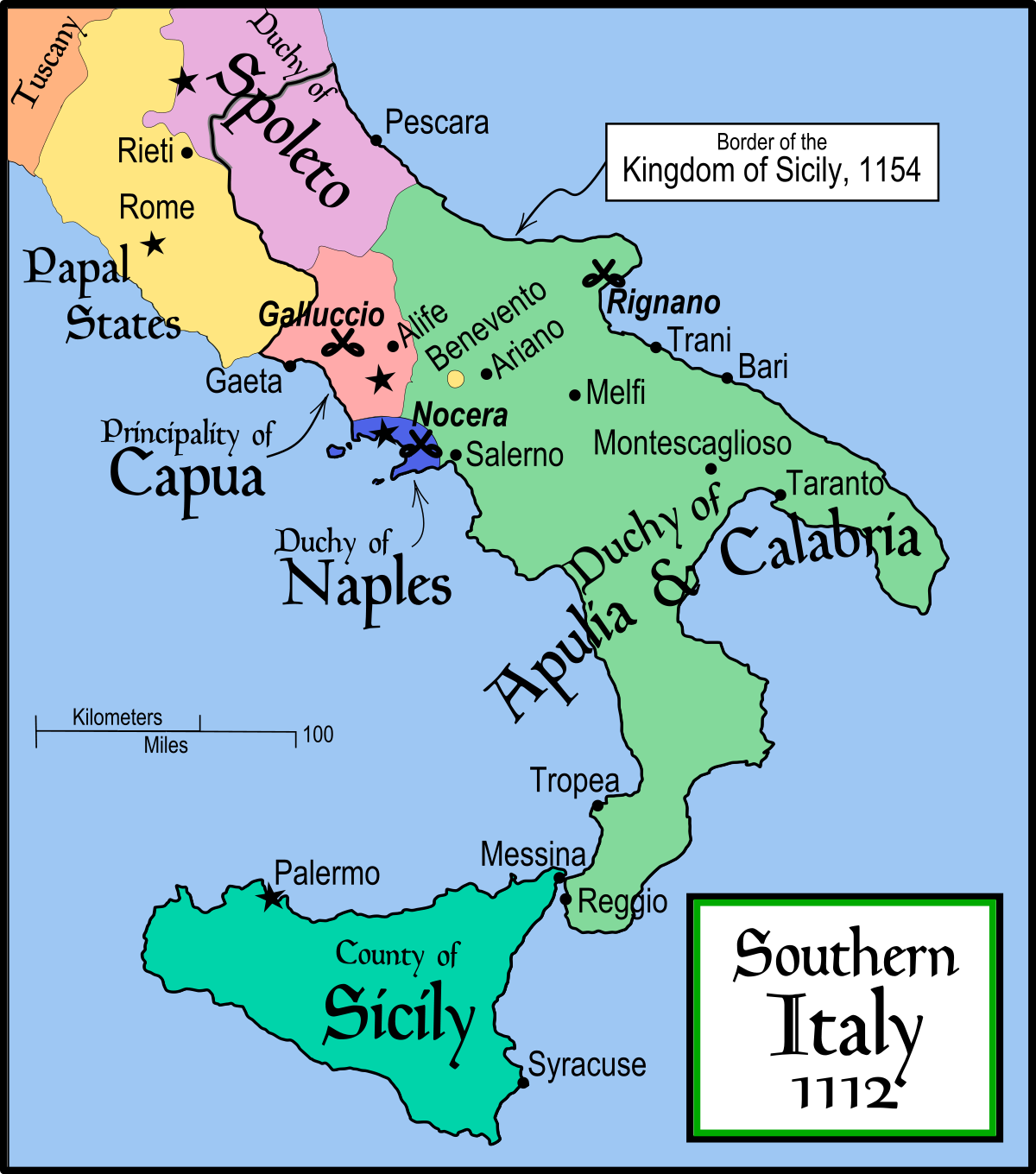
County of Sicily - Wikipedia

Bari was the most prosperous seaport of the region.  In later years it would become even wealthier serving as a slave depot, primarily for Venice, used to store slaves from Slavic lands (primarily the areas that became Poland and Prussia) before transport and sale to Arab principalities.

In 847 the city was seized by a band of Arab raiders under the leadership of Kalfun, a shadowy figure who may have been part of a mercenary garrison installed by the Prince of Benevento to control Bari.  Kalfun was probably of Berber origin, possibly an escaped servant of the Aglahbid dynasty which ruled North Africa and Sicily.  Kalfun's successor, Mufarrag, who became emir in 852, sought and obtained recognition as an emirate from the Abbasid Caliph and expanded its territory, launching raids across the southern part of the peninsula.  Sawdan was next in line, taking power in 857.

According to Barbara Kruetz, author of Before The Normans: Southern Italy in the Ninth & Tenth Centuries, we only have fragmentary information about the emirate and Sawdan.  

At some point in the mid-860s, the Frankish monk Bernard, on his way to the Holy Land with two companions, came to Bari . . . 

They obtained from Sawdan safe conduct letters addressed to the princes of Baghdad and Jerusalem.

The narrative of Bernard's journey suggests no shock that Bari, 'formerly belonging to the Beneventans' was now in Muslim hands; Bernard and his companions received courteous treatment there and seem simply to have accepted the fact that Bari was no longer part of the Christian world.

Kruetz also writes of the Chronicle of Ahimaaz, an eleventh century Hebrew narrative of the history of a south Italian Jewish family:

Many of the anecdotes in this chronicle seem questionable, but it is noteworthy that Sawdan  . . . is memorialized in it as a wise and eminently civilized ruler . . . Doubtless much of this story was romantic fiction . . . Yet it is interesting that the author, who did not mince words concerning the havoc wreaked by Arab raids (and on some key Jewish communities), nonetheless depicted Muslim Bari as a stable and well-governed city.

She also points to evidence that "Bari under Muslim rule came to be accepted as simply another piece of the south Italian jigsaw puzzle, merely one more entity to be dealt with", citing Christian rebels fleeing to Sawdan for protection and the emir's envoys coming to Salerno where they were lodged in the bishop's palace. 

That is not to say that Sawdan was a peaceful man.  Far from it.  Plunder was essential to his survival and prestige.  His bands pillaged all over south Italy, particularly Benevento and Capua, burning the fortified town of Ascoli, seizing the castle of Venafro near the abbeys of Monte Cassino and San Vincenzo, from both of which massive gold ransoms were extracted.  He also defeated Lombard attempts to recapture Bari.

By the mid-860s it seemed like south Italy might be headed in the same direction as Sicily.

Enter Louis II, great-grandson of Charlemagne and, since 844, King of Italy and Holy Roman Emperor.   In response to calls for help against the Arabs and a desire to assert his real, as opposed to nominal supremacy, Louis II ventured south in 866 with a goal of retaking Bari. What he encountered was a tangled web of competing principalities and shifting alliances which delayed him, leading initially to several unsuccessful campaigns before Bari finally fell in February 871 Bari fell, resulting in Sawdan's capture and transport to Louis' headquarters in Benevento, where the most remarkable part of the emir's story takes place.

Mere months later, in August 871, Louis found himself and his family suddenly surrounded and put under guard in close confinement.  After a month of negotiations, Louis and the family were released but only after he had taken an oath never to return to Benevento; a humiliating end to what had seemed a triumphal campaign for the emperor.

What happened?

Although Louis came south to rid the area of the threat from Bari, he had showed no signs of leaving after its fall.  For the families ruling the local principalities that was a bad thing because they had no desire to submit themselves to Louis. And, according to all the surviving chronicles, much of the blame for the seizure of Louis was due to Sawdan.

Sawdan must have had a substantial reservoir of charm to draw upon.  He quickly became popular at Benevento, entertaining a constant stream of well-born visitors and dining frequently with Louis.  According to Kreutz:

"He became a lighting rod, attracting Lombard complaints about the Franks and Frankish complaints about the Lombards.  Then . . . he put to use what he had learned from each side . . . [Sawdan] purportedly inflamed the Beneventans by warning that Louis planned to send many of them north, in chains; . . . The evidence suggest that Sawdan had access to information from both sides, and that he passed it on in the manner most likely to be helpful to his own cause."

Louis left Benevento, never to return, dying four years later.  Sawdan, kept in comfortable captivity in Benevento, was released upon Louis' death and then, unfortunately, disappears from history so we do not know his fate.

Saturday, October 10, 2020

A Walk In Ravello

If you are looking for a way to imagine yourself outside the Covid penalty box and lower your blood pressure at the same time, watch this real-time video of a walk in Ravello.  Located on Italy's Amalfi Coast on a thousand foot high plateau looming over the coast it is a dramatic, beautiful and peaceful location.  The Mrs and I were supposed to be there right now before Mr Covid thought otherwise.  We've walked all these paths before and had looked forward to returning for our 4th visit.  Now we hope to make it there in 2022.  The hotel we stay in is located about 150 yards beyond the end of the tunnel shown in the last minute of the video.  Don't miss the view from the Belvedere of Infinity at the Villa Cimbrone which begins about 42 minutes in.


Monday, April 27, 2020

Villa Cimbrone

One of our favorite spots in the world, beautiful and peaceful, particularly if you can avoid the height of tourist season and visit in during the morning.  The views, the gardens, and the joy of just sitting quietly.  The entire town of Ravello is worth a couple of days visit.

We had planned to return this fall.  Hope to make it next year.

Monday, March 19, 2018

Roman Snow

On February 26, Rome had its first measurable snow in six years which yielded some beautiful portraits of the city in white.

Via Twisted Sifter this is drone footage by Oliver Astrologo, much of which is over the Colosseum and Forum areas of the city.

Below a snowball fight between seminarians in St Peter's Square.

More pictures, from the NY Post, can be found here.  Some of the 18 photos lack good labeling.  I'll help:

8 - Equestrian statue of Emperor Marcus Aurelius; 2nd century AD.  This is copy of statue; original is in the museum building to the right of the statue.

11 - On the Sacred Way between the Colosseum and the Forum.  Palatine Hill on left.  Temple of Mars and Venus on right.  Arch of Titus at top of street.

12 - Trevi Fountain

13 - Palatine Hill in distance

14 - Spanish Steps

17 - Open field beneath which ruins of the Circus Maximus are buried.  Sledge is being pulled up Aventine Hill.  In background is Palatine Hill with ruins of Imperial Palace.

Friday, January 5, 2018

This Is What A 1,900 Year Old Concrete Dome Looks Like

The ceiling of the Pantheon in Rome.  Built during the reign of Emperor Hadrian (117-138 AD), after nearly 2,000 years it remains the largest unreinforced concrete dome in the world.  The best preserved of the buildings of ancient Rome due to its conversion into a church in 609, the external facade has suffered damage including stripping of bronze roof tiles by the Byzantine Emperor Constans II in 663, and removal of marble cladding at various points over the centuries.  The photo is remarkable, seeing it in person even more so.

Image may contain: indoor

Wednesday, July 12, 2017

A Dutchman In Rome

Born in Amerfoort, Holland in 1653, Caspar van Wittel left the Netherlands in 1674 for Italy, residing primarily in Rome, where he died in 1736.  He became well known for his urban landscape paintings, many of which juxtaposed the remnants of imperial Rome with the reality of the shrunken city at the beginning of the 18th century.

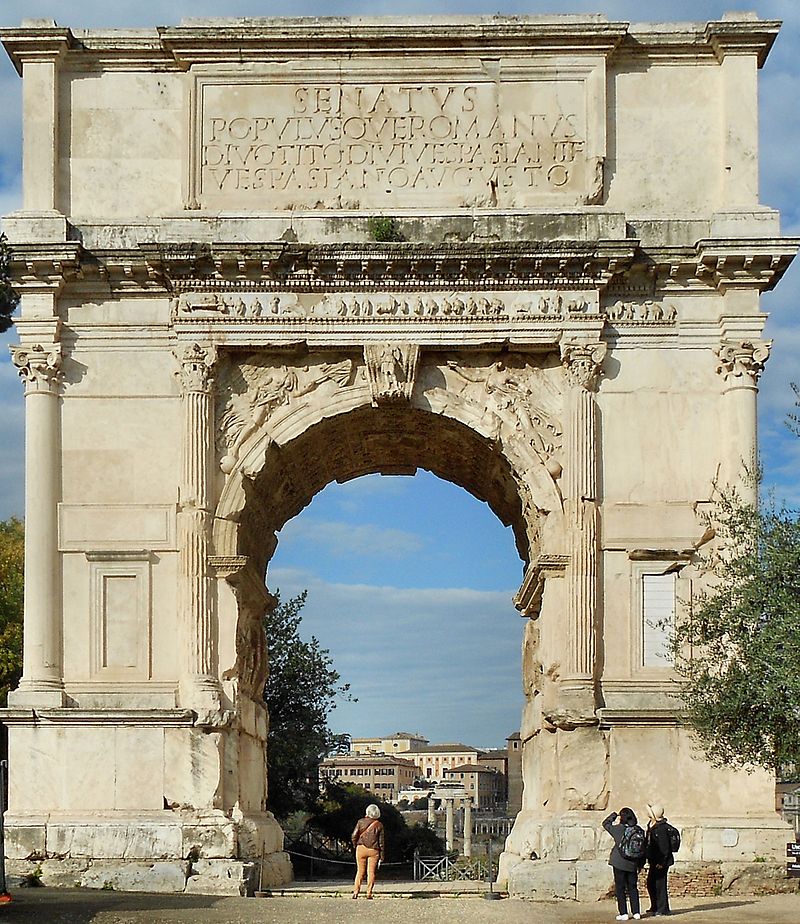
I've always been taken with this particular piece which shows the Arch of Titus with the Palatine Hill on the left.  It's a reminder both of durability and fragility.  The structure, though damaged remains, but the city and Forum surrounding it are mostly long gone, as well as those who built it.  The humbleness of the inhabitants we see is also a reminder of the transitory nature of things.  The Arch straddles the Sacred Way.  Triumphal processions would approach it up a slight incline having just passed by the Colosseum, 300 yards away.  Straight in front of them, down another slight incline was the Roman Forum, the heart of the empire.

To the left, the Palatine Hill was crowned by an enormous sprawling complex of Imperial Palaces clad in marble.  In 1700 we see the Palatine covered in trees, and scattered people walking through the ruins around the Arch, with a horse walking down the path from the Palatine.  The once carefully paved Sacred Way reduced to a rough dirt path.  The Arch itself is no longer maintained and is slowly eroding away.  The monumental buildings surrounding it long ago had their marble cladding stripped and their exposed cores left to crumble.  For more on the deterioration of Classical Rome over the centuries read Belisarius Enters Rome.

The inscription on the Arch reads:
The Senate
and the People of Rome
to the late revered Titus Vespasian Augustus
son of the late revered Vespasian
The monument was erected by the Emperor Domitian (81-96), the younger brother of the Emperor Titus (79-81), the sons of Emperor Vespasian (69-79), who constituted the Flavian Dynasty.  Vespasian, an experienced and stern soldier came to power in the wake of the overthrow and subsequent suicide of Nero (54-68) and amidst the turmoil of the Year of the Four Emperors when it was demonstrated that the legions far from Rome would be the decisive force in choosing the new emperor.

As a ruler, Vespasian was strict and personally austere, a complete contrast to the profligate,  undisciplined and disliked Nero.  Vespasian had his predecessor's hated palace, The Golden House, turn down, filled in its lake and on its former location had the Flavian Amphitheatre (better known to us as the Colosseum) built for the people of Rome.  Succeeding him, Titus was more charismatic and popular and his early death due to illness was a shock.  The Arch was built shortly after Domitian's accession to the throne.  Domitian was also initially popular but sank into paranoia and more and more irrational acts unlike he was assassinated in a conspiracy led by his own wife who feared for her life.

Much of the decorative aspect of the Arch commemorates the accomplishment for which he was most honored by Romans; his crushing of the Jewish Revolt in 67-70 and the sacking and complete destruction of the great temple in Jerusalem.  In the photo below the picture you can see a depiction of the great menorah being removed from the temple as a trophy of Rome's victory.  When I first saw the Arch in person it created quite a mixture of emotions for me.  Thousands of Jews were enslaved by the end of the rebellion and many of them brought to Rome where they worked as part of the labor force constructing the Colosseum.  Some may still have been around to work on the Arch of Titus.

Much of the exterior of the Arch a tourist sees today is not the same as that painted by Wittel three hundred years ago.  By the early 19th century there had been so much further degradation of the structure that in 1822, at the direction of the Pope, it was completely rebuilt in travertine.  The inscription, however, is the original.
https://upload.wikimedia.org/wikipedia/commons/thumb/c/c2/7_Rome_View_of_the_Arch_of_Titus.jpg/1008px-7_Rome_View_of_the_Arch_of_Titus.jpg

The menorah being carried away.
Image result for arch of titus location map

As it looks today:
By Rabax63 (Diskussion) - Own work (Original text: Eigene Aufnahme), CC BY-SA 3.0, https://commons.wikimedia.org/w/index.php?curid=31309658

Monday, March 20, 2017

The Magic Bus

[UPDATE:  I never expected that so many others would share their memories of those wacky and memorable Magic Bus days when I wrote this.  Thanks to everyone who has commented.  I so enjoy reading them!] 

UPDATE: 12/30/25 - This year I was contacted by a writer for a popular online Greek newspaper who was writing a feature on The Magic Bus which, I learned, has a legendary status in that country and was actually the subject of a hit song by a Greek rock band in the 80s!  You can find the article and the song at the post The Return of the Magic Bus.

As we plow through stuff stored away for years in preparation for our move to Arizona, we've come across many items bringing back memories.  Here's one - a flyer for the Magic Bus from the summer of 1978.


In May of 1978, I'd quit my job and gone to Paris, where the future Mrs THC was at the time,  working as an au pair for a French-American family, studying French, and living in a 6th floor walk up garret room with a primitive communal toilet down the hall.

During July we'd traveled to England and Scotland and, after a few weeks of recuperation from my badly sprained ankle (see The Highlands for more), set out south for another adventure.  We were backpacking, alternating camping and staying in cheap hotels as we had little money.  I'd brought all my saving (about $1200 which needed to cover expenses for five months plus my air fare back to the States). We traveled by train through France (I remember camping on an island in the Rhone opposite Avignon) and into Italy, visiting Florence and then rolling down its Adriatic Coast to Brindisi.  Italy was in the grip of the Red Brigades terror campaign and that may have prompted our unusual reception getting off the train at Brindisi.  We were welcomed by heavily armed Italian soldiers who escorted us as we walked the mile or so to the city's port to catch the ferry to Patras in Greece.

We couldn't afford a cabin so slept on the deck during the overnight trip, but it was wonderful waking up early in the morning to see the Greek coast gliding by.  I think it was by train we got from Patras to Athens where we stayed for several days (most of it with an old high school classmate of mine who was teaching at the American School), though before we found him we spent one night sleeping on a mattress on a fire escape at a crowded hostel.  Barb and I hiked up the Acropolis at dawn where she took this picture; back then there were no barriers and access was easy.
We did a side trip, again by train, to Mycenae and then took a hydrofoil to visit the island of Hydra.  Our final trip was to Samos, just off the coast of Turkey, on a ancient ferry that had seen prior duty in the North Sea till it was no longer fit for those rough waters, and listed the entire way across the placid Aegean.

By the time we returned to Athens it was late September and we were almost out of money.  Surveying our options for getting back to Paris, the only route we could afford was the Magic Bus, which ran three times a week from Athens to London.  Two of their routes went via Paris and we chose the one going through Italy.  It was $40 for a 48 hour ride in a rickety, un-air conditioned bus (or maybe it was $48 dollars for a 40 hour ride; this memory thing is tricky) that had 48 seats.

I came across this recollection from someone who rode the Magic Bus in 1975 and it matches up well with our memory:
You had to find a certain doorway in a side street off Syntagma Square, climb four flights of rickety stairs to a scruffy office where 1,700 drachmas changed hands. Your name was laboriously and inaccurately added to a passenger list and you were handed a scrap of paper which purported to be a ticket.
We set off on a late Friday afternoon, heading north towards the Yugoslav border where a jackbooted uniformed guard carrying a firearm got on the bus and carefully inspected passports.  When he got to the few Americans aboard he took our passports, left the bus and only returned with them awhile later.

The Magic Bus drove day and night, only stopping for food and bathroom breaks about every eight hours (some of the male passengers brought along their own private arrangements to help deal with the latter issue).  Most of us carried our own food supply, since nobody had extra money to indulge in expensive cafeteria food available at the stops along the highway.  Much of our trip remains a blur as we became increasingly exhausted.
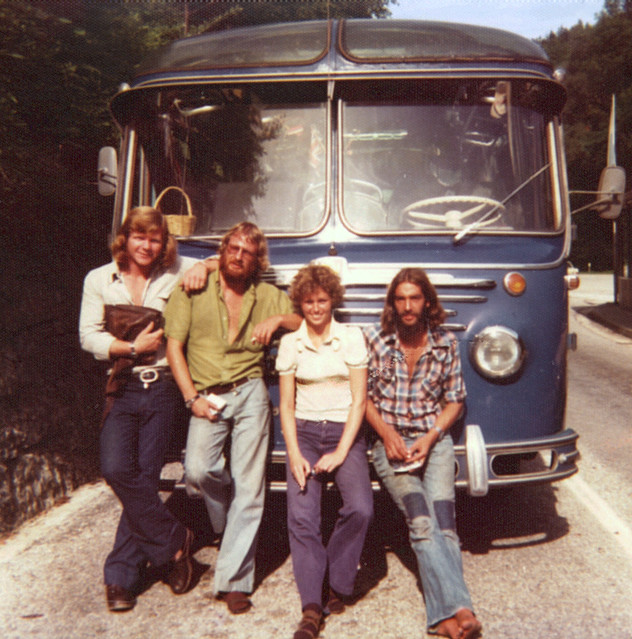
Image result for Magic Bus from athens to london(Travelers with the Magic Bus in 1976, from Flickr)

Initially we sat towards the middle of the bus but we had two obnoxious guys behind us who never stopped talking so eventually we able to get seats closer to the front which give us a close view of the most memorable moment of the journey.

It was on the highway in France, somewhere between Lyon and Paris.  There were two drivers on the bus, both Greek, who switched on and off every few hours - did I mention they always switched while the bus was moving to save time?  A loud argument erupted - what it was about we didn't know since it was all in Greek.  Both drivers were shouting and finally the one driving stood up to argue with the other - there was no one at the wheel as we careened down the highway!  The passengers all started yelling and finally the driver returned to his seat so we survived to write this in 2017.

Saturday, October 1, 2016

Atrani

The small town of Atrani is wedged in between the sea and the cliffs along the Amalfi Coast of Italy, just east of the town of Amalfi.  We've visited the area three times.  The road carried on the viaduct and around the building on the right is the Amalfi Coast Drive, the only road that goes from start to finish on the coast.  It's barely wide enough for two small cars to pass each other.  To be helpful, they've put mirrors on the corners (you can see one in the picture) as you drive around that big building so you can try to see what's coming at you.  Photo is from Conde Nast Traveler.
Atrani (Campania)

Thursday, February 11, 2016

The Ruined Tower

Painted in 1838 by the American artist, Thomas Cole, Italian Coast Scene with Ruined Tower, was generally not known to the public until purchased by the National Gallery of Art from a private collector in 1993.
 File:Italian Coast Scene with Ruined Tower-1838-Thomas Cole.jpg

The tower is similar to those THC has seen along the Amalfi Coast and commonly known as Saracen Towers, originally built in the 9th and 10th centuries to provide early warning of Saracen pirates coming from Sicily and North Africa.  To see what one of these towers looks like today go here and here.

Monday, September 14, 2015

Tivoli

By Sanford Robinson Gifford (1823-80.  Gifford visited Italy in 1856 and painted this in 1870.  Tivoli sits on hills overlooking the plain extending to Rome, about 20 miles to the west.  At the base of these hills is the splendid villa built by Emperor Hadrian in the second century AD.  Gifford's interest was less in the town itself than in capturing the effect of light on the landscape.Tivoli
And this is by another American painter, Thomas Cole (1801-48).  Cole visited the Tivoli area in 1832 and painted this scene showing the ruins of an aqueduct built in the first century AD to supply water from the mountains behind the town to the city of Rome.  Both paintings are via The Metropolitan Museum of Art.
A View near Tivoli (Morning)


Tuesday, September 1, 2015

Dangerous Roads

For those of you who enjoy driving, Dangerous Roads (which we've featured before) has redesigned and greatly improved its website so you can more easily explore some of the best and most challenging driving in the world.  Or if you don't like driving it's still fun to look at the pictures.

A couple of THC's favorites:

Tian Men Shan Big Gate Rd, Hunan Province, China
Tian Men Shan Big Gate RoadThe text mentions that "The driver should be extra careful during the drive. Taking it slow and paying attention to every curve and turn. Not being overly careful could make it too easy to junk a car, or worse injure and even kill passengers."

D915, Trabzond Province, Turkey
Bayburt Of Yolu-D915The text advises "there are many excellent photo opportunities"!  The road is in the same region of Turkey described in the post on the Sumela Monastery.

And this is a road THC has driven several times; the Amalfi Coast Drive in Italy.  Fold in your side view mirrors before attempting.
  Amalfi Coast Road

Tuesday, July 14, 2015

Marina Piccolo

On the isle of Capri.  19th century painting by Albert Bierstadt from this website.  The island is much more developed today.  The main town is located on the plateau to the right of the large mountain in the center of the picture.

http://www.canvasreplicas.com/images/Marina%20Piccola,%20Capri%20Albert%20Bierstadt.jpg

Sunday, May 3, 2015

Thursday, January 22, 2015

Villa Of The Papyri

In 1752 excavations began near the small Italian town of Ercolano along the Bay of Naples, partially uncovering the largest Roman villa in the region and perhaps in the entire Roman world.  From the second century BC through the third century AD, the Naples region was the equivalent of today's Hamptons on Long Island.
http://www.romit.org/images/villa-of-the-papyri.jpg
The building found during the excavation had a frontage of more than 250 meters (two and a half football fields) on the bay and covered 30,000 square feet, surrounded by acres of gardens.  It is believed to have been owned in the first century BC by Lucius Calpurnius Piso Caesoninus, whose daughter, Calpurnia, became the third and last wife of Julius Caesar.  The villa was located just north of the town of Herculaneum (for photos of THC's 2013 visit to the town go here), and like the town was buried under 100 feet of volcanic ash from the eruption of Mount Vesuvius in 79AD, an eruption which also destroyed Pompeii.

The magnificence of the villa has impressed all who have seen it and a recreation has been done at the J Paul Getty Museum in Pacific Palisades, California though much of the original still lies buried beneath the ash and a new round of excavation is underway.  But it was what the villa contained that is the most significant and historically important aspect and it is what has given the villa its modern name - Villa of the Papyri.  You can find a virtual model of the exterior and interior of the villa at this link.

Constructed in the early 1970s, the Getty Villa is modeled after a first-century Roman country home.(Reconstruction Getty)
                                                                           (from naplesldm.com)

In 1754 the excavators came upon a room filled entirely with what turned out to be 1,785 papyrus scrolls, an intact library from 2,000 years ago.  Unfortunately, the scrolls had been carbonized in the eruption of 79.  Efforts were made to unroll some of the papyri but it proved difficult to unroll without destruction and, in any event, nothing could be read of the contents.   Nonetheless classicists understood the potential.  So much of classical literature has been lost; could the contents of the villa contain some of those "lost" writings?  See, for instance, Robert Cotton's Library Catches Fire.  We know of many famous authors for whom only some of their works have survived - Aristotle, Tacitus, Livy, Archimedes - and of many authors of whom all we know is a reference to them contained in other works that have survived.  Even without knowing the contents, it was recognized that the find was something extraordinary as shown by the gift of six of the rolled scrolls to Napoleon Bonaparte in 1802. 
scroll-whole.jpg(A rolled scroll given to Napoleon)

During the course of the 20th century some progress was made on deciphering contents of the unscrolled rolls using binocular microscopes, x-rays and digital photography but these techniques did not work on the scrolled rolls which constitute the vast majority of the collection.  The scrolls that have been deciphered were all written in Greek and a number are previously unknown works by Philodemus an Epicurean philosopher.

Now, a scientific team has announced in the January 20, 2015 edition of Nature Communications it has been able to read two of the six scrolled rolls given to Napoleon using X-Ray Phase Contrast Tomography. At this point they have deciphered some letters which, in their words, are 'proof of concept", and believe that the remained scrolls may be able to be read in a decade.   That may sound like a long time but since we've already gone 261 years since the discovery of the scrolls THC thinks it's okay to wait a while longer.  And, by the way, there are indications that in the still unexcavated part of the villa is a second library, filled with scrolls written in Latin!  Perhaps eventually we will find some of the lost classics.

Below is some of what the researchers found on the scrolls.  For more detail read this.
scroll-alphabet.jpg

Friday, December 26, 2014

View Of Paestum

Two Views of Paestum by Antonio Joli (1758).   For more on this ancient Greek town on the Bay of Salerno in the south of Italy and to see how the temples look today see THC's photos at Paestum.

Sunday, November 9, 2014

A Little Bit Of Italy

On Monday THC was at his dentist's office and things were running late so he was browsing through the magazines.  Imagine his surprise when he pulled out the April 2014 issue of Travel and Leisure Magazine from beneath a rusting pile of periodicals and on the cover was a picture of his favorite place in Italy about which he's written before.  The article was on restaurants with a view and the one featured on the cover was il Pirata located in the Marina Di Prai area of Praiano along Italy's Amalfi Coast.  This picture shows part of the restaurant and above it on the headland the 10th century Saracen tower built to warn the locals about sea-raiders from Sicily and North Africa.

Not pictured but less than 50 feet to the right and up the hill about 25 feet is the Hotel Onda Verde where we've stayed three times in recent years.  Here's a link to the restaurant which features some more pictures of the location.  And yes, it is a nice as it looks.

Restaurants with a View: Il Pirata          Here's the view from the marina area back towards Il Pirata and just above and to the right, the Hotel Onda Verde.