THC Memorial Day posts can be found here.
Showing posts with label Memorial Day. Show all posts
Showing posts with label Memorial Day. Show all posts
Sunday, May 25, 2025

Monday, May 27, 2024
A Memorial Day Address
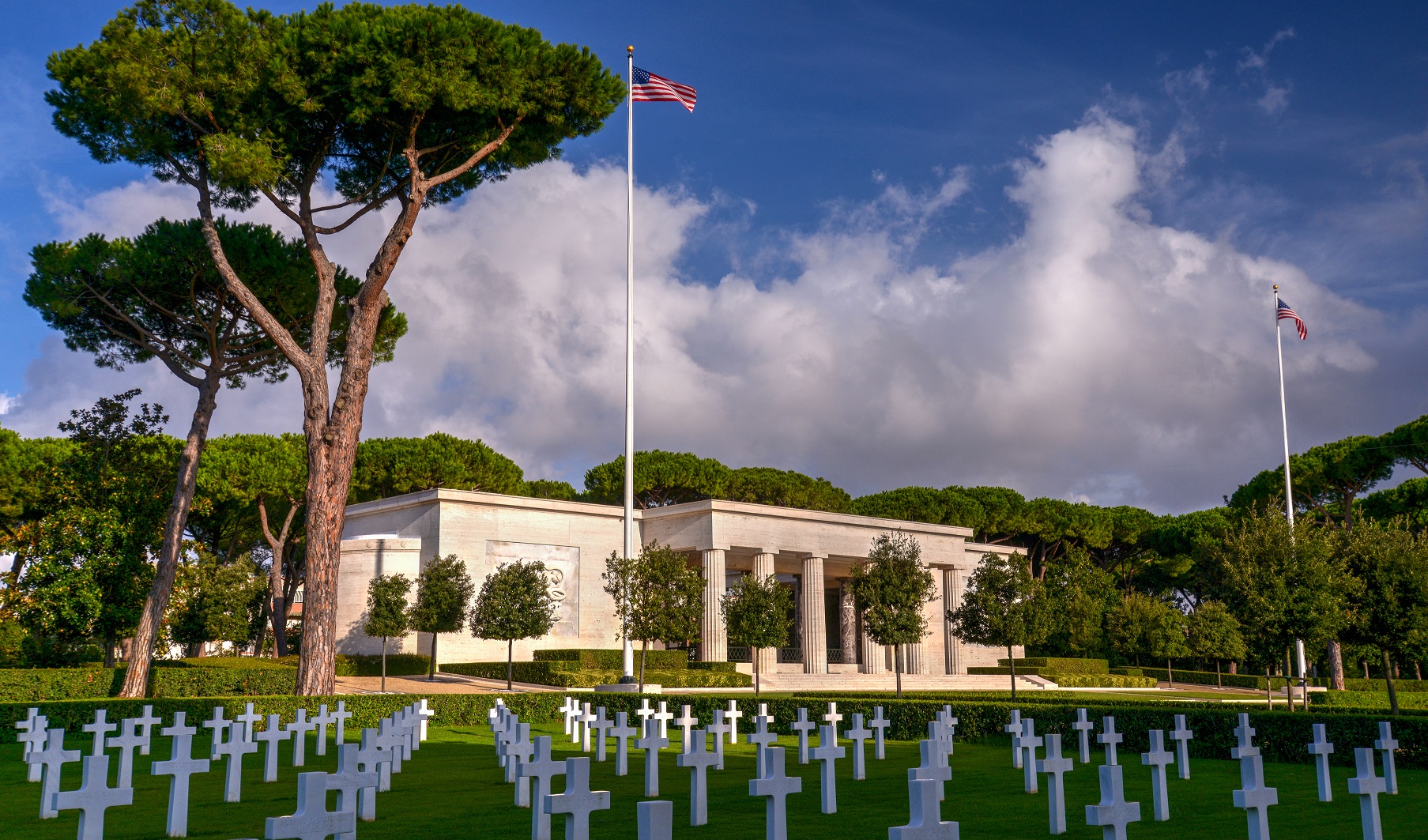
Memorial Day 1945. The location: the Sicily-Rome American Cemetery in Nettuno, Italy. At the time, approximately 20,000 American soldiers were buried in the cemetery, killed during the campaign in Sicily and the first part of the subsequent Italian campaign (Sept. 1943 - June 1944). Over the years, many American families had the bodies of their loved ones returned to the United States. Among the 7,858 still in the cemetery is Captain Henry Waskow, subject of the most famous column written by an American journalist in the war; Ernie Pyle (killed by the Japanese in April 1945).
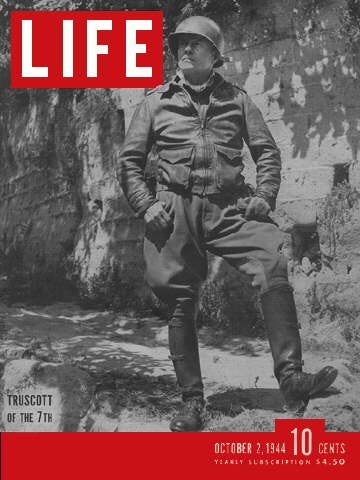
The speaker was General Lucien Truscott, commander of the Fifth Army. When he rose to speak, Truscott turned away from the audience to face the dead who he addressed in his gravelly voice. There is no transcript of his remarks. The most complete account we have is from Bill Mauldin, the famous Army cartoonist, who was in the audience. Mauldin was a GI favorite because he understood the soldiers and took pokes at the top brass. This is what he later wrote:
“When Truscott spoke he turned away from the visitors and addressed himself to the corpses he had commanded here. It was the most moving gesture I ever saw. It came from a hard-boiled old man who was incapable of planned dramatics.
“The general’s remarks were brief and extemporaneous. He apologized to the dead men for their presence here. He said everybody tells leaders it is not their fault that men get killed in war, but that every leader knows in his heart this is not altogether true.
“He said he hoped anybody here through any mistake of his would forgive him, but he realized that was asking a hell of a lot under the circumstances. . . . he would not speak about the glorious dead because he didn’t see much glory in getting killed if you were in your late teens or early twenties. He promised that if in the future he ran into anybody, especially old men, who thought death in battle was glorious, he would straighten them out. He said he thought that was the least he could do,”
Truscott commanded a division in the invasion of Sicily and later in the advance up the Italian peninsula. His division participated in the landing at Anzio in January 1944 and he was promoted to Corps commander in March, leading the Allied breakout in May. His Corps landed in the invasion of Southern France in August 1944 and in December he was promoted to command of the Fifth Army in Italy, leading it in its final campaign in the spring of 1945. In October 1945 he took over command of Third Army in Germany after General George Patton's dismissal. He retired in 1947 and died in 1965.
In a 2023 article, the general's grandson, Lucien Truscott IV, wrote about his grandfather and that day. Of General Truscott's time in Germany, Lucien writes:
General Dwight D. Eisenhower relieved Patton of command of the Third Army and turned command over to Grandpa, appointing him Military Governor of Bavaria and putting him in charge of all the Displaced Person camps in Southern Germany. Under Patton, Jewish survivors of the Holocaust were being kept in camps in conditions not much better than they suffered in the Nazi concentration camps. Grandpa moved the Jewish survivors into housing at German army posts he seized and arranged for a dozen Army Rabbis to be sent to Bavaria to serve the survivors. Grandpa ordered that the first Seder in Germany in over a decade be held in Munich in April of 1946, and ordered that “A Survivors Haggadah” be compiled by survivors and printed by the Third Army for the occasion.
He then recounts a discussion that General Truscott had with Lucien IV's father, when he was preparing to ship out for the Korean War:
I knew Grandpa growing up as a boy and spent several summers with him and Grandma, Sara Randolph Truscott, at their home in Northern Virginia. I don’t recall seeing Grandpa smile much when I was a boy. The war, and what he did as a commander of U.S. soldiers, and what he saw during and after the war, left him a broken man. The only time he ever said anything about the war was to my father on the night before he shipped out to serve in the Korean War. They were standing at night after supper along a fence behind a farmhouse Grandpa had bought for his retirement in Loudon County, Virginia. Dad asked Grandpa what advice he could give him before he went to war. Dad told me it was the only time in his life he ever saw his father cry. Dad said that Grandpa began sobbing so hard, he had to lean with his arms over the fence in order to remain standing. Every Memorial Day, I remember his words to my father that night: “The bodies, the bodies, all those dead boys, the bodies…”
Sunday, May 26, 2024
John Robert Fox
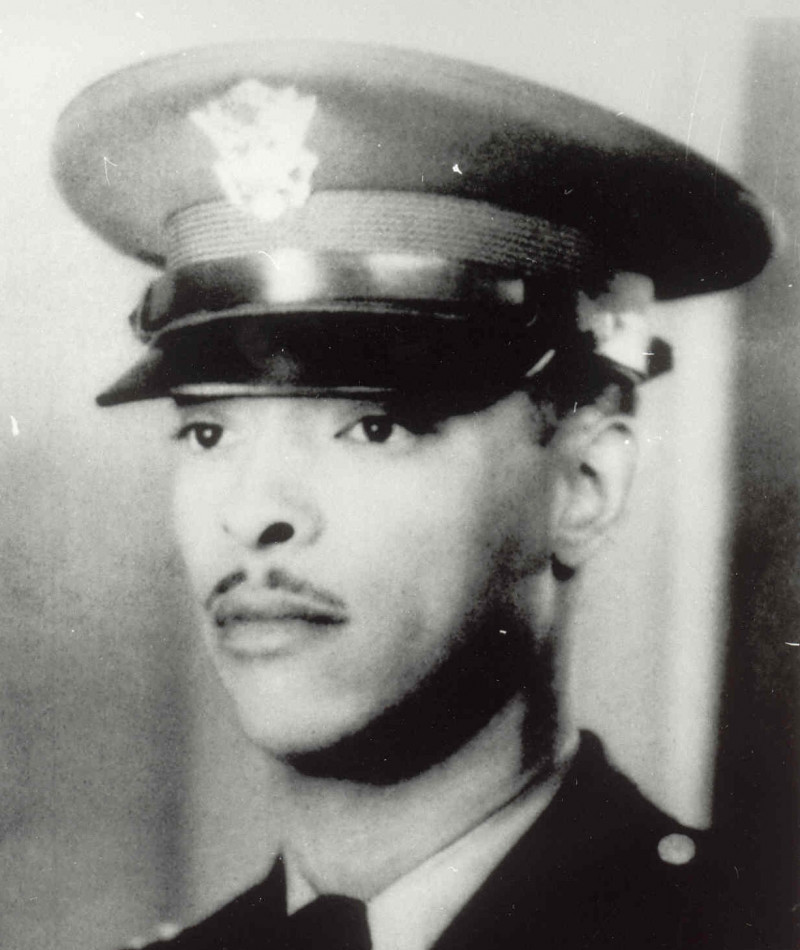 John Robert Fox received the Medal of Honor for his actions on December 26, 1944. Fox was a 29 year old first lieutenant and a forward artillery observer. He was stationed, along with eight Italian partisans, in the small Italian mountain town of Sommocolonia, when it was overrun by German soldiers. Calling in artillery as the enemy drew closer, he finally called in a strike directly on his position, despite the risk to his own life. The resulting barrage killed Fox and the partisans, along with about 100 Germans. His citation is below.
Negro soldiers, as they were called then, were denied Medal of Honor consideration during World War Two. It was only in the 1990s that an Army review commission recommended several soldiers for our country's highest honor. In 1997 President Clinton presented the Medal of Honor to seven recipients. For six, including Fox, the award was posthumous and presented to family members.
For conspicuous gallantry and intrepidity at the risk of his life above and beyond the call of duty: First Lieutenant John R. Fox distinguished himself by extraordinary heroism at the risk of his own life on 26 December 1944 in the Serchio River Valley Sector, in the vicinity of Sommocolonia, Italy. Lieutenant Fox was a member of Cannon Company, 366th Infantry, 92d Infantry Division, acting as a forward observer, while attached to the 598th Field Artillery Battalion. Christmas Day in the Serchio Valley was spent in positionswhich had been occupied for some weeks. During Christmas night, there was a gradual influx of enemy soldiers in civilian clothes and by early morning the town was largely in enemy hands. An organized attack by uniformed German formations was launched around 0400 hours, 26 December 1944. Reports were received that the area was being heavily shelled by everything the Germans had, and although most of the U.S. infantry forces withdrew from the town, Lieutenant Fox and members of his observer party remained behind on the second floor of a house, directing defensive fires. Lieutenant Fox reported at 0800 hours that the Germans were in the streets and attacking in strength. He called for artillery fire increasingly close to his own position. He told his battalion commander, "That was just where I wanted it. Bring it in 60 yards!" His commander protested that there was a heavy barrage in the area and the bombardment would be too close. Lieutenant Fox gave his adjustment, requesting that the barrage be fired. The distance was cut in half. The Germans continued to press forward in large numbers, surrounding the position. Lieutenant Fox again called for artillery fire with the commander protesting again, stating, "Fox, that will be on you!" The last communication from Lieutenant Fox was, "Fire It! There's more of them than there are of us. Give them hell!" The bodies of Lieutenant Fox and his party were found in the vicinity of his position when his position was taken. This action, by Lieutenant Fox, at the cost of his own life, inflicted heavy casualties, causing the deaths of approxamately 100 German soldiers, thereby delaying the advance of the enemy until infantry and artillery units could by reorganized to meet the attack. Lieutenant Fox's extraordinarily valorous actions exemplify the highest traditions of the military service.
Danny Peterson
There were 6 boys in my 7th-grade class, one of whom was Danny Peterson. Nicest kid you ever knew. He won the Medal of Honor, died in Vietnam in 1970. The highway that runs past our little town has been named in his honor. It's not enough, but there's not much else you can do. pic.twitter.com/Mw7imNqSSH
— Bill James Online (@billjamesonline) November 12, 2020
Danny Peterson's Medal of Honor citation:
Specialist Petersen distinguished himself while serving as an armored personnel carrier commander with Company B during a combat operation against a North Vietnamese Army Force estimated to be of battalion size. During the initial contact with the enemy, an armored personnel carrier was disabled and the crewmen were pinned down by the heavy onslaught of enemy small arms, automatic weapons and rocket-propelled grenade fire. Spec. Petersen immediately maneuvered his armored personnel carrier to a position between the disabled vehicle and the enemy. He placed suppressive fire on the enemy's well-fortified position, thereby enabling the crewmembers of the disabled personnel carrier to repair their vehicle. He then maneuvered his vehicle, while still under heavy hostile fire to within 10 feet of the enemy's defensive emplacement. After a period of intense fighting, his vehicle received a direct hit and the driver was wounded. With extraordinary courage and selfless disregard for his own safety, Spec. Petersen carried his wounded comrade 45 meters across the bullet-swept field to a secure area. He then voluntarily returned to his disabled armored personnel carrier to provide covering fire for both the other vehicles and the dismounted personnel of his platoon as they withdrew. Despite heavy fire from 3 sides, he remained with his disabled vehicle, alone and completely exposed. Spec. Petersen was standing on top of his vehicle, firing his weapon, when he was mortally wounded. His heroic and selfless actions prevented further loss of life in his platoon. Spec. Petersen's conspicuous gallantry and extraordinary heroism are in the highest traditions of the service and reflect great credit on him, his unit, and the U.S. Army.
Peterson was 20 years old when he died.
Sunday, May 28, 2023
Waddy's Wagon
When life imitates (nose) art.
— WW2 Airfields Archive (@WW2Airfields) February 14, 2023
B-29 Superfortress crew replicate the nose art which is a caricature of them in November 1944.
I believe the aircraft and crew was lost in action in 1945. pic.twitter.com/BwcNG9YnJa
I'd seen this photo before but until recently did not know the entire crew was killed in action. This is Waddy's Wagon, a B-29 Superfortress based in Saipan. The crew is imitating the caricature painted on the plane. They flew their first mission over Tokyo in November 1944. On January 9, 1945 Waddy's Wagon was shot down while attempting to escort another damaged B-29 to safety after a raid on the Nakajima aircraft factory.
The man in the lead is Captain Walter R "Waddy" Young from Oklahoma, an All-American college football player who also played in the National Football League. He volunteered for the Army Air Corps in 1941 and was 28 when he died.
The other crew members are:
Jack Vetters, pilot, Texas
John Ellis, bombardier, Missouri
Paul Garrison, navigator, Pennsylvania
George Avon, radio operator, New York
Bernard Black, flight engineer, New York
Kenneth Mansie, flight technician, Maine
Lawrence Lee, gunner, North Dakota
Wilbur Chapman, gunner, Texas
Corbett Carnegie, gunner, New York
Joseph Gatto, gunner, New York
Sunday, May 29, 2022
Those We Remember
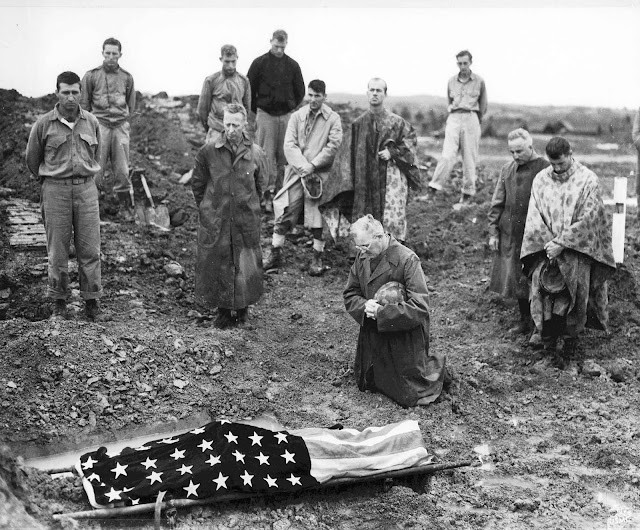
Okinawa, May 7, 1945. The man kneeling is Marine Colonel Francis Fenton. The flag serves as a shroud for Marine Private First Class Mike Fenton, Colonel Fenton's son. Father and son served in the same regiment. Pfc Fenton was killed beating back a Japanese counterattack. After praying over his son, Colonel Fenton rose, looked at the bodies of other dead Marines and remarked, ‘Those poor souls. They didn’t have their fathers here’.
Sunday, May 30, 2021
Remembering
I'd never seen this photo before either. The carrier Intrepid was hit by three kamikaze planes between the fall of 1944 and spring 1945, killing 85 American sailors. We honor them.
NEVER FORGET
— BraveHeart (@Braveheart_USA) May 30, 2021
"This is a mass burial at sea, on the USS Intrepid in 1944 following a kamikaze attack. I've never seen this photo, and I figure most of you probably haven't either. I posted so people can see, and remember the incredible sacrifices made on our behalf." pic.twitter.com/PZ9CkXklal
Monday, May 25, 2020
Six Seconds
Excerpt from speech by Lt Gen John Kelly on November 13, 2010:
[O]n April 22, 2008, two Marine infantry battalions, 1/9 “The Walking Dead,” and 2/8, were switching out in Ramadi. One battalion was in the closing days of its deployment, the other just starting its seven-month combat tour. Two Marines, Cpl. Jonathan Yale and Lance Cpl. Jordan Haerter, 22 and 20 respectively, one from each battalion, were assuming the watch at the entrance gate of an outpost that contained a makeshift barracks housing 50 Marines.
The same ramshackle building was also home to 100 Iraqi police, our allies in the fight against terrorists in Ramadi – known at the time as the most dangerous city on earth, and owned by al-Qaeda.
Yale was a dirt-poor mixed-race kid from Virginia, with a wife, a mother and a sister, who all lived with him and he supported. He did this on a yearly salary of less than $23,000. Haerter, on the other hand, was a middle-class white kid from Long Island. They were from two completely different worlds. Had they not joined the Marines, they would never have met each other, or understood that multiple Americas exist simultaneously, depending on one’s race, ethnicity, religious affiliation, education level, economic status, or where you might have been born. But they were Marines, combat Marines, forged in the same crucible, and because of this bond they were brothers as close – or closer – than if they were born of the same woman. The mission orders they received from their sergeant squad leader, I’m sure, went something like this: “OK, take charge of this post and let no unauthorized personnel or vehicles pass. You clear?” I’m also sure Yale and Haerter rolled their eyes and said, in unison, something like, “Yes, sergeant,” with just enough attitude that made the point, without saying the words, “No kidding, sweetheart. We know what we’re doing.” They then relieved two other Marines on watch and took up their post at the entry-control point of Joint Security Station Nasser, in the Sophia section of Ramadi, al Anbar, Iraq.
A few minutes later, a large blue truck turned down the alleyway – perhaps 60 to 70 yards in length – and sped its way through the serpentine concrete Jersey walls. The truck stopped just short of where the two were posted and detonated, killing them both. Twenty-four brick masonry houses were damaged or destroyed. A mosque 100 yards away collapsed. The truck’s engine came to rest 200 yards away, knocking down most of a house down before it stopped. Our explosive experts reckoned the blast was caused by 2,000 pounds of explosive.
Because these two young infantrymen didn’t have it in their DNA to run from danger, they saved 150 of their Iraqi and American brothers in arms. When I read the situation report a few hours after it happened, I called the regimental commander for details. Something about this struck me as different. We expect Marines, regardless of rank or MOS, to stand their ground and do their duty, and even die in the process, if that is what the mission takes. But this just seemed different.
The regimental commander had just returned from the site, and he agreed, but reported that there were no American witnesses to the event – just Iraqi police. If there was any chance of finding out what actually happened, and then to decorate the two Marines to acknowledge their bravery, I’d have to do it, because a combat award requires two eyewitnesses, and we figured the bureaucrats back in Washington would never buy Iraqi statements. If it had any chance at all, it had to come under the signature of a general officer. I traveled to Ramadi the next day and spoke individually to a half-dozen Iraqi police, all of whom told the same story. They all said, “We knew immediately what was going on as soon as the two Marines began firing.” The Iraqi police related that some of them also fired, and then, to a man, ran for safety just prior to the explosion. All survived. Many were injured, some seriously. One of the Iraqis elaborated, and with tears welling up, said, “They’d run like any normal man would to save his life. ”What he didn’t know until then, and what he learned that very instant, was that Marines are not normal. Choking past the emotion, he said, “Sir, in the name of God, no sane man would have stood there and done what they did. They saved us all.”
What we didn’t know at the time, and only learned after I submitted both Yale and Haerter for posthumous Navy Crosses, was that one of our security cameras recorded some of the attack. It happened exactly as the Iraqis described it. It took exactly six seconds from when the truck entered the alley until it detonated. You can watch the last six seconds of their young lives. I suppose it took about a second for the two Marines to separately come to the same conclusion about what was going on once the truck came into their view at the far end of the alley. No time to talk it over, or call the sergeant to ask what they should do. Only enough time to take half an instant and think about what the sergeant told them to do only a few minutes before: “Let no unauthorized personnel or vehicles pass.” It took maybe another two seconds for them to present their weapons, take aim, and open up. By this time, the truck was halfway through the barriers and gaining speed.
Here the recording shows a number of Iraqi police, some of whom had fired their AKs, now scattering like the normal and rational men they were, some running right past the Marines, who had three seconds left to live. For about two seconds more, the recording shows the Marines firing their weapons nonstop. The truck’s windshield explodes into shards of glass as their rounds take it apart and tear into the body of the son of a bitch trying to get past them to kill their brothers – American and Iraqi – bedded down in the barracks, totally unaware that their lives at that moment depended entirely on two Marines standing their ground. Yale and Haerter never hesitated. By all reports and by the recording, they never stepped back. They never even shifted their weight. With their feet spread shoulder-width apart, they leaned into the danger, firing as fast as they could. They had only one second left to live, and I think they knew. The truck explodes. The camera goes blank. Two young men go to their God. Six seconds. Not enough time to think about their families, their country, their flag, or about their lives or their deaths, but more than enough time for two very brave young men to do their duty.
[O]n April 22, 2008, two Marine infantry battalions, 1/9 “The Walking Dead,” and 2/8, were switching out in Ramadi. One battalion was in the closing days of its deployment, the other just starting its seven-month combat tour. Two Marines, Cpl. Jonathan Yale and Lance Cpl. Jordan Haerter, 22 and 20 respectively, one from each battalion, were assuming the watch at the entrance gate of an outpost that contained a makeshift barracks housing 50 Marines.
The same ramshackle building was also home to 100 Iraqi police, our allies in the fight against terrorists in Ramadi – known at the time as the most dangerous city on earth, and owned by al-Qaeda.
Yale was a dirt-poor mixed-race kid from Virginia, with a wife, a mother and a sister, who all lived with him and he supported. He did this on a yearly salary of less than $23,000. Haerter, on the other hand, was a middle-class white kid from Long Island. They were from two completely different worlds. Had they not joined the Marines, they would never have met each other, or understood that multiple Americas exist simultaneously, depending on one’s race, ethnicity, religious affiliation, education level, economic status, or where you might have been born. But they were Marines, combat Marines, forged in the same crucible, and because of this bond they were brothers as close – or closer – than if they were born of the same woman. The mission orders they received from their sergeant squad leader, I’m sure, went something like this: “OK, take charge of this post and let no unauthorized personnel or vehicles pass. You clear?” I’m also sure Yale and Haerter rolled their eyes and said, in unison, something like, “Yes, sergeant,” with just enough attitude that made the point, without saying the words, “No kidding, sweetheart. We know what we’re doing.” They then relieved two other Marines on watch and took up their post at the entry-control point of Joint Security Station Nasser, in the Sophia section of Ramadi, al Anbar, Iraq.
A few minutes later, a large blue truck turned down the alleyway – perhaps 60 to 70 yards in length – and sped its way through the serpentine concrete Jersey walls. The truck stopped just short of where the two were posted and detonated, killing them both. Twenty-four brick masonry houses were damaged or destroyed. A mosque 100 yards away collapsed. The truck’s engine came to rest 200 yards away, knocking down most of a house down before it stopped. Our explosive experts reckoned the blast was caused by 2,000 pounds of explosive.
Because these two young infantrymen didn’t have it in their DNA to run from danger, they saved 150 of their Iraqi and American brothers in arms. When I read the situation report a few hours after it happened, I called the regimental commander for details. Something about this struck me as different. We expect Marines, regardless of rank or MOS, to stand their ground and do their duty, and even die in the process, if that is what the mission takes. But this just seemed different.
The regimental commander had just returned from the site, and he agreed, but reported that there were no American witnesses to the event – just Iraqi police. If there was any chance of finding out what actually happened, and then to decorate the two Marines to acknowledge their bravery, I’d have to do it, because a combat award requires two eyewitnesses, and we figured the bureaucrats back in Washington would never buy Iraqi statements. If it had any chance at all, it had to come under the signature of a general officer. I traveled to Ramadi the next day and spoke individually to a half-dozen Iraqi police, all of whom told the same story. They all said, “We knew immediately what was going on as soon as the two Marines began firing.” The Iraqi police related that some of them also fired, and then, to a man, ran for safety just prior to the explosion. All survived. Many were injured, some seriously. One of the Iraqis elaborated, and with tears welling up, said, “They’d run like any normal man would to save his life. ”What he didn’t know until then, and what he learned that very instant, was that Marines are not normal. Choking past the emotion, he said, “Sir, in the name of God, no sane man would have stood there and done what they did. They saved us all.”
What we didn’t know at the time, and only learned after I submitted both Yale and Haerter for posthumous Navy Crosses, was that one of our security cameras recorded some of the attack. It happened exactly as the Iraqis described it. It took exactly six seconds from when the truck entered the alley until it detonated. You can watch the last six seconds of their young lives. I suppose it took about a second for the two Marines to separately come to the same conclusion about what was going on once the truck came into their view at the far end of the alley. No time to talk it over, or call the sergeant to ask what they should do. Only enough time to take half an instant and think about what the sergeant told them to do only a few minutes before: “Let no unauthorized personnel or vehicles pass.” It took maybe another two seconds for them to present their weapons, take aim, and open up. By this time, the truck was halfway through the barriers and gaining speed.
Here the recording shows a number of Iraqi police, some of whom had fired their AKs, now scattering like the normal and rational men they were, some running right past the Marines, who had three seconds left to live. For about two seconds more, the recording shows the Marines firing their weapons nonstop. The truck’s windshield explodes into shards of glass as their rounds take it apart and tear into the body of the son of a bitch trying to get past them to kill their brothers – American and Iraqi – bedded down in the barracks, totally unaware that their lives at that moment depended entirely on two Marines standing their ground. Yale and Haerter never hesitated. By all reports and by the recording, they never stepped back. They never even shifted their weight. With their feet spread shoulder-width apart, they leaned into the danger, firing as fast as they could. They had only one second left to live, and I think they knew. The truck explodes. The camera goes blank. Two young men go to their God. Six seconds. Not enough time to think about their families, their country, their flag, or about their lives or their deaths, but more than enough time for two very brave young men to do their duty.
Monday, May 27, 2019
Johnnie D Hutchins
It was the photo that caught my attention. I'd been looking for something else when coming across it on Reddit. Struck by its clarity and perspective, seemingly taken from the viewpoint of the chickens in the bare dirt yard; the adult man and woman, along with six children, five girls and a boy, posed in front of a rough wooden unpainted home, far enough away that their features were indistinct, and accompanied by this inscription, I decided to find out more:
"Family of Seaman 1/C Johnnie D Hutchins who was mortally wounded on September 4, 1943 when he turned LST-473 from the path of Japanese torpedo. He was posthumously awarded the Medal of Honor. Family home, Lissie, Texas, 1944."Johnnie D Hutchins was born during 1922 in Weimar, Texas, a town of about 1,000 inhabitants halfway between Houston and Austin, one of eight children (a daughter died in 1941 before this photo was taken). Soon thereafter the family moved to Lissie, a smaller town, about 40 miles closer to Houston, where Johnnie graduated from Eagle Lake High School. His father, Johnnie Marion Hutchins, was a farm laborer, his mother Cally Drue Cooper.
Graduating from Eagle Lake, where he played on the football team, Johnnie worked at a shipyard on the Houston Ship Channel before enlisting in the Navy in November 1942. After training he was sent to the Pacific Theater, where on September 4, 1943 Seaman First Class Hutchins found himself on LST (Landing Ship, Tank) - 473 carrying troops of the Australian 9th Division, along with its normal complement of 163 naval officers and crew, as it approached Lae, New Guinea. His ship was part of a small flotilla of six LSTs, three minesweepers, and two subchasers, which came under heavy attack by Japanese dive bombers and torpedo planes.

(LST-473 in the South Pacific)
Japanese Val dive bombers scored two direct hits on Johnnie's LST, killing six Americans, wounding 31 (including 18 Australian soldiers) and igniting fires, just as the helmsman and Johnnie spotted a torpedo heading directly towards the craft. One bomb hit the pilot house, wounding the helmsman and throwing him clear from the structure. Hutchins, also in the pilot house, was badly wounded in his torso and tossed to the deck. Struggling to his feet, he reached the helm as the torpedo continued to close. Grasping the wheel he turned it to the right, causing the torpedo to miss the 328 foot vessel with little room to spare, saving countless lives. By the time his shipmates reached him Johnnie was dead, his hands still tightly gripping the spokes. The crew were able to extinguish the fires from the two bombs and save the boat.

Along with saving lives, Hutchins' action preserved LST-473 which went on to participate in four more Pacific operations including landings at Leyte (October 1944) and Lingayen Gulf (January 1945).
 (Bomb damage, LST-473)
On May 2, 1944 the U.S. Navy commissioned the destroyer U.S.S. Johnnie D Hutchins, his mother christening the ship with the help of Johnnie's 17-year old fiancee, Ruby Mae Butler. On September 21, 1944 at a public ceremony at the Houston Coliseum, Admiral AC Bennett presented the Congressional Medal of Honor to Johnnie's family. The Hutchins family used the death benefit of $475.20 to purchase the home they rented.
After the war, Johnnie's body was returned from New Guinea and reburied at Lakeside Cemetery in Eagle Lake. He has not been forgotten. Eagle Lake named a street after him and, in 2000, surviving shipmates from LST-473 gathered at the cemetery for a memorial service. A building at the Naval Air Station in Dallas is named after him. In 2017 the Texas Legislature passed a bill designating Alt US-90 within Wharton County as Johnnie David Hutchins Memorial Highway.
In 2001, the family donated his Medal of Honor to the National WW2 Museum in New Orleans, where it is on display. In 2012, Johnnie's brother Harold, who was only five when Johnnie died, recorded this brief oral history for the National WW2 Museum (the video also shows what an LST looked like as well as Japanese bombers).
In 1947, Johnnie's dad passed away from a heart attack at the age of 51. I've been unable to find out more about his mother. Johnnie's fiancee, Ruby Mae, a member of the Texas Cowgirls singing group, worked on bombers during WW2 and learned to fly, married in the late 1940s, became a registered nurse, and died in 2008.
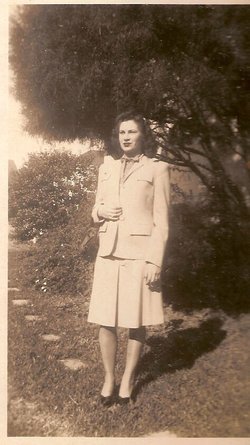 (Ruby Mae Butler Covington)
Sunday, May 27, 2018
Six Seconds
For Memorial Day . . .
Excerpt from speech by Lt Gen John Kelly on November 13, 2010:

(Corporals Jordan and Yale)
[O]n April 22, 2008, two Marine infantry battalions, 1/9 “The Walking Dead,” and 2/8, were switching out in Ramadi. One battalion was in the closing days of its deployment, the other just starting its seven-month combat tour. Two Marines, Cpl. Jonathan Yale and Lance Cpl. Jordan Haerter, 22 and 20 respectively, one from each battalion, were assuming the watch at the entrance gate of an outpost that contained a makeshift barracks housing 50 Marines.
The same ramshackle building was also home to 100 Iraqi police, our allies in the fight against terrorists in Ramadi – known at the time as the most dangerous city on earth, and owned by al-Qaeda.
Yale was a dirt-poor mixed-race kid from Virginia, with a wife, a mother and a sister, who all lived with him and he supported. He did this on a yearly salary of less than $23,000. Haerter, on the other hand, was a middle-class white kid from Long Island. They were from two completely different worlds. Had they not joined the Marines, they would never have met each other, or understood that multiple Americas exist simultaneously, depending on one’s race, ethnicity, religious affiliation, education level, economic status, or where you might have been born. But they were Marines, combat Marines, forged in the same crucible, and because of this bond they were brothers as close – or closer – than if they were born of the same woman. The mission orders they received from their sergeant squad leader, I’m sure, went something like this: “OK, take charge of this post and let no unauthorized personnel or vehicles pass. You clear?” I’m also sure Yale and Haerter rolled their eyes and said, in unison, something like, “Yes, sergeant,” with just enough attitude that made the point, without saying the words, “No kidding, sweetheart. We know what we’re doing.” They then relieved two other Marines on watch and took up their post at the entry-control point of Joint Security Station Nasser, in the Sophia section of Ramadi, al Anbar, Iraq.
A few minutes later, a large blue truck turned down the alleyway – perhaps 60 to 70 yards in length – and sped its way through the serpentine concrete Jersey walls. The truck stopped just short of where the two were posted and detonated, killing them both. Twenty-four brick masonry houses were damaged or destroyed. A mosque 100 yards away collapsed. The truck’s engine came to rest 200 yards away, knocking down most of a house down before it stopped. Our explosive experts reckoned the blast was caused by 2,000 pounds of explosive.
Because these two young infantrymen didn’t have it in their DNA to run from danger, they saved 150 of their Iraqi and American brothers in arms. When I read the situation report a few hours after it happened, I called the regimental commander for details. Something about this struck me as different. We expect Marines, regardless of rank or MOS, to stand their ground and do their duty, and even die in the process, if that is what the mission takes. But this just seemed different.
The regimental commander had just returned from the site, and he agreed, but reported that there were no American witnesses to the event – just Iraqi police. If there was any chance of finding out what actually happened, and then to decorate the two Marines to acknowledge their bravery, I’d have to do it, because a combat award requires two eyewitnesses, and we figured the bureaucrats back in Washington would never buy Iraqi statements. If it had any chance at all, it had to come under the signature of a general officer. I traveled to Ramadi the next day and spoke individually to a half-dozen Iraqi police, all of whom told the same story. They all said, “We knew immediately what was going on as soon as the two Marines began firing.” The Iraqi police related that some of them also fired, and then, to a man, ran for safety just prior to the explosion. All survived. Many were injured, some seriously. One of the Iraqis elaborated, and with tears welling up, said, “They’d run like any normal man would to save his life. ”What he didn’t know until then, and what he learned that very instant, was that Marines are not normal. Choking past the emotion, he said, “Sir, in the name of God, no sane man would have stood there and done what they did. They saved us all.”
What we didn’t know at the time, and only learned after I submitted both Yale and Haerter for posthumous Navy Crosses, was that one of our security cameras recorded some of the attack. It happened exactly as the Iraqis described it. It took exactly six seconds from when the truck entered the alley until it detonated. You can watch the last six seconds of their young lives. I suppose it took about a second for the two Marines to separately come to the same conclusion about what was going on once the truck came into their view at the far end of the alley. No time to talk it over, or call the sergeant to ask what they should do. Only enough time to take half an instant and think about what the sergeant told them to do only a few minutes before: “Let no unauthorized personnel or vehicles pass.” It took maybe another two seconds for them to present their weapons, take aim, and open up. By this time, the truck was halfway through the barriers and gaining speed.
Here the recording shows a number of Iraqi police, some of whom had fired their AKs, now scattering like the normal and rational men they were, some running right past the Marines, who had three seconds left to live. For about two seconds more, the recording shows the Marines firing their weapons nonstop. The truck’s windshield explodes into shards of glass as their rounds take it apart and tear into the body of the son of a bitch trying to get past them to kill their brothers – American and Iraqi – bedded down in the barracks, totally unaware that their lives at that moment depended entirely on two Marines standing their ground. Yale and Haerter never hesitated. By all reports and by the recording, they never stepped back. They never even shifted their weight. With their feet spread shoulder-width apart, they leaned into the danger, firing as fast as they could. They had only one second left to live, and I think they knew. The truck explodes. The camera goes blank. Two young men go to their God. Six seconds. Not enough time to think about their families, their country, their flag, or about their lives or their deaths, but more than enough time for two very brave young men to do their duty.
Excerpt from speech by Lt Gen John Kelly on November 13, 2010:
(Corporals Jordan and Yale)
[O]n April 22, 2008, two Marine infantry battalions, 1/9 “The Walking Dead,” and 2/8, were switching out in Ramadi. One battalion was in the closing days of its deployment, the other just starting its seven-month combat tour. Two Marines, Cpl. Jonathan Yale and Lance Cpl. Jordan Haerter, 22 and 20 respectively, one from each battalion, were assuming the watch at the entrance gate of an outpost that contained a makeshift barracks housing 50 Marines.
The same ramshackle building was also home to 100 Iraqi police, our allies in the fight against terrorists in Ramadi – known at the time as the most dangerous city on earth, and owned by al-Qaeda.
Yale was a dirt-poor mixed-race kid from Virginia, with a wife, a mother and a sister, who all lived with him and he supported. He did this on a yearly salary of less than $23,000. Haerter, on the other hand, was a middle-class white kid from Long Island. They were from two completely different worlds. Had they not joined the Marines, they would never have met each other, or understood that multiple Americas exist simultaneously, depending on one’s race, ethnicity, religious affiliation, education level, economic status, or where you might have been born. But they were Marines, combat Marines, forged in the same crucible, and because of this bond they were brothers as close – or closer – than if they were born of the same woman. The mission orders they received from their sergeant squad leader, I’m sure, went something like this: “OK, take charge of this post and let no unauthorized personnel or vehicles pass. You clear?” I’m also sure Yale and Haerter rolled their eyes and said, in unison, something like, “Yes, sergeant,” with just enough attitude that made the point, without saying the words, “No kidding, sweetheart. We know what we’re doing.” They then relieved two other Marines on watch and took up their post at the entry-control point of Joint Security Station Nasser, in the Sophia section of Ramadi, al Anbar, Iraq.
A few minutes later, a large blue truck turned down the alleyway – perhaps 60 to 70 yards in length – and sped its way through the serpentine concrete Jersey walls. The truck stopped just short of where the two were posted and detonated, killing them both. Twenty-four brick masonry houses were damaged or destroyed. A mosque 100 yards away collapsed. The truck’s engine came to rest 200 yards away, knocking down most of a house down before it stopped. Our explosive experts reckoned the blast was caused by 2,000 pounds of explosive.
Because these two young infantrymen didn’t have it in their DNA to run from danger, they saved 150 of their Iraqi and American brothers in arms. When I read the situation report a few hours after it happened, I called the regimental commander for details. Something about this struck me as different. We expect Marines, regardless of rank or MOS, to stand their ground and do their duty, and even die in the process, if that is what the mission takes. But this just seemed different.
The regimental commander had just returned from the site, and he agreed, but reported that there were no American witnesses to the event – just Iraqi police. If there was any chance of finding out what actually happened, and then to decorate the two Marines to acknowledge their bravery, I’d have to do it, because a combat award requires two eyewitnesses, and we figured the bureaucrats back in Washington would never buy Iraqi statements. If it had any chance at all, it had to come under the signature of a general officer. I traveled to Ramadi the next day and spoke individually to a half-dozen Iraqi police, all of whom told the same story. They all said, “We knew immediately what was going on as soon as the two Marines began firing.” The Iraqi police related that some of them also fired, and then, to a man, ran for safety just prior to the explosion. All survived. Many were injured, some seriously. One of the Iraqis elaborated, and with tears welling up, said, “They’d run like any normal man would to save his life. ”What he didn’t know until then, and what he learned that very instant, was that Marines are not normal. Choking past the emotion, he said, “Sir, in the name of God, no sane man would have stood there and done what they did. They saved us all.”
What we didn’t know at the time, and only learned after I submitted both Yale and Haerter for posthumous Navy Crosses, was that one of our security cameras recorded some of the attack. It happened exactly as the Iraqis described it. It took exactly six seconds from when the truck entered the alley until it detonated. You can watch the last six seconds of their young lives. I suppose it took about a second for the two Marines to separately come to the same conclusion about what was going on once the truck came into their view at the far end of the alley. No time to talk it over, or call the sergeant to ask what they should do. Only enough time to take half an instant and think about what the sergeant told them to do only a few minutes before: “Let no unauthorized personnel or vehicles pass.” It took maybe another two seconds for them to present their weapons, take aim, and open up. By this time, the truck was halfway through the barriers and gaining speed.
Here the recording shows a number of Iraqi police, some of whom had fired their AKs, now scattering like the normal and rational men they were, some running right past the Marines, who had three seconds left to live. For about two seconds more, the recording shows the Marines firing their weapons nonstop. The truck’s windshield explodes into shards of glass as their rounds take it apart and tear into the body of the son of a bitch trying to get past them to kill their brothers – American and Iraqi – bedded down in the barracks, totally unaware that their lives at that moment depended entirely on two Marines standing their ground. Yale and Haerter never hesitated. By all reports and by the recording, they never stepped back. They never even shifted their weight. With their feet spread shoulder-width apart, they leaned into the danger, firing as fast as they could. They had only one second left to live, and I think they knew. The truck explodes. The camera goes blank. Two young men go to their God. Six seconds. Not enough time to think about their families, their country, their flag, or about their lives or their deaths, but more than enough time for two very brave young men to do their duty.
Monday, May 30, 2016
Americans In Europe
For Memorial Day
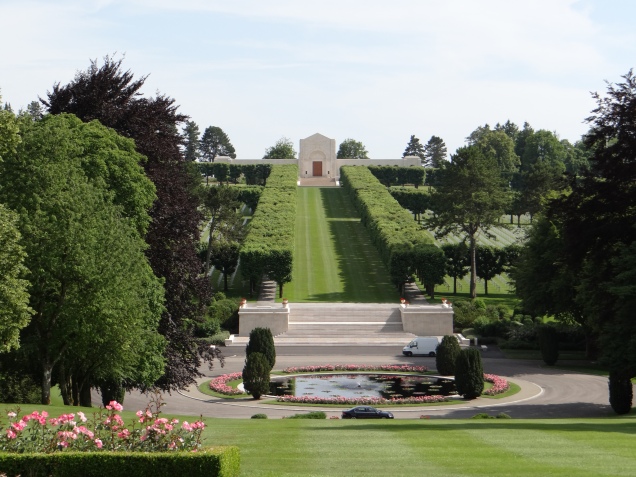
Last year, Civil War historian Brooks Simpson was in Europe visiting battle sites and American cemeteries containing WWI and WWII dead. Take a look at his photos and commentary. A couple of examples:
The Meuse-Argonne Cemetery; 14,246 Americans are buried here.
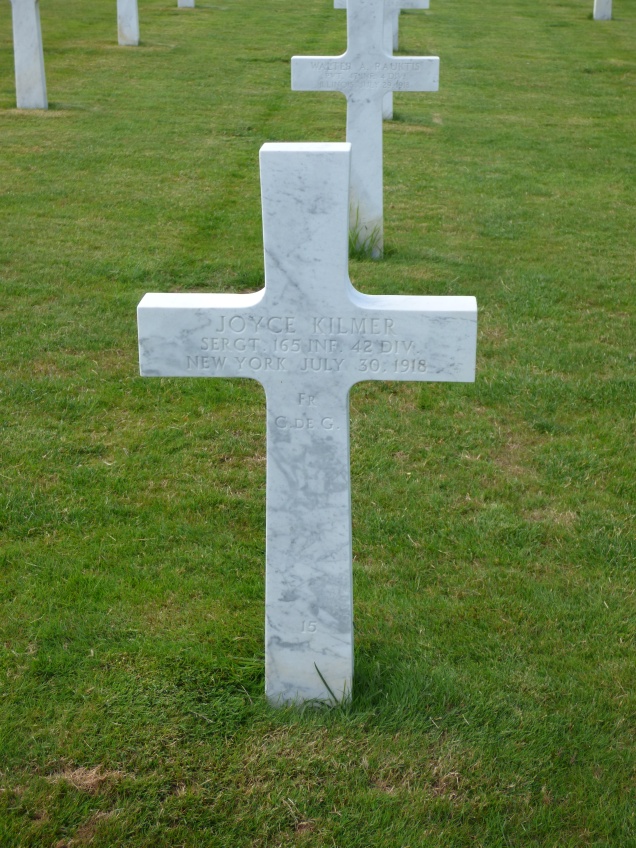
 Grave marker of Joyce Kilmer, author of the poem "Trees", killed in action, July 30, 1918.
Last year, Civil War historian Brooks Simpson was in Europe visiting battle sites and American cemeteries containing WWI and WWII dead. Take a look at his photos and commentary. A couple of examples:
The Meuse-Argonne Cemetery; 14,246 Americans are buried here.
Grave marker of Joyce Kilmer, author of the poem "Trees", killed in action, July 30, 1918.
Sunday, May 24, 2015
The Death Of Captain Waskow
For Memorial Day: the 2013 post featuring Ernie Pyle's moving piece on the death of Captain Henry Waskow. We remember and honor all Americans who died in military service.
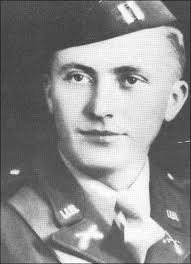 (Captain Waskow)
Saturday, May 24, 2014
The Bloody Angle
"I don't expect to go to Hell, but if I do, I am sure that Hell can't beat that terrible scene."For Memorial Day
For last year's post see The Death Of Captain Waskow
THC spent last weekend in Virginia, along with his friends Larry and Bob, and about forty other Civil War nuts, on a tour of The Wilderness and Spotsylvania Court House, two of the battles of the Overland Campaign of 1864. Our guide was the knowledgeable, entertaining, and acerbic Robert Krick, Chief Historian at Fredericksburg & Spotsylvania National Military Park for 31 years until his retirement in 2002. It was a beautiful Virginia weekend with sunny skies, a high temperature of 70 and very little humidity. The battlefields, particularly Spotsylvania, looked bucolic.
.JPG)
The Battle of the Wilderness was two days (May 5-6). Spotsylvania was two weeks (May 8-21). Major fighting took place on May 8,10,12, 18 and 19, while on the other days there was constant skirmishing, shelling and sniper fire. For instance, on May 9 Union Sixth Corps Commander John Sedgwick was killed by a sharpshooter firing from 600 yards away. Sedgwick was the most senior Union officer killed during the war and the incident occurred as he was trying to reassure his men who were ducking the sniper.
.JPG)
The field fortifications built during the battle dwarfed those of previous battles making the scene look like something from the First World War and other 20th century battlefields.

(Spotsylvania, The Bloody Angle)
Within those two weeks it was the events of May 12 that stood out in everyone's recollection both at the time and after the war. The center of the Confederate line at Spotsylvania was what became known as The Muleshoe, a protruding salient about a mile in depth and width, vulnerable to Federal attack on three sides

To take advantage of that vulnerability a large Federal force under the command of General Winfield Scott Hancock launched a surprise attack at dawn on May 12. The Union troops stormed the Rebel positions by using an unusual tactic. Instead of arraying themselves in line and firing volleys as they approached, the Union regiments aligned in deep columns and charged, not stopping to shoot. The rapid pace of the Union attack led to initial success, aided by Robert E Lee's decision to remove cannon from the salient the night before, and the rainy weather preventing many of the Confederate rifles from firing.
The Confederate line was shattered. Quickly responding, the Rebels began to counterattack and regain some of the lost ground. Lee needed his men to buy some time while he constructed a new defensive line at the base of the salient. In one area a Mississippi and a South Caroline brigade fought their way back to the original breastworks. For the next 20 hours they and the Union forces on the other side were locked together in the most sustained, bitter fighting of the war at what became known as The Bloody Angle.
.JPG)
It rained throughout the day and evening of May 12. Trees shattered by artillery fire (though one 22-inch oak was cut down solely by musket fire a dramatic event at around midnight noted in most of the surviving accounts; its stump still on display at the Smithsonian) stood over a morass of mud which became deeper as the day wore on and to which was added, as one soldier noted, a mixture of "blood and brains". On the Confederate side the breastworks were taller than a man. Behind were traverses; trenches dug perpendicular to the breastwork, with three sides shored up by logs with the Rebel troops huddled inside, isolated from the traverses on either side of them described as like "being in a three sided log cabin without a roof". This configuration led to each group of men in each traverse fighting their own battle for hours on end.
On the other side of the breastworks was a short level area and then a slope leading down to a gully. As long as the Federal troops stayed in the gully, Confederates could not shoot them unless they themselves stood on top of the breastworks. Thousands of Union soldiers eventually huddled there. But all through the day, the Union troops would regroup and launch another charge followed by a Confederate counterattack and when that happened the fighting was at pointblank range. The ferocity was such that the Bloody Angle is one of the few instances in the war where a large number of bayonet wounds documented. As we walked those green fields it was hard to imagine the courage and fortitude it took those brave Union soldiers to venture charge after charge, for hour on end, against those fortifications.
Here are the recollections of two soldiers, one Union and one Confederate both of whom saw much combat during the war and for each The Bloody Angle stood out in uniquely in its horror.
From Hard Marching Every Day by Private Wilbur Fisk, 2nd Vermont Regiment

But the most singular and obstinate fighting that I have seen during the war, or ever heard or dreamed of in my life, was the fight of last Thursday [May 12] . . . The rebels were on one side of the breastwork, and we on the other. We could touch their guns with ours. They would load, jump up and fire into us, and we did the same to them . . . Some of our boys would jump clear up on to the breastwork and fire, then down, reload and fire again, until they were themselves picked off. . . . I visited the place the next morning and though I have seen horrid scenes since this war commenced, I never saw anything half so bad as that. Our men lay piled one top of another, nearly all shot through the head. There were many among them that I knew well . . . On the rebel side it was worse than on ours. In some places the men were piled four or five deep, some of whom were still alive . . . I have sometimes hoped, that if I must die while I am a soldier, I should prefer to die on the battle-field, but after looking at such a scene, one cannot help turning away and saying, Any death but that.The Overland Campaign post tells of the toll taken on the Union army during these weeks. In a letter of January 1, 1865, Fisk looks back on 1864 and reports that the start of the campaign on May 4, 1864 his brigade had 3,899 men fit for duty and had suffered 3,086 casualties over the next eight months.
As awful an ordeal for the Union soldiers, at least many who survived were rotated away from the Angle during the hours of fighting. For the Southerners it was worse. Those who were there at the beginning stayed until the end; there was no relief.
From A Mississippi Rebel in the Army of Northern Virginia by Private David Holt, 16th Mississippi Regiment

Soon the Yanks made a determined charge with fixed bayonets . . . The breastwork was in a bog, and to make a charge in such a place against a line of fierce men close up, who have no idea of giving way, was more than those gallant Yanks could do.
Many of them were shot dead and sank down on the breastworks without pulling their feet out of the mud. Many others plunged forward when they were shot and fell headlong into the trench among us. Between charges we cleared the trench of dead and wounded and loaded all the guns we could get hold of for the next charge. I was shooting seven guns myself . . . Many times we could not put the gun to our shoulder by reason of the closeness of the enemy, so we shot from the hip.
All the time a drizzling rain was falling. The blood shed by the dead and the wounded in the trench mixed with the mud and the water. It became more than shoe deep, and soon it was smeared all over our clothes. The powder smoke settled on us, while the rain trickled down on our faces from the rims of our caps like buttermilk on the inside of a tumbler. We could hardly tell one another apart. No Mardi Gras Carnival ever devised such a diabolical looking set of devils as we were.
After describing an incident when a Union officer came forward during a lull in the fighting to request they surrender and was shot down by another Rebel and how his Orderly Sergeant died next to him after being hit in the head by a bullet ricocheting off a tree, Holt talks of how men broke under the unending stress writing of an episode when a man in his company broke down and tried to surrender to the Yankees before being shot down by a comrade who was afraid that once one man surrendered others would follow:
I will not mention the name of that man who raised the white flag. He was a good soldier, but allowed himself to be overcome by the horror and terror of the situation. Nor will I mention the name of the comrade who shot him. He was his friend.
Sometime that night, around 3-4am, the brigade finally withdrew from its position leaving Holt, who had fallen asleep, behind, assuming he was dead. Awakening a few minutes later, Holt took a last look around him:
I don't expect to go to Hell, but if I do, I am sure that Hell can't beat that terrible scene.
Moving "double quick" he caught up with his unit:
We halted in a pasture and broke ranks. Then came the reaction. All moved by the same impulse, we sat down on the wet ground and wept. Not silently, but vociferously and long. Officers and men together . . . We washed our hands and faces in pools of rain-water. We were covered with bloody mud from head to foot. Soon we got rations of corndodger and fried bacon, but not a man could eat.After the war, David Holt was ordained as an Episcopal priest and archdeacon. Wilbur Fisk became a Congregational minister.
Sunday, May 26, 2013
The Death Of Captain Waskow
For Memorial Day
Ernie Pyle was the most popular American correspondent of WWII, and the most admired and respected by American soldiers because he spent his time on the front lines, not at headquarters. His most famous column, published on January 10, 1944, recounted the death of Captain Henry Waskow near San Pietro, Italy on December 12, 1943. American forces landed at Salerno on the Italian mainland in September 1943 and after initially advancing quickly up the peninsula their advance slowed to a crawl by late fall. Waskow's death occurred near the beginning of six months of grinding combat contained within an area of less than 200 square miles to the north of Naples (an area about the size of the borough of Queens in New York City, so small that it took us less than 5 minutes to traverse via fast train earlier this month), culminating in multiple Allied assaults on, and the destruction of, the ancient Benedectine monastery at Monte Cassino which finally fell in May 1944. The Battle of San Pietro was also the subject of a powerful and moving documentary by director John Huston. It was approved for release by Army Chief of Staff George C Marshall over the objection of some Army officers who disliked its realistic portrayal of combat and the death of American soldiers. The 143rd Infantry Regiment of the 36th Division, which is mentioned frequently in the film, is the unit in which Capt Waskow served.
Pyle's column on Capt Waskow was reprinted nationwide and read on the radio by some of the most popular broadcasters of the time.
(Capt Waskow)
Waskow's last letter, written to his parents and sent to his sister for opening only in the event of his death, was made public 15 years later and read in part:
The death and destruction he witnessed at San Pietro left Pyle greatly depressed and he abandoned the front lines for Allied headquarters in Caserta, Italy where he drank heavily, in despair that his writing could not convey to the American public back home what he had witnessed. He drafted the piece on Waskow but, feeling it was inadequate, did not submit it until was persuaded to do so by a friend. Pyle went on to receive the Pulitzer Prize in 1944 but he had enough of the war and returned to the United States in late 1944. Nonetheless, in early 1945 he felt compelled to join our troops in the Pacific after receiving many requests from the soldiers, sailors and Marines there to tell their story.
On April 18, 1945 Ernie Pyle died instantly when hit in the head by a Japanese machine gunner on the small island of Ie Shima, just west of Okinawa.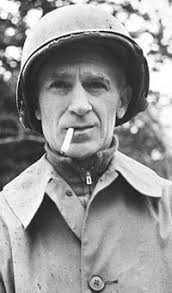 (Ernie Pyle)
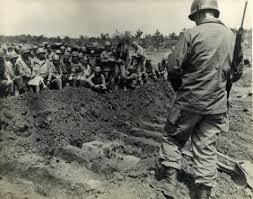 (Pyle's funeral)
Two months to the day after Ernie's death, The Story of G.I. Joe was released. Filmed with Pyle's approval before he went to the Pacific, the movie tells a fictionalized version of Captain Waskow's company and ends with the death of the captain (called Walker in the film and played by Robert Mitchum). To play Pyle, the army was persuaded to release Burgess Meredith from service. It is about as gritty a film as you will find made during the war.
Ernie Pyle was the most popular American correspondent of WWII, and the most admired and respected by American soldiers because he spent his time on the front lines, not at headquarters. His most famous column, published on January 10, 1944, recounted the death of Captain Henry Waskow near San Pietro, Italy on December 12, 1943. American forces landed at Salerno on the Italian mainland in September 1943 and after initially advancing quickly up the peninsula their advance slowed to a crawl by late fall. Waskow's death occurred near the beginning of six months of grinding combat contained within an area of less than 200 square miles to the north of Naples (an area about the size of the borough of Queens in New York City, so small that it took us less than 5 minutes to traverse via fast train earlier this month), culminating in multiple Allied assaults on, and the destruction of, the ancient Benedectine monastery at Monte Cassino which finally fell in May 1944. The Battle of San Pietro was also the subject of a powerful and moving documentary by director John Huston. It was approved for release by Army Chief of Staff George C Marshall over the objection of some Army officers who disliked its realistic portrayal of combat and the death of American soldiers. The 143rd Infantry Regiment of the 36th Division, which is mentioned frequently in the film, is the unit in which Capt Waskow served.
Pyle's column on Capt Waskow was reprinted nationwide and read on the radio by some of the most popular broadcasters of the time.
AT THE FRONT LINES IN ITALY, January 10, 1944Capt Waskow is buried in the Rome-Sicily American Cemetery and Memorial in Nettuno, Italy, about 38 miles south of Rome, along with 7,859 other American servicemen. Henry Waskow was 25 years old when he died, one of eight children from a poor Baptist family in Texas. He was an outstanding student, president of his High School Class and took 2nd prize in a statewide oratory contest.
In this war I have known a lot of officers who were loved and respected by the soldiers under them. But never have I crossed the trail of any man as beloved as Capt. Henry T. Waskow of Belton, Texas.
Capt. Waskow was a company commander in the 36th Division. He had led his company since long before it left the States. He was very young, only in his middle twenties, but he carried in him a sincerity and gentleness that made people want to be guided by him.
"After my own father, he came next," a sergeant told me.
"He always looked after us," a soldier said. "He’d go to bat for us every time."
"I’ve never knowed him to do anything unfair," another one said.
I was at the foot of the mule trail the night they brought Capt. Waskow’s body down. The moon was nearly full at the time, and you could see far up the trail, and even part way across the valley below. Soldiers made shadows in the moonlight as they walked.
Dead men had been coming down the mountain all evening, lashed onto the backs of mules. They came lying belly-down across the wooden pack-saddles, their heads hanging down on the left side of the mule, their stiffened legs sticking out awkwardly from the other side, bobbing up and down as the mule walked.
The Italian mule-skinners were afraid to walk beside dead men, so Americans had to lead the mules down that night. Even the Americans were reluctant to unlash and lift off the bodies at the bottom, so an officer had to do it himself, and ask others to help.
The first one came early in the morning. They slid him down from the mule and stood him on his feet for a moment, while they got a new grip. In the half light he might have been merely a sick man standing there, leaning on the others. Then they laid him on the ground in the shadow of the low stone wall alongside the road.
I don’t know who that first one was. You feel small in the presence of dead men, and ashamed at being alive, and you don’t ask silly questions.
We left him there beside the road, that first one, and we all went back into the cowshed and sat on water cans or lay on the straw, waiting for the next batch of mules.
Somebody said the dead soldier had been dead for four days, and then nobody said anything more about it. We talked soldier talk for an hour or more. The dead man lay all alone outside in the shadow of the low stone wall.
Then a soldier came into the cowshed and said there were some more bodies outside. We went out into the road. Four mules stood there, in the moonlight, in the road where the trail came down off the mountain. The soldiers who led them stood there waiting. "This one is Captain Waskow," one of them said quietly.
Two men unlashed his body from the mule and lifted it off and laid it in the shadow beside the low stone wall. Other men took the other bodies off. Finally there were five lying end to end in a long row, alongside the road. You don’t cover up dead men in the combat zone. They just lie there in the shadows until somebody else comes after them.
The unburdened mules moved off to their olive orchard. The men in the road seemed reluctant to leave. They stood around, and gradually one by one I could sense them moving close to Capt. Waskow’s body. Not so much to look, I think, as to say something in finality to him, and to themselves. I stood close by and I could hear.
One soldier came and looked down, and he said out loud, "God damn it." That’s all he said, and then he walked away. Another one came. He said, "God damn it to hell anyway." He looked down for a few last moments, and then he turned and left.
Another man came; I think he was an officer. It was hard to tell officers from men in the half light, for all were bearded and grimy dirty. The man looked down into the dead captain’s face, and then he spoke directly to him, as though he were alive. He said: "I’m sorry, old man."
Then a soldier came and stood beside the officer, and bent over, and he too spoke to his dead captain, not in a whisper but awfully tenderly, and he said:
"I sure am sorry, sir."
Then the first man squatted down, and he reached down and took the dead hand, and he sat there for a full five minutes, holding the dead hand in his own and looking intently into the dead face, and he never uttered a sound all the time he sat there.
And finally he put the hand down, and then reached up and gently straightened the points of the captain’s shirt collar, and then he sort of rearranged the tattered edges of his uniform around the wound. And then he got up and walked away down the road in the moonlight, all alone.
After that the rest of us went back into the cowshed, leaving the five dead men lying in a line, end to end, in the shadow of the low stone wall. We lay down on the straw in the cowshed, and pretty soon we were all asleep.
Waskow's last letter, written to his parents and sent to his sister for opening only in the event of his death, was made public 15 years later and read in part:
"I will have done my share to make this world a better place in which to live. Maybe when the lights go on again all over the world, free people can be happy and gay again . . . If I failed as a leader, and I pray God I didn't, it was not because I did not try."
The death and destruction he witnessed at San Pietro left Pyle greatly depressed and he abandoned the front lines for Allied headquarters in Caserta, Italy where he drank heavily, in despair that his writing could not convey to the American public back home what he had witnessed. He drafted the piece on Waskow but, feeling it was inadequate, did not submit it until was persuaded to do so by a friend. Pyle went on to receive the Pulitzer Prize in 1944 but he had enough of the war and returned to the United States in late 1944. Nonetheless, in early 1945 he felt compelled to join our troops in the Pacific after receiving many requests from the soldiers, sailors and Marines there to tell their story.
On April 18, 1945 Ernie Pyle died instantly when hit in the head by a Japanese machine gunner on the small island of Ie Shima, just west of Okinawa.
Two months to the day after Ernie's death, The Story of G.I. Joe was released. Filmed with Pyle's approval before he went to the Pacific, the movie tells a fictionalized version of Captain Waskow's company and ends with the death of the captain (called Walker in the film and played by Robert Mitchum). To play Pyle, the army was persuaded to release Burgess Meredith from service. It is about as gritty a film as you will find made during the war.
Monday, May 28, 2012
The Last Full Measure
Since Larry and I visited Gettysburg, Pennsylvania earlier this week it seemed appropriate to post these pictures on Memorial Day in remembrance of all those who have given "the last full measure of devotion".
I've selected one of the many moments that occurred on July 1, 2, and 3, 1863 which exemplify Abraham Lincoln's sentiment.
I've selected one of the many moments that occurred on July 1, 2, and 3, 1863 which exemplify Abraham Lincoln's sentiment.
Subscribe to:
Posts (Atom)