Annie Lennox from the 1990s. A remake of the 1986 original by The Lover Speaks.
The video below was done by a Hispanic fan. I didn't use Annie's video because it's just too creepy. Always found her persona in videos, whether with the Eurythmics or in her solo career, to be quite chilly and odd, but when I saw her in concert (with the Eurythmics) her stage presence was very warm and personal.
Sunday, October 9, 2016

Friday, October 7, 2016
Kit Carson Meets General Kearny
October 6, 1846. It was early autumn and cooler weather had finally arrived as three hundred cavalry troopers rode south for eleven days along the Rio Grande, crossing fields and stands of cottonwoods with the arid mountains looming above them, farther away from the river's banks. They were camped near the deserted town of Valverde, abandoned by its frightened inhabitants because of constant Navajo and Apache raids. During the morning, clouds of dust began rising to the west, the direction to which they'd eventually be turning. Making out about a dozen mounted men riding towards them, they went on alert, thinking they might be Indians, only relaxing once they realized Americans were among the riders.
As the riders entered the camp, a small (5'5''), thin (less than 140 lbs), sunburnt man with lanky blond hair down to his shoulders, dismounted, informing the troopers he was carrying important messages from California to be delivered to Washington DC. When asked his name, the man replied, "I''m Kit Carson".
 (Kit Carson)
It was General Stephen Kearny's introduction to the scout who had already gained a national reputation.
We've told part of the story of how they came to meet in Forgotten Americans: Henry Lafayette Dodge. At the start of the Mexican-American war, Kearny led an army across the Great Plains, capturing Santa Fe in August 1846, after Mexican government officials fled without a fight. Once the territory was secured, Kearny had orders to proceed to California to capture that Mexican state for America. Selecting three hundred of his best cavalry, Kearny left Santa Fe on September 25 (one of his guides being Jean Baptiste Charbonneau, the son of Sacagewea, born during the Lewis & Clark expedition). He knew it would be an arduous journey; first south along the Rio Grande, then west across the little known high plains, mountains and Sonoran Desert for 800 miles to San Diego and then fighting the Mexican army.
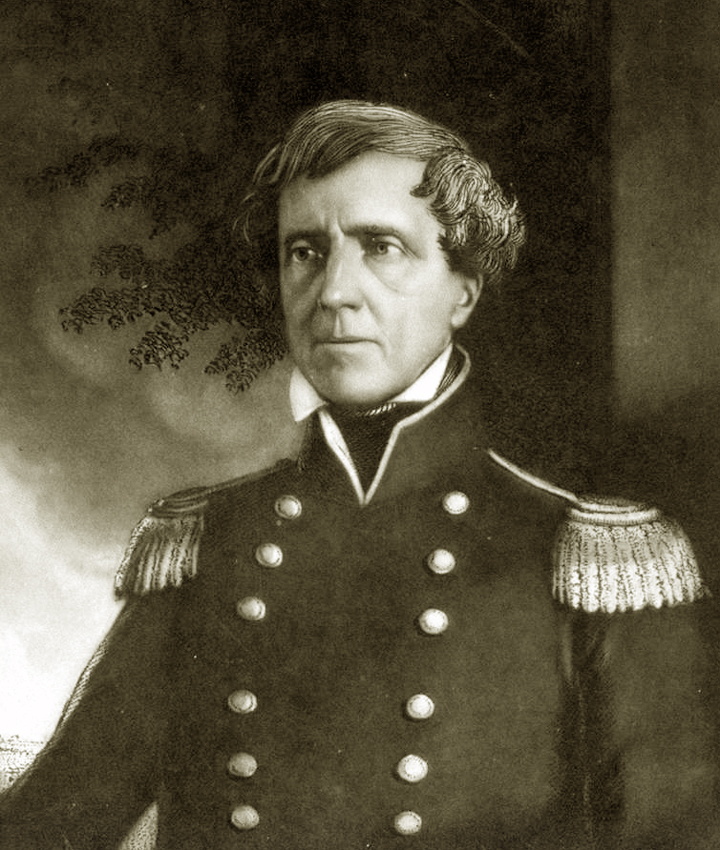
A New Jersey native, born in 1794, Stephen Kearny enlisted in the army at the start of the War of 1812. Staying in the service after the war, by 1833 he was a Lieutenant Colonel, having, by that time, been a member of expeditions across the Great Plains and into the Rockies. In that year, the well-thought of Kearny became second in command of the newly formed 1st Dragoons Regiment, the regular army's first cavalry unit. Kearny developed the army's initial mounted fighting tactics and is considered the father of the American cavalry. Promoted to brigadier general at the outset of the Mexican-American War, Kearny planned the complex and logistically complicated march of the Army of the West from Ft Leavenworth, Missouri to Santa Fe. He was known as a man of iron will with "a resolute countenance and cold blue eyes which there was no evading".
Carson's journey to Valverde was a little more roundabout. A resident of Taos, New Mexico and married to a Mexican (after two earlier marriages to Arapaho and Cheyenne women), the former mountain man and renowned scout was the best known person in the territory. Born in Missouri in 1809, Kit had moved to Nuevo Mexico, settling in Taos in 1826. Over the next years he trapped, hunted and traded all over the west, from Wyoming and Montana to California. One journey, that would play a role in the events of 1846, was an 1829 trip as a member of a trapping party led by Ewing Young which became one of the first groups to travel cross country from Nuevo Mexico to California.
 (Josefa Carson and their son)
His national renown came about from a chance meeting with John C Fremont on a Missouri River steamboat in the summer of 1842. Fremont, an officer in the U.S. Army Corps of Topographical Engineers was preparing an expedition to map the Oregon Trail as far west as South Pass in Wyoming. Fremont, an ambitious self-promoter, recently married to the daughter of Senate Democratic leader Thomas Hart Benton of Missouri (who, before becoming an ally of President Andrew Jackson, had, in 1813, engaged the future president in a pistol gunfight at a Nashville tavern), immediately hit it off with Carson and asked him to join the expedition as a scout.
Carson would serve as scout on each of Fremont's three journeys of exploration. The first was the successful five month trip to South Pass. The second made both Fremont and Carson famous. They traversed the Oregon Trail to the Columbia River with a side trip to the Great Salt Lake. They then made an illegal trek to California and were saved from suffering from the bad weather in the Sierra Nevada mountains by Carson's wilderness acumen. Expelled from California by the Mexican Governor they returned to the U.S. Fremont's well publicized report on their travels gave Carson copious credit but one event he recounted gained particular notoriety. At one point they came across two Mexicans (a man and boy) in the Mojave Desert who were survivors of a groups ambushed by Indians who had killed the men as well as women (after raping them) and stealing all their horses. Carson and one other man went after the killers, tracking down and killing two of them, recovering the horses and returning them to their owners. Although the first dime novel portraying Carson was not published until 1847 (see below, depicting the incident in the Mojave), it was Fremont's report in 1844 that made Kit famous and earned Fremont the nickname "The Pathfinder".
 (from wikimedia)
The third expedition began in the summer of 1845, initially taking Fremont and Kit back to Oregon. They then proceeded into California, still under Mexican rule and possibly in accordance with secret orders from the Polk administration which sought to annex the area. Expelled once again, they returned to Oregon, returning to the state with the onset of war and organizing a revolt of American settlers which soon took control of the state. Fremont, eager to get the news to Washington, asked Kit to carry dispatches across the country, which Carson promised to do in sixty days. Twenty-eight days out he met Kearny.
Carson's news was startling. California was already under American control. Kearny pondered the news and quickly reached a decision. His orders were to proceed to California and he would fulfill them. However, since he was increasingly worried about reports of the unruly Navajo and anticipated no military action on the west coast, he sent most of his three hundred dragoons back to Santa Fe, only retaining one hundred for the next stage of his expedition.
He sent a note to back to Santa Fe notifying them of the change of plan:

Kearny, Carson and the dragoons proceeded south, turning west on October 15, near the modern-day town of Truth Or Consequences. Reaching the headwaters of the Gila River in western New Mexico five days later, they followed it through Arizona (through the present day towns of Safford and Florence, and south of Globe and the Phoenix area, none of which were settled at the time), finally reaching the Colorado River, south of present day Yuma, on November 22. I've visited the pass over which Kearny's men struggled southeast of Globe (photo below).

Four days out of Valverde, Kearny agreed with Carson that his supply wagons were slowing the column down and sent them back to Santa Fe, packing everything on mules, except for two howitzers the general insisted on taking. Even without the wagons it was tough going. One officer wrote of a day on the route in Arizona:
The starving troopers found some succor when they entered the irrigated lands of the friendly Pima Indians, near present day Phoenix and were able to obtain fresh food.
One of Kearny's assignments was to find a viable passage for road and railroad to California and in his official report of December 12, 1846, written after reaching San Diego, he noted:
Crossing the Colorado, Kearny and Carson entered California, but as tough and exhausting as their march had been so far, their difficulties were only beginning, as they situation was much different than what they expected; California was in chaos. Between contention over American military leadership between Fremont and Navy Commodore Stockton, overconfidence and ineptness in their occupation, they enabled the Mexican population to regroup and, with some military reinforcements, to retake much of the state. Kearny could have used those 200 troopers he sent back to Santa Fe.
After climbing 3,000 feet out of the Imperial Valley and into the hills as they approached the California coast, the weary men were confronted by well-trained Mexican lancers on horses. On December 6, Kearny and his men were battered by the lancers, losing 18 dead and seven severely wounded (Kearny being one of them), ending up surrounded on a hilltop. It was Kit Carson to the rescue as he made a daring nighttime escape through the Mexican lines, making his way to San Diego and Commodore Stockton after walking barefoot for thirty hours without food or water. A relief force was sent which rescued Kearny. Kit stayed behind, unable to walk for a week because of the condition of his feet.
On December 12, 1846, General Kearny entered San Diego, completing the 1,900 mile march of the Army of the West, one of the greatest accomplishments in American military history.
Kearny, Stockton and Fremont were able to cooperate in defeating the Mexican forces and reoccupying the entire state but thereafter fell out in a long and dreary dispute which ended up in Kearny sending Fremont back to Washington to be court-martialed, from which he was saved by his political connections.
Kearny served as military governor of California, returning to Washington in 1847 to a hero's welcome and then serving as governor of Veracruz and Mexico City before the signing of the final peace treaty. Unfortunately he contracted yellow fever in Veracruz and returned to St Louis, dying in 1848.
Fremont recovered from his tumultuous adventure in California to become a leading abolitionist and, in 1856, the first Republican Party candidate for President.
Kit Carson went on to have many more adventures. He was a well-respected Indian agent in New Mexico and continued to do tracking. A Union man when the Civil War started, he became commander of 1st New Mexico Volunteer Infantry and helped to defeat the Confederate invasion of New Mexico in 1862. He also led his troops in the 1864 Battle of Adobe Walls in the Texas Panhandle, fighting Commanche, Kiowa and Apache, one of the largest conflicts between American troops and Indians on the Great Plains.
He also, with misgivings, led the campaign to force the surrender of the Navajo and their transport from their sacred lands to a reservation on the eastern border of New Mexico. Kit then became one of the important voices for allowing them to return to their lands along the New Mexico/Arizona border, which finally occurred in 1868, the same year Carson died.
He always remained a quiet, soft spoken man, embarrassed by his illiteracy. William Tecumseh Sherman met him while in California during 1847:
 (Kit Carson, 1868)
As the riders entered the camp, a small (5'5''), thin (less than 140 lbs), sunburnt man with lanky blond hair down to his shoulders, dismounted, informing the troopers he was carrying important messages from California to be delivered to Washington DC. When asked his name, the man replied, "I''m Kit Carson".
(Kit Carson)It was General Stephen Kearny's introduction to the scout who had already gained a national reputation.
We've told part of the story of how they came to meet in Forgotten Americans: Henry Lafayette Dodge. At the start of the Mexican-American war, Kearny led an army across the Great Plains, capturing Santa Fe in August 1846, after Mexican government officials fled without a fight. Once the territory was secured, Kearny had orders to proceed to California to capture that Mexican state for America. Selecting three hundred of his best cavalry, Kearny left Santa Fe on September 25 (one of his guides being Jean Baptiste Charbonneau, the son of Sacagewea, born during the Lewis & Clark expedition). He knew it would be an arduous journey; first south along the Rio Grande, then west across the little known high plains, mountains and Sonoran Desert for 800 miles to San Diego and then fighting the Mexican army.
A New Jersey native, born in 1794, Stephen Kearny enlisted in the army at the start of the War of 1812. Staying in the service after the war, by 1833 he was a Lieutenant Colonel, having, by that time, been a member of expeditions across the Great Plains and into the Rockies. In that year, the well-thought of Kearny became second in command of the newly formed 1st Dragoons Regiment, the regular army's first cavalry unit. Kearny developed the army's initial mounted fighting tactics and is considered the father of the American cavalry. Promoted to brigadier general at the outset of the Mexican-American War, Kearny planned the complex and logistically complicated march of the Army of the West from Ft Leavenworth, Missouri to Santa Fe. He was known as a man of iron will with "a resolute countenance and cold blue eyes which there was no evading".
Carson's journey to Valverde was a little more roundabout. A resident of Taos, New Mexico and married to a Mexican (after two earlier marriages to Arapaho and Cheyenne women), the former mountain man and renowned scout was the best known person in the territory. Born in Missouri in 1809, Kit had moved to Nuevo Mexico, settling in Taos in 1826. Over the next years he trapped, hunted and traded all over the west, from Wyoming and Montana to California. One journey, that would play a role in the events of 1846, was an 1829 trip as a member of a trapping party led by Ewing Young which became one of the first groups to travel cross country from Nuevo Mexico to California.
(Josefa Carson and their son)His national renown came about from a chance meeting with John C Fremont on a Missouri River steamboat in the summer of 1842. Fremont, an officer in the U.S. Army Corps of Topographical Engineers was preparing an expedition to map the Oregon Trail as far west as South Pass in Wyoming. Fremont, an ambitious self-promoter, recently married to the daughter of Senate Democratic leader Thomas Hart Benton of Missouri (who, before becoming an ally of President Andrew Jackson, had, in 1813, engaged the future president in a pistol gunfight at a Nashville tavern), immediately hit it off with Carson and asked him to join the expedition as a scout.
Carson would serve as scout on each of Fremont's three journeys of exploration. The first was the successful five month trip to South Pass. The second made both Fremont and Carson famous. They traversed the Oregon Trail to the Columbia River with a side trip to the Great Salt Lake. They then made an illegal trek to California and were saved from suffering from the bad weather in the Sierra Nevada mountains by Carson's wilderness acumen. Expelled from California by the Mexican Governor they returned to the U.S. Fremont's well publicized report on their travels gave Carson copious credit but one event he recounted gained particular notoriety. At one point they came across two Mexicans (a man and boy) in the Mojave Desert who were survivors of a groups ambushed by Indians who had killed the men as well as women (after raping them) and stealing all their horses. Carson and one other man went after the killers, tracking down and killing two of them, recovering the horses and returning them to their owners. Although the first dime novel portraying Carson was not published until 1847 (see below, depicting the incident in the Mojave), it was Fremont's report in 1844 that made Kit famous and earned Fremont the nickname "The Pathfinder".
(from wikimedia)The third expedition began in the summer of 1845, initially taking Fremont and Kit back to Oregon. They then proceeded into California, still under Mexican rule and possibly in accordance with secret orders from the Polk administration which sought to annex the area. Expelled once again, they returned to Oregon, returning to the state with the onset of war and organizing a revolt of American settlers which soon took control of the state. Fremont, eager to get the news to Washington, asked Kit to carry dispatches across the country, which Carson promised to do in sixty days. Twenty-eight days out he met Kearny.
Carson's news was startling. California was already under American control. Kearny pondered the news and quickly reached a decision. His orders were to proceed to California and he would fulfill them. However, since he was increasingly worried about reports of the unruly Navajo and anticipated no military action on the west coast, he sent most of his three hundred dragoons back to Santa Fe, only retaining one hundred for the next stage of his expedition.
He sent a note to back to Santa Fe notifying them of the change of plan:
I this morning met an Express from Upper California to Washington city, sent by Lieut.Col. Fremont, reporting that the Americans had taken possession of that department, in consequence of which I have re-organized the Party to accompany me to that country as well be seen by Order No. 34, herewith enclosed.And what better use could he make of the surprising appearance of the best known guide in the southwest? Kearny ordered Carson to lead his men back to California, while he would arrange for someone else to get the dispatches to Washington. Carson briefly thought of disobeying. He'd not seen his wife and family in nearly two years and hoped to spend one night with them in Taos on the way to the east coast and he felt an obligation to keep his word to Fremont and Stockton. He later described his feelings (according to Hampton Sides in Blood and Thunder; the book to read about this era in the southwest):
I was pledged to them and could not disappoint them, and besides that I was under more obligations to Captain Fremont than any man alive.He finally agreed to accompany Kearny, or as Kit later put it, "Kearny ordered me to join him as his guide. I done so." His decision gained the admiration of Kearny's officers, one writing:
He turned his face to the west again, just as he was on the eve of entering the settlements, after his arduous trip and when he had set his hopes on seeing his family. It requires a brave man to give up his private feelings thus for the public good; but Carson is one such! Honor to him for it.(Kearny's route, from The West Point Atlas of American Wars)

Kearny, Carson and the dragoons proceeded south, turning west on October 15, near the modern-day town of Truth Or Consequences. Reaching the headwaters of the Gila River in western New Mexico five days later, they followed it through Arizona (through the present day towns of Safford and Florence, and south of Globe and the Phoenix area, none of which were settled at the time), finally reaching the Colorado River, south of present day Yuma, on November 22. I've visited the pass over which Kearny's men struggled southeast of Globe (photo below).

Four days out of Valverde, Kearny agreed with Carson that his supply wagons were slowing the column down and sent them back to Santa Fe, packing everything on mules, except for two howitzers the general insisted on taking. Even without the wagons it was tough going. One officer wrote of a day on the route in Arizona:
I shall not attempt to describe the route we have passed over today. I have no language to convey even a faint idea of it. Could we have foreseen so much difficulty it would have been better to have retraced our steps 20 miles, to have taken another and more practicable route. From the moment of starting until we dismounted at our present camp, our poor animals were stepping over and among rock of great size - some fixed, but most of them loose, and then the steep hills and gullies were very frequent.Their horses and many mules died. Most of the time the men walked. Both animals and men grew short of food. One officer wrote: "Twere better for it to be blotted out from the face of the earth. It is the veriest wilderness in the world. . . ", and later observing that "Invalids may live here when they might die in any other part of the world, but really the country is so forbidding that no one would scarcely be willing to secure a long life at the cost of living in it."
The starving troopers found some succor when they entered the irrigated lands of the friendly Pima Indians, near present day Phoenix and were able to obtain fresh food.
One of Kearny's assignments was to find a viable passage for road and railroad to California and in his official report of December 12, 1846, written after reaching San Diego, he noted:
This River (the Gila) more particularly the Northern side, is bounded nearly the whole distance by a range of lofty Mountains, & if a tolerable waggin Road to its mouth from the Del Norte is ever discovered, it must be on the South side & therefor the boundary line between the U. States & Mexico should certainly not be North of the 32°of lat. the country is destitute of timber, producing but few cotton wood & mesquite trees, & tho' the soil on the bottom lands is generally good, yet we found but very little grass or vegetation in consequence of the dryness of the climate & the little rain which falls here - The Pimo Indians who make good crops of wheat, corn, vegetables & irrigate the land by water from the Gila, as did the Aztecs (the former inhabitants of the Country) the remains of whose sequias or little canals were seen by us, as well as the position of many of their dwellings, & a large quantity of broken pottery & earthen ware used by them -Elsewhere Kearny wrote of the lands he'd traversed, "It surprised me to see so much land that can never be of any use to man or beast".
Crossing the Colorado, Kearny and Carson entered California, but as tough and exhausting as their march had been so far, their difficulties were only beginning, as they situation was much different than what they expected; California was in chaos. Between contention over American military leadership between Fremont and Navy Commodore Stockton, overconfidence and ineptness in their occupation, they enabled the Mexican population to regroup and, with some military reinforcements, to retake much of the state. Kearny could have used those 200 troopers he sent back to Santa Fe.
After climbing 3,000 feet out of the Imperial Valley and into the hills as they approached the California coast, the weary men were confronted by well-trained Mexican lancers on horses. On December 6, Kearny and his men were battered by the lancers, losing 18 dead and seven severely wounded (Kearny being one of them), ending up surrounded on a hilltop. It was Kit Carson to the rescue as he made a daring nighttime escape through the Mexican lines, making his way to San Diego and Commodore Stockton after walking barefoot for thirty hours without food or water. A relief force was sent which rescued Kearny. Kit stayed behind, unable to walk for a week because of the condition of his feet.
On December 12, 1846, General Kearny entered San Diego, completing the 1,900 mile march of the Army of the West, one of the greatest accomplishments in American military history.
Kearny, Stockton and Fremont were able to cooperate in defeating the Mexican forces and reoccupying the entire state but thereafter fell out in a long and dreary dispute which ended up in Kearny sending Fremont back to Washington to be court-martialed, from which he was saved by his political connections.
Kearny served as military governor of California, returning to Washington in 1847 to a hero's welcome and then serving as governor of Veracruz and Mexico City before the signing of the final peace treaty. Unfortunately he contracted yellow fever in Veracruz and returned to St Louis, dying in 1848.
Fremont recovered from his tumultuous adventure in California to become a leading abolitionist and, in 1856, the first Republican Party candidate for President.
Kit Carson went on to have many more adventures. He was a well-respected Indian agent in New Mexico and continued to do tracking. A Union man when the Civil War started, he became commander of 1st New Mexico Volunteer Infantry and helped to defeat the Confederate invasion of New Mexico in 1862. He also led his troops in the 1864 Battle of Adobe Walls in the Texas Panhandle, fighting Commanche, Kiowa and Apache, one of the largest conflicts between American troops and Indians on the Great Plains.
He also, with misgivings, led the campaign to force the surrender of the Navajo and their transport from their sacred lands to a reservation on the eastern border of New Mexico. Kit then became one of the important voices for allowing them to return to their lands along the New Mexico/Arizona border, which finally occurred in 1868, the same year Carson died.
He always remained a quiet, soft spoken man, embarrassed by his illiteracy. William Tecumseh Sherman met him while in California during 1847:
"His fame was then at its height, ... and I was very anxious to see a man who had achieved such feats of daring among the wild animals of the Rocky Mountains, and still wilder Indians of the plains ... I cannot express my surprise at beholding such a small, stoop-shouldered man, with reddish hair, freckled face, soft blue eyes, and nothing to indicate extraordinary courage or daring. He spoke but little and answered questions in monosyllables."How odd it must have felt for such a man to become a dime novel hero. In 1849 he tracked a woman (Ann White) and her infant daughter, kidnapped by the Apaches who had murdered her husband and others in a wagon train. He found the horribly abused woman dead, with an arrow in her heart and daughter gone, never to be seen again (it was later learned the Indians killed the baby shortly thereafter). In the Indian camp he also discovered a dime novel featuring him on the cover; the first time he'd ever seen himself in print. Carson remained haunted that the woman "had read the same ... [and prayed] for my appearance that she might be saved", feeling always that he let her down.
(Kit Carson, 1868) Wednesday, October 5, 2016
Reality Bites
For the Obama Administration, that is . . .

Bill Clinton, campaigning in Michigan, calls President Obama's signature domestic initiative, the Affordable Care Act, "the craziest thing in the world". He goes on to point out:
Prediction: Progressives will try to fix this by making Obamacare even more of a top-down bureaucratic exercise and throwing even more money at it.
William Russell Mead, an old-line Democrat and professor at Bard College, laments the latest Obama foreign policy fiasco involving Russia and Syria, concluding by comparing him with James Buchanan, considered one of the worst presidents in American history:
Bill Clinton, campaigning in Michigan, calls President Obama's signature domestic initiative, the Affordable Care Act, "the craziest thing in the world". He goes on to point out:
“You’ve got this crazy system where all the sudden 25 million more people have healthcare and then the people are out there busting it, sometimes 60 hours a week, wind up with their premiums doubled and their coverage cut in half,”
“We gotta figure out what to do now on healthcare,” he said, adding that the current system only “works fine” if people are receiving the ObamaCare subsidies or are enrolled in Medicare or Medicaid.
“The people who are getting killed in this deal are small business people and individuals who make just a little bit too much to get any of these subsidies,” he said, arguing that the law does not give any new bargaining power for people struggling to pay their healthcare costs.As we have pointed out on multiple occasions, Obamacare was passed by the President and his allies employing a bodyguard of lies (aka "incorrect promises" in New York Timespeak) and built on upon a complicated top-down strategy, ill-suited for a modern economy, as even the Times is being forced to admit.
Prediction: Progressives will try to fix this by making Obamacare even more of a top-down bureaucratic exercise and throwing even more money at it.
William Russell Mead, an old-line Democrat and professor at Bard College, laments the latest Obama foreign policy fiasco involving Russia and Syria, concluding by comparing him with James Buchanan, considered one of the worst presidents in American history:
The press does its best to avert its eyes from this dispiriting spectacle, but Obama’s foreign policy legacy is withering away before our very eyes, even as the clock runs down on the most disastrous American foreign policy presidency since World War II. One hopes that he’ll take some stands; even now, President Obama could help his successor by reversing course on some of his key decisions and laying the foundation for a revival of American power and prestige. But it seems more likely that, much like President James Buchanan who dithered in the White House as the Confederacy rose in the South, Obama just wants to run out the clock, and is hoping that nothing catastrophic happens on the world stage before he can get back to the more congenial realm of thought leading and oratory.And, of course, our exit note:
My favorite part about the Obama era is all the racial healing.— jon gabriel (@exjon) November 24, 2014
Monday, October 3, 2016
Big Papi's Big Day

Yesterday afternoon the Missus and I were at Fenway Park for the last regular season game of David Ortiz, the most popular player in the history of the franchise. In the hour long farewell ceremony:
The Mayor of Boston named a street after Big Papi
Not to be outdone, the Governor of Massachusetts named a bridge after Big Papi
The President of the Dominican Republic (Danilo Medina) showed up to throw the first pitch to - - - Big Papi, who was born in the Dominican and became a U.S. Citizen in 2011
Big Papi took a selfie with the President

Kevin Spacey recited Rudyard Kipling's If
Three National Anthems were played (Canada, Dominican Republic, U.S.)
Mary J Blige (Papi's favorite singer) sang The Star Spangled Banner, as well as One by U2.
The Red Sox and team owners donated $1 million to Big Papi's charity which funds life saving operations for kids in the Dominican and New England (563 so far)
Former teammates from the 2004, 2007 and 2013 champion teams walked out of the center field pavilion carrying the World Series trophies to join Big Papi
Manny Ramirez managed to remember to show up
 (Manny & Papi hug, Pedro Martinez on left, Jason Varitek on right)
It was emotionally exhausting (video of his speech is here). And there was a game afterwards. Turned out to be a pretty good one. Now, on to the playoffs.
All through the year, I feared Papi would tail off from his amazing start. While it did to a minor degree, he never plunged into the lengthy slump many of us anticipated. He led the American League in doubles, RBI, slugging, on base + slugging, intentional walks and extra base hits, along with finishing 6th in batting average, 3rd in on-base percentage and 8th in homers and walks. It was his best season since 2007 and the best final season over the natural career arc of any major league ballplayer (Ted Williams had an incredible final season at age 42, but was only a part-time players, starting only 87 games with 390 plate appearances compared to 626 for Papi; another recent, and often forgotten, outstanding finale was for 39 year old Mike Mussina, who went 20-9 for the 2008 New York Yankees). The only comparable final years were in careers cut short, Sandy Koufax's 1966 campaign, ended at age 30 by an arthritic elbow, and Shoeless Joe Jackson in 1920, terminated at age 32 by the Black Sox Scandal.
Recently watching a lengthy interview with Ortiz broadcast on NESN we learned several things:
He hated playing for the Minnesota Twins who, he complained, tried to make him into a singles hitter and didn't want him taking big swings. The Twins apparently didn't think much of him, releasing Ortiz in December 2002 at the age of 27, an incredible mistake in retrospect.Along those lines, one of the things that jumps out is his recovery from what looked like a terminal decline in 2008 through 2010, to finish with such a strong kick over his final six seasons. It looks like a key factor was his approach to controlling the strike zone. In most cases, a batter's strikeouts increase as they get older and can't get around on the fastball anymore. During 2009 and 2010 Papi was striking out in almost 24% of his plate appearances (PA), and during the early part of 2010, in 33% of his PA. He clearly made some type of adjustment, and in 2011 struck out in less than 14% of his PA, maintaining that pace right through this year.
He gives Pedro Martinez credit for getting him to Boston (and gave him special mention in his farewell speech yesterday). When Pedro learned Ortiz was released he called the Red Sox front office urging them to sign him, which they did despite misgivings.
The two people he singled out for helping him become a better hitter were Jason Varitek and Manny Ramirez. In his first season with the Red Sox, Tek persuaded him to switch to a heavier bat which he said would make Papi use his wrists more and body less and give him more power. Ortiz said it made an immediate difference.
From Manny, he learned how to have a plan for each at bat. Despite his well-known eccentricities (like letting uncashed $50,000 pay checks sit in his locker), Manny has always had the reputation as a very smart hitter.
His major adjustment as he got older was to stop looking for inside pitches and concentrate on the outer half of the plate, feeling he could always handle the inside pitch. He was right.
Papi from The Players' Tribune:
Boston is not just my team. Boston is my city. I consider myself a Bostonian, and it’s the thing I’m most proud of in the world.For some wonderful pictures from throughout the career of David Ortiz go here.
Sunday, October 2, 2016
Thoughts For The Day
"It turns out that the future is not “a boot stamping on a human face – forever.”* The future is a conference call on which a cheery 30-something says things like “progressively coordinate functional strategic theme areas” – forever."
From the z man blog
* From George Orwell
----------------------------------------------------------------------------------------------
“It isn’t necessary to imagine the world ending in fire or ice — there are two other possibilities: one is paperwork, and the other is nostalgia.”
---------------------------------------------------------------------------------------------------
Why Does Time Go Forward Instead Of Backward? (Popular Mechanics)
Just another example of bad science. In the U.S., time goes backward every fall. That is, except for Arizona. Or perhaps it is the only scientifically literate state? (THC)
Saturday, October 1, 2016
Atrani
The small town of Atrani is wedged in between the sea and the cliffs along the Amalfi Coast of Italy, just east of the town of Amalfi. We've visited the area three times. The road carried on the viaduct and around the building on the right is the Amalfi Coast Drive, the only road that goes from start to finish on the coast. It's barely wide enough for two small cars to pass each other. To be helpful, they've put mirrors on the corners (you can see one in the picture) as you drive around that big building so you can try to see what's coming at you. Photo is from Conde Nast Traveler.

Subscribe to:
Posts (Atom)