Friday, August 19, 2022

A Post About What I'm Not Going To Post On

The Mar-a-Largo search.

I don't trust the FBI, I don't trust the Department of Justice, I don't trust Donald Trump.

I don't trust the media reporting from any source.

This will take a while to sort out and get an understanding of the underlying facts.

The only thing I am certain of is that both the Democrats and Donald Trump are very happy to have Donald Trump as the center of attention.

Thursday, August 18, 2022

The New Guy: Ringo

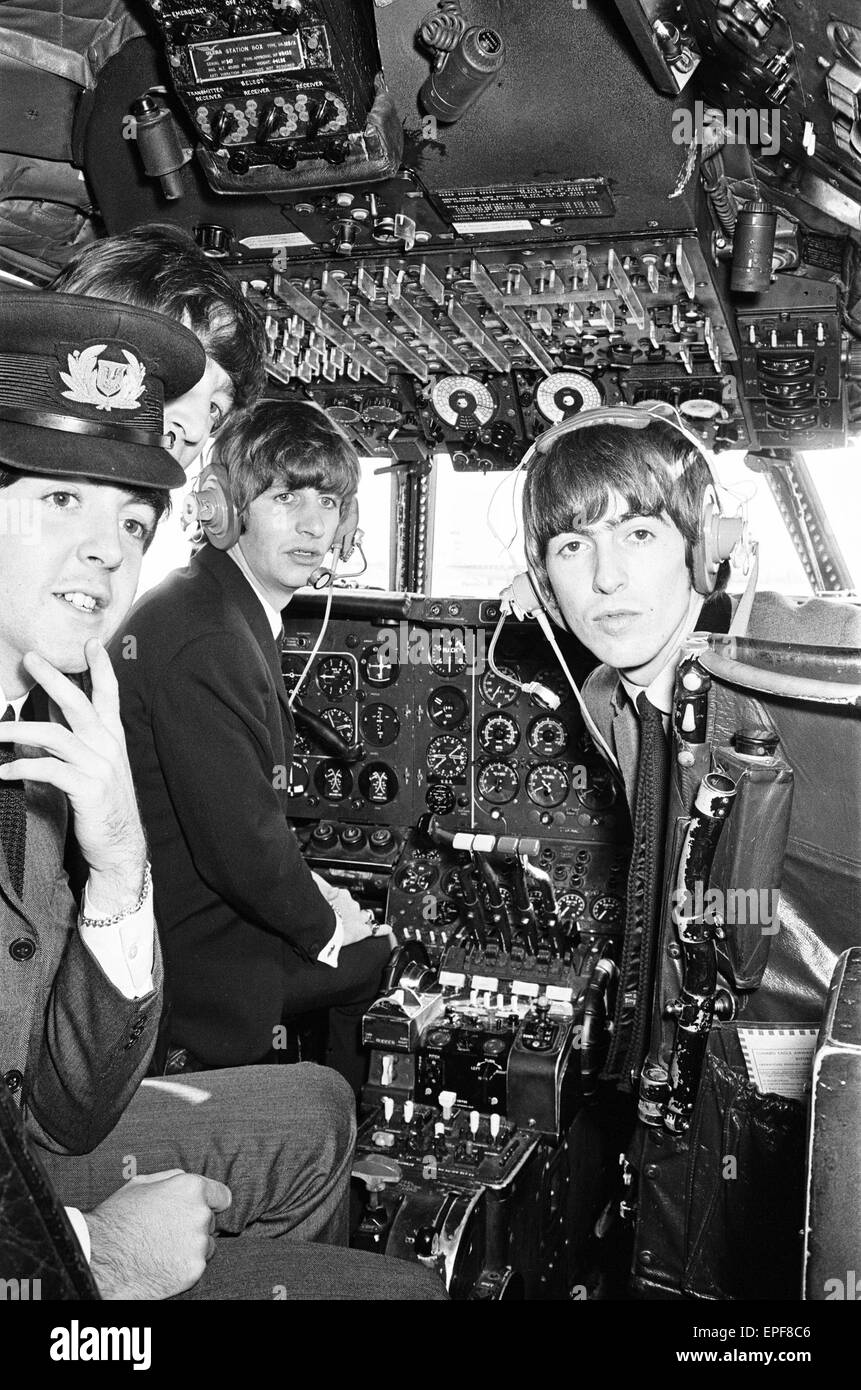
The Beatles in Liverpool for the Premier of a Hard Day's Night. Ringo Starr,  George Harrison and Paul McCartney pictured here in the cockpit of the  plane on their flight to Liverpool.

On this date sixty years ago, Ringo Starr made his first performing appearance with The Beatles.  He turned 82 last month and still looks good.

I've come to really appreciate Ringo's drumming, which I did not so much during the 60s.  If you've read this blog you know that I love Keith Moon, who played with flash, incredible energy and often was musically leading The Who.  Ringo's style was very different and listening more deeply over the decades, I understand how well they served the songs.  Ringo didn't have a "style" in the sense that Moon or John Bonham did.

The first time I noticed it in the 60s, was in the intro and first verse of Sgt Pepper's A Day In The Life (listen as Ringo kicks in about 47 seconds into the song) but, other than that, I didn't pay much attention to him.  Now I understand much better what he brings to the music of The Beatles.

For one thing, there are few drummers who have more recognizable drum riffs.  If all you heard were the drums you'd know what the song was.

Some examples:

I Feel Fine - the drum break at around 1:20, though Ringo's samba style beat throughout is outstanding.

Ticket To Ride - the off-kilter beat throughout the song; so distinctive.

Come Together

Others I enjoy, listed chronologically:

The punctuated beat of She Loves You

The intro on the exuberant Tell Me Why, which also features one of Lennon's best vocals

In My Life

Ringo has been often quoted that Rain is his favorite drumming part.  Great interplay with McCartney's bass.

She Said She Said - that compressed cymbal sound and the subtle tempo change in the middle

Groundbreaking in many ways, Tomorrow Never Knows is held together by Ringo's unusual metronomic drum pattern and Paul's drone bass.  This is before digital magic was available in the recording studio.  It's Ringo live throughout. 

Strawberry Fields Forever - wistful and beautiful.  Ringo stays away from obvious choices.

And then we arrive at Abbey Road, the band's last recording and Ringo's consistently best and most innovative work from start to finish.  It's worth listening to him on every song.  We've already listened to Come Together, but we also have Something (particularly on the bridge), Here Comes The Sun. The End, and Polythene Pam/She Came In Through The Bathroom Window.

The special treat on Abbey Road is You Never Give Me Your Money, which is several different song snippets put together by Paul.  I think it is one of the 5 best songs by the group.  This video deconstructs each track so you can hear Ringo's brilliance but you should also listen to George and John's guitar work, Paul's piano track and the vocal track.

Wednesday, August 17, 2022

It Wasn't All Great

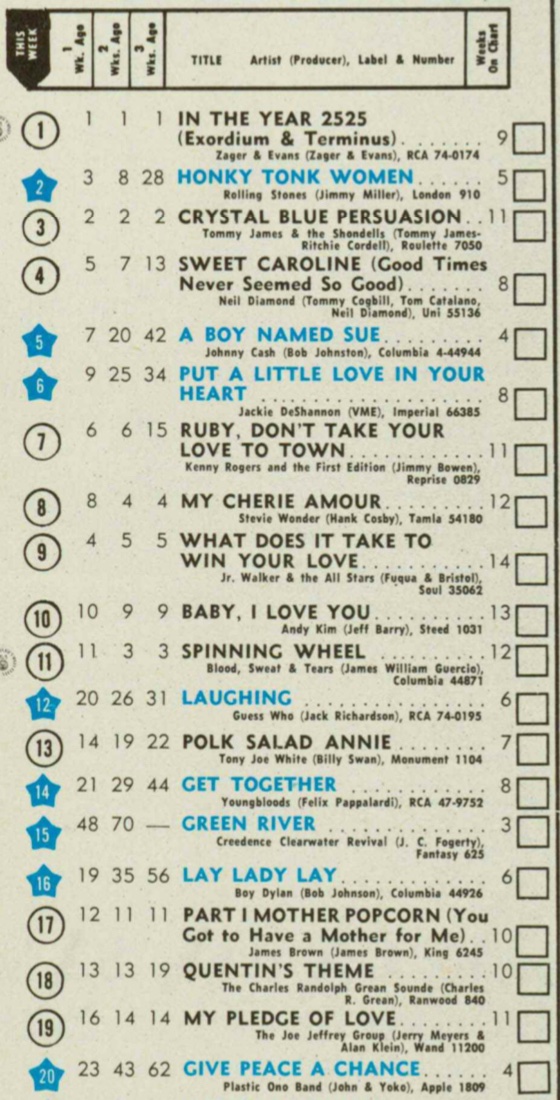
 Image As someone who's done so many posts on the great music of the 1960s and 70s, this chart, which I came across today, is a forceful reminder that we also had a lot of popular dreck on the radio.  This shows the top 20 singles for this week in 1969.
In The Year 2525 remains one of the top contenders for worst #1 song and it held that spot for weeks on end.  #2 is Honky Tonk Woman and, no question, it is a great tune.  But look at the next three slots.  Junk from Tommy James and Neil Diamond (though the latter was given a second life by the Red Sox), and a terrible song by an artist I like, Johnny Cash.  Going further down the list we have one of the weakest singles ever released by the great Stevie Wonder, a below-average entry from The Guess Who (an above-average band I need to do a post on), and Get Together by The Youngbloods, a soppy song from one of my favorite bands of that period.

You've got to get to #15 before there is something decent again, Green River, my favorite Creedence song. Dylan's Lay Lady Lay is another good one, as is Mother Popcorn.  Then we close with more mediocrity, capped by the execrable Give Peace A Chance.

That's only four good songs in the Top 20, a poor batting average.  No wonder I preferred FM to AM.

Sunset At Aqua Claudia

 Image

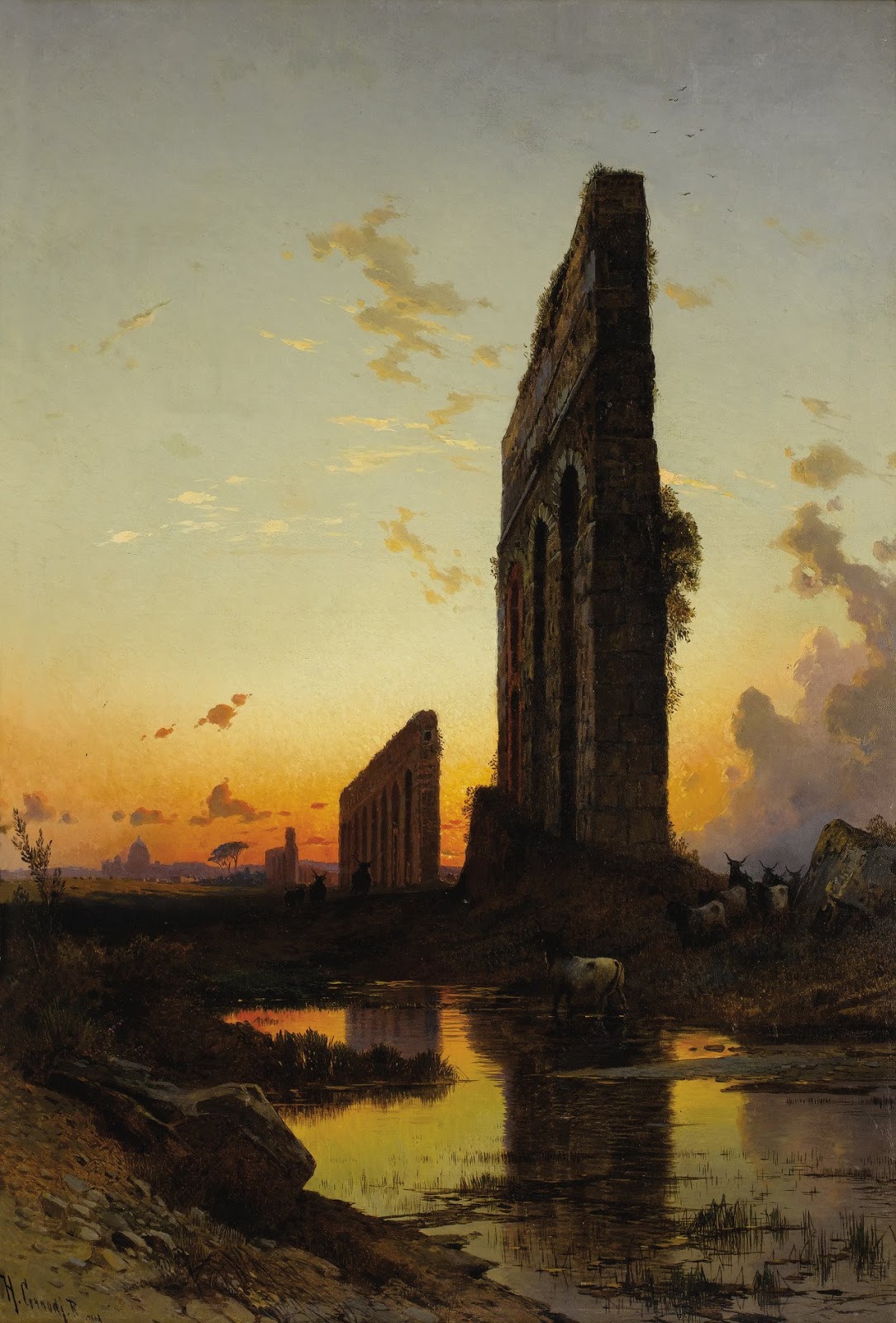
By Hermann Corrodi, an Italian painter; done sometime in the 1870s.  The remnants of a vanished world.  

The Aqua Claudia was one of the largest capacity aqueducts supplying water to Rome.  Started under Emperor Caligula (37-41 AD) and completed in the reign of Emperor Claudius (41-54 AD), it eventually extended to most of the districts of Rome, including the Imperial Palace on the Palatine Hill.  Most of its 43 mile length was underground until it emerged on the plains outside Rome from where it was carried on arches the last few miles into the city.   The cutting of Aqua Claudia and the other aqueducts during the 6th century siege of Rome by the Goths accelerated the decline of the classical city, prompting the abandonment of the Palatine Hill, and migration of the city's remaining population to other locations in Italy or closer to the Tiber River.

From Wikipedia, this is a current view of the largest remaining section of the aqueduct.


Tuesday, August 16, 2022

Well Done

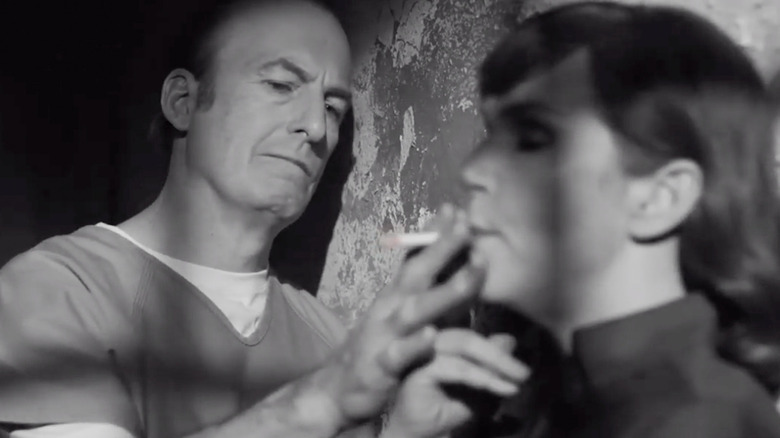
Jimmy taking cigarette from Kim

Better Call Saul wrapped up last night, bringing to an end 14 years, 11 seasons, 125 episodes, and one movie (El Camino) for the Breaking Bad/Better Call Saul universe (and we've seen it all).  Unlike Breaking Bad's blood soaked finale, Better Call Saul ended without violence, though with much drama and many twists.  In this final go-round, we had the return of so many characters (most now dead) - Walter White, Mike Ehrmantraut, Chuck McGill, Marie Schrader - but it never felt forced.  Well done.  Amazing work by Vince Gilligan and Peter Gould in bringing this world into existence and with the consistent attention to the minute details of setting, scene, story, and characters that sustained it for so long.  And by Bob Odenkirk as Jimmy/Saul/Gene.  Who would have thought the slimy, comic relief character from BB could have shouldered an entire series as a compelling character? 

Sunday, August 14, 2022

The Baseball Memory Bank

Over the years I've reconstructed many baseball games I've attended, or thought I'd been at, trying to match my memories to accounts of the games at Baseball-Reference.com or in publications available online.

During the 1960s, I attended many Mets games at Shea Stadium, most of them with my Dad.  We saw a lot of the San Francisco Giants because of Willie Mays but also went to other games.  Among my memories is a distinct remembrance of watching Warren Spahn pitch during his brief stint with the Mets, but I've had conflicting memories of what the game was.  One dim memory is of Spahn being beaten by the Dodgers on a home run by the opposing pitcher, Don Drysdale, and the other is of Spahn pitching against Bob Gibson, who hit a triple, and was so tired the next inning that the Mets got to him for some runs.  Based on my research I now think I may have seen Spahn pitch twice.

From 1946 through 1964 Warren Spahn had a great career with the Boston and then Milwaukee Braves, winning 356 games.  In 1963 at age 42 he'd gone 23-7, with one of those losses in the classic 16-inning pitching duel with Juan Marichal, which Spahn lost 1-0 on a home run by Willie Mays.  After four days rest, Spahn pitched a complete game, 5 hit shutout (he also completed his next 9 starts!).  In 1964, age finally got to Warren and he went 6-13, pitching poorly for the entire season.  During the off-season, the Mets purchased his contract from the Braves.

In 1965, Spahn started 19 games for the Mets, before being released and signing with the Giants with whom he finished his career.  I probably was at two of his starts.

On May 11, Spahn started against the St Louis Cardinals and the opposing pitcher was Bob Gibson with 24,519 in attendance.  In the 3rd inning, with the score 0-0, Gibson hit a line drive to center and is credited with a double, not a triple.  But, with the help of Baseball-Reference, I found that Gibson was thrown out at third base, trying for a triple!  I can still visualize Gibson sliding into third but did not remember he was thrown out on a relay from CF Ron Swoboda to SS Roy McMillan to 3B Bobby Klaus.

My recollection that the Mets touched a tired Gibson up in the bottom of the third was incorrect.  After giving up a single and walk to the first 2 batters, Gibson retired the next three.  He held the Mets scoreless until the 5th when they pushed across one tally, followed by two more in the 6th.  The Cards won the game 4-3 with Gibson going the route, while Spahn tossed eight innings.

On June 11 the Mets played the Dodgers.  The Dodgers and Giants were always the biggest draws and it was a Friday night so the attendance was 55,023 with Spahn and Drysdale the starting pitchers and both in top form that night.  The game was scoreless until the 5th, when John Roseboro took Spahn deep and the Mets pushed across the tying run in the bottom of the frame.  It stayed that way until the 8th, when Drysdale hit a home run to center, just like I remembered, giving the Dodgers the lead which they held, winning 2-1.  Both pitchers threw complete games, Drysdale giving up only 4 hits and Spahn 5 with both walking only one hitter and striking out six.  Spahn also picked Maury Wills off first base! Though he lost, it was Spahn's second-best outing during his time with the Mets, only surpassed by his May 5 start against the Phillies, giving up only 4 hits but once again losing, this time 1-0.

Until confirming my memories via Baseball-Reference I wondered if I was confusing events and had only been at one Spahn start.  This also clarifies how I remember the crucial acts.  My visual of the Gibson attempted triple is from the perspective of someone sitting in the left-field grandstand, while that of the Drysdale home run is viewed from the right-field grandstand.  It really was two different games I attended and got to see three Hall of Fame pitchers in action.