Tuesday, August 13, 2024

Promoting Misinformation

Regarding the kerfuffle about Tim Walz's military service, we've seen defenders of Walz claim he is being "Swiftboated", an allusion to attacks on John Kerry during the 2004 campaign.  A recent example is from PBS News Hour Anchor Amna Nawaz who asserts:

“This is so reminiscent of that swiftboating attack on John Kerry back in 2004 . . . Why run with these attacks when there’s no evidence for what they’re saying right now?”

She goes on to say that the attacks on Kerry were “discredited".  If Nawaz was drawing a comparison with the attacks on Kerry, the accurate one would be that the allegations against Kerry and Walz were similar, in that both are correct.  However, I doubt that is what she meant.  

Walz did not have the rank claimed as of his retirement and, on multiple occasions, stated, or left the impression, he had served with his unit in combat in Iraq, rather than resigning once he learned the unit would be going to Iraq.  The governor's immediate superior, battalion commander, and unit chaplain, all confirm the allegation. Attempts to defend Walz have relied upon mischaracterizing the allegations.

As for Kerry and Swiftboating, I wrote in 2016 (and updated in 2020) about the true story:

For those of you who may not remember, the "Swift Boat Incident" or Swiftboating as Democrats liked to call it, was in their version the slandering of Presidential candidate John Kerry's Vietnam War record during the 2004 campaign.  If you notice, Baquet refers to it as an "allegation".  In the preferred liberal summary, the Incident was about mischaracterization of Kerry's record as a Swiftboat commander during the war and the awarding of his combat medals.  In reality, the television ads by Swift Boat Veterans For Truth focused primarily on Kerry's alleged treasonous actions in carrying out secret negotiations with the communist government of North Vietnam and in denouncing his fellow soldiers for atrocities in front of the U.S. Congress, a denunciation used by the communists as justification for torturing American POWs.  All of this is completely true.

A secondary theme was an attack on Kerry's claim, made on the floor of the Senate, that he spent Christmas on his Swift Boat in Cambodia, in what would have been an illegal incursion at the time, a demonstrably false claim.  The final claim was that his actions in combat were not deserving of his medals and that he had manipulated the system to obtain them.  This claim is controversial and the only one by the Veteran's group which may not be accurate (unfortunately the Wikipedia entry on this topic focuses almost exclusively on this last point and is very one-sided).

When YouTube first became available several years ago, I went back and found the original Swiftboat ads.  Unfortunately, they are not all still available but my fragmentary notes indicate that six of them focused on Kerry's post service actions - negotiating with the enemy, his Congressional testimony and throwing the ribbons from his medals away in a protest.  Two others and part of a third dealt with his Christmas in Cambodia fabrication and one part of one raised the question of the validity of his medals.  I view all except the last as fair game. 

The Swift Boat Veterans were a coalition of two groups.  The first were POWs, held in North Vietnam under brutal conditions, who deeply resented John Kerry's support for the enemy.  The second were members of the Swift Boat unit who had served with, before or after Kerry.  The leader of the second group was John E O'Neill, who had debated Kerry on the Vietnam War back in 1971 on the Dick Cavett show.  I happened to see O'Neill on C-Span during the 2004 campaign.  In response to a question he referred to President Bush as "an empty suit".  This was always about John Kerry, not Bush.

By mischaracterizing the substance of the Swiftboat attacks and turning them into merely a dirty political tactic, Democrats and their media accomplices sought to avoid dealing with the substance raised by the ads; Kerry's statements after his service disparaging the U.S and his fellow servicemen and the question of why so many people disliked the man.  I was still reading the Times back then and the Swift Boat ads were out there for weeks before it wrote a word about them.  It was as if the paper was awaiting instructions from the Kerry campaign about what to do.  Finally, the Kerry campaign responded and the Times printed a front page story but, as it was mostly an attack by Kerry without a full explanation of what the controversy was about, it must have been very baffling for most readers.  In any event, Baquet appears to have fallen for this hook, line and sinker.

If what Nawaz meant to reference were inaccurate and discredited allegations there is an example from the 2004 campaign that fits the bill - the attacks on George W Bush's service in the Texas Air National Guard (TANG).  In fact, the better term for unjustified and false allegations about a candidate's military service is being "TANGed", not "Swiftboated".  

In the case of the TANG controversy, Dan Rather of 60 Minutes used the vice-chair of the Kerry election campaign as his primary source for the allegations against Bush, a man whose claims had been denounced by his own daughter (a fact not disclosed on the broadcast)!  Rather himself, a native Texan and partisan Democrat, also had a son who was running fundraisers for the Texas Democratic Party.  60 Minutes ignored the substantial evidence contradicting its thesis (no one who served with Bush confirmed the story and there was documented contemporary evidence supporting Bush) and, most famously, used a document to seal its case, allegedly from 1973, that turned out to have been composed using Microsoft software not invented until the late 1990s!!  Oh, and Rather's producer gave a heads up to the Kerry campaign before the broadcast, so they were in position to release campaign ads as soon as the segment broadcast.  Rather still maintains his reporting was accurate.

Whether it is New York Times editor Dean Baquet in 2016 or Aman Nawaz in 2024, they exist in a enclosed universe in which their crowd just repeats the same lies to each other over and over again, until they become accepted truth.  This is the same crowd claiming to be so alarmed about misinformation, by which they mean information they disagree with.  

Sunday, August 11, 2024

No Turning Back

 On May 5, 1864 the Army of the Potomac crossed the Rapidan River in Virginia, opening its 1864 campaign.  Accompanying the army's commander, George Meade, was US Grant, appointed in March as commander in chief of all U.S. armies.  At the same time, General Sherman began his advance on Atlanta and three other Union campaigns kicked off, two more in Virginia and one in Louisiana.  Though the latter three failed, Meade and Sherman's campaigns spelled the end of the Confederacy.

On that day, General Grant sent a letter to President Lincoln, telling him "Whatever happens, there will be no turning back."

Grant was pledging that he war in 1864 would be much different from 1861, 1862, and 1863.  In the prior three years most battles were one or two days, with an occasional three days of combat (Gettysburg, Chancellorsville).  And, in Virginia, each time the Army of the Potomac was defeated or stalemated, it would turn back.  That is what Grant was referring to in his letter to the president.

And so, it proved.  From May 6, when Robert E Lee's Army of Northern Virginia attacked the federal forces in the Wilderness, until June 12, the Army of the Potomac and Lee's army were in constant contact, in full battle or skirmishing.  And each time the Army of the Potomac encountered a stalemate it continued to advance.  By the end of that period more than 4 of every 10 soldiers in each army as of May 5 were killed or wounded.  The survivors were exhausted.

Grant then moved his army across the James River, laying siege to Petersburg for nine months.

The year of 1864 was the topic of the Annual Symposium of Emerging Civil War, held August 2-4 at Stevenson Ridge in Spotsylvania which I attended.  It was the 10th annual ECW symposium but my first.

I was able to speak directly with General Grant as you can see from the photo above.  That is Curt Fields who has played Grant with impeccable accuracy, both in speech and appearance, since 2010 and, I can assure you, Curt IS Grant.  Curt appeared via Zoom for our Roundtable in 2020 and will be coming in person in early 2026 to help celebrate the 250th anniversary of the United States; appropriate since Grant was president during the centennial of the country.  The conference was kicked off with Curt talking about the upcoming 1864 campaign at Massaponax Church which existed during the Civil War and still contains graffiti from soldiers of both armies.

For the next two days we heard from speakers on various aspects of 1864.  Some of the highlights: 

George McClellan's controversial West Point speech in June 1864 was the subject of a talk by Zachery Fry on the presidential election of that year.  McClellan was the Democratic nominee that year and I'd not previously been aware of the speech which was implicitly partisan.  McClellan's ideas of a suitable settlement of the war were mired in 1862, when it was still solely a war of Union, rather than of 1864 when emancipation was an additional war aim.  He seemed to think the country could return to its pre-war form, something that Senator Reverdy Johnson, Democrat from Maryland, realized was impossible two months prior.

More are familiar with Andersonville, the Confederate POW camp in Georgia, and the deadliest of the war, than with Elmira, New York, the location of the deadliest Union POW camp.  Derek Maxfield walked us through the history of the camp and why it proved so fatal for so many.

Jonathan Noyalas explained how and why Phil Sheridan came to command the army charged with finally eliminating the threat from Confederate forces in the Shenandoah Vally, how he succeeded, and its importance to the re-election prospects of President Lincoln.

"Damn the torpedoes, full speed ahead!"  Did Union Admiral David Farragut really say that?  Well, not exactly, according to Neil Chatelain but he did have himself tied to the mast to better observe.  Neil provided both a clear explanation of the attack on Mobile Bay while dispelling some of the myths that have grown around it and its significance.

Tim Talbott told the tale of the attack of United States Colored Troops at the Battle of New Market Heights, near Richmond in September 1864.  Another example of valiant efforts of Union soldiers, undermined by poor leadership and coordination.

The Army of the Tennessee missed a great opportunity to bag a Union Army at Spring Hill in November 1864.  Instead, the next day it launched its great frontal assault at Franklin, losing 7,000 men and 6 generals, including Pat Cleburne.  Joe Ricci explained how it all happened.

The meeting concluded on Sunday with a tour of Mule Shoe salient and of the portion of that line now known as The Bloody Angle, the scene of the most sustained hand to hand combat of the war, lasting twenty hours.  The Battle of Spotsylvania Court House lasted thirteen days, but it was the Union assault on the Mule Shoe Salient on May 12 that remains its most memorable day.  Ten years ago I wrote of that day and the memoirs of two survivors, one Union and one Confederate.

Our tour guide was Chris Mackowski, founder of ECW and moderator of the symposium.  Chris was a masterful guide, mixing the details of the events with well-chosen stories while keeping us oriented in the often confusing topography of the area.  He's the guy in the white shirt in the photo below.

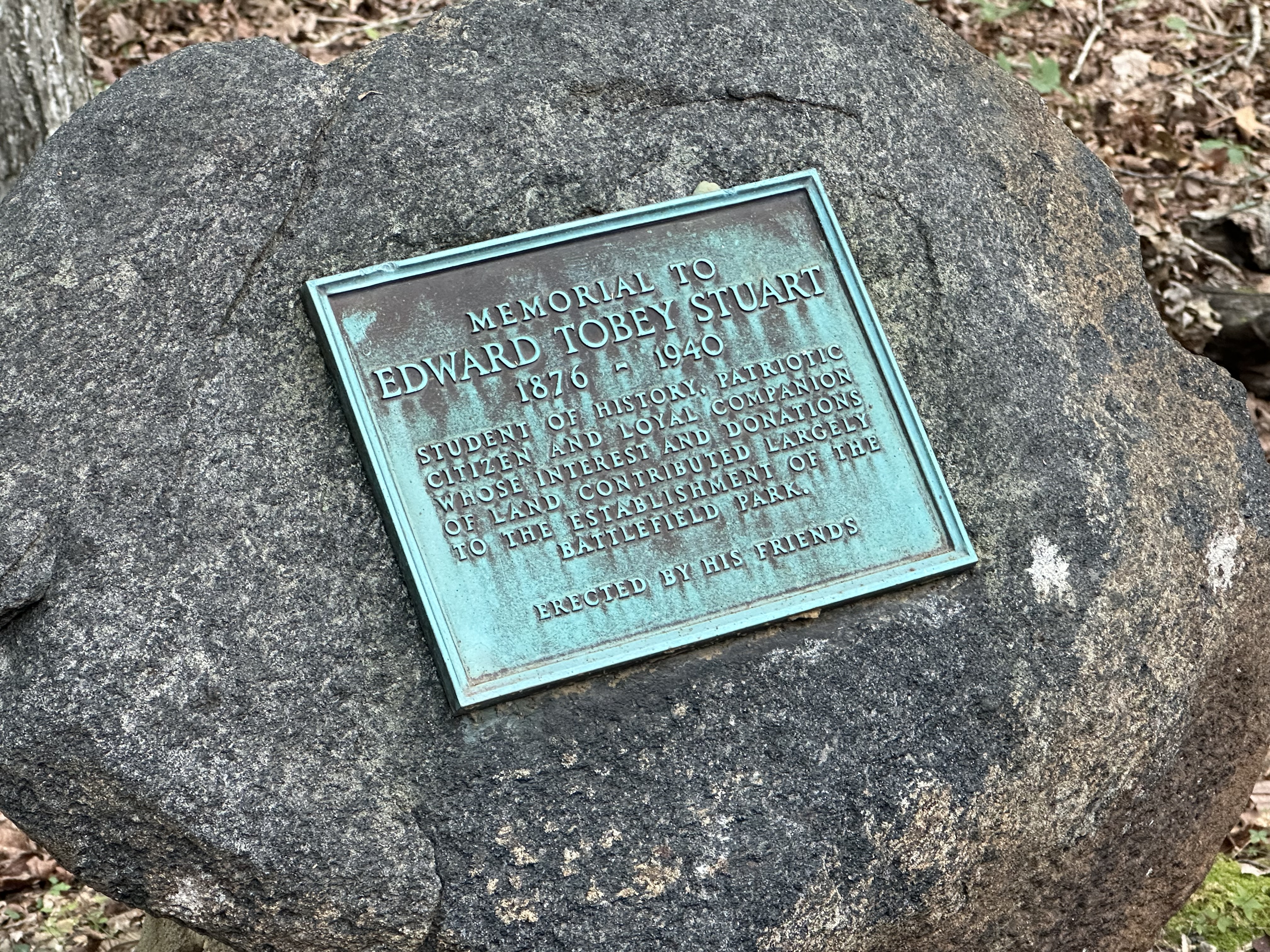
I particularly liked that Chris took us off the beaten path and into the woods to visit a little known and visited (and neglected) monument, pictured below.


Chris told us that Edward Tobey Stuart and his father were responsible for the original purchase of 130 acres at the battlefield, an acquisition intended to preserve it, well before it became a National Military Park.  He emphasized that it was the efforts of people like the Stuarts and those of us, who in a smaller way, contribute towards the preservation that is so important for the history of our country and the memory of those who fought there.  Over the past eight years our Roundtable has made $40,000 in donations to organizations like the American Battlefield Trust and the Central Virginia Batttlefields Trust which, with matching grants, has enabled the acquisition of more than $2.3 million in land parcels.

I plan on returning for the 11th symposium next year. 


Saturday, August 10, 2024

Back In The Mire Again

I posted a version of this song in 2021 when first discovering Billy Strings.  Since then, I've listened to 15 or 20 live versions of Away From The Mire and seen Billy and his band perform their dynamite live set.  It remains my favorite with its strong melody, lyrics, and other-worldly guitar solo.  This version is from Lollapolozza 2022.


Let go of the pain and hold onto the rhythmIt's consciously held back in youYou're drowning a sorrow that's long been at restThe past is a hell, it can creep up inside youSo let me remind you of thisIt's the reason your troubles exist

Friday, August 9, 2024

It Begins

On this date in 1914, the British light cruiser HMS Birmingham rammed and sunk the U-15, the first German submarine to be lost in World War One.  The armies of the continent were mobilizing, about to plunge Europe into the disaster that set the course for the rest of the century.

Following the assassination of Archduke Franz Ferdinand, heir to the throne of Austria-Hungary (AH), and his wife Sophie, in Sarajevo on June 28, by the teenage Slav nationalist Gavrilo Princip, the Austrians delivered an ultimatum to Serbia on July 23, and then declared war on the Serbs five days later.  Serbia's ally Russia, began mobilizing its military against AH on July 31.  In response, AH's ally Germany, declared war on Russia the following day and then on Belgium and Russia's ally France on August 3.  The following day, the United Kingdom made its declaration against Germany.  Two days later AH went to war against Russia, and Serbia issued its declaration against Germany.

As with the American Civil War, none of the parties, to quote Abraham Lincoln's second inaugural address, "expected for the war the magnitude or the duration", while "Each looked for an easier triumph, and a result less fundamental and astounding".

In preparation for a visit to Western Front battlefields next month, I've been doing some reading.  While some has focused on the military aspects like The First World War by Hew Strachan and The Western Front by Nick Lloyd, I've also been delving into the origins of the war.  A few years ago I read Christopher Clark's The Sleepwalkers: How Europe Went to War in 1914.  Over the last month I read July Crisis by TG Otte and listened to a series on podcasts on The Rest Is History, the outstanding podcast by British historians Tom Holland and Dominic Sandbrook, on the assassination of Franz Ferdinand and the failed diplomatic efforts of the following five weeks that gave the world its war. 

The period from the morning of June 28 to July 31 leaves one with the same feeling as watching a "by the numbers" horror movie where find yourself thinking "don't open that door!", "don't go in that room!!", and "splitting up is a really bad strategy!!!", yet the characters proceed to go ahead, nonetheless.

What is striking is how much the actions of the major actors in those weeks, Austria-Hungary, Russia, and Germany was driven by fear, not expansionism or militarism.  Austria-Hungary saw itself as a weakening power, threatened by the demands of multiple nationalities within the empire, and particularly by its Slav population incited, as they saw it, by the Serbs.  Without action to finally end the Serb threat, the Hapsburg faced a dire future, a view shared by a Germany, increasingly concerned about its main ally's slow decline.  The Russians felt humiliated by recent diplomatic setbacks and worried about the lose of reputation and status if it failed to respond in defense of its ally Serbia.  The Germans feared the rapid growth of the Russian economy and its military strength which might surpass theirs within a decade, as well as the growing strength of France, leading to threats on two fronts.  As for the French, they mostly played an inciting role in this period, encouraging strong action by their Russian ally, while seeing an opportunity to liberate Alsace-Lorraine.

Though AH was seeking to militarily punish Serbia, none of the countries sought a general European war, yet they achieved that result, due to miscalculation, negligence and inattentiveness early in the crisis, and the irresponsibility of diplomats in AH, Russia, Germany, and France, along with the disengagement of Britain for much of July.

The Serbian government did not plan, nor desire the assassination, and made some ineffective efforts to stop the team of assassins once learning something was afoot.  But it was organized by Serbs of the secretive Black Hand organization, led by Dragutin Dimitrijevic, known more widely by his alias of Apis, who was also chief of Serbian Military Intelligence.  Through intermediaries a group of young and reckless Slav idealists, including the Bosnian Serb Princip, were easily manipulated into carrying out the attack on the Archduke.

Franz Ferdinand was selected as a target because as heir to the ailing 83 year old monarch Franz Joseph, he was seen as the leading AH proponent for war against Serbia, and was also advocating for a larger role for Slavs within the empire as a counterbalance to the Hungarians, a policy which, if successful, would undermine Serbian goals of establishing a larger Slav state to be run by Serbs.  On the latter issue, the Serbs made the correct assessment, but on the former, not only was Franz Ferdinand not an advocate of war against Serbia, he was the leading figure opposing a war on that nation.

On the morning of June 28 it took a series of individual decisions by officials and a lack of communication to bring about that moment when, by chance, after the driver took a wrong turn, the car carrying Franz Ferdinand and his wife stopped directly in front of the dejected Princip, who had seen one of his fellow plotters toss a bomb at the car earlier with little impact, and believed their attempt had failed completely.  Princip took advantage, acted quickly, firing two shots, and killing Ferdinand and Sophie.  If any one of those decisions or actions had gone differently Princip would never have had the opportunity.

In the aftermath most AH political and military figures saw an opportunity to attack and dismantle Serbia and designed an ultimatum they knew would be unacceptable to the Serb government.  Heedless of the larger implications of its plans it plunged ahead.  Astonishingly it was not until just before issuing its ultimatum, premised on a fast followup attack on Serbia, that the civilian government was informed by its military that it would not be prepared to attack until mid-August!  Nor did anyone give any much thought to what would happen if Russia intervened.  To the extent Russia was considered the Austrians figured that since they had been diplomatically humiliated when AH annexed Bosnia-Herzegovina in 1908 and in Balkan War maneuvering it would react the same in 1914.  But Russia, looking at those same two events when it backed down, was determined not have it happen again.

While efforts were made in Germany, Russia, and near the end of July by Britain, to prevent a wider war, they proved at cross-purposes and ineffectual.  Perhaps if Europe still had statesman with the skill and vision of Metternich, Bismarck, and Disraeli, there would have been a faster and more effective attempt to find a solution short of war but statesmen were in short supply in July 1914.

What followed cost more than ten million lives, ended the monarchies in Russia, AH, Germany,  completed the dissolution of the Ottoman Empire, gave birth to fascism and communism, and planted the seeds for the next European war.  

Austria-Hungary, the country most responsible for the war, proved inept militarily, setting the stage for its self-destruction.  In a giant humiliation for the empire, its first three attempted invasions of the small nation of Serbia were easily repulsed.  It was only with the help of Bulgaria and Germany that it finally succeeded in late 1915.  Indeed, Austria's only military successes in the war occurred with German help and under its direction; the offensive against Russia in 1915, the attack on Romania in 1916, and the offensive against Italy in 1917.

As for Serbia, whose unstable and faction ridden political scene lit the fire leading to the war, a quarter of its population died.  Though Serbia emerged from the war as the leading power in the new Yugoslavia, it was also unstable and violence prone.  In 1934, the Yugoslav king was murdered by Croatian nationalists.  In World War Two, the Germans occupied Yugoslavia, triggering a partisan war of resistance in which 10% of the population died and a fascist Croatian puppet state killed somewhere between 200,000 and 400,000 Serbs.  After the war, under the rule of the Communist Tito, a unified Yugoslavia existed for four decades, but after his death the nation fell apart, going through a series of bloody civil wars, finally splitting into six different nations.  No one dreams anymore of a greater Slav nation.

Gavrilo Princip was immediately captured after the assassination, admitted his guilt but, at 19, was too young to be executed under the law of Austria-Hungary.  Sentenced to life imprisonment he died from tuberculosis on April 28, 1918, six months before the end of the war.  

In 1917, the Serbian government-in-exile convicted the inveterate plotter Apis in a conspiracy to assassinate Prince Regent Alexander.  Apis, the individual most responsible for the war, was executed in June of that year.


There is a school of history which believes the World War was inevitable, given the military buildup in the early 20th century, and the rivalry of the Great Powers.  I'm not an adherent of that school of thought because I lived through the Cold War.  Growing up in that period, it was difficult to see a peaceful ending, yet the Cold War ended unexpectedly and peacefully.  People and contingency play a large part in how events turn out. 

In the case of pre-war Europe, the great naval buildup by Germany which caused tension with Britain had ceased.  In 1912, France extended its term of military service from two to three years which allowed it to significantly increase its army, leading Germany to divert funds from its navy to army.  The result was an easing of tension between Germany and Britain and the beginnings of productive discussion between the two countries. Sir Edward Grey, Britain's secretary of state, was a firm advocate of better relations and meetings between foreign ministers of the two countries might have occurred later in 1914, if war had not intervened.  Improved relations between the two great powers would have lessened the chances of war.

Without a war, Franz Ferdinand would have become emperor when his uncle died in 1916.  Could he have succeeded in his plan to grant autonomy to a Slav entity within the empire?  If so, could that have eased tensions?

Without a war could Russia, the fastest growing economy in Europe, continue its rapid industrial expansion?  Could it deal with its rising class tensions and could the Romanovs have transformed into a more constitutional monarchy?  Well, perhaps that last one is a bit much as it would have required brains.  Without a war, does Lenin (the horrible, but indispensable man) ever return to Russia?

It was Italy's participation in the war, and the disappointment with its share of the spoils afterwards, that emboldened Mussolini and led to the rise of fascism.  Without a war in 1914, does fascism still emerge?

And then, we have Germany without a losing war.  Enough said.

Thursday, August 8, 2024

The Year Of Living Dangerously

If you'd forgotten how young Mel Gibson and Sigourney Weaver once looked, The Year of Living Dangerously is the movie for you.  It also happens to be a fine movie.  Saw it when it was first released in 1982 but not since.  This reminds me to watch it again.

Director Peter Weir was on a role at the time.  His prior film was Gallipoli and next up was Witness with Harrison Ford.  Weir's best films have a distinct haunting and tense atmosphere about them.

The movie is set during the lead up to, and during, the Indonesian military coup in 1965 that removed President Sukarno.  Gibson plays a newly arrived and naive reporter for an Australian TV network while Weaver portrays an employee at the British embassy.  In an Academy Award winning performance Linda Hunt is Billy Kwan, a Chinese-Australian man.

The film was banned in Indonesia until 2000.

This video of L'Enfant by Vangelis from the film, triggered memories prompting this post.

Wednesday, August 7, 2024

Law School

THC graduated from Boston College Law School in 1976.  In retrospect I now realize that BC Law was near the end of its transition from a trade school, where one went to learn the practice of law, to a law school aspiring to the upper ranks of academia. BC was successful and is now ranked around #20 among American law schools.

THC didn't enjoy law school.  He was a poor student, more focused on getting out to a job than in studying.  With the help of Dean Huber, with whom he did an independent study, THC was able to work full time during his third year and just show up to exams for the two courses he was enrolled in.  Working did prove much more fulfilling than school.

Over the years, THC has witnessed the further transition of BC Law into an advocacy focused institution, like many of the other top law schools.  In its faculty, course selections, and in BC Law Magazine it is uniformly progressive.  It is about teaching students what the law ought to be in order to advance an ideological agenda, rather than what the law is.  The magazine is its periodical celebration of those who best advance the cause.

An example can be found in the most recent issue of the magazine, an article on a new book by constitutional law professor Aziz Rana, titled The Constitutional Bind: How Americans Came to Idolize a Document that Fails Them, which calls for "significant changes to our system of government" in order to deal with the "overlapping pathologies . . . of our governing arrangements."  The core problem, according to Rana is:

"the existing order makes it especially difficult for today's multiracial and largely urban majority coalition to implement widely backed policies in response to significant social problems".

According to the article, Rana is gleeful that "creedal constitutionalism has begun to lose its hold on the American imagination", because progressives have been disappointed in recent elections and Supreme Court decisions.

Apparently the author is disappointed by the failure of FDR's court packing scheme in the 1930s, and admires "a little-remembered convention sponsored by the radical Black Panther movement and attended by a broad swath of the activist left, with the goal of replacing the Constitution with a more democratic document".

Professor Rana's views are representative of those of legal academia in the leading schools.  He has the right pedigree; Harvard undergraduate; Yale Law School; member Council of Foreign Relations; and Fellow at the Quincy Institute think tank which is aligned with the Iran-China-Russia axis.  And his views have been enthusiastically endorsed by Nancy Pelosi, according to the BC Law article.

The legal academy is part of the broader progressive movement which has tortured the meaning of democracy, so that its definition is now simply "anything progressives favor", while anything opposed to progressivism is "anti-democracy".  

It is from the ranks of the students in these top law schools that the next generation of lawyers and judges will be drawn from.  They come from a post-constitutional legal world where the only thing that counts is the result and furthering the progressive agenda.  In this world, for a judge to decide a case in a way consistent with the law but not supportive of the progressive agenda would be unthinkable.  The courts are essentially just another legislative branch.(1)

The purpose of the original constitution that progressive seek to overthrow was to establish a federal government with defined and limited powers that allowed for individual and regional diversity in beliefs and politics, and which did not impact most of the everyday life of its citizens.

The new constitution sought by those like Rana seeks to ensure a permanent entrenched federal regime in order to impose a defined set of beliefs and to punish dissent, while controlling the everyday life of its citizens.  Implementing the "widely backed policies in response to significant social problems" is merely the excuse for repression and crackdowns on freedom of speech.

If you want to see the difference between those who believe in the "creedal constitution" and those who believe in "whatever gets it done", watch this exchange between Joe Biden and Kamala Harris during a 2020 campaign debate.(2)

UPDATE: Sept 27, 2025.  Read this recent column by Jonathan Turley, The Counter-Constitutional Movement: The Assault on America's Defining Principles, being led by law professors disappointed about not getting the political results they desire because the existing document leads to too much "rights talk" and identifying free speech as America's "Achilles' heel".

-----------------------------------------------------------

(1) To illustrate the transformation from liberal jurisprudence to progressive legislative jurisprudence, we can look at Roe v Wade.  At the time, the 1973 decision received a great deal of criticism from legal scholars who supported liberalizing state abortion laws legislatively but felt Roe was bad constitutional law.  As liberal constitutional scholar John Hart Ely wrote in a 1973 article responding to the decision,"Were I a legislator I would vote for a statute very much like the one the [Supreme] Court ends up drafting", but, as a constitutional matter, he concludes:

It [Roe v Wade] is bad because it is bad constitutional law, or rather because it is not constitutional law and gives almost no sense of an obligation to try to be.

In 1970, Judge Henry Friendly of the Federal 2nd Circuit wrote a draft opinion regarding a challenge to New York's abortion law.  Because the state modified its abortion statute prior to the opinion being issued, the draft was never released, and Friendly passed in 1986.  However, the draft remained in one of his clerk's possession for thirty years before he spoke of it publicly and released the text.  Friendly was one of the most highly regarded Federal judges of the time and supported the passage of more permissive abortion laws by state legislatures.  However, Friendly's draft upheld the constitutionality of the New York law, despite his personal beliefs.  This article, describing the draft opinion, was written by his clerk.  Unfortunately, I have been unable to relocate the text of the draft though I read it online 15 or so years ago.

The analytical approach of Ely and Friendly is inconceivable for someone like Rana and, for that matter, most of today's progressives who see their role of using the judicial system to enact their legislative preferences.  I should note that there are still occasional progressive holdouts in legal academia for the more traditional view; see, for instance, Akhil Reed Amar of Yale Law School, regarding abortion, but their numbers are fast dwindling.

It is also why, in recent decades, when any politically sensitive issue is in front of the Supreme Court, the question is always whether one of the conservative justices will break ranks because everyone knows the opinions of the liberal justices will always conform to their policy preferences.

(2) After his election, President Biden adopted Harris' suggested approach to the Constitution.