Sunday, October 25, 2015

St Crispin's Day

On the 600th anniversary of the Battle of Agincourt, it's time for the St Crispin Day's speech from Shakespeare's Henry V.  This is from the Kenneth Branagh version which is the best Shakespeare you will ever see on film.  Henry V was 28 years old at the time of the battle as was Branagh when he made the film in 1989.  During the fateful summer of 1940 Winston Churchill evoked the speech with his reference to "the few" when praising the pilots of the Royal Air Force during the Battle of Britain.


You'll notice when comparing the video to the text below that Branagh does not use the entire speech.  Throughout the film he did a brilliant job editing the play and in his imaginative staging of the scenes.  If you watch the film you should do follow along with the text of the play so you can see the decisions he makes.

WESTMORELAND
O that we now had here
But one ten thousand of those men in England
That do no work to-day!
KING HENRY V  
What's he that wishes so?
My cousin Westmoreland? No, my fair cousin:
If we are mark'd to die, we are enough
To do our country loss; and if to live,
The fewer men, the greater share of honour.

God's will! I pray thee, wish not one man more.
By Jove, I am not covetous for gold,
Nor care I who doth feed upon my cost;
It yearns me not if men my garments wear;
Such outward things dwell not in my desires:
But if it be a sin to covet honour,
I am the most offending soul alive.

No, faith, my coz, wish not a man from England:
God's peace! I would not lose so great an honour
As one man more, methinks, would share from me
For the best hope I have. O, do not wish one more!

Rather proclaim it, Westmoreland, through my host,
That he which hath no stomach to this fight,
Let him depart; his passport shall be made
And crowns for convoy put into his purse:
We would not die in that man's company
That fears his fellowship to die with us.

This day is called the feast of Crispian:
He that outlives this day, and comes safe home,
Will stand a tip-toe when the day is named,
And rouse him at the name of Crispian.
He that shall live this day, and see old age,
Will yearly on the vigil feast his neighbours,
And say 'To-morrow is Saint Crispian:'
Then will he strip his sleeve and show his scars.
And say 'These wounds I had on Crispin's day.'

Old men forget: yet all shall be forgot,
But he'll remember with advantages
What feats he did that day: then shall our names.
Familiar in his mouth as household words
Harry the king, Bedford and Exeter,
Warwick and Talbot, Salisbury and Gloucester,
Be in their flowing cups freshly remember'd.
This story shall the good man teach his son;
And Crispin Crispian shall ne'er go by,
From this day to the ending of the world,
But we in it shall be remember'd;
We few, we happy few, we band of brothers;
For he to-day that sheds his blood with me
Shall be my brother; be he ne'er so vile,
This day shall gentle his condition:
And gentlemen in England now a-bed
Shall think themselves accursed they were not here,
And hold their manhoods cheap whiles any speaks
That fought with us upon Saint Crispin's day.

Saturday, October 24, 2015

My First Ballgame?

With several UPDATES added.

The recent passing of Yogi Berra got me to thinking about the first major league baseball game I'd seen and I decided to track down the details.  In doing so it's made me confront issues of memory - what is it we remember and what is it we think we remember?  How many of our memories are because we've assembled those memories in a certain form for many years even though they might not resemble the original events?

Here is what I was certain about that first game:

My Dad took me to the game.
It was a day game at Yankee Stadium.
The New York Yankees beat the Boston Red Sox.
The Yankees won on a walk-off home run.
The Yankees hoisted the player who hit the homer onto their shoulders.

Here is what I also thought happened at that game:

I think it was Yogi Berra who hit the homer.
The home run was hit to right or right-center.
I have a vague recollection that a Yankee pitcher, Bob Grim, was involved. 
The weather was mild, not hot.  It was partly cloudy or there was a haze.
It took place sometime between when the Giants left New York after the 1957 season and when the New York Mets began play in 1962. 

Here is what was jumbled in my mind:

At times I distinctly remember Ted Williams played for the Sox but at other times I remember my Dad telling me how disappointed he was that Ted was not playing that day.
Our seats were many rows back at ground level, somewhere between first and third base by my memories vary; sometimes I see us watching the game from the third base side, sometimes from behind home and other times along first.

A few years before Dad died I asked him what he remembered but his recollections were fuzzier than mine.

In trying to pin down the game I started with the most noteworthy event - the walkoff home run - and wouldn't you know it, there is a website that lists every walkoff in Yankee history (Yankee Numbers.com).
 http://i.ebayimg.com/00/$(KGrHqV,!h0E1LP7PD7QBN(ObzYBJQ~~_35.JPG
During the four seasons in question (1958, 59, 60 and 61) the Yankees twice beat the Red Sox on walk offs.  The first was on September 3, 1958 when Yogi Berra hit a three run homer in the bottom of the 9th to break a tie and give the Yankees an 8-5 victory.  The second was on October 2, 1960, when Dale Long hit a two run homer in the 9th to give the Yankees an 8-7 win (this was the final game of the year).

But then I noticed something else in the list of walk-offs.  The Yankees also had two walk-off wins against the Red Sox in 1957.  On April 28, 1957, Yogi Berra hit a bases empty homer in the bottom of the 10th to give the Yankees a 3-2 win and on September 5, 1957 pitcher Bob Grim stroked a three run homer for a 5-2 Yankee win.

So what's the story?  Which game did I see?  How certain was I that the game was during the 1958-61 window?  In reflecting on it, I knew for certain it was no later than 1961, but was less certain that it could have been in 1957.  I realized that my assumption was we were seeing the Yankees because the Giants, my Dad's favorite team, had already left New York, but that may be wrong.

I started to look for other information.  The first was when the games occurred as I thought it unlikely that my Dad would have taken me out of school to see it.  The games on April 28, 1957 and October 2, 1960 both took place on Sunday.  The September 5, 1957 and September 3, 1958 games were on a Thursday and Wednesday respectively.  I decided to check out when Labor Day was those years since when I was in elementary school the school year always started on the Wednesday or Thursday after Labor Day.  It turns out that Labor Day was on September 2 in 1957 and September 1 in 1958 so the games might have been on a school day.

Next step was to go the box scores and play by play at Baseball-Reference.com to see if there was anything there that could narrow down the possibilities.

April 28, 1957

A big crowd, almost 38,000.  Temperature at game time was 71.  Frank Sullivan started for the Sox and Ike Delock took the loss.  Ted Williams was in the lineup.  Whitey Ford pitched seven shutout innings for the Yankees but Bob Grim blew the save, with Don Larsen picking up the win when Yogi homered.  Mickey Mantle and Billy Martin were both ejected for arguing with the umpire. The play by play does not indicate to which field the lefty swinging Yogi homered.  UPDATE: The New York Times reports Yogi's shot landed in the lower right field pavilion.  I also found a detail that makes me doubt this was the game I saw - there was an 18 minute rain delay in the bottom of the 7th inning, something I have no recollection of, though it doesn't mean it did not happen.

September 5, 1957

Only 15,600 in attendance.  Temperature was 72.  Willard Nixon pitched the entire game for the Sox.  Williams did not play.  Bob Turley started for the Yankees with Bob Grim pitching the top of the 9th and getting the win on his three run homer.  The bottom of the 9th was strange by today's standards.  Yogi led off with a single and was caught stealing (perhaps a missed hit and run?) UPDATE:  According to the NY Times report Yogi overslid second and was tagged out.  Harry Simpson made the second out.  Jerry Lumpe singled and Enos Slaughter walked and Casey Stengel let Grim, hitting .125, bat which is simply unthinkable in today's game.  Grim batted righty but there is no indication where the homer was hit.  UPDATE: Found an extensive report on Grim's homer from the Kingston Daily Freeman:

Grim HR
And here is some more from the NY Times:

"Even in batting practice I could never hit a ball to right field" said Grim, still in a happy state of semi-shock . . .  "I would have had somebody bat for him, except we had nobody much left to hit, pitch or field" Stengel said "Then he did it and my only worry was that when he got to second base he'd peel off and go out and see how far that ball went".

When they weren't pounding Grim on the back, various elated Yankees took time out to exclaim "Wow" or "Whoopee".

September 3, 1958 

Attendance was 13,600.  Temperature unknown.  Frank Sullivan started for the Sox with Leo Kiely giving up Yogi's game winner.  Williams did not play.  Murray Dickson started for the Yanks with Ryne Duren getting the win for his two innings in relief.  Mickey Mantle hit a homer earlier in the game which rings a bell with me but I don't trust my memory now.  Berra hit his homer following singles by Mantle and Slaughter.  No indication of field.  UPDATE:  Found a newspaper report that Berra's blast was deep into the right field bleachers.

October 2, 1960

Attendance was 16,900.  Temperature 64.  Earl Wilson started for the Sox with Arnold Early taking the loss.  Williams did not play - this was the series after Ted closed out his career in Boston by hitting a home run against the Orioles in his last at bat.  Ralph Terry started for the Yankees followed by Whitey Ford, Ryne Duren, Luis Arroyo and Duke Maas who picked up the win.  Dale Long, a lefty hitter, got his home run with one out in the 9th.

Well, that wasn't a lot of help.  I also looked for newspaper articles and photos, in particular any reference to the home run hitter being carried off the field but found none. 

So which game was I at?  The only one I'll rule out was the last one in which Dale Long homered.  I would have been nine years old at the time and think I would have remembered this better if it was the game.  Moreover, there is nothing that matches up in my memory with this one.

The only other possible narrowing down is if, in fact, the September 5, 1957 and September 3, 1958 games were on the first or second day of the new school year it is unlikely that Dad would have taken me to the game making April 28, 1957 the most likely first game I ever saw.  UPDATE:  Now that I know about the rain delay in the April 1957 game I have no idea which game I saw.

Wednesday, October 21, 2015

Turn To Stone

Was reminded of this song when watching Black Mass a few evenings ago (post forthcoming on the film).  Great tune by riffmaster Joe Walsh from his outstanding 1974 album, So What.  THC predicts a Joe Walsh guitar mashup coming soon to this blog.

So What contains some very subtle and tender music.  Listen to Help Me Thru The Night, Falling Down:
Making no deposit, no return
Making the same mistakes, we never learn
All of the pain in those faces
Trying not to show concern

Spent and broken
Like a worn out subway door in the city

Hanging in the closet, wait in line
When you go by the laws, you pay the fine
I'm burning the candle at both ends
Twice the light in half the time

Down to crawlin'
Feel like I'm falling
Oh & yes, the rain doesn't have to hurry in the city;
Falls sadly to the ground
Rain doesn't have to hurry in the city                                                                                   Only way to fall is down
And finally, Song For Emma, which THC did not realize until researching this post was written for Joe's 3-year old daughter who died earlier that year in a car accident while on her way to nursery school.

Tuesday, October 20, 2015

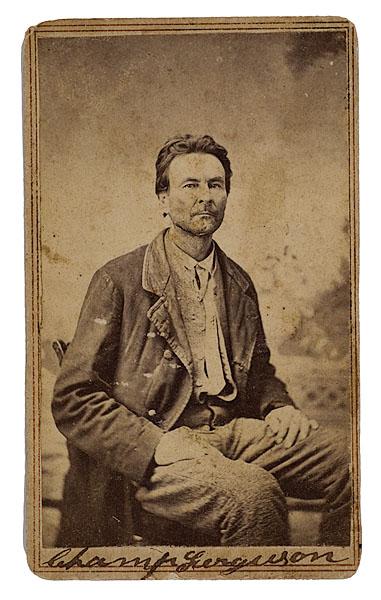
Champ Ferguson

Champ Ferguson was hanged that morning.  They got right to it.  In Nashville.  October 20, 1865.  Sure, the Civil War had wound down by then and most of the Reb soldiers had gone home without the Federal government bothering them.  But there were a couple of exceptions.  One was William Quantrill, the Confederate guerrilla who'd led the attack on Lawrence, Kansas in 1863 during which more than 150 civilian men and boys sympathetic to the Union were murdered.  Frank and Jesse James along with Cole Younger learned their bushwhacking trade serving under Quantrill.  Quantrill was finally hunted down in Kentucky where he was wounded and captured, dying on June 6.

Another was Captain Henry Wirz, commander of the notorious prisoner of war camp in Andersonville, Georgia where 13,000 Union prisoners died under horrendous conditions.  Wirz was one of only two men to be tried and convicted of war crimes in the aftermath of the Civil War.  The other was Champ Ferguson.
Champ Ferguson sitting.jpg(Champ Ferguson from Wikipedia)

Clinton County in east Kentucky, was where Champ was born in 1821.  During the 1850s he moved his family just over the state line to White Country, Tennessee about halfway between Nashville and Knoxville.  Champ was always a rough guy.  Well before the war he was known as a "gambling, rowdyish, drinking, fighting, quarrelsome man" according to HistoryNet and in 1858 he'd killed Sheriff James Read of Fentress County.

When war broke out in 1861, there were many Union sympathizers in east Tennessee, including most of Champ's family but he decided to throw his lot in with the Confederates.  By early 1862 Ferguson had organized his own guerrilla band which varied over the course of the war from dozens to hundreds.  HistoryNet notes:
By the spring of 1862, relatively few major military engagements had taken place in Tennessee, but the Cumberland Mountains were filled with violence. Roaming bands of outlaws took advantage of the war to steal whatever they wanted with no regard for their victims’ politics. It was not uncommon for these outlaws simply to declare a man an enemy sympathizer and then take his possessions or even kill him. Families, friends, and neighbors were so passionately divided that even idle rumors questioning a man’s alignment could soon lead to his death. Many prudent people avoided their own homes.
It wasn't just east Tennessee.  Everywhere west of the Appalachians, guerrilla warfare thrived and raiding, destruction, murders and massacres happened all the way to Texas.  It was a brutal chapter in a war which gave license to those with the least restraint in society with each outrage provoking retaliation from the other side and further rounds of mutual brutality. 
http://thomaslegion.net/sitebuildercontent/sitebuilderpictures/longstreets_knoxville_campaign_civil_war.jpg(East Tennessee from thomaslegion.net)

History Net goes on to report:
In the middle of all this chaos stood Champ Ferguson. Many of the Union men he took prisoner — some in the army, some not — were found shot and often stabbed through the heart. Ferguson favored the Bowie knife and often finished his victims off with one. There were rumors of decapitations.
An account in The New York Times adds:  
His first victim was a neighbor, William Frogg. When he rode up to the Frogg cabin, Mrs. Frogg suspected no ill will; she had known Ferguson since childhood, and offered him a seat and an apple. He refused both, and sought out her husband, who lay ill in his bed. Champ inquired as to Frogg’s health, and his neighbor responded, “I am very sick. I had the measles, and have had a relapse.”

Champ accused Frogg of having contracted his illness while visiting the Yankee recruitment center at nearby Camp Dick Robinson, which Frogg vehemently denied. Ferguson simply drew his pistol and shot Frogg twice in front of his wife and child, killing him on the spot. He then ransacked the cabin, looking for weapons. At his trial four years later, Ferguson would voice what would become his constant refrain: “I considered myself justified in killing him.”
He also claimed at his trial that he had personally killed over one hundred men in the war, all in self-defense.

It was an event in early October 1864 that would eventually seal Champ's fate.  The main source of salt for the Confederacy, an essential element for its survival, were the saltworks in the aptly named town of Saltville, Virgina near its border with Tennessee.  Finally realizing the importance of the saltworks the Union launched a raid against the town which was defended by regular Confederate troops along with Ferguson's ragtag band.  The Federal force was repulsed and many prisoners and wounded were left in Rebel hands.  Ferguson and his men, possibly with some participation from regular Confederate troops set about murdering the captive Yankees, particularly those from the 5th US Colored Cavalry and their white officers.  According to the Times account:
Following the fighting, the Union lieutenant Elza C. Smith of the 13th Kentucky Cavalry lay wounded in the Emory and Henry College Hospital, along with several of his white and African-American soldiers. Suddenly, Ferguson burst into the ward at the head of his band. He strode across the room, and when he came to Smith’s cot, he raised his rifle and snarled, “Do you see this?” He placed the muzzle a foot from Smith’s forehead as the injured man lay helpless, pleading for his life.
Ferguson drew back the hammer, and … “click!” The weapon misfired. He cocked his rifle and pulled the trigger twice more, with the same result. Finally, mercifully, on the fourth attempt the gun discharged, and Lieutenant Smith lay dead on his cot, a bullet through his head. 

Both before and after the killing of Lieutenant Smith, Ferguson and his men rampaged through the hospital and the grounds, slaying injured black troopers where they found them, as well as the white soldiers and officers with whom they served. Spying one wounded young white trooper crawling along the ground, Ferguson demanded to know why he had “come down there to fight with the damned niggers.” Ferguson drew his pistol and asked the hapless soldier, “Where will you have it, in the back or in the face?” The terrified youth was incoherent with pain and fear, so Ferguson peremptorily chose for him. 
http://thomaslegion.net/sitebuildercontent/sitebuilderpictures/saltworksbattlecampaignmapsaltville.jpg(Map from Thomaslegion.net)

Modern historians have concluded that between 45 and 50 Union soldiers were murdered that day before another Confederate unit, the Thomas Legion of Cherokee Indians and Highlanders intervened to stop the slaughter.   The Saltville massacre reached the attention of Robert E Lee and other Confederate Army leaders who ordered Ferguson's arrest.  Although he was held for two months he was ultimately released.  For a detailed account of the massacre see this summary at southern studies.org.

A second raid on Saltville in December 1864 was successful, putting the works out of commission.

With the end of the war, Champ returned home apparently assuming the general pardon would apply to him but the Federal government had other plans and he was arrested, charged with 53 murders and went through a lengthy trial with 43 prosecution witnesses after which he was deservedly convicted and hung.


Sunday, October 18, 2015

Isonzo

https://upload.wikimedia.org/wikipedia/commons/f/f8/G%C3%B6rz_Br%C3%BCcke_Isonzo.jpg(The Isonzo from Wikipedia)

With dawn breaking 1,200 artillery pieces opened fire on enemy positions across the river.  It was the morning of October 18, 1915.  The artillery was that of the Italian Army.  The enemy were the forces of Austria-Hungary (AH).  The river was the Isonzo.  The firing marked the opening of the Third Battle of the Isonzo.  The dreary drawn out slaughter of World War One was continuing a mere 80 miles from Venice.

We are much more familiar with the battlefields of the Western Front - Somme, Verdun, Ypres, Marne, the Argonne Forest and even Loos but the lesser known and even more futile Battles of the Isonzo should be marked as examples of how horrible that war was.

Historians disagree on how many battles took place along the Isonzo from June 1915 through the fall of 1917; depending on how you are counting it's ten, eleven or twelve.  With the exception of the final battle, about a million soldiers on both sides were killed, wounded or captured and with the exception of that final battle all were offensives by the Italian Army.  The later battles were the backdrop for Ernest Hemingway's novel, A Farewell To Arms.  Hemingway served as an ambulance driver supporting the Italians.

Italy was not involved in the initial outbreak of the war in August 1914; in fact it had a secret alliance with Germany and Austria-Hungary but refused to enter the war on their side.  For the next several months Italy entertained offers from both sides, eventually deciding to join Britain and France based on their assurances of territorial gains in the Tyrol and Istria at the expense of the Austrians after the end of the war.

On May 23, 1915, Italy declared war on AH.  Although mobilization of the Italian army had begun earlier in the year, the military was hamstrung by a lack of equipment; of 1.2 million men called to arms there was only equipment for 700,000.  Furthermore, the military leaders were not notified by the government until a few days beforehand of the planned declaration of war.

The Isonzo battles arose from the reality of the military situation and geography.  Militarily, AH would be content to remain on the defensive since its army was already fully occupied coping with a successful Russian offensive and secondarily with Serbia.  And since it was the Italians who had territorial aspirations it was they who would launch the offensives.

Map of the Italian front.  The Isonzo is along the right side bordering the Adriatic.  
Italian Front 1915-1917.jpg
The AH could afford to adopt a defensive posture on the Italian front since most of the 400 mile border between the two countries was dominated by steep mountains.  It was only along the 60 mile stretch of the Isonzo which drained to the Adriatic Sea were there was some relatively open land and it was here that Italian Army Chief of Staff Luigi Cadorna focused his attacks.  But concluding that attacking along the Isonzo was a better option than attacking through the Alps did not make the Isonzo a good option.  Because it drained the Alps the river was frequently flooded and during the war the region was subject to record rainfalls and snowmelts.  Moreover, on the northern end of the Isonzo battlefield along the Austrian side were mountains that provided the AH army great vantage points to observe any Italian buildups on the other side of the river.  In addition, the remainder of the battlefield was also not a particularly favorable for offensive action as described by the British Official History of the Italian Front (from worldwarone.com); for reference the area east of the Isonzo was on the AH side:

East of the [Isonzo] the arid limestone uplands sloping gently westwards are deeply cut into a tangle of ridges and valleys. Here the denuded plateaux, known to fame as the Bainsizza and the Carso, the wooded Selva di Ternova lying back between them, form enormous natural fortresses, towering 2,000 ft or more over the surrounding lowlands. The Bainsizza is described as "not flat, but traversed by ridges which rise to a considerable height above the general level" and the Carso is depicted as "a howling wilderness of stones sharp as knives." [Italian troops came to hate the barren Carso, particularly, with its relentless summer sun and crushing winter wind called the "Bora".] 
Isonzo Front Map(from worldwar1.com)
 
For these reasons the Third Battle of the Isonzo was as unsuccessful as the prior two for the Italians.  The official end date of the Third Battle was November 3, but the Fourth Battle which was essentially a continuation of the Third began on November 10 and lasted until December 2.  The Italians suffered 115,000 casualties during the two battles, the Austrian-Hungarians about 72,000.
 http://img0.worldhistoryproject.org/photos/images/3dbadeb776e94f408228bab875c4582f_three_column.jpg(Italian army along the Isonzo front)

For over two years the Italians hammered away along the Isonzo line making very little headway.  The futility of these repeated efforts undermined the morale of the army and General Cadorna proved an uninspiring leader.  Finally on October 24, 1917 the AH, reinforced by German divisions (and a young officer named Erwin Rommel) launched a massive counteroffensive which shattered the Italian Army, inflicting 300,000 losses (mostly prisoners), driving it back to the outskirts of Venice where British and French divisions rushed from the Western Front helped to stiffen the defensive line.  This battle is alternatively known as the 12th Battle of the Isonzo or the Caporetto Campaign.

There were two positive aspects of the final battle.  First, it prompted the Italian government to finally remove the inept General Cadorna and secondly, it was also costly for the AH army which was almost as demoralized as the Italians.  They were unable to capitalize on the victory and advanced no further in the war.

Another sad episode in an unnecessary war.


Saturday, October 17, 2015

Driving In Domme

Domme is completely surrounded by its medieval walls and cliffs so its footprint has not expanded in seven centuries which presents a challenge for driving.  To enable the town to function most streets are one way.  The four short videos below document the route we had to take from entering the town to getting to our house.  NOTE:  Videos may not display properly on mobile devices.

#1:  You see the remnants of the town wall and then we drive through the narrow gate.  Our house is on the same street only a block and a half further uphill but it is one way in the wrong direction.  Instead we have to take a right which eventually brings us to one of the two main squares in town.

#2:  We drive through the square and take a right which takes us past the other gate into town.  We then start going uphill towards the upper part of town and the cliffs overlooking the Dordogne River Valley.

#3:  At the upper town we turn left and drive past the hospital.

#4:  We drive through the other main square in town and then turn left and head downhill towards the gate through which we originally entered.  At the end you can see our house directly ahead.  You'll also hear Mrs THC mutter "oh rats" because she's noticed that on the little side street to the right the parking spot we usually tried to get was already taken.