A beautiful ballad from Jack Bruce's third solo album, Harmony Row (1971), a wonderful recording and commercial failure. Jack is on bass and piano, as well as vocals.
Tuesday, November 8, 2022
Folk Song

Monday, November 7, 2022
Baked Alaska
In preparing my Changing Climate post, I read again my prior climate change posts and thought one deserved an update. In a 2015 post, Controlling The Narrative: Climate Change, I took a Washington Post science writer to task for a misleading article linking forest fires in Alaska to climate change, in the course of which he mischaracterized the data on temperature increases in that state.
I knew the article was incorrect the moment I read it because, since the early 2000s, I'd been following Alaska climate trends via the website of the Alaska Climate Research Center (ACRC) of the University of Alaska. That had been prompted by a misleading article in the New York Times about Alaska climate trends.
In both cases, the newspaper narrative used convenient start and end dates to support its claims. I've seen these tactics used by both climate change alarmists and self-proclaimed debunkers. Always look beyond the start and end dates to see if trends change. You can read the linked post for more detail on why the WaPo article was misleading and learn about the Pacific Decadal Oscillation (PDO).
However, it is another part of the post that requires an updating as I've continued to occasionally check in on the ACRC. In the 2015 post I noted:
I have one observation of my own regarding the ACRC data. On the second chart, notice that Barrow — which lies on the Arctic Ocean, much further north than the other Alaska weather stations — has noticeably warmed since 1976 in contrast to the rest of the state. Carbon dioxide greenhouse gas warming theory predicts that the greatest temperature increases will initially be seen in the Arctic and Antarctic, so the Barrow data is intriguing. I’m not familiar with temperature trends in other areas of the Arctic, so can’t tell you whether this change is due to a local anomaly or is part of a broader trend. However, in the Antarctic there is no warming trend, with the exception of the Antarctic peninsula which extends farther north than the rest of the continent. It’s something I’d like to know more about but won’t trust anything Mooney [author of the WaPo article] might write about it.
I like predictions that can be falsified. Unfortunately, too many climate claims can't be. More rain than normal? Climate change! Less rain than normal? Climate change! Less snow than normal? Climate change! More snow than normal? Climate change! The list goes on and on. But the prediction for larger temperature increases at the poles can be falsified.
It turns out that since 2015, the warming trend at Barrow (now called Utqiagvik) has not only continued, but accelerated. From 1949 through 2020, the town's annual temperature has increased by 7.5 degrees, and by 10 degrees in the winter. The annual increase is almost 2 degrees more than any other town in the state and almost twice the average increase for the entire state.
The change is even more dramatic if measured from 1976. During this period, average state temperature increased by 3.3 degrees but Utqiagvik has increased 12.4 degrees, including by nearly 20 degrees in the autumn and 13 degrees in the spring. As mentioned in the 2015 post, I have not conducted detailed research on Antarctic data or on other Arctic regions, but the Utqiagvik data is consistent with warming theory. The ACRC notes that temperature increases have been the highest across the regions closest to the Arctic Ocean:
The most significant temperature increases have occurred along the North Slope, the Arctic Coast, and the adjacent Arctic Ocean from the Beaufort to the Chukchi Sea.
These same years since 2015 have also shown a continued elevated temperature increase across the state as shown in this ACRC chart:
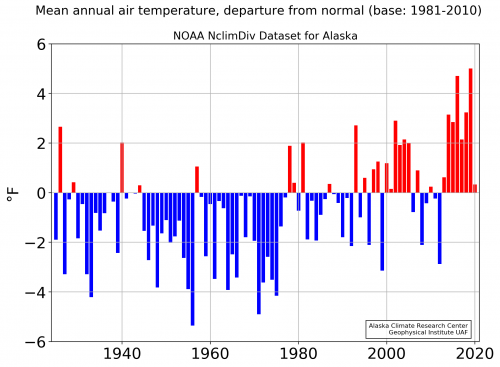
The ACRC has this note regarding the above chart:
The stepwise shift appearing in the temperature data in 1976 corresponds to a phase shift of the Pacific Decadal Oscillation from a negative phase to a positive phase. Synoptic conditions with the positive phase tend to consist of increased southerly flow and warm air advection into Alaska during the winter, resulting in positive temperature anomalies.
Changes in the PDO have major impacts on Alaska weather, and it is unpredictable when it next changes to a negative phase in which it brings cold air advection into the state. However, the northerly parts of the state which have seen the greatest temperature increases in recent years may be the least impacted region by a change in the PDO.
Opinions
The Supreme Court recently held oral arguments on the affirmative action programs of Harvard and the University of North Carolina which, at least in the case of Harvard, where I'm familar with the data, has increased black and hispanic admissions while significantly limiting Asian admissions. I expect the Court will overturn the diversity rationale first expressed by Justice Powell in the Bakke case (1978) and then made an explicit holding of the Court in the 2005 Grutter case, which provided cover for academic institutions to unleash the scourge of Division, Intolerance, and Exclusion (DIE). While I believe that to be the correct constitutional conclusion, the reality is that the Court's ruling will not make a difference to the admission practices of the elite colleges and universities most committed to DIE. There are quite a few potential ways to work around the Court's anticipated ruling in order to achieve the same goals which, in turn, will trigger more litigation.
Reading the transcript of the arguments led me to reread the opinions in Bakke and two aspects jumped out to me.
The first was Justice Powell's explanation of the purpose of "diversity", why it was important in the educational environment, and thus a permissible factor in admissions. Excerpts:
The atmosphere of "speculation, experiment and creation"—so essential to the quality of higher education—is widely believed to be promoted by a diverse student body. As the Court noted in Keyishian, it is not too much to say that the "nation's future depends upon leaders trained through wide exposure" to the ideas and mores of students as diverse as this Nation of many peoples.
Thus, in arguing that its universities must be accorded the right to select those students who will contribute the most to the "robust exchange of ideas," petitioner invokes a countervailing constitutional interest, that of the First Amendment. In this light, petitioner must be viewed as seeking to achieve a goal that is of paramount importance in the fulfillment of its mission.
"The law school, the proving ground for legal learning and practice, cannot be effective in isolation from the individuals and institutions with which the law interacts. Few students and no one who has practiced law would choose to study in an academic vacuum, removed from the interplay of ideas and the exchange of views with which the law is concerned."
Ethnic diversity, however, is only one element in a range of factors a university properly may consider in attaining the goal of a heterogeneous student body.
What is striking about Powell's rationale is that it appears no longer applicable in education, particularly in the elite colleges and universities. His assumption is that ethnic and racial diversity, in and of itself, is an element in creating the "robust exchange of ideas". Precisely the opposite is currently happening in academia. What is important for students (and faculty) is complete conformity to a rigid set of ideas based upon race and gender being the sole lenses through which human experience and knowledge should be viewed. Applicants, students, and faculty are increasingly being forced to pledge adherence to every element of the new creed, and dissent is immediately punished. Classroom discussion, student group activities, outside speakers are all subject to a stifling conformity.
In light of the state of 21st century academia, Powell's concept of "diversity" has simply been nullified. On that basis alone, Grutter should be overturned.
The second thing that stood out was Justice Marshall's opinion. Marshall's opinion is concerned solely with the situation of the Negro (his word) and the history of discrimination, pre- and post-Emancipation, experienced by that group. After a lengthy recitation of that history, the Justice concludes;
. . . these differences in the experience of the Negro make it difficult for me to accept that Negroes cannot be afforded greater protection under the Fourteenth Amendment where it is necessary to remedy the effects of past discrimination.
It is a view I have sympathy with, though the argument carries less power in 2022 than in 1978. The unique aspects of the descendants of the freed slaves, and the discrimination they faced nationwide consistently until the post-Second World War era are at the heart of this. In the July 2022 post Justice You Shall Pursue, I wrote about an interview with Charles Fain Lehman:
Two thoughts prompted by the interview:
The first is whether the Civil Rights Act of 1964 (CRA) was a mistake in not limiting its scope to the problem we were trying to remedy - the exclusion of black Americans from the full scope of legal rights of citizenship, as well as their de facto exclusion from large parts of American life.
During the debates over the 14th Amendment after the Civil War, an alternative was proposed simply stating:
All national and State laws shall be equally applicable to every citizen, and no discrimination shall be made on account of race and color.It was overwhelmingly defeated in the Senate and instead we ended up with the more complex and legally ambiguous version of the Amendment we have now, in which we are still debating what "due process of law", "privileges and immunities of citizens" and "equal protection" mean 150 years later.
The one sentence version was doomed to defeat because, at the time, white Americans would not accept social equality for blacks, but in the long-term I think it would have served us much better. Was the same true of the CRA, which I've always considered one of the two greatest federal legislative achievements of the 20th century (the other being the 1965 Voting Rights Act)? It is something recent events have led me to question. (1)
(1) My point is not whether other groups should have civil rights, but perhaps we would have been better served focusing on the unique circumstances of those involuntary brought to America, held in servitude, and their descendants. Whatever other groups may have faced, the degree, extent, and duration of discrimination against these people is unparalleled in our history.
Ironically, the elite academic institution focus on diversity has led to a highly disproportionate percentage of black admissions to be of first and second generation African immigrants or biracial applicants. In some cases, as with Barack Obama, applicants fall in both categories. This has been noticed by some black organizations who have called for preferences for those descended from slaves, in order to correct this imbalance.
Unfortunately, all this is a diversion from the real issue - the failure of K-12 education to develop a pipeline of students for the institutions of higher learning. The result is that the elite institutions are competing against each other for a small pool of black applicants. Expanding that pool should be the focus. There are a lot of theories about why this has happened but, unless and until it is solved, this issue will remain with us in one form or another.
On a side note, until rereading the case, I had not realized that arguing for the University of California was Archibald Cox, of Harvard Law School, and the Special Prosecutor fired by President Nixon in the Saturday Night Massacre of October 1973.
Sunday, November 6, 2022
Changing Climate
In the New York Times, David Wallace-Wells, the paper's climate change reporter, recently wrote "Beyond Catastrophe A New Climate Reality Is Coming Into View". I've spent the past two decades engaged with climate issues (more on my background at the end of this post), so before getting to the Times article, these are my current views.
CO2 and other greenhouse gases emitted by human activities are contributing to warming.(1)
The degree of such contribution and of any associated warming, to date and in the future, is less than commonly portrayed in most of the media. This is not an extinction event. There is no imminent "tipping point".
Because of the persistence of CO2 in the atmosphere, our human-impacted climate future for the next 25-50 years is pretty much baked in. Actions taken today would have their maximum impact in the late 21st century.
The United States has, for the past quarter-century been a declining source of global emissions, reduced from about 26% in 1997 to about 14% today. (2) In 2000, US emissions were twice those of China, while by 2012 China emissions equaled that of the US and EU combined. Today, China emissions are more than twice those of the US.
Geopolitics makes it very unlikely that global agreement can be reached, and more importantly complied with, on the 50-80% reduction (usually using a 2005 baseline) that some claim is required to avoid "catastrophe".
Wind and solar can be greatly expanded, but cannot provide the baseline power provided by fossil fuels and nuclear power. In fact, the expansion of renewables also requires expansion of baseline power to deal with fluctuations in the power provided by renewables.
Expanding wind, solar, and batteries requires staggering amounts of metals and rare earths. Many of these materials are dominated by China, whether because the resource is internal to that country or because of contractual arrangements it has made in recent years with developing countries, particularly in Africa. To understand the scale of this increase read this 2021 assessment from the International Energy Agency, "The Role of Critical Minerals in Clean Energy Transitions". An excerpt:
An energy system powered by clean energy technologies differs profoundly from one fueled by traditional hydrocarbon resources. Solar photovoltaic plants, wind farms and electric vehicles generally require more minerals to build than their fossil-fuel based counterparts. A typical electric car requires six times the mineral inputs of a conventional car and an onshore wind plant requires nine times more mineral resources than a gas-fired plant. Since 2010 the average amount of minerals needed for a new unit of power generation capacity has increased by 50% as the share of renewables in new investment has risen.
Unless the U.S. is willing to rely upon China for its energy, security, and economic future, expansion of renewables and battery technologies requires radical revision of local, state, and federal permitting requirements for mining, processing of materials, and major projects.
There is a consistent underestimation of the current and future energy needs of the world. This is way beyond cars and the lights in our homes. For details, read Vaclaw Smil's recent book, "How The World Really Works", particularly the sections on the energy inputs required to produce the four essentials of modern civilization - ammonia, steel, concrete, and plastics. Smil advocates action to minimize impacts of climate change but is frustrated by the refusal of the proposals of most advocates to recognize what it will entail.
Nuclear power provides the lowest-risk, low GHG baseline power.
I remain optimistic that large-scale usable and financially sustainable energy alternatives may be developed but that is still decades away.
Adaptation, including infrastructure improvements, to a slowly warming climate needs to be the emphasis going forward.
Now, back to the Wallace-Wells article. The author writes that, in the past, he'd been a believer in a catastrophic climate future:
In 2017, I wrote a long and bleak magazine article about worst-case scenarios for the climate, focused on a range of possible futures that began at four degrees Celsius of warming and went up from there. In 2019, I published a book about the disruptions and transformations projected by scientists for lower but still “catastrophic” levels of warming — between two degrees and four. I was called an alarmist, and rightly so — like a growing number of people following the news, I was alarmed.
But new findings have altered that prospect, making it possible that warming can be limited to 2 degrees or so:
For decades, visions of possible climate futures have been anchored by, on the one hand, Pollyanna-like faith that normality would endure, and on the other, millenarian intuitions of an ecological end of days, during which perhaps billions of lives would be devastated or destroyed. More recently, these two stories have been mapped onto climate modeling: Conventional wisdom has dictated that meeting the most ambitious goals of the Paris agreement by limiting warming to 1.5 degrees could allow for some continuing normal, but failing to take rapid action on emissions, and allowing warming above three or even four degrees, spelled doom.
Neither of those futures looks all that likely now, with the most terrifying predictions made improbable by decarbonization and the most hopeful ones practically foreclosed by tragic delay. The window of possible climate futures is narrowing, and as a result, we are getting a clearer sense of what’s to come: a new world, full of disruption but also billions of people, well past climate normal and yet mercifully short of true climate apocalypse.
First, worst-case temperature scenarios that recently seemed plausible now look much less so, which is inarguably good news and, in a time of climate panic and despair, a truly underappreciated sign of genuine and world-shaping progress.
But that perspective was nowhere to be seen in the huge set of models, mixing economic and demographic and material assumptions about the trajectory of the future, which climate scientists used to project impacts later this century, including for the United Nations Intergovernmental Panel on Climate Change (I.P.C.C.). The most conspicuous example was an emissions pathway called RCP8.5, which required at least a fivefold growth of coal use over the course of the 21st century. Because it was the darkest available do-nothing path, RCP8.5 was reflexively called, in the scientific literature and by journalists covering it, “business as usual.” When Ritchie and his doctoral adviser published their research in Energy Economics in 2017, they chose a leading subtitle: “Are Cases of Vastly Expanded Future Coal Combustion Still Plausible?” The world’s current path appears to offer a quite simple answer: no.
There is much more on climate in the article, some I agree with, some I disagree with, but I want to focus on RCP 8.5 and the role it has played in distorting climate discussion. I give Wallace-Wells a lot of credit from backing off his apocalyptic vision, but while doing so, he has carefully elided several important questions.
Why has RCP 8.5 dominated discussion for so many years?
What has been the impact of that domination?
Why were journalists covering climate so slow to recognize that 8.5 has been increasingly detached from reality for over a decade?
In the first decade of the century, the IPCC developed four scenarios - RCP 8.5, 6.0, 4.5, and 2.6, based upon different projections of economic growth and fossil fuel use, which were converted into emissions scenarios. These scenarios were commonly referred to as models, but they aren't. They are precisely what they say they are, scenarios, not models. RCP 8.5 with its growth and fossil fuel scenarios gives the largest temperature increases. However, over time, actual economic growth and fossil fuel projections increasing diverged, not just from 8.5 but also 6.0, currently being somewhere between 4.5 and 2.6. Indeed, global temperature measurements have been consistent with the lower emission scenarios.
The problem is that most research involving future projections of temperature increase and impacts use RCP 8.5. In fact, the most recent federal climate assessment, conducted by NOAA during the Trump Administration, uses 8.5. It also turns out that all of the climate research funded by Michael Bloomberg, Tom Steyer, and other wealthy private advocates, requires grantees to use 8.5. That's why you get a constant stream of scary climate stories for the media to devour. There was a vested interest in the continued use of 8.5 because the stream of doom stories it generates feeds hysteria over climate.
Even as a reader of the IPCC reports, I'd missed the true significance of 8.5, even though the details of the IPCC reports, while raising alarm about climate, did not strike an apocalyptic tone. In fact, the economic chapters projected that while global GDP would be a few points lower in 2100 than otherwise (which is still significant), economic collapse, starvation, and extinction was not in the cards; the world in 2100 would be wealthier than in 2020, but less wealthy than it might have been. It's why I was puzzled reading apocalyptic reports on research in the media, because I had not realized they were using 8.5. It was as if someone said, "just draw the scariest picture possible", because they thought it made for powerful advocacy, but it distorted and curtailed intelligent discussion about solutions.
In addition to the advocacy and funding aspects of why the continued emphasis on 8.5, Wallace-Wells also indirectly mentions another reason why the mounting evidence of the problem with 8.5 was ignored for so long. The author writes:
But to a striking degree, broad skepticism about high-end emissions scenarios has come from a small handful of people who read Ritchie’s work and took to Twitter with it: Ritchie’s sometime co-author Roger Pielke Jr., a professor of environmental studies and frequent Republican witness at congressional climate hearings.
Look at the wording here. The person Wallace-Wells notes as the key player in reevaluating 8.5 is Justin Ritchie, described as an "energy researcher and podcast producer", not a climatologist, a supposed disqualifier for the "experts". This is a common tactic by climate advocates but it is incorrect. Much of what climate "experts" do is based upon the use of statistics and methodological techniques from adjacent fields. Many of the best critics of aspects of the "expert" case are in those adjacent fields and have the expertise to analyze statistically based arguments and other related analyses. And who is his sometimes co-author? A professor who is a "frequent Republican witness". This is the Wallace-Wells sending up the bat signal to his readers at the Time. Obviously, Pielke must be some right-wing crank who believes the whole warming thing is a hoax. Pielke is anathema to progressives, but not because he's a "hoaxer" or "denier".
The truth is much different. I started reading Roger's work around 2005 and a couple of years later had the opportunity to have a private meeting with him. Pielke has always thought climate change is a real threat, is a careful reader of, and reporter on, the IPCC reports, and a proponent of real world, not fanciful, policy responses.
The problem is that he has also criticized specific shortcomings of those reports particularly on hurricane frequency and damage, a subject on which he is an expert. He's also pointed out the practical policy and technological obstacles to transforming energy use.
For his occasional critiques he's been labeled a heretic and denounced as a stooge of the oil companies, from whom he never accepted funding, and been subject to harassing inquiries and investigations from Democrats in Congress. When Nate Silver started 538, he named Pielke as a science writer, but, under pressure, took the knee and stopped publishing Roger after a coordinated campaign by progressives; Pielke eventually resigned. Wikileaks later revealed this was part of a larger progressive effort to discredit Pielke, personally coordinated by the head of the progressive Center For American Progress, John Podesta, who two months ago became Senior Advisor to President Biden for Clean Energy Innovation and Implementation, in which position it has been announced he will have responsibility for distributing the multi-hundred billion green energy slush fund recently authorized by Congress and ensuring it reaches the right political hands.
Pielke remains a liberal Democrat, explaining that because he has been expelled from progressive circles for his dissents on climate orthodoxy and effectively deplatformed by mainstream media, the only people who request his presence or input are Republicans, and he welcomes any invitation to testify on issues he has expertise and feels are important. Because of the progressive assaults however, he has mostly abandoned the field of climate policy for other areas of science policy, only recently returning to the fray described in the Wallace-Wells article.
It is worth reading Pielke's account of these events, published in the Wall St Journal in 2016. Along with recounting the political campaign against him, Pielke comments:
More troubling is the degree to which journalists and other academics joined the campaign against me.
Pielke specifically calls out writers at the New York Times, The Guardian, New Republic, Slate, and Salon for joining that campaign. [See footnote update below]
In the world of the New York Times, any association with Republicans is sufficient excuse to ignore any story. It allowed this story to be ignored for years by journalists writing in support of set narratives. The deplatforming tactic, along with censorship by the tech companies is a growing problem. It is a method of silencing critics and avoiding debate by declaring the subject off-limits for anything but repeating the articles of the faith. And it is getting worse. In June of this year, then White House Climate Advisor Gina McCarthy, speaking at an event sponsored by Axios, remarked that:
. . . tech companies need to crack down on the spread of false and misleading information about the climate crisis. While flat-out climate denial has waned, McCarthy said misinformation on major social media platforms persists in a different but “equally dangerous” form.
“The dark money is still there,” she said. “The fossil fuel companies are still basically trying their best to make sure that people don't understand the challenge of climate.”
Specifically, she said a small but vocal group of users are repeatedly using tech and social media platforms to sow doubt about the feasibility of the energy transition. The transition to zero-carbon technologies isn't just doable; it's necessary. And most importantly, it's happening. Yet McCarthy said the entrenched fossil fuel interests are "seeding, basically, doubt about the costs" of the clean energy.
"We need the tech companies to really jump in," she added.
See what she is doing? This is not even about the science around climate change, it's about censoring discussion of the technical and legal aspects of solutions! By McCarthy's lights, this post should be suppressed (for more on McCarthy see footnote 4). I'm still waiting for my check from the fossil fuel companies!
One other aspect of the Times story to note is this paragraph:
The world looks almost as different for politics and policy. Five years ago, almost no one had heard of Greta Thunberg or the Fridays for Future school strikers, Extinction Rebellion or the Sunrise Movement. There wasn’t serious debate about the Green New Deal or the European Green Deal, or even whispers of Fit for 55 or the Inflation Reduction Act or the Chinese promise to peak emissions by 2030. There were climate-change skeptics in some very conspicuous positions of global power. Hardly any country in the world was talking seriously about eliminating emissions, only reducing them, and many weren’t even talking all that seriously about that. Today more than 90 percent of the world’s G.D.P. and over 80 percent of global emissions are now governed by net-zero pledges of various kinds, each promising thorough decarbonization at historically unprecedented speeds.
I think Wallace-Wells is badly mistaken. All of the individuals and groups named have been driven by the distorted and inaccurate apocalyptic reports about climate and are preventing any rational discussion of solutions. Are those gluing their hands to paintings advancing anything practical? Many of those advocating for the Green New Deal are innumerate and ignorant of the basic facts around emissions and technologies, with a not insignificant number primarily seeing it less as a climate initiative than as an opportunity to restructure society in a more authoritarian direction. I've always felt sorry for Greta Thunberg, a troubled child manipulated by her parents and NGOs. Shame on all of them. And now, Greta says that her real goal is to overthrow capitalism. None of this is helping. It just makes it easier for sane people to shrug and dismiss it all.
As for net-zero pledges, it's just words. There have been changes in the energy mix over the past two decades, emissions are growing more slowly than predicted in 8.5, temperatures rising more slowly than predicted, and there will be further changes in that mix, but not fast enough to stop all human contributions to warming.
My involvement with climate issues began in the early 2000s when I was director of environment, health, and safety (EHS) for a large global manufacturing and financial services company. In that role I was responsible for overseeing compliance with the various EHS laws in the jurisdictions in which we operated, and for developing, and ensuring compliance with, internal standards for EHS performance. I was also responsible for anticipating developing issues. In 2002, it became apparent to me that the company needed to start doing an annual GHG inventory of its operations and was able to persuade enough folks so that we conducted our first inventory in 2003.
In 2005, as part of a broader corporate initiative, I proposed GHG and energy conservation goals for the company, which were approved by the CEO. Until retiring in 2012 I managed that project, in which we exceeded our goals, reducing GHG emissions by 29% during that period, so I've had a good deal of practical experience with reducing emissions - our 2011 (my last full year) emissions were over two million tons less than the 2004 baseline. (3)
The company also had a large initiative on research regarding alternative energy technologies and I participated in some reviews of those projects, learning quite a bit about the technical and financial opportunities and hurdles. One part of our financial services business invested in conventional fossil fuels but its fastest growing portfolio was in wind and solar, and I engaged with them on issues associated with these investments.
I did extensive research and reading on technical and financial analyses of the infrastructure required for an American and global energy transition, as well as carefully following annual country by country GHG estimates by organizations like the IEA.
The UN Intergovernmental Panel on Climate Change (IPCC) issues periodic reports and I started reading them. To the extent, people read anything of the IPCC reports it is primarily the summary chapter for policy makers which is prepared by a small group. I read the entire reports, which are wide-ranging on the technical, financial, and policy aspects, more interesting, and often more nuanced, than the policy maker summary written to generate headlines. Through a mutual connection I was also able to get to know the person serving as Chair of the IPCC from 2002 to 2015, having one on one lunches, visiting his institute in India, and arranging for him to speak to our company's Board.
Working for a large company with a very public GHG initiative also provided an opportunity to engage with NGOs and with groups putting on climate meetings, often speaking at such meetings or to the media. (4) For instance, it was through this process I first met Jeffrey Sachs of Columbia's Earth Institute (read footnote 6 in this post for more background). It was at another one of these conferences in 2005 that I became aware of a new media push by policy advocates to label anyone dissenting from any aspect of what they deemed "the consensus" as "climate deniers", a tactic I abhor, and which has poisoned so much of the dialogue around potential solutions.
I also closely followed controversies around the science, reading all perspectives. In my first few years that often centered on the "hockey stick" used by the IPCC in one of its reports and have continued to follow some of the controversies since then.
You can find my previous posts on climate here.
-------------------------------------------------------------
(1) It is difficult to disentangle the human climate footprint from the natural cycles of warming and cooling we've seen throughout earth's history. In the Southwest, we are currently experiencing a long drought period. Is it human emission induced in whole or in part? Is it part of the recurrent mega drought cycle we've seen in this region (it was another decades long drought in the 13th century that drove the Anasazi from the Colorado Plateau)? Whatever the cause, we were glad to have this summer's huge monsoon season and hope we get a lot of snow on the plateau this winter; in any event we need a decade of above normal precipitation to restore the water balance.
(2) You may see arguments that the U.S. cumulative impact is much larger than that of the current largest emitter, China. Many people unfamiliar with the data make this claim but they simply don't understand the magnitude of the change in 21st century China, and the decline in U.S. emissions. In 2000, U.S. GHG emissions were twice that of China, by 2006 China emissions equaled the U.S., and by 2012 China emissions were equal to the U.S. and the EU (I still have a memo I wrote in 2007 predicting 2012 as the year this would occur); since then the gap has grown even further. Cumulative emissions for the U.S. and China between 1970 and 2020 are equal. Based on current trends, and even without further U.S. legislative action, by the end of this decade U.S. and China cumulative emissions will be the same going back to the 1930s.
(3) This reduction is an apples to apples comparison. If we sold a GHG emitting operation during that period, we deducted it from both our current accounting and our baseline, so received no credit. Given the quantity of acquisitions and divestments during this period, accounting accuracy was quite a challenge. All of our methodology and assumptions regarding how we conducted the inventory were disclosed publicly. I also personally reviewed our methodology with the World Resources Institute, an environmental NGO. We also brought in a GHG auditing firm, with no other business connections with our company, to conduct a review of our processes, which found no material discrepancies and concurred with the decisions we'd made regarding what, and how, to count GHG emissions.
We achieved these reductions primarily through reductions of non-fossil fuel related GHG emissions; that is from reductions or eliminations of the use of industrial gases. These were projects that had very fast payback (ROI or Return on Investment) and/or supported strategic business decisions. It was a learning experience to realize that substantial reductions would not have been achievable solely, or even primarily, via fossil fuel related emissions. The global contribution of non-fossil fuel related GHG emissions is substantial, but not well recognized, in discussions regarding solutions to reducing GHGs. For background, please read the post A Note On Emissions.
At times I was urged to enter the carbon credit market in order to achieve our goals. After investigating that market I felt it lacked credibility and methodological integrity and decided the company would not purchase any credits. My understanding is that those problems still exist in the carbon credit market.
(4) At one event my fellow panelist was Gina McCarthy, who later served as EPA administrator during the second Obama administration and, until recently, was White House National Climate Advisor for President Biden.
(UPDATE, 5/13/23) - Yesterday, Roger Pielke Jr released a substack podcast explaining how he became the Evil One due to his dissent. Along the way he references a 2010 debate he participated in and says (and I agree) the debate would not happen today because of deplatforming. Enforced conformity is the rule today. Anyone dissenting in any way from "the consensus" is denounced as a "denier". It turns out that climate deplatforming was a precursor to what is now the common use of the tactic regarding any dissenter from any aspect of the progressive tenets on race and gender.
How 'Bout Them 'Stros?
Like it or not, you have to credit the Astros with building an outstanding track record of sustained excellence over the past few seasons, though I'm still waiting on the remake of Bang The Trash Can Slowly.
Saturday, November 5, 2022
Tilt
This view of the Mediterranean and surrounding lands on a north-side axis instead of the usual east-west is disorienting but brings you into the perspective of those living in Classical times.
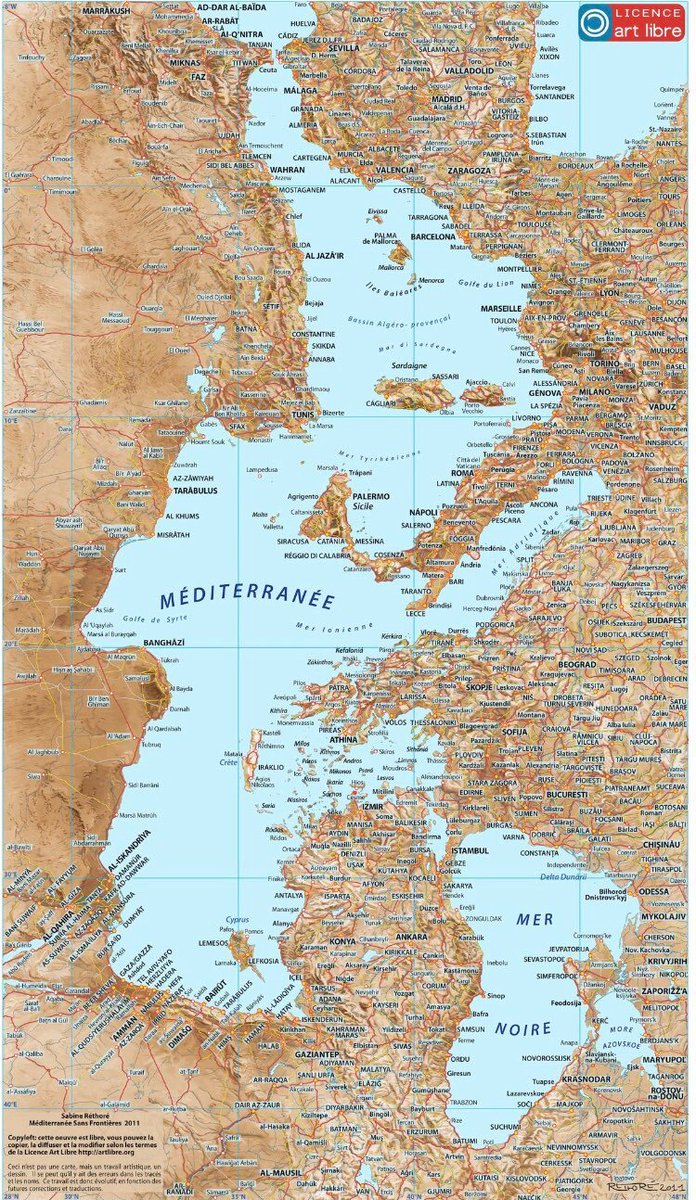
I've always liked these different perspectives and wrote about a view from the Horn of Africa a few months ago. Without a scale, my first impression is that the Mediterranean looks more like one of the Great Lakes than a Sea, and it accentuates the connection between it and the Black Sea.
More than 90% of the lands shown were part of the Roman Empire during its heyday of the first three centuries AD - the only time when the Mediterranean was completely under the control of one power. The centrality of Italy, Sicily and what is now Tunisia in North Africa is also emphasized as is the connection between Asia Minor (which looks like Michigan to me) and Greece, with the scattered islands between looking like shattered shards of marble. You can easily see how the Anatolian farmers spread from Asia Minor into the Balkans and the rest of Europe from 7000 to 3000 BC. From 3000 BC on, Europe was overrun by the Yamnaya of the Eurasian steppes, whose genetic imprint now dominates throughout the continent, except for isolated Sardinia, which retains its Anatolian imprint.
Something else is accomplished by this view. In the traditional orientation, while Rome dominates a lot of Europe, most is still left to the "barbarians". But in the Roman view, what we see here was, by far, more important - it is where civilization, wealth, and population resided, not the poor and underpopulated north and east of Europe.
Subscribe to:
Posts (Atom)