Tuesday, February 3, 2026

A Little More Geography

While we are doing some geography today let's talk about the Midwest.  This is from the very funny Midwest vs The Rest account.

Having spent considerable time in Wisconsin and Iowa and driven through small-town Kansas, Nebraska, Illinois, and Michigan's Upper Peninsula I can testify to the accuracy of the Midwest Starter Pack.


Culver's, Menards, and Dollar General are indeed the three branches of Midwest government, though one could easily justify Kwik Trip as a fourth.


And, finally, the answer is yes.  

I Miss Florida

Saw some bigger iguanas during our years there. 


Monday, February 2, 2026

I Like Me

The THC Son and I recently watched I Like Me, the documentary on the life of John Candy.  A funny and poignant reflection on a man who died at such a young age - 43.  Full of commentary by his fellow comedians and actors, Steve Martin, Eugene Levy, Bill Murray, Dan Ackroyd, Tom Hanks, Martin Short, Mel Brooks among them.  McCauley Caulkin, who was in Uncle Buck with Candy, speaks very perceptively about Candy and Hollywood. Also featured is Catherine O'Hara, whose wonderful eulogy at Candy's funeral is shown.  We watched I Like Me a couple of hours after hearing of O'Hara's passing.

I'd not been aware of Candy's father passing of a heart attack at the age of 35, nor of the crippling anxiety he experienced in the three years before his death in 1994.  Interviews with his wife, son, and daughter explore that side of his life.

Watching the comedy and film clips reminds the viewer of not just how fine a comedian Candy was but how good he could be as a dramatic actor.  The film's title is taken from one of his greatest dramatic scenes in Trains, Planes, and Automobiles.  

Friday, January 30, 2026

A Turbulent Time


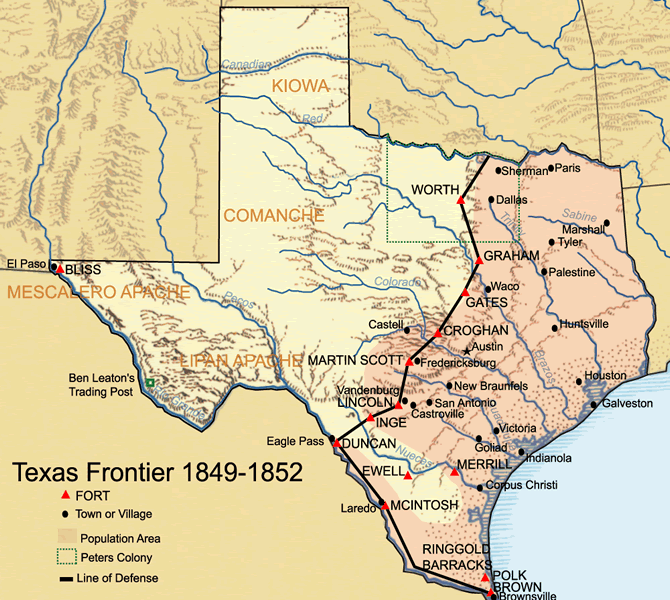
This map, from Texas Beyond History, a public education service of the Texas Archeological Research Laboratory (TARL) at the University of Texas at Austin, developed in collaboration with many other organizations, is useful in illustrating several aspects of Texas and American history. 

The map illustrates Texas near the end of a very turbulent period.(1) A new nation was born in 1836 when it established its independence from Mexico. Mexico's refusal to recognize Texas as independent and Texian expansionism led to Texas invading Mexico in 1841 and 1843 and two Mexican attacks on Texas in 1842 (see Yo, Adrian).  The second Mexican invasion triggered the bizarre episode of the Texas Archive War. A bankrupt Texas entered the United States in 1845, while the outcome of the Mexican War (1846-48) established the state's southern boundary on the Rio Grande (Mexico claimed it was the Nueces).  The Compromise of 1850 led to Texas relinquishing its claim to what is now New Mexico as far as the Rio Grande, which would have placed Santa Fe and Albuquerque in Texas.  You can read more about this episode at When Texas Invaded New Mexico. Meanwhile, the failure of the 1848 revolution in Germany resulted in a large migration of free-thinking Germans to Texas where most settled in the Hill Country west of Austin.

Though Texas was the largest state in the Union, most of its territory was dominated by Indians;  Comanche and, to a lesser extent, Apache.  The map shows the end point of a couple of centuries of fighting among the tribes.  The southern Great Plains had once been the home of the Navajo.  They were driven westward across the Rio Grande by the Apache.  In the early 1700s the Comanche (and their Kiowa allies) drifted south from Wyoming and pushed the Apache westward and southward.

It was the Comanche presence that caused newly independent Mexico to encourage Anglo settlement in Texas during the 1820s.  Mexico, and its predecessor Spain, had difficulty encouraging settlements from the Hispanic population and turned to the Americans to help form a protective barrier from Comanche raids.

The new nation of Texas still struggled against the Comanche, with one Indian raid in the early 1840s even reaching the Gulf Coast near Corpus Christi.  Along with its dire financial situation it was for protection from Mexico and from the Comanche that prompted the Texian agreement to enter the United States.  The result was the construction of the line of forts by the US Army as indicated on the map.

In areas of Texas, settlement extended beyond the defense lines.  This is a constant theme in American history.  It is the settlers who proceed the government, not the other way around.  In 1763 Britain attempted to establish a settlement line for its American colonies, but the effort failed as settlers moved on their own, in defiance of the government, into Kentucky and Tennessee.  After American independence, the pattern continued with westward expansion, settlers always outpacing the areas under direct government control, provoking conflict with Indians and triggering military intervention to restore the peace and protect the settlers.  You can read many military accounts from this era blaming settlers for most of the conflict.(2)  This was at a time when the U.S. government had little presence in everyday life, outside of local post offices, and maintained a very small military; its capacity a fraction of what we have become accustomed to over the past century.

Comanche raids continued for another twenty years.  In 2019 we visited the ancestral homestead of Lyndon Johnson in the Texas hill country and saw the home where LBJ's grandmother and aunt hid under the floorboards during an Indian raid around 1870.  

And those German immigrants in the Hill Country proved to be Unionists in 1861, leading to years of violent conflict with the Confederate government of Texas. 

-----------------------------------------------------

(1) Some would argue Texas has always been turbulent. 

(2) In any event it is difficult to see how any long-term coexistence with the raiding, nomadic Comanche could succeed, in contrast with the tribes in the southeast who adopted American ways and were still expelled. 


Wednesday, January 28, 2026

Take Five

I've always enjoyed Take Five by the Dave Brubeck Quartet.  Recorded in 1959, the song with its distinctive 5/4 time signature went on to become the best selling jazz single of all time after the album was rereleased in 1961.  The Quartet consisted of Brubeck on piano, Paul Desmond on the smooth sax, Eugene Wright (bass), and Joe Morello on drums. One thing I thought weak on the recorded version was Brubeck's repetitive piano pattern which continued throughout the tune except during the drum solo.

I just came across this 1964 video of a live performance on Belgian TV which is much superior to the recorded version.  Brubeck performs a terrific solo, followed by Morello's remarkable drum solo which is very different from the recorded version.  The whole performance avoids the static aspects of the recording.

Sunday, January 25, 2026

Padley Gorge

Image 

Looks like something from Lord of the Rings. 

Located in England's Peak District, Padley Gorge is officially designated “the best example of the remnant oak-birch woodland that once covered much of the edges of the gritstone uplands of the Peak District.”   Get yourself to the Grindelford Train Station and start your walk from there.  

The photo is by peaklass, who produces calendars and books with her photos.  Unfortunately she does not ship to the U.S.  

Saturday, January 24, 2026

A Lie That Won't Die

The upsurge in anti-semitism in the West since the Hamas attack on Israel in October 2023 has been accompanied by a deluge of lies and distortions, one of which is that Israel manipulated the U.S. into attacking Iraq in 2003.  Journalist Nadav Eyal published an article on the subject today, including an off-the-record discussion he had with Israel Prime Minister Ariel Sharon in the fall of 2002.

Before getting to that, I wanted to review my own experience on the subject.  In the early 2000s I was reading online the right-wing Jerusalem Post and left-wing Haaretz (1).  One thing I discovered was that while Israel's military and intelligence services were fanatic and effective about maintaining operational security, internal government strategic discussions often played out in the press and what I consistently read in 2002 was while Saddam Hussein was definitely a bad actor, Israel felt Iraq was in a box and the much greater threat to Israel was Iran.  If the U.S. was to go over anyone in the War on Terror, Israel's preference was Iran.

Later in the 2000s, I learned that Prime Minister Sharon had conveyed this both directly and indirectly to the Bush Administration and was told in no uncertain terms that Iraq was next after Afghanistan.  Sharon's instructions to his cabinet was, given Israel's dependence on the U.S., it would publicly support whatever decision the Bush Administration made.  In other words, causation ran precisely in the opposite direction from what Mearsheimer and others maintain; it is Israel's reliance on the U.S., not American reliance on Israel, that was the driving force in what happened.

It's actually an example refuting the linkage made between neoconservatives and Israel.  In this case, American neocons urged the Iraq invasion while Israel cautioned against it.  Another division occurred in 2011, when neocons wanted the U.S, to support the Arab Spring uprisings while Israel was much more cautious.

My initial take was reinforced as more information became available about the American decision to invade Iraq.  Perhaps the best summary can be found in Mark Mazarr's 2019 book, Leap of Faith: Hubris, Negligence, and America's Greatest Foreign Policy Tragedy.  Mazarr's book benefits from his access to participants and documents which, with the passage of time, became more available.  The Iraq decision was driven by George Bush and Dick Cheney and was made even as the early stages of the Afghanistan action were underway in late 2001.  The degree of dysfunction in the Bush foreign policy team, including Powell, Rumsfeld, and Rice is appalling, with a lot of passive-aggressive behavior involved on everyone's part.  I didn't think much of Bush when he was elected but felt reassured that steady hands like Cheney, Rumsfeld, and Powell would help steer things the right way on foreign policy.  What a mistake!  Nowhere in Mazarr's account does Israel play a role in the decision making.

More recently, I've seen a lot being made of Benjamin Netanyahu's Congressional testimony in 2002, urging an attack on Iraq.  That did occur, but those using the testimony fail to note (no doubt deliberately) the point Eyal makes:

In 2002 he was a private citizen plotting a political comeback. Sharon had taken control of Likud and sidelined Netanyahu decisively. The two camps detested each other. Netanyahu had no contact with Sharon when he testified and did not speak on behalf of the Israeli government.

Eyal's article pulls together in one place, the various threads I've come across over the years on this subject and is well worth reading.  Some excerpts:

I remember his message [during the off the record conversation with Sharon on the flight back from America in 2002] with unusual clarity. Israel, Sharon said, was not lobbying for this war. He told us that he had made Israel’s position explicit in Washington: this was the wrong war. Iraq was not the central threat to the region. Iran was. His concern, as he framed it, was that an American fixation on Iraq would come at the expense of confronting Iran’s growing regional ambitions.

By “wrong war,” he was not advocating the occupation of Iran or a campaign of regime change. At the time, Iran’s nuclear program was still in its early stages — and relatively unknown to the West and Israel. The Israeli preference was for crippling sanctions that would halt it before it matured.

They added that Sharon understood Israel had to stay out of the invasion debate altogether, given how contentious the issue already was in American politics. Sharon — unlike Netanyahu — was meticulous about preserving bipartisan support in Washington. He believed Israel’s strategic relationship with the United States depended on it. For him, even if he had supported the war, lobbying for it would have amounted to a stupid mistake. So he didn’t.

You do not have to take my word for it. Lawrence Wilkerson, chief of staff to Secretary of State Colin Powell, later recalled that senior Israeli officials warned Washington against focusing on Iraq. “The Israelis were telling us,” Wilkerson said, “Iraq is not the enemy — Iran is the enemy.” 

Eyal goes on to argue that one of the consequences of the Iraq invasion eventually led to the Hamas takeover of Gaza.

--------------------------------------------------------------------------------

(1) Today I read the Times of Israel and several Israeli writers on X and Substack, though I still have a difficult time understanding the factions and parties in Israeli politics which often doesn't make much sense to me.  I rarely look at the Jerusalem Post and never at Haaretz which is today published for the benefit of those hostile to Israel since its internal very left-wing audience dramatically shrunk in the aftermath of the Second Intifada.  More recently Haaretz has been entangled in scandal as it was revealed that one of its prominent journalists was receiving payments from the Hamas supporting government of Qatar.

Friday, January 23, 2026

Shetland

We are watching Season 10 of Shetland, the murder mystery series set in those beautiful and isolated islands off the north coast of Scotland.  I don't watch many series but Mrs THC convinced me to take a look and I got hooked.

First, a reality check.  After the first few seasons, I calculated the show's murder rate and realized it was considerably worse than New York City at its peak in the early 1990s.  In the real world, Shetland has only two murders in the past 50 years. And most of the characters on the show seem depressed and/or angry.  I  hope it's not like that for real.

Having said that the mysteries are very well plotted, acting is top notch (with one exception), and the cinematography spectacular, making the islands look stunning.  The main character for the first 7 series was DI Jimmy Perez played superbly by Douglas Henshall.  When it was announced Henshall was leaving we wondered if Shetland would continue.  Season 8 kicked off with a new, and possibly temporary, lead character DI Ruth Calder, portrayed by Ashley Jensen, who I knew from the Ricky Gervais comedy Extras.  It got off to quite a rocky start, and the Mrs and I considered pulling the plug, but they got themselves straightened out by the last episode and Jensen has been very good since then, as have the plots.

But we are still not going to the Shetlands for vacation. 

Monday, January 19, 2026

Cold Irons Bound


I'm beginning to hear voices and there's no one aroundNow I'm all used up and I feel so turned-aroundI went to church on Sunday and she passed byAnd my love for her is taking such a long time to dieGod, I'm waist deep, waist deep in the mistIt's almost like, almost like I don't existI'm 20 miles out of town, Cold Irons bound
 
From 1997's Time Out of Mind album.  This live version is superior to the album cut.  I enjoy seeing how Dylan manages to look ill at ease and like Mr Cool at the same time.  That is one tight band backing him up. 
 

Russell's Corners

From George Ault (1891-1958).  Russell's Corners is in Woodstock NY but it reminds me of scenes I've encountered in the Midwest.  The artist, born into a wealthy family,. lived a very troubled life.

Image 

Sunday, January 18, 2026

Methodologies

The ruins of Pattara lay near the Mediterranean coast in southwestern Turkey.  A once flourishing city in the Roman province of Lycia.  After a forest fire in 1993 cleared the area, the ruins of a road monument were discovered.  Erected in 46 AD and dedicated to the Emperor Claudius, the structure displays 53 city names and 65 routes and distances, including previously unknown cities which got the archaeologists quite excited.  Below is a corner block of the monument.


What interested me more was the inscription:

To Tiberius Claudius, son of Drusus, Caesar Augustus Germanicus, Pontifex Maximus, with his fifth tribunician power, eleventh salutation as emperor, father of fatherland, and fourth consulate in prospect, the savior of their nation, (dedicated by) Lycians as Rome- and Caesar-loving loyal allies, for they were freed from mutiny and lawlessness and banditry by his divine foresight; after the conduct of state was (taken) from the incompetent majority and entrusted to councilors chosen from amongst noblest men, (and) by this means they (Lycians) were given the possession of the homeland by him (Emperor) through Quintus Veranius, legatus propraetore of Tiberius Claudius Caesar Augustus, they (Lycians) have recovered concord, the fair administration of justice and the ancestral laws. 


It's this section that caught my eye:

". . . for they were freed from mutiny and lawlessness and banditry by his divine foresight; after the conduct of state was (taken) from the incompetent majority and entrusted to councilors chosen from among noblest men . . ."

What occurred in Pattara is that with the permission of the Roman governor and the emperor, the democratic government (the "majority") was removed, replaced with an appointed aristocracy, and peace and security restored.

A constant thread in history is that people seek to live in security, peace, and with protection and opportunity for their family and property.  Though it is often mistaken for the end purpose or goal, democracy is simply one of the methodologies for achieving these goals.  If it fails to do so, people will choose other methods.

After Hanukkah

I've updated my December 14 post from last year with two additional footnotes with important information regarding the situation of Jews in Western countries.  Sneak preview of one note - the United Arab Emirates will no longer send its students to British universities because the Muslim Brotherhood has radicalized those academic institutions!  That's how bad things are in Europe (and elsewhere).

Saturday, January 17, 2026

Madness

Greenland.  Denmark has been a long time and strong ally of the United States(1).  We've had military bases and other presence on the island since the Second World War.  If the U.S. wants to expand its linkage with Denmark and Greenland for security, including resource issues, we would be able to do so.

Instead, President Trump, needlessly and recklessly, is pursuing the acquisition of Greenland, and has now threatened tariffs on any country that disagrees with his push to acquire that icy land.  This is lunacy. He has only one mode of operation; sometimes it makes sense, sometimes it doesn't, but there is never any overall coherence, other than being tied to his need for self aggrandizement.  MAGA is whatever Trump does at any particular moment, nothing more, nothing less.(2)  He has no check engine light.  He will keep pushing for whatever he is obsessed with in the moment, regardless of the law, the constitution, or long term implications.  The only way to stop him is a punch in the face, repeated frequently.  China's effectively done it with the result that Trump's economic policies are now tougher on our allies than on our enemies.

There are things that, at a policy level, I agree with Trump on, but the overall chaos, repeated reversals by the president, the number of incompetent personnel he has appointed, his inability to persuade anyone on the fence, and the lack of thoughtful strategy means that little of what he is doing is sustainable (3)  Not that he cares.  He lives in the moment, in his own reality show.

And then there is the corruption.  Pardons given out in exchange for contributors or payments to Trump intermediaries. Actions to pump the value of the Trump family's crypto currency investments.  The golf course and other investments in Qatar.  And it's blatant.  In May 2025, Donald Trump Jr was to appear on a panel titled "Monetizing MAGA" at an investment conference in Doha until somebody finally realized that it was a bit over the top and changed the title.  Yes, the Biden family was also corrupt, but so what?(4)

His disinterest in the future outside of himself and his family means that when he leaves office the Republican party will be a hollowed out shell.  The primary occupation of likely successor JD Vance is playing with his online friends while he decides what he wants to be when he grows up. 

As for the Democrats, we are witnessing the derangement of the entire party apparatus and its supporting institutions.

There are no adults in the room.   

------------------------------------------------------

(1) Denmark is also the only western European country without a surging right-wing anti-immigration party because the existing centrist government has taken strong action to control its borders, insist upon immigrant assimilation, and deports those who are a danger to the country. 

(2) That's why I have not wasted any time reading the new National Security Strategy (NSS).  Trump hasn't read it so why should I?  Regardless of what is in the NSS, our foreign policy will be whatever Trump says it is at any particular moment in time. 

(3)  In the case of Greenland, acquisition requires approval by a 2/3 vote of the Senate and approval of the purchase appropriation by House and Senate. Good luck with that, though I am sure that Trump will take the position he can do it by Executive Order.  He's also threatened military action which he cannot do without Congressional approval, which he will not get.  I am sure he will take the position that it is a national security emergency that does not require Congressional approval, but attacking a NATO ally that poses no threat is different from Iran and Venezuela, which is why Trump has no legal authority under existing legislation to impose the tariffs.  Not that he cares.  The only thing that matters to Trump is can he get away with it.  While I think it unlikely Trump would take military action he is unpredictable enough that it cannot be ruled out.  If he does so without Congressional approval he should be impeached and convicted.  

(4) UPDATE:  From the Feb 2, 2026 edition of The Scroll from Tablet Magazine.  I'll quote the whole thing because it illustrates the scope of Trump family entanglement with foreign interests.  This doesn't even touch the pay to play aspects of domestic pardons granted by the president.

It is an open secret by now that President Donald Trump’s family members and associates, including those who serve in his administration, freely mix their personal financial interests with U.S. foreign policy. A weekend report in The Wall Street Journal offers a window into how this process has played out with the United Arab Emirates—suggesting, at best, major conflicts of interest and, at worst, corruption on a scale that would make Hunter Biden blush. 

 The Journal reports that on Jan. 16, 2025, a few days before Trump’s inauguration, a company controlled by the Emirati royal and national security adviser Sheikh Tahnoon bin Zayed Al Nahyan paid $500 million for a 49% stake in World Liberty Financial, the cryptocurrency firm launched before the election by Trump’s son Eric and special envoy Steve Witkoff’s son Zach. According to WLF corporate documents and “people familiar with the matter,” half of that sum was paid up front, directing $187 million to entities controlled by the Trump family and $31 million to entities controlled by the Witkoff family. An additional $31 million went to an entity controlled by WLF cofounders and crypto scammers Zak Folkman and Chase Herro. “At the time of the investment,” the Journal notes, “World Liberty had no products,” and the deal granted the Emirati company no rights over WLF’s future crypto token sales, up to then WLF’s only source of revenue. 

 A few months later, in May, the Trump administration approved the sale of 500,000 Nvidia artificial intelligence chips per year, including state-of-the-art Blackwells, to the UAE. Under the Biden administration, these sales had been blocked due to fears that the chips could fall into Chinese hands. In particular, there was bipartisan concern about G42, an Emirati AI company owned by Tahnoon, and its China-born CEO, Peng Xiao. “G42’s CEO Peng Xiao operates and is affiliated with an expansive network of UAE and [People’s Republic of China]-based companies that develop dual-use technologies and materially support PRC military-civil fusion and human rights abuses,” a report from the Republican-chaired House Select Committee on the CCP had warned in 2024. Under the deal announced in May, G42 will annually receive 35,000 Blackwells, which are prohibited from being exported to China. 

 Indeed, G42 now appears to be deeply enmeshed in WLF’s corporate governance. Under the deal, a Tahnoon-owned company called Aryam Investment 1—registered in Delaware and Abu Dhabi in December 2024, a month before the deal—became WLF’s largest shareholder and the only investor outside the company’s founders. The deal placed two Aryam executives on WLF’s five-member board. Both of these “Aryam executives,” however, were also executives at G42, which jointly manages Aryam with the Tahnoon-owned investment firm MGX. One of them was Peng. G42’s head of crypto and blockchain and an adviser to the Abu Dhabi Department of Economic Development, Fiacc Larkin, joined WLF in January 2025 as its “chief strategic advisor.”

 After the initial January investment, the Trump and Witkoff families subsequently made other deals with Tahnoon-owned entities, even as Tahnoon was lobbying for access to U.S.-made chips. In May, Zach Witkoff announced at a crypto conference in Dubai that MGX would be using WLF’s stablecoin, USD1—a crypto token pegged to the value of the U.S. dollar—to make a $2 billion investment in the crypto exchange Binance, in a project to be managed by G42’s Larkin. The deal, which overnight made USD1 one of the world’s largest cryptocurrencies, meant that WLF could earn an additional $80 million per year just by investing its $2 billion cash pile in U.S. Treasurys. 

 Following the investment, the UAE also began lobbying for Trump to pardon Binance’s founder, Changpeng Zhao, who had pled guilty to financial crimes including money laundering and spent four months in U.S. prison in 2024. (A lawsuit filed in November 2025 under the Antiterrorism Act accuses Binance of “knowingly moving at least $50 million for Hamas, Hezbollah, Iran’s Islamic Revolutionary Guard Corps, Palestinian Islamic Jihad and other terrorist organizations” since the Oct. 7 attacks, as well as helping Venezuela and Iran evade U.S. sanctions.) Zhao, who lives in the UAE and has cultivated close ties with the Emirati royal family, was pardoned by Trump in October 2025—which may or may not be related to his son’s business ties with Zhao’s company. The Journal reported in August that WLF had generated $4.5 billion since November 2024 in large part due to “a partnership with an under-the-radar trading platform quietly administered by Binance.” That platform, PancakeSwap, tried to increase the usage—and therefore the value—of USD1 by offering payouts to top users of the currency. Many of those users, according to the same report, communicated with one another in Chinese. 

 The same overlapping set of companies was also involved in the Trump administration’s TikTok deal, which we criticized last week for allowing the platform’s Chinese former parent company, ByteDance, to retain a major ownership stake in TikTok US while potentially leaving the TikTok algorithm under the control of the Chinese. Under that deal, MGX received a 15% stake in TikTok US, as did Silver Lake, a U.S.-based private equity firm that is a major investor in G42. G42, meanwhile, is a former investor in ByteDance, having sold its $100 million stake in the company in February 2024, as part of a bid to convince the Biden administration to allow it to purchase AI chips. 

 All of this is, of course, fairly shocking. But what is potentially more concerning are the backroom deals we don’t yet know about. The UAE, though imperfect, is at least somewhat aligned with U.S. foreign-policy interests. That’s far less true of Qatar, which has done billions of dollars’ worth of business with the Witkoff family and Trump’s son-in-law Jared Kushner; Russia, which has sold Witkoff on the idea of big deals in the future; and other deep-pocketed and unscrupulous actors ranging from Saudi Arabia to China and Turkey. We are learning about these deals with the UAE a year after the fact, and only because of some impressive legwork by the Journal. We can only imagine what else might be out there, waiting to be discovered when the Democrats take back the House.  

The New Rome Metro Stations

Two new stations have opened in Rome, at the Colosseum and Porto Metronia, and I can't wait to see them.  Both display archeological findings uncovered during construction.  This video by Darius Arya shows the stations and the displays.  Darius was wonderful videos on ancient Rome and Italy.  If you are interested in the topic you shouldn't miss them. 

The Autumn Of John Ford

Came across this reprint of an article Peter Bogdanovich (before becoming a director) wrote about John Ford, one of my favorite directors, for the April 1964 edition of Esquire.

Bogdanovich perfectly captures Jimmy Stewart's speech pattern here:

“I love ’im. That’s ... that’s first of all,” he began. “And that is, of course, intermixed with respect and….” He pursed his lips and nodded twice. “Admiration.” Stewart leaned forward in his chair. “He’s just ... he’s a genius. The way he’ll do a script. Gets it across visually. Hates talk. I just wish there were more people like him.” Stewart shook his head and pursed his lips. “Everybody’s always talkin’ about the Ford stock players, y’know.... I think it’s a helluva good idea! Wish everybody’d do it. The people know how to work together. They don’t have to … each film doesn’t have to be the first time. And a lotta directors … y’know … it’s a barrel a laughs on the set and ya have fun and … and then you see the picture and you say, ‘Where is it? Where’s the….’ But Ford gets it on the screen. And he’s a real leader. I think he is the best man doing the job.” He nodded vehemently.

Some other excerpts:

Monument Valley lies within the Navajo Indian Reservation, straddling the Arizona-Utah state line. The red cathedral-like buttes and mesas that form its landscape were created by erosion and are named for their shapes: The Mittens, The Big Hogan, Three Sisters; from minute to minute the shadows change their appearance. There is a timelessness to the country that makes it as remarkable a natural wonder as the Grand Canyon, but far more dramatic. John Ford has made several movies there, the most recent of which is Cheyenne Autumn, which tells a true story of the heroic flight of three hundred Cheyenne men, women and children from an Oklahoma reservation (where, because of neglect, they faced death from starvation and disease) to their native Yellowstone country, some fifteen hundred miles away. Pursued all the way by the Cavalry, only eighty survived to see their homeland.

Harry Goulding, the tall, aging Westerner who owns the lodge in Monument Valley, was standing nearby, watching. He shook his head once and spoke with a deep Western twang. “Certainly is somethin’, isn’t it,” he said quietly. Goulding was the person who first introduced John Ford to the valley, in 1938 when the director was searching for a location on which to film Stagecoach. “I didn’t know if I was goin’ inta the studio or inta the jail,” he said, grinning shyly. “The Navajos’d been hit pretty bad by the Depression an’, by God, if an Indian’d walked into our store an’ put a dollar on the counter, why Mrs. Goulding an’ I’d a fainted.” He shook his head. “So I got inta the studio and I showed a whole stack a pictures to Mr. Ford an’ three days later there was a score a jobs for the Navajos and a lotta lives was saved.” He took off his hat, ran his hand over his head, and replaced the hat. “Then you heard ’bout the Hay Lift,” Goulding went on. “In 1949, just after Mr. Ford’d finished shootin’ She Wore a Yellow Ribbon here, we had a blizzard that left the valley covered with ’bout twelve feet a snow. Army planes dropped food in. Thanks to that an’ the hundred fifty-two hundred thousand dollars he’d left behind, why, another tragedy was prevented.” Goulding looked off across the river. “An’ this year, he heard his friends was gonna have too little t’eat, an’ here he is again.”

“Now this thing,” he said, nodding at the script of Cheyenne Autumn lying on the table. “I’ve wanted to make this for a long time. Y’know. I’ve killed more Indians than Custer, Beecher and Chivington put together.” He raised his arm and pulled the sleeve down again. “People in Europe always wanta know about the Indians. They just see them ride by, or they’re heavies. I wanted to show what they were like. I like Indians very much,” he said warmly. “They’re ... they’re a very moral people. They have a literature. Not written. But spoken. They’re very kindhearted. They love their children and their animals. And I wanted to show their point of view for a change.” Ford pulled down on his cheeks. “S’amazing....” He paused. “It is amazing, working with them, how quickly they catch on despite the language barrier.” He rubbed his mouth with the handkerchief.

The article is packed with captivating stories about a talented man who liked to make things difficult and enjoyed it all the while.   

Monday, January 5, 2026

The Jason Russell House

On April 19, 1775, 49 Americans were killed in the fighting that began on the Lexington Green early that morning and continued at North Bridge in Concord.  For the rest of the day Americans from neighboring towns attacked the British as they retreated towards Boston.  Of the 49 deaths, twenty five occurred in Menotomy (now known as Arlington), the town southeast of Lexington and, of those, twelve were killed inside or on the property of the Jason Russell House which still exists.  The owner, Jason Russell, age 59, was killed, along with a number of men from Danvers who had rushed 16 to 18 miles that day to reach Arlington.

I recently came across the videos of Katie Turner Getty who has put together a series on the Revolutionary War in the Boston area.  They are very informative plus she has an authentic Boston accent!  This is her video on the events at the Jason Russell House and there is a lot more to watch on her YouTube channel and on her website.  She knows her stuff.

For more than a decade I worked less than two miles from the Jason Russell House and often passed it, but never went inside.  Wish I had. 

I wrote about April 19, 1775 in The Road Back, as well as Tough Guy, about another stalwart fighter in Menotomy that day, 78-year old Samuel Whittemore, who, after killing three British soldiers, was shot in the face, bayoneted somewhere between 6 and 13 times, clubbed in the head with a musket, and left for dead.  He lived another 18 years.

Sunday, January 4, 2026

Breathe Easy, Canada!

Canada no longer has to worry about being the 51st state.  Looks like that will be Venezuela!(1)

Whatever we've just done(2) will be a success if the country remains peaceful and we can quickly exit.  If violence breaks out and we end up mired in Venezuela it will be a failure. 

----------------------------------------------------------------

(1) Unless Trump seals the deal with Greenland first. 

(2) I've no idea what that is or what the ultimate objective is.  I think we're all bozos on this bus.  Here's Jonathan Turley's attempt to make sense of it all.

Saturday, January 3, 2026

The "Real Trouble"

A few years ago there was a study of Harvard students comparing their knowledge of American history when they were entering freshmen to when they were university graduates.  The results were that they were less knowledgeable after four years at Harvard.  Not actually surprising.

I was reminded of this reading a New York Times puff piece on NPR President Katherine Maher, published on December 30. A Times reader would finish the piece not having any idea why Maher is controversial and a less knowledgeable and informed citizen than before reading the piece,

Before getting to the Times article, let's review what we knew about Maher before the article was published.

Katherine Maher is the daughter of a Goldman Sachs executive and grew up in the very wealthy suburban town of Wilton, Connecticut.  I'm from Wilton's significantly less wealthy neighboring town of Norwalk, so know Wilton quite well.

Armed with a university degree is in Middle Eastern and Islamic Studies from NYU, Maher did post-graduate work in Cairo and Damascus.  Academic Middle Eastern studies was a field was initially funded by the Federal government back in the 1950s in the expectation that it would train experts in that area of the world who could help advise the government.  The 9-11 postmortems found that these programs were abject failures in providing graduates who could make accurate assessments of what was happening in the Middle East.  Instead, the programs had been taken over by academics hostile to the West and instead used to promote the theory that later became known as settler-colonialism, in which the West was responsible for everything bad that happened in the Islamic world.  This was the setting in which Maher was marinated (it's only gotten worse since then).

Post-graduate employment followed with UNICEF, the World Bank, and the National Democratic Institute.  In 2014 she joined the Wikimedia Foundation, initially as Chief Communications Officer and then as Executive Director, remaining with the organization until 2021.  Along the way Maher also became a member of the Council on Foreign Relations and the Atlantic Council.  During the Biden Administration she joined the State Department's Foreign Affairs Policy Board.  She has all the right credentials.

The Wikimedia Foundation sets the strategy for Wikipedia and, under Maher's direction, it made a significant change in its approach.  Even by 2014, Wikipedia was beginning to have credibility and reliability issues due to its editing process and susceptibility to manipulation.  However, its stated purpose was still to be an accurate reflection of current knowledge.  That was to change with Maher.

According to an article in the August 2024 edition of Pirate Wires,  "How the Regime Captured Wikipedia, the proposed changes generated controversy within Wikimedia:

"The controversy was ultimately about who would control the site containing “all the world’s knowledge,” and hundreds of millions in Wikipedia funding. Would the site’s community of decentralized, uncompensated editors continue to govern it according to its principles of openness, transparency, and neutrality, or would a handful of highly paid NGO technocrats re-orient Wikipedia toward endorsing and promoting the ever-shifting currents of the Western elite social justice regime? "

"The Movement Strategy, also known as Wikimedia 2030, was indeed a massive undertaking. Launched in 2017 by then-WMF executive director and CEO Katherine Maher, the strategy would be a complete re-imagining of WMF and Wikipedia’s mission. Where Wikipedia had been built on the principle of decentralized knowledge, the Movement Strategy would veer into the hyper-centralized space of top-down social justice activism and advocacy."

"As the driving force behind the Movement Strategy, Maher would directly endorse this view in comments revealed after she took the top job at NPR this year, in which she said she opposed the “free and open” ethos of Wikipedia because it was rooted in “white male Westernized construct” that precipitated the “exclusion of communities and languages.”

Further, Maher played a critical role in establishing the Wiki Endowment:

"The central aspect of WMF’s new financial strategy was the establishment of the Wikimedia Endowment, a pool of money that, as its name suggests, is designed to fund the organization essentially “in perpetuity.” Distinct from Wikimedia's budget, which funds Wikipedia's day-to-day operations, the Endowment was set up in 2016 as a donor-advised fund at leftist mega-fund, Tides Foundation, an $800 million fund that’s part of the wider Tides Center, a network of such funds “that partners with social change leaders and organizations to…accelerate social justice.” The Tides Foundation’s IRS 990 filing lists its mission as “Grantmaking through funds to accelerate the pace of social change.” 

When you use Wikipedia you will often see a page asking for donations to support Wikipedia.  However, this is misleading because Wikipedia has more than enough funding to continue its current operations.  Instead, your donations go to the Wikimedia Endowment which funnels money to left-wing causes.

Maher bragged about her accomplishments.  According to Katherine Maher's Color Revolution in the April 2024 edition of City Journal:

In a speech to the Atlantic Council, an organization with extensive ties to U.S. intelligence services, she explained that she “took a very active approach to disinformation,” coordinated censorship “through conversations with government,” and suppressed dissenting opinions related to the pandemic and the 2020 election.

In that same speech, Maher said that, in relation to the fight against disinformation, the “the number one challenge here that we see is, of course, the First Amendment in the United States.” These speech protections, Maher continued, make it “a little bit tricky” to suppress “bad information” and “the influence peddlers who have made a real market economy around it.”

Maher’s general policy at Wikipedia, she tweeted, was to support efforts to “eliminate racist, misogynist, transphobic, and other forms of discriminatory content”—which, under current left-wing definitions, could include almost anything to the right of Joe Biden.

The City Journal goes on to note:

On the surface, this appears to be a contradiction. Maher backed dissent abroad but suppressed it at home. She not only censored content at Wikipedia but also supported deplatforming then-President Donald Trump, who opposed the domestic revolution following the death of George Floyd. “Must be satisfying to deplatform fascists,” Maher wrote on Twitter, after Trump was effectively removed from social media. “Even more satisfying? Not platforming them in the first place.”

This is not hypocrisy; it is the politics of friend and enemy. For Maher, “democracy” means the advancement of left-wing race and gender ideology all over the world. This requires elevating progressive dissidents overseas, while suppressing conservative dissidents at home. For partisans of Color Revolution, dissent and censorship are not in contradiction—they are two sides of the same coin.

This misuse of "democracy" is common across leftists in the countries of the West.  According to EU bureaucrats, voting the way they want is supporting democracy but voting against the desired policies of bureaucrats is anti-democracy.  Any opposition to progressive policies is anti-democracy. 

What Maher did to Wikipedia, and here statements about why or, as she would say, "intentionality", demonstrate why she is such a danger to a free society.  Wikipedia has always had its problems, but under Maher it deteriorated into a propaganda machine that is now integrated into larger communication networks. While Wikipedia is still useful if you want to find out the release date of Reach Out (I'll Be There) by The Four Tops or the birth and death dates for a person, it is useless when it comes to any topic that progressive ideology believes is political.  The network designed for spreading Wikipedia's agitprop includes Google, where Wikipedia results show at the top of every search (Google also poured more than $200 million into the Wikipedia Foundation), and many of the AI models include Wikipedia as one of the sources used for their training.  The result is Google searches and AI incorporate deliberately misleading information approved by Maher and people who think like her.

It's also why total control of social and traditional media is so important to people like Maher and why progressives became so hysterical when Elon Musk took control of Twitter.  That progressives still controlled most social and traditional media was not the point.  Any outlet they could not control in order to suppress dissent is considered a danger to democracy.  In the case of Twitter pre-Musk, people were banned or suspended for misgendering, accounts were permanently suspended for merely posting Department of Justice crime statistics without making any comment, or accounts suppressed if then-President Trump retweeted them. I saw all of this happen; these weren't nutcase conspiracy or hardcore MAGA accounts, they just happened to not be progressives, or were progressives who dissented from orthodoxy on a particular topic.

In Maher's worldview everyone should be like her in following the strict progressive line, not deviating one inch.  In 2016 she criticized Hillary Clinton for using the phrase "boy and girl" because “it’s erasing language for non-binary people”, and it's no surprise that in 2020 she tweeted that "America is addicted to white supremacy".

So, in 2024 when Maher was named as CEO of National Public Radio, there were legitimate questions about her lack of commitment to free speech and her express agenda to privilege left-wing beliefs;  Particularly germane questions for an organization receiving significant taxpayer funding when she so publicly disdained the views of many Americans.

But according to the Times you would be mistaken if there were legitimate questions to be asked of Maher.  Let's look at how the story starts:

NPR’s C.E.O. Was a Right-Wing Target. Then the Real Trouble Started.

Katherine Maher has taken an unyielding approach to NPR’s biggest battles — which has sometimes put her at odds with her colleagues in public media.
 

A flattering photograph depicting a resolute Maher notes that she "has dealt with plenty of criticism this year.  Did she consider quitting?  "I really don't like bullies," she said. 

The third sentence of the article tells readers, "Right-wing activists dredged up her old posts on social media and tried to get her fired." 

Remember that when reading the New York Times what you need to focus on is not the substance of a story.  The key questions are why is the Times publishing this story at this particular time and what is the narrative it is trying to create?

For the narrative part look at the beginning; title and sub-title, photo, and opening sentences.  The narrative here is Katherine Maher is one of the "good guys" since she was a Right-Wing Target (which in Timespeak is equivalent of being a Nazi).  She's "unyielding", a fact reinforced by the photo and legend telling the reader those attacking her are "bullies".  And just to make sure there is no doubt, we learn "Right-wing activists dredged up her old posts".  Ah, those Nazi dredgers!  And, since they are old posts of what possible relevance could they be?

All this to set up the closing part of the narrative - that some of those who should be her allies in public media may not be as steadfast as they should be in supporting here because of that nasty right-wing intimidation. They need to strengthen their backbones to deal with those Nazis!

Here are some other excerpts with my comments.  The entire article is linked at the start of this post. 

She has become a target not just of NPR’s traditional opponents on the political right but of some within the tightknit world of public broadcasting, who wanted her to take a more pragmatic tack. At one point, the chief executive of the Corporation for Public Broadcasting, one of NPR’s biggest supporters, told Ms. Maher she should quit. Her predecessors were accused of bringing a tote bag to a knife fight.  “The government targeted public funding to punish specific editorial decisions it disagreed with,” she said in a recent interview with The New York Times. “That’s not a funding dispute dressed up as a constitutional case; that’s textbook First Amendment retaliation." Ms. Maher’s stance brought support pouring in for her organization. NPR emerged from the biggest political battle in its history on firm footing, generating record donations.

This is a warning to those in public broadcasting to toughen up.  Maher is a role model. It also casts her as a champion of the First Amendment.  The First Amendment argument is absurd.  Maher would never stand up for the First Amendment rights of someone she disagreed with and arguing that a decision by the government not to fund an organization dedicated to bias and being one-sided has anything to do with the First Amendment is simply nonsense.  It is Maher's sense of entitlement that makes her demand that I fund NPR.  She is compelling my support of her speech, while wanting to suppress mine even though I'm not seeking federal funding.

As we've seen Maher was singing a different tune before being appointed to NPR.  So was the Times.  Remember that after the 2022 midterms, when it was looking like Biden would be reelected and the Democrats could also control the House and Senate, the Times began running news stories and op-ed pieces about how "we" needed to rethink the First Amendment.  If the Democrats had achieved a trifecta and controlled Congress the crackdown on speech would have been brutal.  The Progressive view of speech and freedom is expressed in this quote from Frank Herbert's Children of Dune:

When I am weaker than you, I ask you for freedom because that is according to your principles; when I am stronger than you, I take away your freedom because that is according to my principles.

The Times then tells us about the crisis faced by Maher as her critics "seized the moment".  

In early April 2024, Ms. Maher and NPR faced an unexpected crisis. Uri Berliner, a senior editor at NPR, published an essay in The Free Press accusing the network of a liberal bias in its news coverage.

The crisis deepened a week later. Chris Rufo, the conservative activist who ran social media campaigns against figures including Claudine Gay, the former Harvard president, circulated years-old social media posts from Ms. Maher that criticized Donald J. Trump and supported liberal causes. (“Also, Donald Trump is a racist,” read one.) 

NPR’s critics seized the moment. In early May, Republicans in Congress called on Ms. Maher to testify on allegations of bias. Compounding the situation: Some at NPR were surprised by Ms. Maher’s social media posts; she told The Times that the board hadn’t asked her about them before she was hired. 

The hearing was predictably divided along partisan lines. The Republicans, who argued that NPR and PBS were outmoded, a waste of taxpayer money or liberally biased, interrogated Ms. Kerger and Ms. Maher, asking the NPR chief executive about her social media posts and the network’s coverage of Hunter Biden’s laptop.

There are several things to note about this section.  The Uri Berliner piece created an uproar.  Berliner was a long time NPR employee and, by 20th century standards, a card-carrying liberal who voted against Trump.  You can read his article here.  To describe it as "accusing the network of a liberal bias" is a misleading characterization; that's not what Berliner is complaining about.  He writes;

It’s true NPR has always had a liberal bent, but during most of my tenure here, an open-minded, curious culture prevailed. We were nerdy, but not knee-jerk, activist, or scolding. 

In recent years, however, that has changed. Today, those who listen to NPR or read its coverage online find something different: the distilled worldview of a very small segment of the U.S. population. 

An open-minded spirit no longer exists within NPR, and now, predictably, we don’t have an audience that reflects America. 

That wouldn’t be a problem for an openly polemical news outlet serving a niche audience. But for NPR, which purports to consider all things, it’s devastating both for its journalism and its business model. 

There’s an unspoken consensus about the stories we should pursue and how they should be framed. It’s frictionless—one story after another about instances of supposed racism, transphobia, signs of the climate apocalypse, Israel doing something bad, and the dire threat of Republican policies. It’s almost like an assembly line.  

He goes into some detail using three examples, Russiagate, the Hunter Biden laptop, and COVID coverage, of the bias and distortion in NPR and how it failed to admit mistakes.(1)

Berliner also tells us, "I wrote to a top news executive about the numerous times we described the controversial education bill in Florida as the “Don’t Say Gay” bill when it didn’t even use the word gay."  Of course it would not be corrected by NPR because, at the time, the Democratic priority was to damage Governor DeSantis, so anything that aided in that goal was fine. It is also consistent with traditional media practice in referring to Republican bills by the name Democrats give it, while referring to Democrat bills by the name preferred by Democrats. 

Finally, he writes of the madness that descended upon NPR in the wake of George Floyd and transgender mania.  He never uses the word, but what Berliner describes is a corrupt organization.

Berliner was suspended without pay for writing the article and resigned several days later. 

The Times article is very careful not to be too specific about the allegations made by those nasty right wingers. The author and his editors want the reader to understand who the bad guys and good guys are and not get too caught up in the details.  The piece also states that Maher was criticized for supporting "liberal causes", but Maher is not a liberal, she's a progressive authoritarian.  A liberal supports free speech, freedom of conscience, due process, equal protection under the laws, fairplay, treating people equally.  21st century progressives reject all of this.

The only two specific "right-wing" claims mentioned in the article are Maher's characterization of Donald Trump and NPR's coverage of the Hunter Biden laptop. NPR refused to cover the story at all, with its managing editor for news writing “We don’t want to waste our time on stories that are not really stories, and we don’t want to waste the listeners’ and readers’ time on stories that are just pure distractions.”  As we now know, the FBI validated the contents of the laptop in 2019 and the 51 Intelligence Community former officials who denounced it were very clever in stating that it had "all the hallmarks of Russian disinformation", allowing them to later claim that they never said it was disinformation.  The truth is that NPR refused to cover the story because of the potential damage to the Biden campaign.

Near the end of the Times story we encounter this passage: 

On a call this spring, Patricia Harrison, the chief executive of the Corporation for Public Broadcasting, asked Ms. Maher whether she would be willing to say anything to members of Congress or the press to acknowledge concerns from listeners who viewed NPR’s reporting as biased, according to two people familiar with her remarks. 

Ms. Maher rebuffed that suggestion. She didn’t believe that NPR was biased, and she thought saying so would undermine the organization and fail to placate those who were critical of the network, according to a person familiar with her thinking.

Maher is one of those folks who talks about "her truth" and "your truth" and how we all have truths.  But, in truth, she believes her truth is the real truth and if you don't agree with it you are wrong, so she is not biased and you have no right to speech.  Katherine Maher and the New York Times are blights upon this nation.  They are at least as great a threat to our future as creatures like Tucker Carlson. 

 --------------------------------

(1) Berliner notes how on Russia, "we hitched our wagon to Trump’s most visible antagonist, Representative Adam Schiff.  Schiff, who was the top Democrat on the House Intelligence Committee, became NPR’s guiding hand, its ever-present muse. By my count, NPR hosts interviewed Schiff 25 times about Trump and Russia. During many of those conversations, Schiff alluded to purported evidence of collusion. The Schiff talking points became the drumbeat of NPR news reports".

If you've read my Russia Collusion posts, you know that Adam Schiff lied about everything.  I've read the same testimony he heard and then lied about.  None of the "journalists" at NPR had the slightest interest in comparing documentary evidence with Schiff's claims because it would have undermined their desired narrative.

Credit..

Friday, January 2, 2026

Becoming Led Zeppelin

On the recommendation of the THC Daughter (a huge Zep fan) I watched Becoming Led Zeppelin, a recent documentary covering the founding of the band and its first two album and initial tours.  The Daughter gets A+ for her recommendation.

Becoming features recent interviews with Jimmy Page, Robert Plant, and John Paul Jones, as well as a previously unheard late 1970s interview with John Bonham (who died in 1980) along with incredible footage of early Zeppelin gigs which I'd never seen before.

We get the origin stories for the band members, including Bonham and Plant who were friends before Zeppelin.  I knew about Page's background as a studio musician and Yardbird but little about the others and found it quite interesting - Plant was studying to be a chartered accountant!  I also hadn't been aware of the extent to which putting the band together and its initial recordings were a Jimmy Page driven project.

The performance footage shows Zeppelin as a overpowering sonic powerhouse right from the start and Bonham sure hits those drums hard.  The documentary is also a reminder that the rock critics, particularly the influential Rolling Stone, hated Led Zeppelin, but despite that the band quickly built a huge following. 

Page, Plant, and Jones were engaging in their Old Guy interviews and watching them listening to the Bonham interview (which they'd never heard) was touching.

I was also happy to see Page give a public nod to Jake Holmes as the inspiration for Dazed and Confused.  You can read about the specifics of how Page was "inspired" by Holmes here.

Thursday, January 1, 2026

Tiny Desk Concert

Billy Strings and company on NPR's Tiny Desk last month performing four tunes, Red Daisy, a traditional bluegrass, and three originals by Billy from his recent Highway Prayers album, the Appalachia themed My Alice, Malfunction Junction an instrumental with a lot of changes, and my favorite, Gild The Lily.

A nice way to start off the New Year.