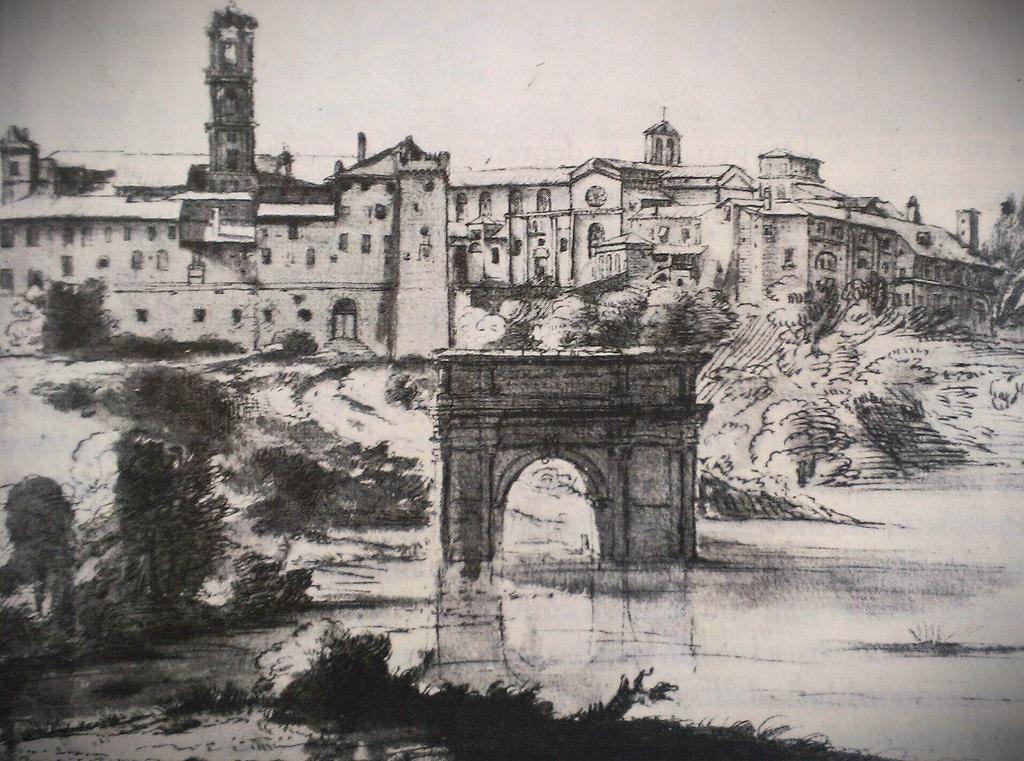
Showing posts sorted by relevance for query belisarius enters rome. Sort by date Show all posts

Friday, June 26, 2026

The Transformation Of Rome

The Making of Medieval Rome: A New Profile of the City, 400 – 1420 

 The 2015 post, Belisarius Enters Rome, discussed the decline and slow rise of the city of Rome from the 4th to the 19th centuries.  Most prominent of the sources cited for the late Empire and early Medieval periods was Richard Krautheimer's Rome: Profile of a City, 312-1308, published in 1980.  Krautheimer's work is still highly regarded but over the past 40+ years a great deal of new archeological work in Rome on its formerly neglected medieval period has been conducted, along with a reanalysis of the written sources, and the findings change some of the picture we'd previously had, and which is reflected in my earlier post.  In particular, the timing of the key periods of transition from the city of the Caesar's to today's city has changed from the "traditional" explanation of why when looking at the ancient monuments, a visitor is often looking down into an excavated area ten or more feet below street level.

I prefer the cover of Krautheimer's book!

Rome 

I find it fascinating when reading, or visiting Rome, to realize how many layers of history are present both visible and below our feet. 

Hendrik Dey's 2021 book, The Making of Medieval Rome: A New Profile of the City, 400-1420, incorporates these new findings and builds upon his 2011 work, The Aurelian Wall and the Refashioning of Imperial Rome, AD 271-855, which I read in 2022. 

The Making of Medieval Rome and Belisarius Enters Rome have the same starting place.  Dey reminds us that from the 2nd century BC through the 4th century AD, Rome "was the most populous city outside of China that the world had ever seen" and that until the 18th century no European city would rival it in size and population.  He then notes that a Roman from 200 AD would, in 600 AD, see "a place transformed beyond recognition, and wept to see it". 

For centuries the city was dominated by ruins, its inhabitants living, around, within, and on top.  New buildings, including churches, were built from recycled stones, bricks, columns, and fragmented marble.  The lime for the mortar needed for construction was created by melting marble and limestone blocks from the imperial era.

The inhabitants, who for a thousand years never amounted to more than 5-10% of the number during the imperial era, were scattered across the landscape within the Aurelian Walls. 

Although the city's population had begun to decline in the 4th century and further after its sack by the Goths in 410, there was some rebound after the sack with the population by mid-5th century at perhaps 350,000. Dey dates the tipping point of steep decline to the aftermath of the Vandal sack of 455, after which there is evidence of an accelerated pace of building abandonment and decay.  The ability to recover was also degraded as the inflow of taxes from the rest of the Empire, along with grain from North Africa and the steady flow of immigrants into the city all ceased.  By the end of the century the population may have been reduced to 50,000.  From then, until at least the 15th century, Dey estimates the population never exceeded 50-60,000 and may, at times, have been a low as 20-30,000.

Though the situation was somewhat stabilized during the reign of Theodoric the Great (489-526) there was awareness that the days of glory were past.  Theodoric's chancellor Cassiodorus marveled:

It is clear how great Rome's population must have been, the vast enclosure of the city walls, the sprawling embrace of the spectacle buildings, the marvelous size of the baths, the numerousness of the grain mills specifically dedicated to feeding the people. 

But, as Krautheimer noted in his book;

Try as Cassiodorus might, his efforts to halt the erosion were in vain.  Sewers were in need of repairs. So were aqueducts . . . The public granaries had 'collapsed through old age'. . . Bronze statues all over were being looted '. .  nor are they mute; the ringing sound they give forth under the blows of thieves . . . wakes the dozing watchman.'  Marble, lead, and brass were looted from public buildings . . . Temples, Cassiodorus complains, 'have been handed over to spoliation and ruin' . . . Many of the great mansions, too, had been abandoned . . .    

In the wake of the Gothic Wars of 535-554, which saw the Byzantine reconquest of Italy, Dey disagrees with Krautheimer, about the strength of the role of the papacy in governing the city.  According to Dey, it was the Byzantine civil administration which controlled the city, though the papacy was becoming stronger during that period.  The Byzantine state owned the city's public architecture and was responsible for its maintenance and that of the public works, including the aqueducts.

While the pace of construction, reconstruction, and maintenance was less than that of earlier centuries, the quality of the work by a still functioning building industry continued until the last decades of Byzantine rule in the mid-8th century. 

In Belisarius Enters Rome I wrote:

A transformed city emerged from the wreckage of the Gothic Wars in the later 6th century, with a much diminished population concentrated along the Tiber River, particularly on the former Campus Martius on the east bank, and in the Travestere and the area that later became the Vatican on the west bank, where water was more readily available (referred to as the abitato).  Large tracts of the ancient city, including the Forums, the hills (including the Palatine on which the Imperial Palace was sited), and the area around the Colosseum, were mostly abandoned except for the farms and vineyards that had sprung up among the ruins and for the churches and monasteries scattered among the ruins, most prominently the Lateran in the far southeast of the walled city, which until the 15th century was the seat of the Papacy; an area known as the disabitato.  

In contrast, Dey reports the concentration of population within what Krautheimer referred to as the abitato occurred no earlier than the 11th century.  For the five hundred years after the Gothic Wars, the much diminished population was scattered more broadly across the city's landscape.  Dey writes:

There is now broad consensus that Rome's remaining tens of thousands of inhabitants tended to collect in settled 'islands" scattered across much of the intramural area and separated by more or less vacant stretches of abandoned buildings and ruins, some of which sprouted gardens and orchards and pastures. . . . Proximity to main roads was desirable . . . Running water from surviving aqueducts was also important.

Dey goes on to note that the excavations of the past forty years have revealed that during the Byzantine period the population was not as impoverished as previously thought.  Mediterranean trade routes still operated, there is significant evidence of imported tableware and ceramic, and of still-existing local manufacturing capabilities.

The significant change came in the 8th century with Byzantine support reduced as the empire came under more pressure from the Arab onslaught and the end of the Mediterreanan trade with the Arab conquest of North Africa.  It was only that then Rome became a state ruled by the popes, and the papacy began investing more in public buildings and infrastructure. 

Later in the 8th century, wealth began to flow back into the city, much from donations from the Frankish kingdom and from the agricultural lands and cities outside Rome acquired by the papacy.  With these resources the papacy, between 772 and 816, undertook infrastructure improvements including repairing the Aurelian Wall and restoring four aqueducts to working condition.  This revival continued into the mid-9th century.  Even with these activities new surfaces for roadbeds consisted of poorer and less stable materials than the pavers used in antiquity and the drains and sewers ceased to be cleaned and maintained over the course of the century.  Two large earthquakes hit the city during the 9th century destroying more of the ancient structures.

It was also during this period that the structures in the imperial forum area began to be demolished for  reuse in Church-sponsored building projects.  According to Dey, the travertine pavement in the Forum of Caesar was removedf as while as the white marble revetment from the walls in the Forums of Trajan and Peace.  The white marble from Trajan's was burned to produce 7,000 tons of lime to be used in construction elsewhere.  The pavements of the Trajan, Augustus, and Nerva forum were removed during this period, as small structures, buildings, and animal pens began to appear within.  

Such dwellings are basically urban farmhouses that resemble actual rural residences . . . such that even members of the nobility lived among domestic animals, and gardens and orchards.

It was during this time of Papal supremacy that once building materials were removed from the imperial forum area, the Church opened the area to private landowners. 

Despite this, Dey claims the central forum area well into the 9th century still looked, from a distance, much as it had at the end of the Empire.   However, from late in that century into the mid-11th, the power of the papacy declined and that of local families rose, resulting in a loss of central authority within the city.

The restoration of the Aurelian Wall around 850 would be the last for three centuries.  No significant civic monument or infrastructure was built for two centuries.  The last repair of the aqueducts was carried out around 860 and by the 11th century, all but one had gone out of service.  The failure of the aqueducts would have led to the abandonment of the neighborhoods dependent on their water supply.

Indicators across the city point to the 11th century as the inflection point when Rome's previously diffuse settlement landscape began to contract into a denser nucleus in the low-lying plains between the slopes of the Capitoline Hill and the Tiber in the west, leaving the hills in the eastern half of the intramural area mostly uninhabited.

It was during this period that dirt, rubbish, and sediment began to accumulate in the area of the Forum, as well as the Pantheon.

But it is the period from the mid-11th century to the 13th century that Dey dates the real visible and topographic transformation from ancient to medieval Rome.  It is during this era that we see Roman nobles living in fortified complexes with walls and towers; the population clusters in the lower lands of the Campus Martius, and when;

. . . thick deposits of soil and rubble covered widely separated areas of low-lying terrain raising the ground across parts of the [Forums and Colosseum areas], the southern Campus Martius, Trastevere, and elsewhere several meters above late ancient and early medieval levels. 

Until the excavations of recent decades it had been thought the submersion of ancient Rome's low-lying areas by fifteen feet or more below current street levels had incurred incrementally over centuries due to soil washed from the hills, Tiber floods, and disposed wastes.  It now appears to have occurred in a matter of decades in;

. . . a coordinated series of interventions on a massive scale, involving the systematic infilling of low-lying areas with vast quantities of earth and rubble . .  .

New religious and domestic architecture would no longer take shape in and among the blasted wrecks of a bygone age, but rather safely atop them.  The thousand-year-old ruins that until then had threatened collapse, damaged buildings and blocked streets when they did collapse, and trapped swampy pools of muck undrained by long-blocked sewers, became the solution to the problem.  By razing and/or leveling off ruins and spreading the rubble evenly, the masterminds behind this feat of urban engineering created a solid base for future urban development.  Atop the fill, new roads and churches and residential neighborhoods took shape, less exposed to flooding and, for the first time, largely independent of the contours of the ancient city now buried beneath them.

This topographical transformation were lasting.  Since the 12th century, ground levels have increased by less than 0.5 meters (1.5 feet) in Rome.  This project appears to have been undertaken by a revitalized Papacy.   

Wednesday, July 12, 2017

A Dutchman In Rome

Born in Amerfoort, Holland in 1653, Caspar van Wittel left the Netherlands in 1674 for Italy, residing primarily in Rome, where he died in 1736.  He became well known for his urban landscape paintings, many of which juxtaposed the remnants of imperial Rome with the reality of the shrunken city at the beginning of the 18th century.

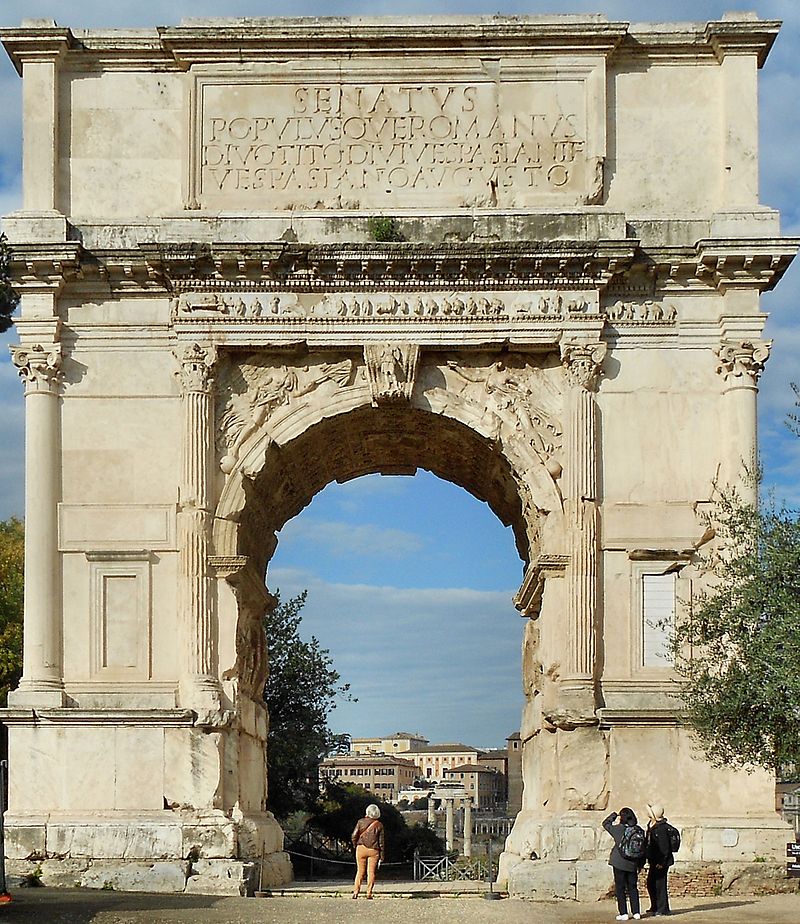
I've always been taken with this particular piece which shows the Arch of Titus with the Palatine Hill on the left.  It's a reminder both of durability and fragility.  The structure, though damaged remains, but the city and Forum surrounding it are mostly long gone, as well as those who built it.  The humbleness of the inhabitants we see is also a reminder of the transitory nature of things.  The Arch straddles the Sacred Way.  Triumphal processions would approach it up a slight incline having just passed by the Colosseum, 300 yards away.  Straight in front of them, down another slight incline was the Roman Forum, the heart of the empire.

To the left, the Palatine Hill was crowned by an enormous sprawling complex of Imperial Palaces clad in marble.  In 1700 we see the Palatine covered in trees, and scattered people walking through the ruins around the Arch, with a horse walking down the path from the Palatine.  The once carefully paved Sacred Way reduced to a rough dirt path.  The Arch itself is no longer maintained and is slowly eroding away.  The monumental buildings surrounding it long ago had their marble cladding stripped and their exposed cores left to crumble.  For more on the deterioration of Classical Rome over the centuries read Belisarius Enters Rome.

The inscription on the Arch reads:
The Senate
and the People of Rome
to the late revered Titus Vespasian Augustus
son of the late revered Vespasian
The monument was erected by the Emperor Domitian (81-96), the younger brother of the Emperor Titus (79-81), the sons of Emperor Vespasian (69-79), who constituted the Flavian Dynasty.  Vespasian, an experienced and stern soldier came to power in the wake of the overthrow and subsequent suicide of Nero (54-68) and amidst the turmoil of the Year of the Four Emperors when it was demonstrated that the legions far from Rome would be the decisive force in choosing the new emperor.

As a ruler, Vespasian was strict and personally austere, a complete contrast to the profligate,  undisciplined and disliked Nero.  Vespasian had his predecessor's hated palace, The Golden House, turn down, filled in its lake and on its former location had the Flavian Amphitheatre (better known to us as the Colosseum) built for the people of Rome.  Succeeding him, Titus was more charismatic and popular and his early death due to illness was a shock.  The Arch was built shortly after Domitian's accession to the throne.  Domitian was also initially popular but sank into paranoia and more and more irrational acts unlike he was assassinated in a conspiracy led by his own wife who feared for her life.

Much of the decorative aspect of the Arch commemorates the accomplishment for which he was most honored by Romans; his crushing of the Jewish Revolt in 67-70 and the sacking and complete destruction of the great temple in Jerusalem.  In the photo below the picture you can see a depiction of the great menorah being removed from the temple as a trophy of Rome's victory.  When I first saw the Arch in person it created quite a mixture of emotions for me.  Thousands of Jews were enslaved by the end of the rebellion and many of them brought to Rome where they worked as part of the labor force constructing the Colosseum.  Some may still have been around to work on the Arch of Titus.

Much of the exterior of the Arch a tourist sees today is not the same as that painted by Wittel three hundred years ago.  By the early 19th century there had been so much further degradation of the structure that in 1822, at the direction of the Pope, it was completely rebuilt in travertine.  The inscription, however, is the original.
https://upload.wikimedia.org/wikipedia/commons/thumb/c/c2/7_Rome_View_of_the_Arch_of_Titus.jpg/1008px-7_Rome_View_of_the_Arch_of_Titus.jpg

The menorah being carried away.
Image result for arch of titus location map

As it looks today:
By Rabax63 (Diskussion) - Own work (Original text: Eigene Aufnahme), CC BY-SA 3.0, https://commons.wikimedia.org/w/index.php?curid=31309658

Thursday, December 10, 2015

Belisarius Enters Rome

Figure thought to be Belisarius, mosaic from Basilica San Vitale, Ravenna

He entered the city through the Porta Asinaria, a gate on the Aurelian Wall, built by the third century emperor who restored a splintered empire.  Belisarius and his small army were reconquering the city of Rome for the Roman Emperor Justinian, based in Constantinople.  The city had not had a Roman Emperor in sixty years.  It was December 9, 536 AD.

In the 2nd and 3rd centuries Rome was the largest city in the world with a population estimated at one million.  Even with the slow decline and eventual end of the western Roman Empire, the city remained prosperous (at least relative to much of the rest of the West) into the early 6th century with perhaps 200,000 inhabitants as late as 500 AD.

Yet a decade after Belisarius' entry Rome went through a brief period when it was virtually depopulated and a decade after that the population was still no more than 30,000.  Indeed, for a thousand years, Rome's population did not exceed 50 or 60,000 (except for brief periods when refugees from various wars crammed inside its walls) and did not again reach a million inhabitants until the 1930s.  What happened?

At the beginning of the fourth century Rome covered about 3,400 acres within the Aurelian Walls,  and its total urbanized area may have been 6,000 acres.  The city contained 28 libraries, 1,352 street fountains, and 856 communal baths with a capacity of 63,000.  To supply the city with 200,000 tons of grain annually and other vital supplies, seventeen ships arrived each day during the sailing season at the city's ports at Ostia.  More than 300,000 amphorae containing olive oil arrived each year which, when empty, were discarded into a huge landfill that still exists today containing the rubble of an estimated 53 million amphorae rising 30 meters high and a kilometer in circumference. (Statistics from Rome: A Living Portrait Of An Ancient City, Stephen L Dyson (2010)).

And what would a visitor see in the heart of the city?
The great streets . . . all ended in the same general area, marked by the Capitoline Hill, Forum, Palatine, and Colosseum.  Over the centuries this area had grown into a grand display of state architecture  . . . There, Romans, provincials, and foreigners gawked at temples, basilicas, theatres, porticos; heaps of marbles . . . gilded capitals, triumphal arches, honorific statues . . . all this was the grand show that reflected the glory of Rome and her empire (Rome: Profile of a City, 312-1308,  Richard Krautheimer (1980))(Interior of Pantheon)
Below, Circus Maximus, seating capacity of 200,000.  Imperial palace on the Palatine Hill to the left.  On the other side of the Palatine were the forums and the Colosseum.  (From Roman History Facebook Page)


During the 4th century the population slowly declined as Rome ceased to be political capital of the Empire; the Emperors in the east resided in Constantinople while those in the West kept their residences in cities like as Trier and Milan, closer to the frontiers threatened by barbarians across the Rhine and Danube.  Even so, as the 5th century dawned it still appeared the city and empire would go on eternally.

Things quickly changed.  In 402 the Goths made their first appearance in northern Italy triggering a convulsive series of events (for more see Adrianople) that would lead to the sack of Rome in 410 while other barbarians temporarily overran Gaul and Spain, and Britain was abandoned forever.  While some semblance of order was restored in Italy after the Goths moved into Gaul in 414 the province had been devastated.  Despite brief periods of stability the Empire in the west continued its decline.  In 455 Rome was subject to a second, and more brutal, sacking at the hands of the Vandals who had conquered Roman Africa in 439.  The last emperors were mostly figureheads and by 476 the Romanized barbarians who controlled them grew tired of the charade, overthrowing the last emperor (Romulus Augustus) and sending the imperial regalia to the eastern Emperor in Constantinople.

In 493 Theodoric the Ostrogoth seized control of Italy, restoring order and stability until his death in 526.   While Theodoric's capital was at Ravenna, he attempted to maintain Rome in the face of its  slow deterioration.  Krautheimer describes the efforts of Cassiodorus, Theodoric's chancellor:
Try as Cassiodorus might, his efforts to halt the erosion were in vain.  Sewers were in need of repairs. So were aqueducts . . . The public granaries had 'collapsed through old age'. . . Bronze statues all over were being looted '. .  nor are they mute; the ringing sound they give forth under the blows of thieves . . . wakes the dozing watchman.'  Marble, lead, and brass were looted from public buildings . . . Temples, Cassiodorus complains, 'have been handed over to spoliation and ruin' . . . Many of the great mansions, too, had been abandoned . . .  
The tenements and apartment houses suffered even more.  Theodoric the Great has a positive historical reputation for what is seen as his relatively enlightened rule.  Of course, "enlightened" is a relative term.  He became sole ruler of Italy in 493 when, at a celebration banquet marking the end of a four year war with his predecessor and future co-ruler Odoacer, he terminated the peace agreement by coming up behind Odoacer and, with one swipe of his sword, sliced him from the shoulder down to his waist.  He was also responsible for the arrest and execution in 525 of the man often referred to as "the last Roman", the philosopher Boethius, who served as one of his principal administrators.
http://vignette2.wikia.nocookie.net/deadliestfiction/images/1/1b/Sdfgrfgrarg.jpg/revision/latest?cb=20110902011003(Theodoric, without sword)

Theodoric's death the next year triggered succession struggle lasting a decade.  Amidst the chaos, eastern Roman Emperor Justinian (527-65) saw an opportunity to fulfill his ambition to reestablish the empire in the west.  In 533 the emperor sent his trusted general Belisarius, who had achieved great success fighting the Persians, on an expedition against the Vandals and their capital Carthage, located in modern-day Tunisia.  With a small army of 10,000 men, the general gained a quick and stunning victory leading to the collapse of the century old barbarian kingdom in 534.  The next year Belisarius seized Sicily and in the fall of 536 landed his force in Italy taking Naples in November and Rome the following month.  Outmaneuvering his Gothic enemies he occupied Rome without a fight.  It seemed that this war would be ended as quickly and triumphantly as the one against the Vandals.

Instead the reconquest of Italy turned into a long drawn out affair as the Goths rallied and fought fiercely until finally being defeated in 554.  It was the Gothic War, not the fall of the western empire in the prior century, which brought the definitive end of classical Rome and Italy.   Byzantine and Goth armies marched up and down the peninsula leaving a path of devastation and impoverishment.  Maintenance and upkeep of the cities declined and their populations fled to rural areas only to find many of the villas and smaller towns had been pillaged.  Some of the aqueducts supplying water to Rome (which changed hands five times during the war) were wrecked and never repaired, leaving parts of the city unable to support a dense population.  And little more than a decade after the final triumph over the Goths, Italy was invaded from the north by the Lombards initiating more years of warfare and redividing the province.

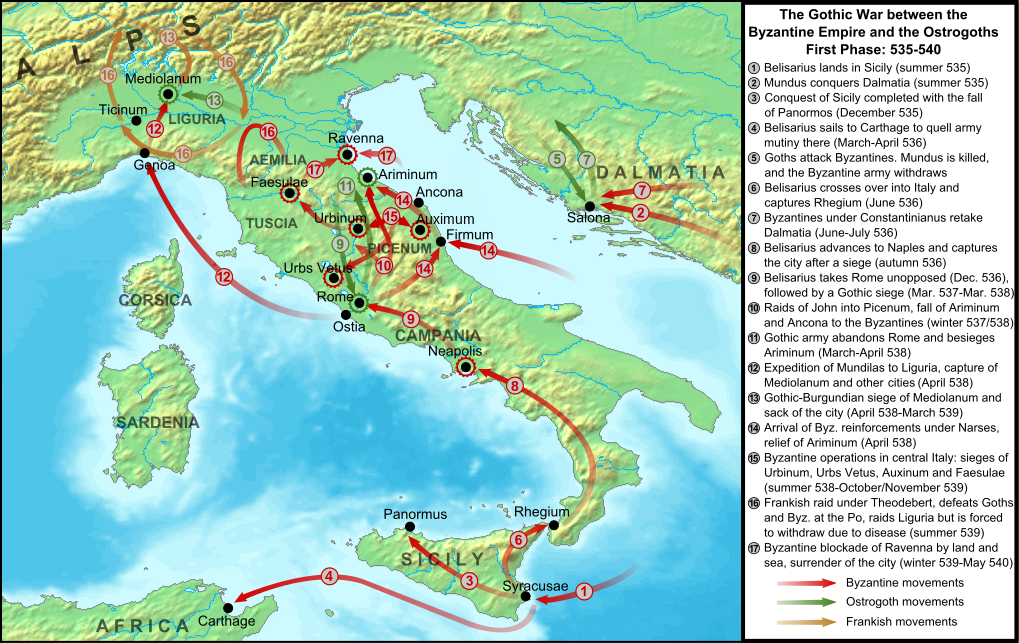
The map below covers only the first phase of the Gothic Wars.

It was during the Gothic Wars that the symbols of the power of the Roman Empire ceased to be used.  The last record we have of the Baths of Caracalla operating is in 537, and both the Coliseum and the Circus Maximus saw their final shows during these years.

A transformed city emerged from the wreckage of the Gothic Wars in the later 6th century, with a much diminished population concentrated along the Tiber River, particularly on the former Campus Martius on the east bank, and in the Travestere and the area that later became the Vatican on the west bank, where water was more readily available (referred to as the abitato).  Large tracts of the ancient city, including the Forums, the hills (including the Palatine on which the Imperial Palace was sited), and the area around the Colosseum, were mostly abandoned except for the farms and vineyards that had sprung up among the ruins and for the churches and monasteries scattered among the ruins, most prominently the Lateran in the far southeast of the walled city, which until the 15th century was the seat of the Papacy; an area known as the disabitato. 

The city that emerged from the Gothic Wars was also different in another way, it was Christian, completing a transformation starting in the 4th century.  Although nominally ruled by the Byzantines until the mid-8th century, the city was actually governed by the popes, and, indeed, without their presence it is conceivable the city could have been completely abandoned, though there were still occasional visits by imperial dignitaries.  In 608 the Byzantine Emperor Phocas came and a column was set up in his honor in the Forum, the last such monument to be placed there.  The Emperor Constans II visited in 667 and one of his retinue carved the emperor's name inside the Column of Trajan.

Almost all new construction during this period was Christian - churches, monasteries, convents.  A year after the visit of Phocas a temple was Christianized becoming the church of S. Maria Rotunda - the Pantheon built during the reign of Hadrian (117-138) - allowing this building with its remarkable architectural and structural aspects to be preserved relatively intact into the modern era.  Likewise, the Column of Trajan, was saved for posterity in 1162 when it was placed under the protection of the Senate to ensure the column would "remain whole and undiminished as long as the world lasts"; which it has except for the substitution of the figure of St Peter in place of Trajan at the top of the column.

Below, the Pantheon, flooded in 1800, drainage in the city was still not as good as during the Roman empire.  From Krautheimer  

Column of Trajan and ruins of Trajan's Forum.  The monstrosity to the right and behind is the Victor Emmanuel monument, built in the early 20th century to in honor of Italy's first king after reunification in 1870.  (Photo from National Geographic)

The first systematic steps towards urban recovery occurred during the papacy of Gregory the Great (590-604).  Some repairs were undertaken, the major streets and plazas were kept open and a few of the aqueducts and baths still functioned.  The Forum of Trajan still saw some use and the former imperial palaces on the Palatine kept in some semblance of repair, though unused.
Image of Pope Saint Gregory the Great(Pope Gregory)

It was probably Gregory who restarted a scaled down version of the old imperial welfare offices in the city at which food was doled out at the start of each month.  These centers, known as diaconiae, were scattered throughout the city with financial support coming from landholding set aside by the Church or from wealthy donors.  The diaconie also served another audience, providing shelter and hospital services to the increasing number of religious pilgrims who visited the city beginning in the latter part of the 6th century, and whose numbers greatly increased during the 7th and 8th centuries.  Krautheimer describes them:
The largest number came from among the peoples recently converted in the West.  Franks, Irish and English, joined in the eighth century by Frisians and South Germans, struggled over the Alpine passes on foot or horseback . . . Hostels were set up in Provence and North Italy to shelter them on the road . . . 
The pilgrims consisted of bishops, clergy, monks and nuns, nobles and "ordinary folks in large numbers" making the perilous journey.  Most only made the journey once.  During the mid-9th century one of the child pilgrims was the young boy who became Alfred the Great, King of Wessex and victor over the Vikings.

The Basilica of Constantine & Maxentius, Giovanni Piranesi, 18th century.  Ruins of the last large structure built in the Forum (4th century).  From Indianapolis Museum of Art.
Despite becoming a religious center, the city remained poor and struggling.  Though the Byzantine Empire lost its eastern and North African provinces to the followers of Muhammed in the 7th century it simultaneously attempted to assert control of Rome and its remaining Italian possessions.  The city saw an influx of Greek refugees from the lost eastern provinces, and for a century an almost unbroken line of Greeks and Syrians served as popes.

Tensions were arising.  A new class of local Rome landholders arose who objected to increasing Byzantine taxation, while an enormous rift opened between Rome and Constantinople over the abolition of images, iconoclasm, which had been decreed in the East.  The final element was the renewal of efforts by the Lombards to crush the Byzantines.  In 751 the Lombards captured Ravenna, the Byzantine capital of Italy, and in 753 laid siege to Rome.  Realizing the enfeebled eastern empire could not provide help, Pope Stephen II appealed to Pepin the Short, King of the Franks, who intervened, saving the city.  Twenty years later, when the Lombards tried once again to attack Rome, Pope Hadrian I sought help from Pepin's son, Charlemagne, who in 774 invaded Italy, crushed the Lombards, and ended their kingdom.  In 800, the Pope crowned Charlemage as Emperor of the West and of what became known as the Holy Roman Empire.  For the next three centuries there ensued a constant struggle for control of Rome between the Holy Roman emperors, the popes and the most powerful families within the city.

The wars of the late eighth century caused additional damage to Rome and its environs.
Once again, estates outside the walls, private and Church property, were looted and burned, country folk and monastic congregations were driven into the city . . . The aqueducts, neglected and partly destroyed in the Lombard sieges, functioned badly or not at all . . . time and again the Tiber flooded the town and the fields across the river [the flood control structures of the Roman empire had long ago decayed] . . . buildings were in poor repair.
A new threat arose in the early 9th century.  After completing the conquest of North Africa in 698, Moslems invaded Sicily early in the 9th century. They also began raiding the Italian mainland, in 846 looting the churches of Saints Peter and Paul, which at the time lay outside the walls of Rome and the threat continued into the early 10th century.

What was it like to be in Rome during those centuries?  As Krautheimer notes, after the Gothic War "Rome had become a rural town, dependent on agricultural produce close at hand"; when the Tiber flooded, famine ensued and the crumbling ancient drainage systems led to malaria becoming endemic.  The populace huddled against the river with the ruins of the imperial city surrounding them.  Ancient structures like the Theaters of Pompey and Marcellus were converted into crowded housing or small market stalls, others were dismantled for their valuable exteriors, marble or bronze, or stripped for other construction (Emperor Constans had offended Romans when during his visit in 667 he removed the bronze tiles from the Pantheon and shipped them to Constantinople).

Theatre of Marcellus with shops in 1880.  From Krautheimer
  
More ancient monuments and buildings lay further afield in the disabitato.  Rome had:
no need to search for the remains of antiquity.  They were ever present: the Pantheon, the Colosseum . . . the ruins of the great thermae and of the palaces of the Palatine; the remains of the temples on the forum and the Campus Martius, the forums themselves, those of Nerva, Augustus, Trajan; the triumphal arches and the monumental columns of Marcus Aurelius and Trajan, the mausolea of Hadrian and Augusuts, the obelisks . . . Ancient sculpture, too, was plentiful: the reliefs on the triumphal columns and arches  . . . Wall paintings, mosaics, and stucco decoration must have been accessible in the ruins of the Golden House, on the Palatine, in the vaults of the Colosseum - many lost to us but surviving in their medieval reflections.

The hoi polloi of Romans and visitors, especially pilgrims, would be overwhelmed by the sheer size of a building or a colossal statue surviving in fragments and spin strange yarns about it . . .  
After the turmoil of the 9th and 10th centuries, large scale building activity resumed.  As Krautheimer points out, while not a commercial center, Rome:

had developed resources of a different kind: the vast income of the Church . . . the swollen bureaucracy of the Curia; the city's place as the foremost legal center of Europe with lawyers, clerks, and scribes attracting business; the flux of pilgrims . . . the banking operations of and connected with the Church
This revival, unlike the earlier ones, was sustained and by 1527, when the first real census was undertaken, the population had risen to 55,000.  It was also in these centuries that most of the damage to the structures of ancient Rome occurred.  Krautheimer describes the city of those centuries as:
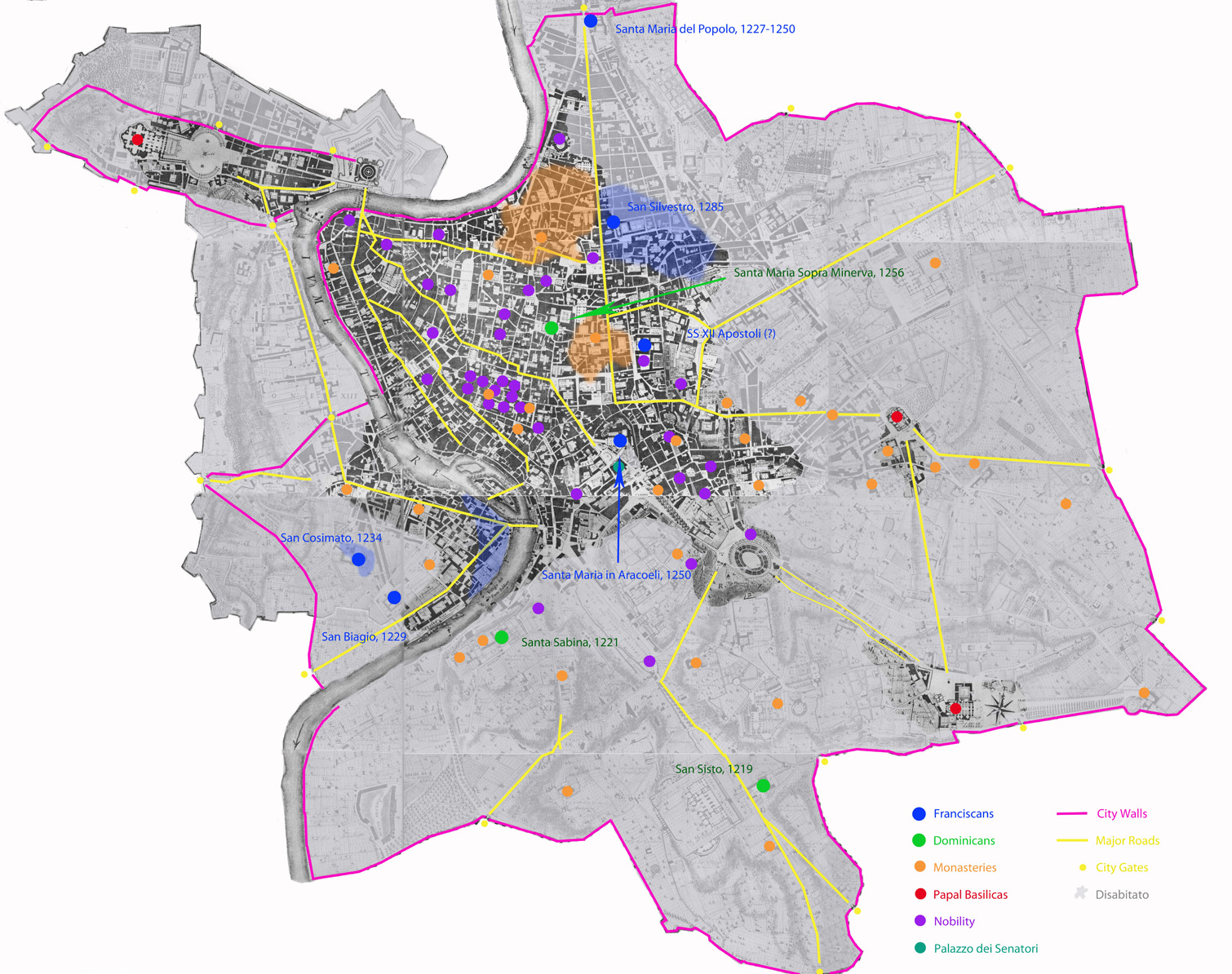
. . . not so much as a coherent unit, but as a conglomerate of built-up clusters separated by large ruins, gardens, and stretches of wasteland, with only scattered houses linking the clusters.
Settlement in 13th century Rome.  You can see how little of the area within the walls is urbanized. (From the Mendicant Revolution)
https://nesolicitisitis.files.wordpress.com/2010/05/composite1.jpg

The accelerated pace of building took place within the established clusters of settlement and created increased demand for building materials.  Remaining marble cladding was removed from the old buildings and the buildings themselves disassembled to provide materials for new construction.  Some structures had almost completely disappeared.  The vast Circus Maximus, pictured near the beginning of this post in all its glory, lay in a valley between the Palatine and Aventine hills.  Much of its structures was removed and Once drainage systems were no longer maintained it became vulnerable to flooding from the Tiber;  repeated inundations over the centuries left a thick layer of mud over the entire site, which remains 20 to 30 feet below the surface.

Flooding also affected the low lying Forum.  The accumulated mud eventually became a grazing area for cattle with only the tops of monuments peeking above ground until excavation of the area began in the 19th century.
Below, Arch of Septimius Severus in the Forum showing inundation by Claudio Lorense (1650)

The same area in 1575 with a defensive tower built on top of the arch.  The Roman senate house is to the right.  From Krautheimer.

Below, the disabitato south of the Colosseum still existed in 1870.  Today this area is entirely urbanized. From Krautheimer.

What would have it been like to walk around the city in the year 1000?  You'd see some structures already in ruins, or, if in low lying areas, mostly covered in mud.  Other buildings would still have their marble cladding, perhaps damaged or partially covered by plant growth.  Much of the statuary, now damaged or lost, was still relatively intact.  The Stadium of Domitian (built in the 1st century) still existed though crumbling, and its racing area remained open land.  It was not till the 17th century that a large church was built and the open area converted into the grand piazza that we see today.  From an aerial view (below) you can still see the layout of the ancient stadium and track.

stadiodomiziano(from capitolivm.it)


The Colosseum was not the partly dismantled wreck it is today; the arena floor had been converted into a cemetery and the arcades under the seating had been converted into workshops and housing.  It was not until after an earthquake 1349 that parts of the massive structure were removed for use elsewhere in the city.  It was only saved from further use as a quarry by order of Pope Benedict XIV who in 1749 designated it as a sacred site because of the martyrdom of early Christians in its arena.   Seeing these buildings, statues and monuments would evoke a sense of wonder in us - and of what had been lost - what did those who lived there in those centuries think?


Wednesday, February 21, 2018

Monte Testaccio

monte-testaccio-7
(Monte Testaccio, from amusing planet website)

The hill stands 115 feet high, covering an area of over five acres on the outskirts of Rome.  Known as Monte Testaccio it received a brief mention in a prior THC post (see Belisarius Enters Rome).  It is not a natural hill.  Rather, it is a planned landfill, active for at least the second and third centuries AD, consisting of remnants of an estimated 53 million amphorae, primarily 18 gallon containers formerly containing olive oil imported from Baetica (southern Spain), Africa (Tunisia), and Libya.  The amphorae could not be reused because residue of the oil permeated the containers making them sticky and smelly.

The scale of imports, through the imperial ports at Ostia, near where the Tiber River enters the Tyrrhenian Sea, was required to meet the ravenous needs of the one million inhabitants of the Imperial capital. Olive oil was so important a staple that the Empire established an official olive oil reserve near the banks of the Tiber and very close to Monte Testaccio.

The landfill was engineered, with fragments of the broken jars carefully place, as you will see in the pictures below.  Some fragments are inscribed with the name of the importers, as well as with the names of the inspectors who weighed them.

The area was abandoned during the late Empire and remained deserted as the city of Rome shrank over the centuries.  As late as the 19th century it was a pastoral area used for recreation.


(City and walls of Rome from Monte Testaccio, JMW Turner; early 19th century)
Rome From Monte Testaccio - J.M.W. Turner
The pyramid in the wall, known as the Pyramid of Cestius was built by a prominent Roman, Gaius Cestius around 15 BC.  It is possible Cestius may have been a member of the Roman expedition to Nubia, south of Egypt on the Nile, in 23BC, and inspired by the sharp pointed Nubian pyramids.  At the time the tomb was built it was outside the old 4th century BC walls of Rome.  When Aurelian ordered the construction of a new wall in the 272AD, the pyramid was incorporated into it as a defensive bastion.

Inside the hill:


Engineered walls:
monte-testaccio-6

Broken pieces of amphorae:
monte-testaccio-1

Flavio al Velavvodetto Restaurant at the base of the hill
Amphorae in Monte Testaccio from Flavio al Velavevodetto restaurant


Sunday, December 28, 2025

Reading 2025: Non-Fiction, Part 1

Ancient History 

What happens if you are a Greek mercenary, deep in Mesopotamia, and the guy you hired you gets killed in battle and his cause collapses?  Read Anabasis by Xenophon to find out.  Also called The March of The Ten Thousand, Anabasis is the story of those mercenaries, hired by Cyrus the Younger in 401 BC to help seize the Persian throne from his brother Artaxerxes II.  This is one of those books I'd read about countless times but had never read until this year.  Xenophon, one of the mercenary commanders, wrote Anabasis about thirty years after the events.  Before reading I'd been under the impression that the core of the book covered the fighting retreat of the Greeks after the battle of Cunaxa until they reached the Black Sea but that's only half the story.  Quite an adventure and a reminder of how different and violent the Classical world was.  

Cato the Younger was Caesar's great enemy at the end of the Roman Republic.  Fred Drogula's study attempts to reconstruct Cato's life and motives and provides a convincing explanation for his ultimate ineffectiveness and inability to help forge a compromise that might have saved the Republic.

Peter Brown is considered the leading historian of late antiquity and Through The Eye of A Needle: Wealth, the Fall of Rome, and the Making of Christianity in the West, 350-550 AD, is a masterwork.  I had some hesitation before starting the book, worried it might be dry and too scholarly.  It is certainly scholarly but not dry and extremely well-written and engaging.  The title is from the words of Jesus as recounted in the New Testament, "It is easier for a camel to go through the eye of a needle than for someone who is rich to enter the kingdom of God."  Avoiding cynicism, Brown provides a sympathetic study of how a struggling church, embraced by a minority of the population in 350, becomes the dominant and wealthiest player in the formerly Roman west two centuries later as it tries to reconcile the words of Jesus with the conditions of the disintegrating empire.  Making the reader rethink some of the common assumptions about that era, Brown focuses on individuals like Augustine, Ambrose, Pelagius, Jerome, Ausonius and others to help the reader understand the arguments over the appropriate role of wealth and the wealthy within the Church.  In other books and articles I've found it difficult to understand the nuances of early Christian theological arguments, but Brown provides admirable clarity in this work. A very rewarding read.

A decade ago THC wrote about the history of Rome after the 4th century (Belisarius Enters Rome)  relying greatly upon Richard Krautheimer's classic work from 1980, Rome: Profile of a City, 312-1308.  The last few decades have seen an upsurge in archaeological activity in Rome focused on the post-Empire history of the city and this year I read two books by Hendrik Dey incorporating the new information; The Aurelian Wall and the Refashioning of Imperial Rome, AD 271-855 and his most recent work, published in 2025, The Making of Medieval Rome: A New Profile of the City, 400-1420.  Building upon the work of Krautheimer and the recent archaeology, Dey's books provide an update portrait and way of thinking about the city during its "dark ages".  I will be writing more about both books in 2026.

Israel

The Old City of Jerusalem is, as the name states, "Old" and contains the Temple Mount.  However, it is only in the past three decades that close to, but not within, the Old City is the City of David, dating back to King David around 1000 BC.  When The Stones Speak by Doron Spielman tells the story of its discovery and excavation and the political storms ignited by the archeological work.  Spielman has worked on the project and the discovery part is quite exciting, particularly finding the passageway between the City of David and the Temple Mount.  Because the area of the City of David is adjacent to an Arab settlement and given the Palestinian strategy to deny any historical Jewish connection with Jerusalem, each step of the excavation process has triggered controversy.

In The War Of Return, Einat Wilf argues the hypothesis that the highest aspiration of the Palestinian people is to have their own state has been proven to be incorrect as they have repeatedly demonstrated that the destruction of the Jewish state is a higher priority.  She writes that the actions of the United Nations, and of Western Nations, and the peculiar nature of the United Nations Relief and Works Agency for Palestine Refugees in the Near East (UNRWA) has contributed to the inability to resolve the conflict.  UNRWA created a unique category of refugee for Palestinians, unlike that of the tens of millions of other refugees around the world created in the wake of WW2.  UNRWA has become a facilitator of Palestinian rejectionism and the only hope to resolve the conflict is the dissolution of UNRWA.  I previously wrote about Wilf and her hypothesis in An Irreconcilable Conflict of Principles.

Music

I read the first two volumes of Ricky Riccardi's trilogy on the life of Louis Armstrong, Stomp Off, Let's Go: The Early Years of Louis Armstrong and Heart Full of Rhythm: The Big Band Years of Louis Armstrong.  Riccardi is director of research collections at the Louis Armstrong House Museum in the borough of Queens, NYC (worth a visit!) and himself a musician.  This is an incredibly well researched and almost day by day account of Armstrong's life and brings a lot of previously unknown information to light.  Riccardi is a great admirer of the man but does not shy away from giving us a portrait of the man in full.  If you like Armstrong's music you'll find some new cuts to enjoy and be overwhelmed by the man's drive and talent.  It remains a miracle to me that a young man could come from such a trying and terrible background and grow to display not just enormous talent but such a positive disposition and view of life. It's why I've written many times about Armstrong.

Inspired after watching A Complete Unknown, I read Elijah Wald's, Dylan Goes Electric!: Newport, Seeger, Dylan, and the Night that Split the Sixties.   Dylan Goes Electric gave me a much better understanding of the folk music revival of the 50s, Pete Seeger's key role, and why Dylan's rejection to being annointed the savior the folkies had been searching for was so significant.  The movie and the book also inspired my recent visit to the Dylan museum in Tulsa.

Monday, December 10, 2018

Arch Of Constantine

Painting by Giovanni Canaletto, a Venetian, who visited Rome in the 1720s.

https://upload.wikimedia.org/wikipedia/commons/4/44/Giovanni_Antonio_Canal%2C_il_Canaletto_-_Rome_-_The_Arch_of_Constantine_-_WGA03924.jpg Just to the right of the Arch can be seen part of the Colosseum.  The Arch was constructed in the early 4th century after the Constantine the Great's defeat of his rival Maxentius at the Battle of the Milvian Bridge in 312, just outside of Rome.  It was the last triumphal monument of the Rome Empire constructed in the city.  Even by that time the quality of monumental art had declined, with many of the statutes and facades of the Arch scavenged from monuments of prior centuries.

Within two centuries the city entered a period of sharp decline with the monuments, building, and palaces of the empire no longer being maintained and, in most instances, having their marble cladding removed or sometimes the very structure being dissembled for use elsewhere.

The city proper retreated to the banks of the Tiber with many of the outlying areas, including the former Forum and the area around the Colosseum left to decay, surrounded by agricultural lands, vineyards, gardens, and occasional churches, monasteries, villas, and strongholds for the quarreling families that dominated local politics for centuries.  For more on this period read Belisarius Enters Rome, which occurred on December 9, 536.

As late as 1870 much open land remained south of the Colosseum.

Tuesday, October 26, 2021

The Pastoral City

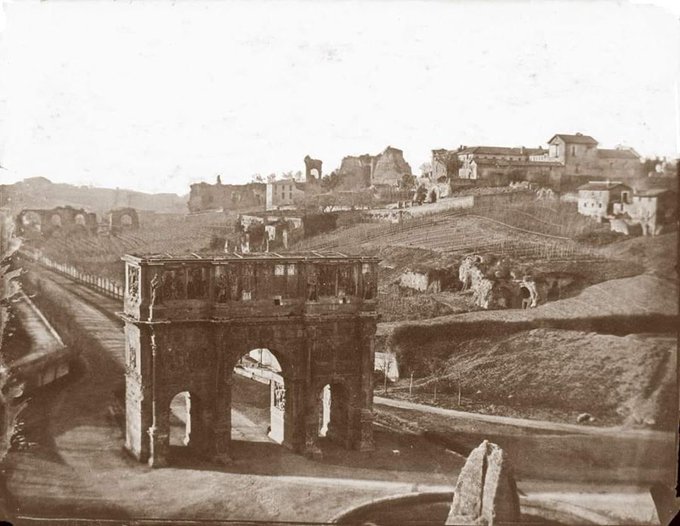
 Came across this remarkable 1850 photo of Rome.

Image

It looks like it is taken from inside the Colosseum, probably on its second level, and it pictures the area to the west of the structure. The stone sticking up in the lower right center is the remnant of the Meta Sudans, which was bulldozed at Mussolini's order.  Directly center is the Arch of Constantine (constructed in the early 4th century).  The modern road has been rerouted so it passes around, not through, the Arch.  Further down that road on the right is part of the aqueduct that carried water to the Palatine Hill.  The elevated ground in the distance behind the aqueduct is the Aventine Hill and the valley in between is where the Circus Maximus was located.  

The upper center-right of the photo is dominated by the Palatine Hill, home of the Imperial Palace.  During the time of the empire it was almost completely covered by palace buildings.  In 1850 the highest point has a monastery on it though you can see remnants of the palace as the hill slopes down to the aqueduct.  If you could see 90 degrees to your right the Sacred Way leading to the Forum would appear.

The other thing to note is how much of the hill was devoted to agriculture and pasture.  After the 6th century Gothic Wars, this area and much of the rest of the former imperial city ceased to be a place of dense urban habitation.  From Belisarius Enters Rome:

Large tracts of the ancient city, including the Forums, the hills (including the Palatine on which the Imperial Palace was sited), and the area around the Colosseum, were mostly abandoned except for the farms and vineyards that had sprung up among the ruins and for the churches and monasteries scattered among the ruins, most prominently the Lateran in the far southeast of the walled city, which until the 15th century was the seat of the Papacy; an area known as the disabitato. 

This is what the area between the amphitheater and the Lateran looked like in 1870.   Today it a busy and congested part of the city.

The disabitato existed into the 19th century with the expansion of the city into the Rome we know today only after the reunification of Italy in 1870.  The remaining densely populated part of the city was located on the Tiber in what was called the Campus Martius at the time of the Republic and Empire and on the other side of the river in the area near what became the Vatican in the Middle Ages.

At the time the photo was taken the population of the entire city was probably around 150,000 to 175,000 compared to about a million in 150 AD.  It was not until the 1930s that Rome's population exceeded that of the Second Century AD.

The photographer was Ludovico Tuminello (1824-1907).

Tuesday, April 9, 2024

The View

Image

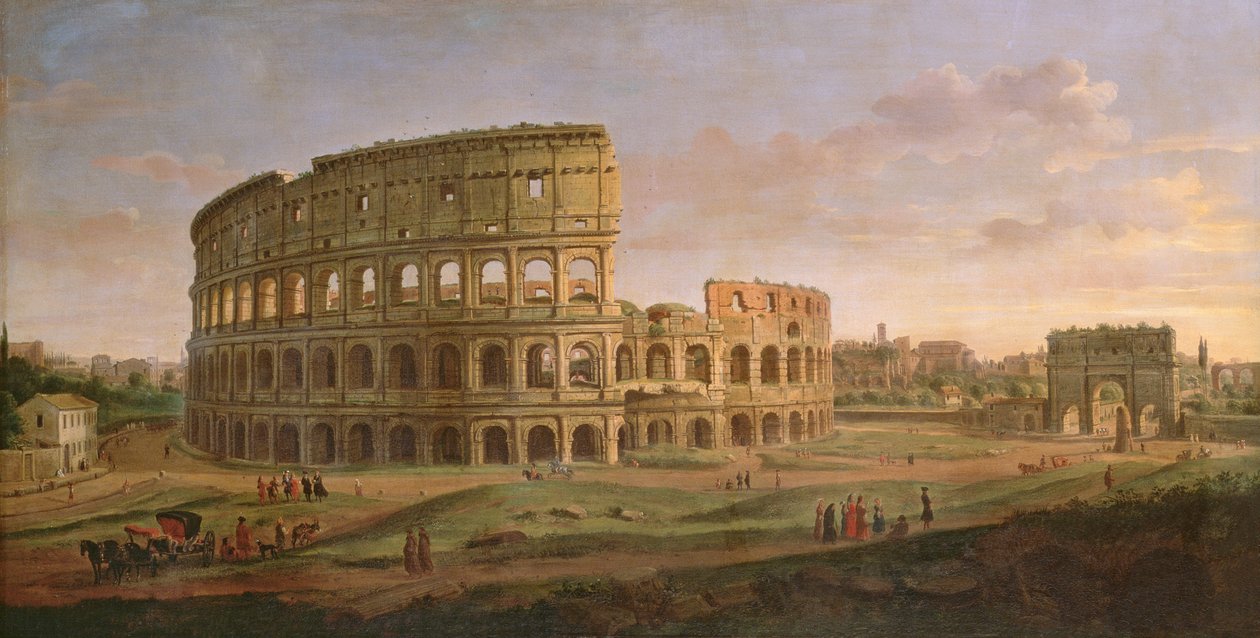
Casper van Wittel, born and trained as a painter in the Netherlands in 1652, emigrated to Italy in the late 1670s where he remained until his death in 1736.  Known for his landscapes, van Wittel was a popular artist of the times and his paintings provide a record of how Rome looked before its transformation, beginning in the late 19th century into the metropolis it is today. I've written before about van Wittel. Of note, it was only around 1900 that Rome regained the same population it had in the second century AD.  For more on what happened between those times read Belisarius Enters Rome.

This painting depicts the Colosseum, built in the 70s AD and the area around it.  It is a bucolic scene.  In other paintings of the amphitheater, van Wittel depicts sheep grazing next to the remains of the monumental structure.  On the right is the Arch of Constantine, constructed 315-20.  In front of it is the mysterious, and stubby, Meta Sudans which existed until it was destroyed during Mussolini's dictatorship in the 1930s.  In the far distance behind the arch to the extreme right is the aqueduct that brought water to the Palatine Hill where the emperor's palace was located.  The severing of the aqueduct in the 6th century meant the abandonment of the Palatine.

The perspective of the painting is from the lower part of the Esquiline, one of the seven hills of Rome.  To the left of the artist would be the ruins of Trajan's Baths.  In the Meta Sudans post there is an 1890 photo showing some of this area.  Looking to the right of the Arch and aqueduct, this 1850 photo, taken from the Colosseum provides a view of the Palatine which would have been very similar to what van Wittel would have seen a 150 years previously.

Monday, September 21, 2020

Palatine

 Our word "palace" derives from the Palatine Hill, home of Roman emperors from the 1st through 5th centuries A.D.  The video below takes you on a leisurely one-hour walk over the hill, which is a jumble of Roman and later ruins and buildings.  Likely the home of the original settlers of the village of the 8th and 9th centuries B.C., the Palatine later became the prestigious home of Roman patricians during the time of the Republic.  The residence of Augustus Caesar was on the hill and even after he established the Principate in 27 B.C. he kept his (relatively) modest residence as part of the elaborate facade he created as "restorer of the Republic", though in truth the Republic had perished.  It was his adopted son and successor, Tiberius, who built the first true palace on the hill and by the end of the 1st century with the construction of the enormous Palace of Domitian, the emperors were the only ones allowed to build on the hill.

On its northeast side the Palatine overlooked the Forum, to the southeast lay the Colosseum and Arch of Constantine, while on the west it overlooked the Circus Maximus (and the palace afforded a direct connection to the stadium).  It was also serviced directly by an elevated aqueduct delivering fresh water from twenty miles away.

Even after the abdication of the last Western Roman Emperor in 476 A.D., the Gothic rules used the palace when visiting from their capitol of Ravenna, until the Byzantine reconquest of 537.  It was around this time that the aqueduct failed and without a reliable supply of water, the Palatine could not support a substantial population.  Over the next centuries, the palaces fell into ruin with the astonishing multi-colored marble facades being stripped for use in other buildings and the statutes removed.  For more on the later history read Belisarius Enters Rome.

The best time to visit the Palatine is early morning just after it opens or late afternoon which gives you the best chance of avoiding crowds.  Even in mid-day it is a relative oasis of calm amidst the usual frenzy, noise, and chaos of life in the Rome.  I particularly enjoyed visiting the Farnese Gardens in the morning and looking down on the Forum (you can see this very spot about 40 minutes into the video which is best watched in full screen).

Monday, January 14, 2019

Rome: 900 AD

An artist's interpretation of the Forum of Nerva as it may have looked in 900.  From History on this Day.

Forum of Nerva in 10th century

Construction of the forum began under the Emperor Domitian around 85 AD but was still underway when the increasingly paranoid emperor was assassinated in 96 in a plot which included his wife (maybe he wasn't so paranoid, after all).  The forum was completed and dedicated in the reign of his successor Nerva (96-98).
Reconstructive view of the Forum of Nerva
The space was one of a series of Imperial Forums constructed adjacent to the older Roman Forum of the Republic.  Nerva's Forum was adjacent to those of Caesar and Augustus, which would be to the right on the image above.

With the deterioration of the City starting in the 5th century and accelerating during the Gothic Wars, the buildings and forums of the Republic and Empire were largely abandoned as the diminished population retreated to the banks of the Tiber.  For more on the history of the city in those times read Belisarius Enters Rome.

Large areas of the Forum returned to marshland as the drainage systems installed centuries before were no longer maintained.  From the archaeological evidence, Nerva's Forum, which lay empty for hundreds of years saw a revival in the 9th century as farm buildings began to occupy its interior, using stone scavenged from the Forum.  It is these tiny farms, huddled in the ruins of a great empire, that are portrayed by the artist in the picture at top.  What did those farmers think of those who built the massive structure centuries before?

As the city began its recovery in the 15th and 16th centuries, the Forum of Nerva and other ancient sites served as quarries for new buildings and many of the statutes and columns pictured above were removed leaving the forum a complete ruin.

Wednesday, April 12, 2017

A Great War, Or, It's The End Of The World As We Know It

A quarter century of war.  Chaos and upheaval.  One empire recovers from the brink of destruction.  Another plunges from heights undreamed of.  Mutual exhaustion in its wake.  A new power  arises.

Though World War One was initially referred to as The Great War before it became sadly apparent it was not to be the only 20th century war to quality for that title, there is another great war that took place 14 centuries ago and transformed history in ways, foreseen by none of the participants, that reverberate today.

By the start of the 7th century, Rome (republic, then empire) and the empires based on the Iranian plateau (Parthian, then Sassinid) had confronted each other for more than 600 years. Though the principals each had periods of weakness and strength, the borders did not change much during this entire period as the combatants found it impossible to put an end to each other.

The Parthian dynasty founded in 247 BC, seized Mesopotamia a century later, creating its new capital Ctesiphon along the Tigris River.  The Roman Republic entered Asia in 133 BC when Attalus III, King of Pergamum, the rich land on the eastern side of the Aegean, died childless and bequeathed his kingdom to Rome.

Rome became increasingly entangled in the East until Pompey the Great's famous expedition in the 60s led to his settlement of the affairs of Syria, Cappadocia, Pontus, Judea and Egypt.  Though it would be another century before the last of these lands were direct subjects, Rome was now a permanent fixture in the Mideast.

The first major conflict between Rome and Parthia was a stunning defeat for the former when Marcus Crassus, part of the First Triumvirate with Julius Caesar and Pompey, was killed and his legions destroyed by the Parthians in the Syrian desert near Carrhae in 53 BC.

Rome and Parthia fought occasional, and indecisive, wars during the next 150 years, mostly over Armenia, a mountainous kingdom to the north of Syria, laying in between the two.

http://www.bestofsicily.com/mag/art159b.gif

In the second century AD, events seemed to tilt decisively in favor of Rome.  In 115-116, Trajan conquered all of Mesopotamia, reaching the Persian Gulf and dreaming of Alexander the Great.  His conquest was relinquished by his successor, Hadrian, but later in the century armies of Marcus Aurelius (165) and Septimius Severus (198) sacked the Parthian capital of Ctesiphon.  The latter campaign led to the Roman annexation of the northern part of Mesopotamia (modern-day eastern Syria and northern Iraq).

The frequent Roman thrashings emboldened internal challenges to Parthian rule and they were overthrown in the 220s by a new dynasty, the Sassinids, who were much more formidable opponents for the Romans.  In the middle of the century Shapur I (reigned 242-72) defeated two Roman emperors, capturing one of them, and leading a great raid culminating in the sacking of Antioch, one of the three great cities of the Roman Empire, during the 250s.

The tide swung back to Rome later in the century as Ctesiphon was sacked once again in 283 and another Roman campaign in 299, leading to further territorial consolidation in northern Iraq, where Roman lands now stretched across the Tigris, almost reaching the present boundary of Iran.

There was one last great Roman effort to defeat its rival.  Julian, the last pagan emperor, launched a massive campaign in 363.  Though the emperor reached the walls of Ctesiphon he was unable to capture the city.  Short of supplies and harassed by raiders he was killed in a skirmish while retreating, leaving his beleaguered army to negotiate its passage home by surrendering part of Mesopotamia.

For much of the 5th century the borderlands between the two empires remained quiet.  Things heated up again in the early 500s but the same pattern prevailed, indecisive conflicts.  A fortress falling here or there, a raid on a vulnerable city with the boundaries and balance of power remaining stable.

In 590 a new Sassanid king, Khosrow II, ascended the throne, but faced an uprising led by one of his generals, causing him to flee to Roman territory where he was welcomed by the Emperor Maurice who had ruled since 582.  The following year, Khosrow returned to his homeland, and with Roman help defeated the usurper and regained his throne.  In returned he ceded two recently captured fortresses and part of Armenia to Rome.  For the next decade relations between the two empires were peaceful.  As the seventh century began both empires appeared prosperous and stable.

(Roman and Sassinid Empires in 600)
The Great War

602 was to prove a violent year.  Maurice had been an effective, but parsimonious, ruler.  The Byzantine army, mostly deployed in the Balkans to confront the Avars (a tribe from the Asia steppes which migrated into the area several decades earlier), became increasingly disaffected, particularly after he cut their pay despite his heavy demands upon them; for the first time since the 4th century, Roman armies were crossing the Danube to fight the barbarians.  In the fall of that year, Maurice announced the army would remain north of the Danube for the winter rather than following the usual routine of moving south into comfortable winter quarters.  The outraged soldiers revolted and, under a general officer named Phocas, marched on Constantinople, dethroned Maurice, murdering he and his six sons on November 27.  Phocas became the new emperor.

Though the empire had experienced frequent upheavals due to its lack of rules for orderly succession, this was the first time since the founding of Constantinople in 330 an eastern emperor had been murdered during an internal uprising.
Image result for roman mesopotamia map

Khusrow, seeing an opportunity to avenge the death of his benefactor as well as to regain the territories he had ceded a decade before, mobilized his army, laying siege to the border fortress of Dara.  He also had a vehicle at hand to help him; whether real or not it is impossible to determine at this distance - Maurice's son, Theodosios.  According to Khusrow, Theodosios had fled the slaughter of his family and sought protection from the Shah who pledged to help him seek revenge.
(Coin depicting Khusrow II)

Of what followed we know only the bare chronology (and even that is uncertain at times), along with frustratingly few scraps of information providing brief illuminations of the events of the next two-plus decades.

The possible Theodosios was persuasive enough to convince Rome's general in Mesopotamia to support him and for some cities to open their gates to him.  In 603 the Persians laid siege to the great fortress of Dara which finally fell in 606.  Shortly after this "Theodosios" disappears from our narratives.  What was probably originally intended by the Persians as a limited action of sieges and raids along the lines of prior conflicts, and which had some of the characteristics of an internal war of succession among the Romans, began to take on a life of its own.

In 608 Khosrow launched an unprecedented raid into Asia Minor and his army reached Chalcedon, opposite Constantinople on the Sea of Marmara.  The same year Heraclius the Elder, Exarch (governor) of Africa (modern Tunisia) renounced his allegiance to Phocas and revolted.  He sent a cousin with an army to seize Egypt which fell in 609 and his son, Heraclius, embarked the following year on an amphibious attack on Constantinople.  The risky venture succeeded, Phocas was killed and the younger Heraclius proclaimed emperor (his father died the same year).

The death of Phocas did not stop Khosrow, who now saw an opportunity to recreate the Persian Empire of Cyrus the Great and to finally crush the Roman state.  During the Heraclian revolt the Persians captured the great Mesopotamian cities of Amida and Edessa and conquered the Caucasus on Rome's northeast border.
Heraclius, Byzantine emperor 610-641 AD(Coin depicting Heraclius)

Completing a major reorganization of the Roman administration and military, Heraclius felt confident in launching a counterattack in Syria during 612-3.  After initial success he was defeated, retreating to Constantinople.  Pursuing Persians once again drove deep into Asia Minor, burning the great city of Ephesus on the Aegean coast.  In 614, Khusrow captured Jerusalem (and, in a traumatic turn of events, seized the True Cross, reputedly a fragment of the Cross on which Jesus was crucified and Christendom's most sacred relic, "discovered" by Constantine's mother, Helen, during her visit to Jerusalem in 326, and taken it to Persia as a trophy), and annexing Syria and Palestine.  This was to be no mere raid.  Khusrow refused to negotiate with Heraclius, demanding his unconditional submission.  A purported missive from Khusrow to the Emperor begins:
From Khusro, beloved of the Gods, master and king of all the earth, son of the great Ahuramazda, to our slave, imbecile and lowly, Herakleios . . .
(The Finding of the True Cross by Agnolo Gaddi, 14th century)

Yet another raid into Asia Minor in 617 resulted in the capture of Chalcedon.  Though the Persians withdrew, they held onto Ancyra (modern Ankara) giving them a permanent base on the plateau.  Two years later they invaded and annexed Egypt, followed by the seizure of Mediterranean and Aegean islands, most importantly the strategic base of Rhodes, creating a Persian naval threat to Constantinople.

It was not only in the East that Heraclius faced catastrophe.  Upon his accession, Heraclius stripped the Balkans of soldiers sending them to confront the Persians.  The region now lay open to the Avars, along with their allied Slav warriors, and during the decade of the 610s they widely pillaged as far south as the Greek cities, capturing Belgrade, Nis and Sofia.  Some of our sources tell us the situation looked so grim that Heraclius considered abandoning Constantinople and moving the capital to Carthage in Africa.
(Sassinid Empire in 620 from wikipedia)

The emperor ultimately chose a different, and extremely risky, course of action.  Of Armenian descent, Heraclius left the capital on April 4, 622, traveled by sea to Pontus and established himself in the mountains of Armenia where he began to build a coalition of Armenians, Romans, tribes from the Caucasus and Turks, a newly arrived Asiatic tribe threatening Persia from the north.  The emperor was forced to return to Constantinople in 623 as the Avars, having overrun the Balkans, now turned their attention to the capital.  Heraclius bribed the tribal leaders with a huge payment that was raised by stripping the city's churches of their accumulated wealth but all knew the Avars would eventually return.  The Emperor left Constantinople a second time on March 25, 624.  It was to be more than four years before he returned.

Slowly building a new army in Armenia, Heraclius began undertaking small scale assaults and defending against Persian attacks, including the burning of the greatest of the Zoroastrian fire temples in retaliation for the sacking of Jerusalem.  He was determined to pursue a long-term strategy regardless of the risk to the rest of the empire.  And it was a great risk. In 626 a Persian-Avar alliance formed and attempted to capture Constantinople in the emperor's absence.  A Persian fleet sailed into the Sea of Marmara, while Persian and Avar armies laid siege on land.  Heraclius refused to relieve the siege with his new army, leaving the defense to his deputies in the city.  In a daring and successful ploy, the Romans deployed Greek Fire to destroy the Persian fleet, direct Avar assaults failed and the Slavs revolted against their masters, forcing the armies to lift the siege.
https://upload.wikimedia.org/wikipedia/commons/1/14/Mohammad_adil_rais-map1.PNG
(Heraclius campaigns)

Meanwhile, Heraclius' coalition came together as he finally convinced the Turks to invade the Sassinid Kingdom.  He also convinced the Persian general, who led the unsuccessful assault on Constantinople and was subject to scathing criticism from Khusrow, to remain neutral. In 627 he launched an offensive, moving south into Mesopotamia, defeating the Persians in a great battle at Nineveh on December 12, in the wake of which he issued an ultimatum to Khusrow:
I pursue and run after peace. I do not willingly burn Persia, but compelled by you. Let us now throw down our arms and embrace peace. Let us quench the fire before it burns up everything. 
The defeats triggered a revolt against Khusrow, who was killed by his eldest son in February.  However, negotiations to formally end the war dragged on. Heraclius was in a vulnerable position as major Persian forces still occupied Syria, Palestine, Egypt and Roman Mesopotamia. Changing tack, Heraclius turned his support to a rival Sassanian general and encourage civil strife within the kingdom, which led to a final treaty in 629; under its terms the frontiers of 602 were restored.  Seemingly nothing had changed after the long conflict.  But everything had.

Aftermath

In March 630, Khusrow's successor was killed by an usurper who, in turn, was murdered 40 days later.  The Sassinid Kingdom's descent into chaos and civil war eliminated it as a threat to the Romans.

The True Cross was returned under the terms of the Peace Treaty.  Heraclius took it first to Constantinople where it was received with jubilation.  He then traveled to Jerusalem.  On March 21, 630, walking and not wearing the usual imperial regalia, Heraclius carried the True Cross into the city.  The Cross was to be captured by Saladin in 1187.  Last seen in Damascus several years later, it is now lost to history. 

When the Treaty was signed in 629, Persian troops still occupied Syria, Palestine and Egypt.  We have no documentation but the process of evacuation must have taken some time and not been complete till some time in 630 or even 631.  Heraclius faced a massive task of reconstruction, reestablishing the Roman administration and reinserting a military presence to protect the regained provinces.  Hampered by the debts incurred in financing the counteroffensive of 624-28, the continued need for funds to support the army against the Avars threat in the Balkans, reconstruction proceeded slowly.  From a military perspective, the focus was on defense of the Mesopotamian frontier.  With the Armenians and Turks not interested in providing soldiers for the rest of the empire, the desert defenses of Palestine and Syria were left to Arab tribes held in low regard by the Romans.  The desert frontier forts constructed in the second and fourth centuries by Trajan and Diocletian remained mostly abandoned (for more on the early Roman frontier with Arabia read Madain Saleh).

In 632, chroniclers noted the first "harsh and strange" raids by Arabs into southern Palestine.  In the same year, a revitalized and ever more strongly Christian Roman empire saw an edict from Heraclius mandating the forced conversion of Jews and Samaritans.

Two years later, the unforeseen storm broke.  Arab forces attacked Palestine and Syria. Initially, the Romans may not have realized the significance of these events as during unstable periods Arab raids were not uncommon.  Two years later Mesopotamia and the Sassinid Kingdom were under assault.

Within a decade, Jerusalem, Palestine, Syria, Egypt and Armenia were lost to Rome, while the Sassinid dynasty had been defeated, Mesopotamia occupied and Arab armies advanced across the Iranian plateau.  In 651 the last Sassinid monarch, reduced to a fleeing refugee, was finally hunted down and killed.  Forty years later, the Arabs ruled North Africa, had almost reached the Atlantic, were laying siege to Constantinople, and approached the borders of India and China.

We know little of the origin of these events or why the Arab armies achieved such quick success.   Historians of the Enlightenment era used to refer to Islam as the first religion born in the full light of history, but we now know how dim and flickering that light was.  The original sources, Greek, Syrian, Armenian, and Arabic are few and all have severe limitations on their reliability.  We've realized there are many questions about early Islam and its conquests for which we do not have answers, and it is unlikely, given the difficulties Western scholars face in researching its origins and the even greater danger faced by any Muslim scholar attempting to seek answers, anything new will be learned under present conditions.  These questions include:
What role, if any, did Mecca play in the origin of Islam?
When was the Qu'ran written?
How much of what is considered Islam today existed at the time of the initial conquests?
Were Jewish tribes involved along with Arabs in the initial attacks?
How did the Arabs consolidate themselves so quickly into an effective military force?
What role did the Arab tribes formerly guarding the Roman and Sassinid frontiers play in the attacks?
What we do know is the Arab conquests were the third, and final, of the hammer blows that destroyed the classical Greco-Roman world.  In the 5th century, the Vandals, Franks, Goths, Alans, Burgundians, Angles, and Saxons ended the Roman world in Britain, Gaul and Spain.  Ironically, it was the Byzantine reconquest of Italy, and the Gothic Wars it triggered in the mid-6th century, that closed the classical era in the land of the Eternal City (for more, read Belisarius Enters Rome).  The Arab invasions terminated the classical world in Syria, Palestine, Egypt and North Africa.
http://iranpoliticsclub.net/maps/images/109%20Muslim%20Conquest%20632-750%20Map.jpg

The surviving rump of the Byzantine Empire was crippled.  Heraclius, having gone from the facing extinction in 620, to resurrection and triumph less than a decade later, and then plunging to defeat after defeat and the loss of his empire's richest provinces, died in 641. For the next two hundred years a much poorer realm would fight for its survival (it would be more than a century before a Byzantine army defeated an Arab army in the field), no longer a world power, with the last remnants of its Roman character shed in the desperate struggle.


Friday, October 28, 2016

The Life Of St Severinus

http://141.84.81.24/cover/b026491.jpg(1877 Edition of Life of St Severinus)

The Roman Empire in the West did not end with a sudden bang in 476 AD, when the last emperor, Romulus Augustus, was deposed and pensioned off to a villa near Naples.  Instead, it withered away, sometimes with convulsive fits and starts, over the entire fifth century.  In some instances by direct conquest, as with the Vandal assault on Africa (modern-day Tunisia), while in others it was the slow disappearance of the emblems of the state, the withdrawal of soldiers, or the end for maintaining roads and aqueducts, the hallmarks of Roman civilization.

Our knowledge of what it was like for the inhabitants of Roman provinces is limited but one source I've run across in several recent books is the Life of St Severinus (Vita Sancti Severini), which provides us with glimpses of the slow collapse of the Roman way of life in the remote frontier province of Noricum along the Danube River in modern-day Austria.  I recently read a translation of the full original text.

https://upload.wikimedia.org/wikipedia/commons/thumb/e/e7/RomanEmpire_117.svg/700px-RomanEmpire_117.svg.png
The biography of St Severinus was written by the priest Eugippius, a follower of the saint, towards the beginning of the 6th century.  It is in the form of a draft, accompanied by a letter sent in 511 by Eugippius to the Deacon Paschasius seeking editorial assistance which, in those times, meant adorning the account with flowery classical rhetoric:
The testimonies concerning his marvellous life accompany this letter, arranged as a memoir, with a table of chapters prefixed.  Grant my request, and let them gain greater fame through thy editorial care.  It remains to ask that thou cease not to associate thy prayers with his for the pardon of my sins.
At the end of the memoir, is attached Paschasius' response, declining the request:
Thou hast sent me a memoir to which the eloquence of the trained writer can add nothing, and in a short compendium hast produced a work which the whole church can read.
Let's take a look at what we can learn about life in Noricum from the work of Eugippius and then discuss the historical setting in which Vita Severini was written.

Noricum

The lands between the northern Alps and the Danube River were incorporated into the Roman Empire in 16 BC, during the reign of Augustus.  Along the Danube, the province boundaries ran from a few miles west of Vienna to a point just across the current German/Austrian border at Passau. Though the province supplied minerals, including iron and gold, it primarily served as a communications, military and trade route, connecting more prosperous provinces, like Pannonia, further downstream on the Danube, with the headwaters of the Rhine and Rome's German and Gaulish provinces to the west, as well as being situated along the Amber Road running from Italy to the Baltic.

For much of its first two centuries in the Empire, Noricum was a quiet backwater, with only auxiliary military units stationed there.  It was only with the reign of Marcus Aurelius (161-80) and the outbreak of the Marcommanic War that a Roman legion was stationed in Noricum.  Though Noricum remained more peaceful than Pannonia and the Balkan provinces to its east, the province's prosperity waned over the course of the 3rd and 4th centuries.  Worse was to come.
(from The Fall of Rome and the End of Civilization, Ward-Perkins)

While much of the Western Empire wrestled with the Visigoths, Vandals, Burgundians and other tribes (see Adrianople for more), it was in the 430s that swarms of Hunnish horsemen under Attila entered central Europe and crossed the Danube, making Pannonia their home and raiding adjacent provinces.  After invading Gaul in 451 and Italy the following year, Attila suddenly died in 453, triggering chaos in his realm, a revolt of subject tribes, and the defeat of his sons two years later.  It is at this point that Severinus enters the picture in Noricum, or as Eugippius tells us:
At the time of the death of Attila, king of the Huns, confusion reigned in the two Pannonias and the other borderlands of the Danube.  Then Severinus, most holy servant of God, came from the parts of the East to the marches of Riverside Noricum and the Pannonias . . . 
Although his birth date is traditionally given as 410, we know little of his life before his appearanceon the Danube.  Telling us he "came from the parts of the East", the letter accompanying the memoir informs Pachasius:
It may perhaps be asked, and with justice, from what country Severinus sprang . . . I confess I have no clear evidence.  For many priests and clerics, and lords temporal and spiritual, natives of the country or drawn together to him from afar, often debated the nationality of this man of such great and resplendent virtue.  And they were at a lost, but no one ventured to question him directly.
Eugippius adds, "Yet his speech revealed a man of purest Latin stock; and it is understood that he first departed into some desert place of the East because of his fervid desire for a more perfect life", but left to come to Noricum after a divine revelation.

Modern scholarship believes Severinus was of southern Italian or Sicilian origin and spent time in the Roman East (Syria or Egypt) as a monk or hermit, possibly as an adherent of cenobitic monasticism (see Gometz, 2008).

When he came to Noricum, Severinus found a land "harassed by frequent incursions of the barbarians".  The townspeople were still Roman, but on both sides of the Danube barbarians roamed through the countryside, and anyone was in danger once beyond town walls.  We hear of many tribes in the Vita, some wandering through, some settling in the area; Rugi, Alemanni, Heruli, Goths, Thoringi. The Vita contains a long litany of their depredations.  Some examples:
"barbarian robbers made an unexpected plundering incursion, and led away captive all the men and cattle they found without the walls"

"the constant incursions of the Alamanni"

"a few barbarians attacked the town of Batavis . . . put to death forty men of the town"

"the Heruli made a sudden, unexpected onslaught, sacked the town, and led most of the people into captivity"

"a vast multitude of Alamanni, minions of Death, laid everything waste"
The new arrival had no official position in the church hierarchy - the Roman inhabitants were already Christian and many of the barbarians Arian Catholics, but the force of his personality, devotion, and personal sacrifice, made a memorable impact:
He subdued his flesh by innumerable fasts, teaching that the body, if nourished with too abundant food, will straightway bring destruction upon the soul.  He wore no shoes whatever.  So at midwinter, which in those regions is a time of cruel, numbing cold, he gave a remarkable proof of endurance by always being willing to walk barefoot . . . Thus we taught men humility by his wondrous example.
A demonstrated ability to negotiate and work with the barbarians while providing practical advice to the Romans, bestowed upon Severinus an authority he would exercise for many years.  As James J O'Donnell writes in The Ruin Of The Roman Empire:
In this world of fading power, Severinus became the new figure of authority - an authority that earthly disasters could not undermine.  He encouraged people and they were cured; he chastised people and they changed their ways; he knew things at a distance and people were in awe.
http://c8.alamy.com/comp/B4WG91/severinus-of-noricum-saint-missionary-circa-410-81482-full-length-B4WG91.jpg
Although the Vita is intended as a compilation of saintly deeds and provides no strict chronological accounting, a picture emerges of life in Noricum.

Amidst cold and snow (Europe entered a cooling period in the 4th century), privation and insecurity, the Romanized urban population tried to maintain itself.  Trade and import of goods from Italy and distant provinces had virtually ceased and there is no mention of any functional Roman administration in the province.  The legions are long gone, with only one town, Batavis (Passau, Germany) still having an army garrison of any type.  Eugippius tells of the sad demise of this unit:
So long as the Roman dominion lasted, soldiers were maintained in many towns at the public expense to guard the boundary wall [frontier].  When this custom ceased, the squadrons of soldiers and the boundary wall were blotted out together.  The troops at Batavis, however, held out.  Some soldiers of this troop had gone to Italy to [Ravenna] fetch the final pay to their comrades, and no one knew that the barbarians had slain them on the way.
The townspeople only discovered what happened when the bodies of the dead soldiers floated down the river.  With no more pay coming, the surviving members of the garrison disbanded.
https://upload.wikimedia.org/wikipedia/commons/thumb/a/a0/Grabrelief_Lauriacum_(RM_Enns).JPG/1024px-Grabrelief_Lauriacum_(RM_Enns).JPG
(Roman era relief found in Lauriacum)

Along with the workings of miracles and preaching, the account presents Severinus as constantly working to maintain the peace between the dwindling Roman population and the barbarian tribes amidst continuous tensions and occasional outbreaks of violence.  He negotiates the return of hostages from raiders and advises the towns on the strategies they need to employ to survive.  To help address the growing impoverishment of the populace he institutes a system of tithing to provide for the needy.

He also managed to become a trusted advisor to some of the tribes, particularly the Rugi, the strongest and most settled in the area.  Asked to intervene in quarrels with the towns and among the ruling families, he remained a figure respected by all.  Eugippius recounts one such example:
The King of the Rugi, Flaccitheus, felt unsafe in his power at the very beginning of his reign because the Goths from Lower Pannonia were violently hostile to him, and he was alarmed by their huge numbers.  In this dangerous situation, he consulted the blessed Severinus as a divine oracle . . .
He was not only a man of peace.  After the people of Quintanis fled their town for Batavis because of constant Alemanni attacks, the barbarians followed them.  Severinus encouraged the Romans to resist, predicting victory:
Therefore, the Romans in a body, strengthened by the prediction of the saint, and in the  hope of the promised victory, drew up against the Alemanni in order of battle, fortified less with material arms than by the prayers of the saint.  The Alemanni were overthrown in the conflict and fled.
The notion of a religious figure like Severinus as an inspirational war leader was not an aberration in those times.  In 429 St Germanus, Bishop of Auxerre in Gaul led a delegation to Britain.  The Romano-British had thrown out the last Roman officials in 410 but tried to maintain a Roman cultural life in the absence of a imperial governing structure and taxation system.  The purpose of the visit was to combat the Pelagian heresy, a Christian variant at odds with the teachings of the Roman Church.  After defeating the Pelagian leader in a debate, Germanus was asked to lead the local inhabitants in a campaign against raiding Picts and Scots, which he accomplished, vanquishing the foes.

But even after the victory of Severinus, the saint provided the local inhabitants with sober, practical, advice:
"Children, do not attribute the glory of the present conflict to your own strength.  Know that ye are now set free through the protection of God to the end that ye may depart hence within a little space of time, granted you as a kind of armistice.  So gather together and go down with me to the town of Lauriacum".
And so it went over the years, as one by one the towns of Noricum fell to the barbarians, until only Lauriacum (Lorch, Austria) was left.  In one of his final acts, Severinus negotiated the surrender of that town to the Rugi king under terms that allowed its inhabitants to be "amicably established in the towns, and live in friendly alliance with the Rugi".

Severinus may have been in his early seventies when he died on January 8, 482, near Lauriacum.  Eugippius reports his last words as "Praise ye the Lord in his sanctuary; let everything that hath breath praise the Lord".  Disinterred six years later, his body was brought by his followers, probably including Eugippius,  accompanied by much of the remaining Roman population of Noricum, over the Alps and into Italy.  Sometime between 492 and 496, the saint's remains found a permanent home near Naples.

The Time Of Eugippius

Eugippius is thought to have been born around 460 and died circa 535. He wrote amidst the last flickering of classical civilization. Theodoric the Great (an Ostrogoth) ruled Italy, but still followed many of the forms of Roman law and culture.  Boethius, Theodoric's magister officiorum until executed in 524, authored the Consolation of Philosophy and his successor, Cassiodorus, oversaw the copying of many of the classical manuscripts for whose existence today we can give our thanks. Rome's populations was much smaller than at its peak, but the palaces and monuments still existed, though not as well maintained as in the past.  The Roman Senate and its membership of wealthy landowners had survived the formal end of empire with minimal disruption.

At the time he wrote Vita Sancti Severini, Eugippius was abbot of the Castellum Lucullanum monastery near Naples, dedicated to the memory of the entombed saint.

(Modern view of the area of the Castellum Lucullanum)

All this ended shortly after Eugippius' death with the outbreak of the long Gothic Wars and, by century's end, the last remnants of classical world had disappeared (for more on this transition read Belisarius Enters Rome), and by the time of Pope Gregory the Great (590-604) we have entered a different land.

The remains of St Severinus remained at Castellum Lucullanum until 904, when they were removed to protect them from Saracen raiders from Sicily (for more on this period of history see The Song of Jan Sobieski).  They were returned several centuries later.

We look back today on these events with the full knowledge of what was to come, as well as an appreciation of what the Roman world was like at its peak  What was it like for those who lived through these disturbing and unpredictable times? 


Sources:
Vita Sancti Severini, Eugippius (511)
The Fall of Rome and the End of Civilization, Bryan Ward-Perkins (2005)
The Reach of Rome, Derek Williams (1996)
The Inheritance of Rome, Chris Wickham (2009)
The Fall of the Roman Empire, Peter Heather (2006)
The Ruin of the Roman Empire, James J O'Donnell (2008) 
Eugippius of Lucullanum: A Biography, Abigail Kathleen Gometz, Doctoral Thesis, University of Leeds, Institute for Medieval Studies (2008)
Eugippius and the Closing Years of the Province of Noricum Ripense, Charles Christopher Mierow (1915)